
What if the biggest obstacle to your VA rating increase isn’t the medical evidence, but the belief that you have to choose only one way to file? Many veterans feel paralyzed by the complex terminology of the M21-1 manual, especially after the May 2026 updates introduced a stricter “but-for” causation standard. It’s normal to feel anxious that one wrong word on a form could lead to a denial. You might be wondering, can a condition be both primary and secondary when you’re building your claim strategy?
The truth is that understanding these multiple paths is the key to a successful outcome. In this guide, you’ll discover how the VA views conditions with overlapping causes and how to choose the right strategy to navigate pyramiding rules. We will walk through the 2026 regulations and show you how to use medical evidence to maximize your combined disability rating. By the end, you’ll have a clear, predictable path forward to secure the benefits you’ve earned through your service.
Key Takeaways
- Identify the clear differences between direct service connection and secondary conditions that are caused or aggravated by your existing disabilities. 🇺🇸
- Understand how a condition can be both primary and secondary and how to select the claim path that most effectively uses your medical evidence.
- Navigate the VA pyramiding rule to ensure your distinct symptoms are rated properly while maximizing your total combined disability rating.
- Learn how to leverage Disability Benefits Questionnaires (DBQs) to provide the standardized documentation required to substantiate your claims.
Understanding Primary vs. Secondary Service Connection
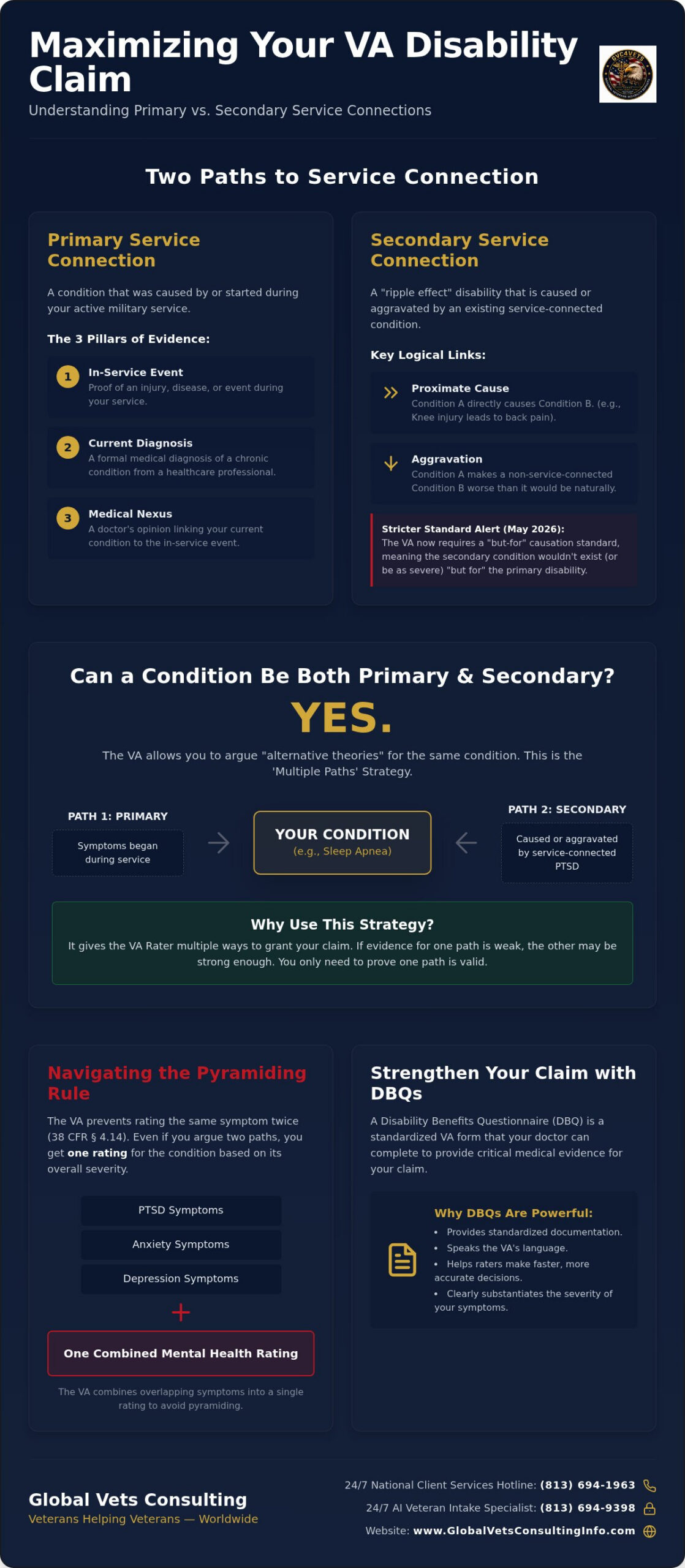
Building a successful claim starts with knowing exactly how the VA classifies your health issues. Understanding Primary vs. Secondary Service Connection is the foundation for every rating increase. A primary condition is one that stems directly from your time in uniform. A secondary condition is a “ripple effect” disability caused or made worse by that initial injury. Veterans often ask, can a condition be both primary and secondary? While the VA typically rates a single diagnosis under one category, the path you choose depends on which medical link is stronger. 🇺🇸
What Qualifies as a Primary Condition?
To establish a primary connection, you must provide three specific pillars of evidence. First, you need direct proof of an event, injury, or disease that occurred during active duty. Second, you must have a formal medical diagnosis of a chronic condition today. Finally, you need a medical nexus, which is a professional opinion linking your current diagnosis to your service. Following the VA disability claims process step by step ensures you don’t miss these critical components.
The Logic of Secondary Conditions
Secondary claims focus on how one service-connected disability negatively impacts another part of your health. This logical link usually falls into two categories. Proximate cause occurs when Disability A directly causes Disability B, such as a service-connected knee injury leading to back pain. Aggravation occurs when Disability A makes a pre-existing Disability B significantly worse. When you wonder can a condition be both primary and secondary, remember that the VA requires a clear “but-for” causation standard as of May 2026. Your documentation must show that your secondary condition would not exist, or would not be as severe, without the primary disability.
Can a Condition Be Both Primary and Secondary?
Many veterans find themselves at a crossroads, wondering can a condition be both primary and secondary when filing their claim. The answer is a definitive yes. You aren’t limited to a single theory of service connection. In fact, the VA allows you to argue “alternative theories” simultaneously. If you have Sleep Apnea, you might claim it as primary because it started during your service, while also arguing it’s secondary because it’s aggravated by your service-connected PTSD. You only need to prove one of these paths to secure your rating. 🇺🇸
The ‘Multiple Paths’ Strategy
Presenting both direct and secondary theories gives the VA Rater multiple ways to say “yes.” This strategy is a powerful tool to prevent a VA claim denied for lack of evidence. If one path lacks a specific service record, the medical link to your other disabilities might provide the necessary nexus. It’s about building the strongest possible case for your current diagnosis by offering the Rater every available piece of clinical evidence.
When the VA Chooses for You
C&P examiners are tasked with evaluating every theory you present during your exam. If the medical evidence is equally balanced for and against your claim, the “Benefit of the Doubt” rule requires the VA to rule in your favor. Navigating the Pyramiding Rule and Combined Ratings ensures you understand that while you might argue two paths, you will receive one comprehensive rating for that condition. If you want to feel more prepared for this process, exploring secondary claim education can help you organize your medical evidence effectively.
Navigating the Pyramiding Rule and Combined Ratings
The VA uses a strict regulation known as the pyramiding rule to prevent veterans from being compensated twice for the same symptom. This rule, found in 38 CFR § 4.14, applies even if you’ve established that a condition meets the criteria for multiple paths of service connection. When you ask, can a condition be both primary and secondary, you must understand that the VA will still only assign one rating based on the most severe manifestation of your symptoms. 🇺🇸
The goal is to ensure your claim is categorized under the highest possible diagnostic code. While you can argue multiple theories, the Rater will choose the one that provides the greatest benefit. This is why medical evidence must be specific. Understanding how these ratings are combined ensures you don’t leave earned compensation on the table.
Avoiding the Pyramiding Trap
Overlapping symptoms are the most common reason for a claim to be restricted by pyramiding. For instance, the VA usually combines all mental health conditions, like PTSD, anxiety, and depression, into a single rating because they often share functional impairments like social withdrawal or sleep issues. You won’t get separate ratings for each diagnosis. Instead, the Rater looks for the highest diagnostic code that covers your total occupational and social impairment. This ensures you receive the maximum compensation allowed for your mental health manifestations without violating federal regulations.
Maximizing Your Rating Increase
Secondary conditions are powerful tools for reaching 100% P&T status, but they must be documented with precision. You can use a dbq for va disability rating increase to clearly show how your symptoms have worsened over time. This standardized medical evidence acts as a bridge between your clinical reality and the VA’s legal requirements. By focusing on distinct symptoms that don’t overlap with your primary rating, you can successfully navigate “VA Math” to increase your total combined percentage. If you’re ready to substantiate your claim with high-quality evidence, explore our educational resources to get started today.
How to Use DBQs to Strengthen Your Service Connection
A Disability Benefits Questionnaire (DBQ) provides the standardized medical evidence the VA requires to adjudicate your claim efficiently. When you are determining can a condition be both primary and secondary, the DBQ acts as the decisive link between your clinical symptoms and the VA’s legal requirements for service connection. To build a successful claim strategy, follow these essential steps:
- Step 1: Secure a formal diagnosis for the condition in question from a qualified medical professional.
- Step 2: Have a provider complete a DBQ that specifically addresses both primary and secondary theories of connection.
- Step 3: Ensure the medical nexus statement uses the “at least as likely as not” language, which indicates a 50% or greater probability of service connection.
Why Medical Evidence is the Key
Medical evidence is the most critical factor in securing a VA rating increase. While a buddy letter provides valuable context about your daily struggles, it cannot replace the clinical weight of a professional dbq for mental health conditions. A detailed DBQ pre-empts common questions from C&P examiners by providing the exact clinical data points and symptom checklists the VA uses to assign ratings. This proactive documentation ensures that your functional limitations are fully captured and reduces the risk of a denial based on insufficient evidence.
Getting Started with Global Vets Consulting
Global Vets Consulting utilizes a peer-to-peer approach to veteran benefits education, recognizing that no one understands the claims process better than those who have served. We help you navigate the complexities of gathering documentation when you are unsure if a condition meets the criteria for primary or secondary connection. Our mission is to simplify the bureaucratic process and provide you with a clear path forward through meticulous documentation.
- 🇺🇸 Veteran-Owned & Operated
- 📞 24/7 National Client Services Hotline: Contact us for immediate assistance.
- 🤖 24/7 AI Veteran Intake Specialist: Available for round-the-clock support.
- 🌐 Worldwide Support: GlobalVetsConsultingInfo.com
Take Control of Your Disability Claim Strategy
Navigating the VA system is a complex mission that requires the right medical intelligence and a clear strategy. You now have the tools to determine can a condition be both primary and secondary, allowing you to file your claim with steady confidence. By prioritizing high-quality medical evidence and choosing the most advantageous theory of service connection, you protect your claim from common denials and maximize your combined rating. This methodical approach ensures your path toward earned outcomes is organized and predictable.
Global Vets Consulting stands as your knowledgeable advocate and steady guide. We provide the peer-to-peer educational resources and documentation support necessary to substantiate your claims with technical accuracy. Our team is ready to assist you immediately through the following channels:
- 🇺🇸 Veteran-Owned & Operated
- 🌎 Worldwide Support: Secure Your Professional DBQ Documentation Today
- 📞 24/7 National Client Services Hotline
- 🤖 24/7 AI Veteran Intake Specialist
- 💻 Website: GlobalVetsConsultingInfo.com
Frequently Asked Questions
Can I change a primary claim to a secondary claim after I file?
You can clarify your theory of service connection at any point before a final decision is made. If you initially filed for direct connection but your medical evidence better supports a secondary link, you can submit a statement or a new DBQ. This flexibility is vital when you’re unsure if a condition meets the criteria for both paths. It ensures your claim accurately reflects your current medical reality.
What happens if the VA denies my primary claim but I have evidence for a secondary connection?
You can re-file your claim as a Supplemental Claim using VA Form 20-0995. This is the correct path if you have new medical evidence linking the denied condition to an existing disability. By shifting from a primary to a secondary theory, you focus on the “ripple effect” of your service-connected injuries. This strategy often overcomes a lack of in-service records, which is a common reason for initial claim denials.
Can a secondary condition be used as a primary trigger for another secondary condition?
Yes, the VA allows for a chain of service connection where one secondary disability causes another. This is common in musculoskeletal claims where a gait change from a foot injury leads to knee and hip issues. When veterans ask can a condition be both primary and secondary, they should look at the entire medical nexus chain. Each link must be supported by clinical evidence to ensure the final condition is rated.
Do I need a separate nexus letter for a condition that is both primary and secondary?
It’s highly recommended to have your medical provider address both theories within your documentation. While you don’t necessarily need two separate letters, your DBQ or nexus statement should clearly outline the direct service link and the secondary aggravation. This dual-path approach provides the Rater with multiple ways to grant service connection. It ensures that your claim remains strong even if one theory is challenged during the C&P examination process.
How does the VA determine which theory of service connection to use?
VA Raters are legally obligated to choose the path that provides the maximum benefit to the veteran. If your evidence supports can a condition be both primary and secondary, they will evaluate which connection is more substantiated by your medical records. If both theories are equally plausible, the Benefit of the Doubt rule applies. This means the VA must rule in your favor and grant the service connection that best supports your rating.

Article by
Willie Daniel
Willie Daniel is the Founder and Chief Executive Officer (CEO) of Global Vets Consulting (GVC4Vets) – National Veterans Disability Services, a veteran-led educational and medical evidence support organization dedicated to helping veterans better understand VA disability rating increases, DBQ medical evidence, secondary claims education, and C&P examination preparation.
He is a retired U.S. Army Medical Service Corps Officer with more than 27 years of honorable military service, a decorated Iraq combat veteran, and a retired federal official with the U.S. Department of Veterans Affairs. Throughout his military and federal career, Willie Daniel served in leadership, healthcare administration, operational, and veteran-support roles focused on improving services and support systems for servicemembers, veterans, and their families.
Drawing from decades of military leadership, healthcare administration, veteran advocacy, and federal government experience, Willie Daniel brings a practical, veteran-centered perspective to Global Vets Consulting’s educational articles, AI-powered veteran resources, video education initiatives, and outreach programs. His experience navigating military systems, medical documentation processes, and veteran-related administrative operations provides valuable insight into many of the challenges veterans face when seeking to better understand VA disability rating criteria, medical evidence, documentation strategies, and secondary condition education.
Through GVC’s “Veterans Helping Veterans” mission, his focus is on delivering clear, educational, and easy-to-understand information designed to empower veterans with knowledge, resources, and educational tools that may help them make more informed decisions regarding their individual VA disability journeys.
The information provided through GVC is intended for educational and informational purposes only and should not be considered legal or medical advice.
Disclaimer
Disclaimer: Global Vets Consulting, LLC (“GVC”) is a veteran-led educational and medical evidence support organization. GVC is not a law firm, is not a Veterans Service Organization (VSO), and is not affiliated with the U.S. Department of Veterans Affairs (VA) or any government agency.
Global Vets Consulting does not provide legal advice, medical advice, medical treatment, or healthcare services. GVC does not prepare, file, or submit VA disability claims on behalf of veterans. All information provided through this website, blog articles, videos, educational materials, AI tools, dashboards, templates, and communications is intended solely for general educational and informational purposes.
Veterans are encouraged to consult with accredited representatives, licensed attorneys, qualified medical providers, or Veterans Service Organizations regarding their specific legal, medical, or VA-related matters. VA disability decisions, ratings, and outcomes are determined solely by the U.S. Department of Veterans Affairs based on applicable laws, regulations, medical evidence, and individual circumstances. Past results do not guarantee future outcomes.