
What if the most important piece of evidence at your next VA appointment isn’t a medical record, but the person sitting next to you? Many veterans ask, “can i bring someone with me to a c&p exam” because they’re worried about forgetting key symptoms or having their pain dismissed by an examiner they just met. It’s a valid concern; the stakes are high, and a single memory gap regarding your symptom frequency can lead to an inaccurate rating.
We agree that these exams often feel like a high-stakes performance where the burden of proof rests entirely on your shoulders. It is natural to feel anxious when your financial security depends on a brief interaction with a stranger. This guide will clarify your legal rights regarding companions in 2026, explaining how to navigate examiner discretion and strategically use a witness to ensure your medical evidence is documented accurately. We will show you how to turn a supportive spouse or caregiver into a tactical asset, providing you with the peace of mind and the thorough documentation necessary to support your claim for the benefits you earned.
Key Takeaways
- Understand the 2026 VA policies regarding companions and why examiner discretion remains the final deciding factor for room entry.
- Learn how to use a witness as a “living buddy statement” to document the frequency and severity of symptoms you might naturally downplay.
- If you are asking, “can i bring someone with me to a c&p exam,” discover how a companion helps bridge memory gaps to ensure your medical evidence is accurately reported.
- Identify specific steps to politely but firmly advocate for your rights using VA directives if a private clinic attempts to refuse your companion entry.
- Discover why a professionally prepared Disability Benefits Questionnaire (DBQ) acts as a critical insurance policy for your VA disability claim.
Can You Bring Someone to Your VA C&P Exam in 2026? 🇺🇸
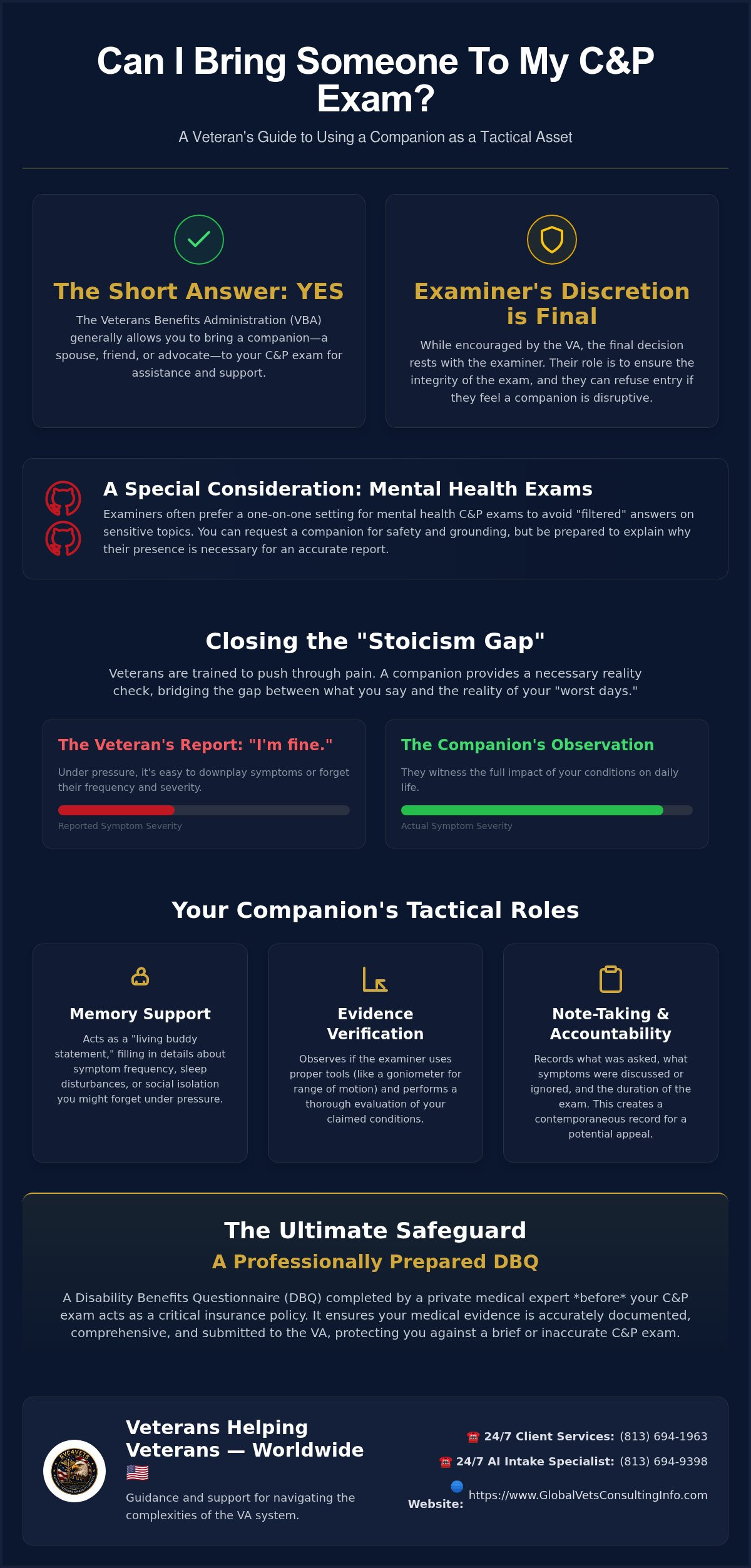
The short answer is yes, you generally can. The Veterans Benefits Administration (VBA) recognizes that many veterans require assistance during medical evaluations. Whether you need help with mobility or simply struggle to recall the frequency of your symptoms, having a companion can be a game-changer. However, you must understand that the examiner holds the final authority. If you’ve been asking, “can i bring someone with me to a c&p exam,” you should know that while the VA encourages transparency, the individual doctor decides who stays in the room.
It’s vital to distinguish between emotional support and acting as a witness. A witness provides objective data for your medical evidence. They see your “worst days” when you are home and the military stoicism has worn off. In the 2026 regulatory environment, the VA prioritizes the integrity of the exam. If your companion remains silent and only speaks when prompted or to clarify a physical limitation, they are far more likely to be allowed to stay. Their role is to observe and support, not to lead the conversation.
The General Rule: Spouse, Friend, or Advocate?
Your companion doesn’t need a specific legal title to attend. It could be a spouse, a family member, or even a fellow veteran who understands your daily struggles. They serve as a vital memory trigger. They can remind you of the migraines you had last month that you might forget to mention due to exam-room anxiety. Their presence ensures that the examiner sees the full picture of your disability, not just a snapshot of your performance during a thirty-minute window.
Mental Health Exams: A Special Consideration
Mental health C&P exams are often handled with more scrutiny. Because these interviews involve deeply personal and sensitive topics, many examiners prefer a one-on-one setting. This prevents “filtered” answers that might occur if a loved one is listening. If you are filing for PTSD or MST, you can request a support person specifically for safety and grounding. Be prepared to explain why their presence is necessary for the accuracy of the report. If they are denied entry, have them wait nearby to help you decompress once the appointment ends.
Strategic Roles: How Your Companion Strengthens Your Claim
Bringing a partner into the exam room transforms them from a passive supporter into a tactical observer. Many veterans ask, “can i bring someone with me to a c&p exam” to ensure they don’t miss details that could impact their VA rating increase. Your companion acts as a witness to several critical areas during the evaluation:
- Medical Evidence Verification: They observe if the examiner uses proper tools, like a goniometer, to measure your range of motion accurately.
- Memory Support: They act as a living buddy statement, filling in details about symptom frequency that you might forget under pressure.
- Note-Taking: They record what the examiner actually asked and which symptoms were ignored during the evaluation.
The “Stoicism Gap” and How to Close It
Veterans are trained to push through pain, which often leads to saying “I’m fine” during a VA disability claim evaluation. Instead of letting military stoicism take over, your companion provides a necessary reality check by documenting your “worst days” in the following ways:
- Highlighting sleep disturbances or night terrors you might naturally downplay.
- Describing irritability or social isolation that affects your quality of life.
- Confirming how often you rely on assistive devices or help with daily tasks.
Post-Exam Accountability
Your companion’s notes are vital for creating a contemporaneous record immediately after leaving the room. This documentation supports the VA disability claims process step by step if you need to appeal an unfair result. To strengthen your file even further, you can explore expert DBQ education to ensure your evidence is complete before the exam begins.
What to Do if an Examiner Refuses Your Companion Entry
If an examiner denies your companion entry, you must remain professional while protecting your rights. While you now know the answer to “can i bring someone with me to a c&p exam” is generally yes, individual clinics may have restrictive local policies. If you are told your spouse or witness must stay in the lobby, follow these immediate steps:
- Request a Reason: Ask the examiner to state clearly why the companion is being excluded and ask them to note this refusal in your medical record.
- Maintain Compliance: Do not leave the facility. Walking out can be categorized as a “failure to report,” which may lead to an automatic denial of your VA disability claim.
- Utilize the Lobby: Have your companion stay nearby to record the exact time you entered and exited the exam room to document the thoroughness of the evaluation.
- Draft a Statement: Immediately after the appointment, write a Statement in Support of Claim (VA Form 21-4138) detailing the refusal and any symptoms the examiner failed to discuss.
The “Notice of Disagreement” Protocol
A solo exam often leads to a report that misses the “stoicism gap” we discussed earlier. If you receive an unfavorable result because your witness was excluded, you can use a VA claim denied for lack of evidence strategy to fight back. Documenting the examiner’s refusal to allow a witness provides strong grounds to request a new examination or a higher-level review.
Contacting the VA Patient Advocate
Escalate the issue if the examiner was adversarial or if the refusal felt like a violation of VA directives. You have clear paths for recourse:
- 📞 Patient Advocate: Contact the advocate at the VA medical center overseeing your claim to file a formal complaint.
- ☎️ Hotline Support: Call the VHA or VBA hotlines to ensure the incident is logged in your permanent record.
- 🌐 Professional Education: If you are worried about future exams, get professional DBQ education to ensure your medical evidence is finalized before you ever walk through the clinic door.
The Ultimate Safeguard: Using a Private DBQ Before Your Exam
While you are determining, “can i bring someone with me to a c&p exam,” you should also consider what happens if that exam doesn’t go as planned. Even with a companion present, a brief evaluation can lead to evidence gaps. This is where a private medical record becomes your strongest asset. A professionally prepared what is a dbq acts as an insurance policy for your claim. It ensures that a thorough medical opinion is already in your file before you even walk into the clinic.
Having your evidence finalized and submitted reduces “Exam Anxiety” significantly. You no longer have to rely solely on a fifteen-minute interaction with a stranger to determine your future. Our “Veterans Helping Veterans” approach focuses on meticulous documentation. We believe that a well-documented file speaks louder than a single appointment. By submitting a private DBQ, you provide the VA with a comprehensive view of your symptoms that a standard C&P exam might miss.
Why a Private DBQ Often Beats a C&P Exam
A typical C&P exam is often rushed. In contrast, a private evaluation allows for a deep dive into your medical history and daily limitations. Global Vets Consulting specializes in educating veterans to ensure their dbq for mental health conditions is accurate and compliant with VA standards. This level of detail can override a negative or “less likely than not” finding from a contractor examiner who doesn’t know your history.
Taking Control of Your VA Rating
Stop hoping an examiner sees your pain and start proving it with evidence. Moving from a passive mindset to a strategic one is the key to a successful VA rating increase. Before your exam day, ensure you have followed this final checklist:
- Review your submitted DBQs so your verbal answers match the written record.
- Confirm the clinic’s specific rules regarding the question: “can i bring someone with me to a c&p exam?”
- Prepare your companion with specific symptoms they need to highlight if you forget.
- Bring a copy of your private medical evidence to reference during the appointment.
Take Command of Your Next VA Appointment 🇺🇸
Understanding your rights regarding the question “can i bring someone with me to a c&p exam” is the first step in protecting your future. By utilizing a companion as a strategic witness and securing private medical evidence beforehand, you remove the guesswork from your VA disability claim. This proactive approach ensures your rating increase is based on facts rather than a rushed evaluation by a stranger.
Global Vets Consulting is a veteran-owned and operated consulting service dedicated to technical accuracy and meticulous documentation. We operate with a mission-driven focus to provide immediate assistance to those who served, ensuring you have a steady guide through the complexities of the VA system.
🌎 Worldwide
📞 24/7 National Client Services Hotline
🤖 24/7 AI Veteran Intake Specialist
🌎 Take Control of Your Evidence—Get Your Professional DBQ Today
Don’t let a single appointment define your benefits. Take command of your medical evidence and secure the rating you’ve earned. We are ready to provide the professional support you need to navigate the system with confidence and peace of mind.
Frequently Asked Questions
Is there a specific VA form to request a companion for a C&P exam?
No, the VA does not currently require a specific form to request a companion’s presence in 2026. You simply arrive at the appointment with your spouse, family member, or a friend. If you’re wondering, “can i bring someone with me to a c&p exam,” just know that no paperwork is needed beforehand. It’s still a good idea to inform the check-in desk that you have a companion with you so they can accommodate the extra person.
Can my spouse speak during the medical examination?
Your spouse should generally remain a silent observer unless the examiner specifically asks them for input. Their primary role is to witness the exam and help you remember details after the appointment. The doctor needs to hear directly from you to assess your condition accurately. If you struggle with memory, your spouse can gently prompt you or clarify a limitation if the examiner permits it. This keeps the focus on your medical evidence.
Will bringing someone with me make the VA think I am faking my symptoms?
No, bringing a companion does not suggest you are faking symptoms. If you’ve asked, “can i bring someone with me to a c&p exam” because you’re worried about how it looks, rest assured that many examiners view it as evidence of severity. It shows that your disability impacts your daily life enough to require support. This transparency helps build a more accurate picture of your functional limitations for your VA disability claim.
What happens if the C&P examiner is rude to my companion?
You should remain professional but document the behavior immediately after the appointment. If an examiner is disrespectful, it may indicate a biased or inadequate evaluation. Ask your companion to write down exactly what was said. You can then report this conduct to the facility’s Patient Advocate or the VBA hotline. This ensures the record shows the exam environment was adversarial; this is critical if you need to challenge the results later.
Does the VA pay for my companion’s travel to the C&P exam?
The VA typically does not reimburse travel costs for companions unless they’re officially designated as a medically necessary attendant. If your medical condition requires you to have a travel assistant, you must have this documented in your records before the trip. For most veterans, the standard travel pay only covers the veteran’s mileage. Always check with the travel office at your local VA medical center for the most current 2026 reimbursement rules.

Article by
Willie Daniel
Willie Daniel is the Founder and Chief Executive Officer (CEO) of Global Vets Consulting (GVC4Vets) – National Veterans Disability Services, a veteran-led educational and medical evidence support organization dedicated to helping veterans better understand VA disability rating increases, DBQ medical evidence, secondary claims education, and C&P examination preparation.
He is a retired U.S. Army Medical Service Corps Officer with more than 27 years of honorable military service, a decorated Iraq combat veteran, and a retired federal official with the U.S. Department of Veterans Affairs. Throughout his military and federal career, Willie Daniel served in leadership, healthcare administration, operational, and veteran-support roles focused on improving services and support systems for servicemembers, veterans, and their families.
Drawing from decades of military leadership, healthcare administration, veteran advocacy, and federal government experience, Willie Daniel brings a practical, veteran-centered perspective to Global Vets Consulting’s educational articles, AI-powered veteran resources, video education initiatives, and outreach programs. His experience navigating military systems, medical documentation processes, and veteran-related administrative operations provides valuable insight into many of the challenges veterans face when seeking to better understand VA disability rating criteria, medical evidence, documentation strategies, and secondary condition education.
Through GVC’s “Veterans Helping Veterans” mission, his focus is on delivering clear, educational, and easy-to-understand information designed to empower veterans with knowledge, resources, and educational tools that may help them make more informed decisions regarding their individual VA disability journeys.
The information provided through GVC is intended for educational and informational purposes only and should not be considered legal or medical advice.
Disclaimer
Disclaimer: Global Vets Consulting, LLC (“GVC”) is a veteran-led educational and medical evidence support organization. GVC is not a law firm, is not a Veterans Service Organization (VSO), and is not affiliated with the U.S. Department of Veterans Affairs (VA) or any government agency.
Global Vets Consulting does not provide legal advice, medical advice, medical treatment, or healthcare services. GVC does not prepare, file, or submit VA disability claims on behalf of veterans. All information provided through this website, blog articles, videos, educational materials, AI tools, dashboards, templates, and communications is intended solely for general educational and informational purposes.
Veterans are encouraged to consult with accredited representatives, licensed attorneys, qualified medical providers, or Veterans Service Organizations regarding their specific legal, medical, or VA-related matters. VA disability decisions, ratings, and outcomes are determined solely by the U.S. Department of Veterans Affairs based on applicable laws, regulations, medical evidence, and individual circumstances. Past results do not guarantee future outcomes.