

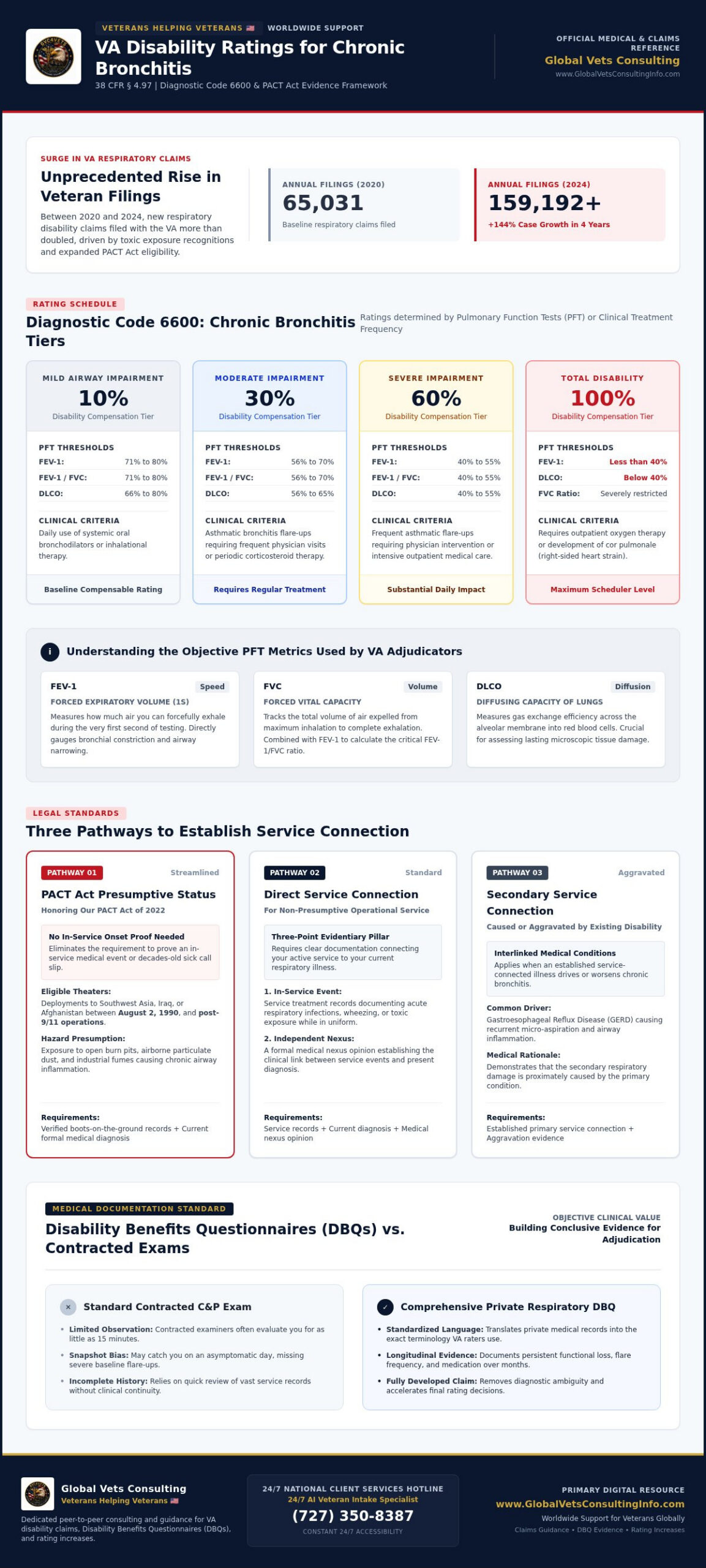
Between 2020 and 2024, new respiratory disability claims filed with the VA surged from 65,031 to over 159,192 cases. If you’re struggling to catch your breath during daily routines and seeking an accurate Chronic Bronchitis VA rating, you already know how exhausting this process can be.
You shouldn’t have to decipher confusing pulmonary function test scores like FEV-1 and FVC alone, nor should you settle for a low rating or claim denial caused by missing medical documentation. You earned your benefits through honorable service, and securing them requires clear, objective evidence.
This guide explains how the VA rates your condition under Diagnostic Code 6600, how the PACT Act establishes presumptive service connection for toxic exposures, and how comprehensive Disability Benefits Questionnaires (DBQs) establish proper compensation. Below, we break down the rating schedule and documentation standards step by step so you can build your claim with confidence.
Key Takeaways
- Understand how the VA assigns a Chronic Bronchitis VA rating between 10% and 100% under Diagnostic Code 6600 using specific pulmonary function test scores.
- Discover how presumptive service connection under the PACT Act eliminates the need to prove an in-service event for toxic-exposed veterans.
- Learn how completing a Respiratory Conditions Disability Benefits Questionnaire translates clinical findings and daily functional limitations into actionable medical evidence.
- Identify the exact steps to overturn an improper claim denial through a Supplemental Claim or pursue a formal rating increase as lung health declines.
VA Disability Ratings for Chronic Bronchitis: 38 CFR Diagnostic Code 6600
The Department of Veterans Affairs evaluates respiratory conditions under 38 CFR § 4.97, Diagnostic Code 6600. A chronic bronchitis VA rating spans 10%, 30%, 60%, or 100%, assigned according to the degree of airway restriction shown during clinical testing. Under Diagnostic Code 6600, disability compensation relies on specific Pulmonary Function Test (PFT) thresholds, assigning 10% for an FEV-1 of 71% to 80%, 30% for 56% to 70%, 60% for 40% to 55%, and 100% for scores below 40% of predicted normal values.
Understanding PFT Metrics: FEV-1, FVC, and DLCO
Objective testing establishes the legal foundation for your claim. Forced Expiratory Volume in one second (FEV-1) measures how much air you forcefully exhale during the first second of testing. Forced Vital Capacity (FVC) tracks total air expelled, while DLCO measures gas exchange efficiency. Adjudicators evaluate these metrics to assign Chronic Bronchitis VA ratings:
- 10% Rating: FEV-1 of 71% to 80%, FEV-1/FVC ratio of 71% to 80%, or DLCO of 66% to 80%.
- 30% Rating: FEV-1 of 56% to 70%, FEV-1/FVC ratio of 56% to 70%, or DLCO of 56% to 65%.
- 60% Rating: FEV-1 of 40% to 55%, FEV-1/FVC ratio of 40% to 55%, or DLCO of 40% to 55%.
- 100% Rating: FEV-1 less than 40%, DLCO below 40%, outpatient oxygen requirement, or cor pulmonale.
Alternative Rating Criteria: Inhaler Use and Flare-Up Frequencies
Testing numbers don’t always capture daily suffering. If your spirometry numbers appear borderline, prescribed treatments help establish appropriate disability levels. Daily use of systemic oral bronchodilators or inhalational therapy establishes a baseline 10% rating. Asthmatic bronchitis flare-ups requiring frequent physician visits or periodic corticosteroid therapy can elevate compensation to 30% or 60% tiers, reflecting your true functional loss.
Proving Service Connection for Chronic Bronchitis Under the PACT Act
The Honoring Our PACT Act of 2022 fundamentally reformed how disability adjudicators evaluate military toxic exposures. By designating chronic airway inflammation as a PACT Act presumptive condition, the law removes the burden of establishing a specific in-service onset event. Instead of tracking down decades-old sick call slips, eligible veterans only need to prove active military presence in covered theaters alongside a verified, current medical diagnosis.
Qualifying Service Locations and Toxic Exposure Presumptions
Presumptive status applies to personnel exposed to open burn pits and airborne hazards across specified operational theaters. Eligible service parameters include deployments in Southwest Asia, Iraq, and Afghanistan between August 2, 1990, and post-9/11 military operations. Airborne hazards including particulate dust and industrial fumes cause lasting tissue damage, making your official military records critical. Your personnel files must confirm boots-on-the-ground service or designated airspace exposure to secure a Chronic Bronchitis VA rating under presumptive rules.
Establishing Direct or Secondary Service Connection
Veterans without qualifying deployment locations must pursue direct or secondary service connection. Direct claims require service treatment records documenting acute respiratory symptoms in uniform, paired with an independent nexus opinion linking your current condition to your service history. Chronic bronchitis also qualifies as a secondary disability when driven or aggravated by an established service-connected illness, such as gastroesophageal reflux disease. Following the VA disability claims process step by step clarifies your development path, while resources at Global Vets Consulting help you understand how complete medical evidence substantiates your earned benefits.
Using a Respiratory DBQ to Build Conclusive Medical Evidence
A Disability Benefits Questionnaire standardizes private clinical records into the precise language VA raters evaluate. Submitting a completed Respiratory Conditions DBQ with a fully developed claim removes ambiguity and speeds up final rating decisions. Instead of relying solely on contracted examiners who may only observe you for fifteen minutes, a private DBQ documents your persistent symptoms over months. Review our comprehensive guide on what is a DBQ to learn how structured medical documentation supports your case.
Critical Medical Information Required on the Respiratory DBQ
Your physician must complete every diagnostic field thoroughly to support your Chronic Bronchitis VA claim. Adjudicators scrutinize specific sections, including:
- Post-Bronchodilator Spirometry: Actual numerical scores and predicted percentages for FEV-1, FVC, and DLCO.
- Symptom Frequency: Documented episodes of chronic productive cough, dyspnea, and recurring pulmonary infections.
- Functional Impairment: Detailed clinical statements explaining how breathlessness limits physical exertion, workplace attendance, and daily mobility.
Avoiding Common Medical Evidence Pitfalls
Simple clinical oversights can prompt the VA to invalidate submitted tests. Spirometry tests conducted on uncalibrated equipment or without post-bronchodilator trials frequently get rejected by raters. In addition, if you have a history of smoking, ensure your clinician addresses it objectively. The medical rationale must clearly distinguish between lifestyle habits and military airborne toxic hazards. Visit Global Vets Consulting to access independent respiratory claims education and ensure your private medical evidence meets strict VA adjudication standards.
Overcoming Denials and Filing for a Chronic Bronchitis Rating Increase
Receiving an unfavorable rating decision is discouraging, but it doesn’t mean your claim journey is finished. Respiratory conditions frequently worsen over time, and diminished lung capacity justifies seeking an accurate Chronic Bronchitis VA rating increase. If your initial filing was turned down, consult our actionable guide on VA claim denied for lack of evidence to identify documentation gaps and reset your strategy.
Supplemental Claims Versus Higher-Level Reviews
Selecting the appropriate review lane under the Appeals Modernization Act impacts your outcome. A Higher-Level Review assigns a senior adjudicator to re-examine existing records, but it forbids submitting new medical records. A Supplemental Claim, however, allows you to introduce updated pulmonary function tests and current clinical findings. Learn how to use a DBQ for a VA disability rating increase to establish the worsening nature of your respiratory impairment.
Partnering with Global Vets Consulting for Worldwide Support 🇺🇸
Global Vets Consulting operates under a dedicated “Veterans Helping Veterans” model, providing peer-to-peer support for veterans worldwide. We deliver independent medical evidence education, C&P exam preparation guidance, and Disability Benefits Questionnaire strategies to substantiate your earned compensation. While we aren’t a law firm and don’t file initial claims, our educational consulting ensures your private medical evidence reflects accurate symptom severity.
- Digital Portal: Get DBQ Guidance
- 24/7 National Client Services Hotline: Call (727) 350-8387
- 24/7 AI Veteran Intake Specialist: Accessible anytime at (727) 350-8387
Take Control of Your Chronic Bronchitis VA Claim Today 🇺🇸
Securing an accurate Chronic Bronchitis VA rating demands thorough medical documentation, from objective pulmonary function metrics to strategic PACT Act presumptive exposure criteria. Whether you’re filing a Supplemental Claim to overcome a denial or pursuing an earned rating increase for progressive airway restriction, comprehensive Respiratory DBQs provide the decisive evidence adjudicators require.
As a veteran-owned and operated consulting team, Global Vets Consulting delivers dedicated peer-to-peer support for veterans worldwide. We specialize in independent medical evidence education, C&P exam preparation, and Disability Benefits Questionnaires. You served honorably, and you don’t have to navigate complex bureaucratic standards on your own.
Connect with Global Vets Consulting for 24/7 Veteran Claim Education 🇺🇸. Contact our 24/7 National Client Services Hotline and 24/7 AI Veteran Intake Specialist at (727) 350-8387 to take the next step toward the compensation you earned.
Frequently Asked Questions
Can I get a VA disability rating for chronic bronchitis if I smoked cigarettes?
Yes, smoking history doesn’t automatically bar you from receiving service connection. While tobacco use can cause airway obstruction, toxic military exposures or burn pits may still be the primary cause or aggravating factor. Under PACT Act guidelines, presumptive coverage applies regardless of personal smoking history. Your medical provider should clearly state that toxic exposures played a distinct, significant role in developing your condition.
What is the minimum VA rating for chronic bronchitis under Diagnostic Code 6600?
The minimum compensable Chronic Bronchitis VA rating is 10%. Under Diagnostic Code 6600, this tier requires an FEV-1 between 71% and 80% of predicted normal value, an FEV-1/FVC ratio in the same range, or a DLCO between 66% and 80%. Alternatively, the VA assigns a 10% rating if you require daily inhalational or oral bronchodilator therapy to manage persistent respiratory symptoms.
Is chronic bronchitis considered a presumptive condition under the PACT Act?
Yes, the PACT Act recognizes chronic bronchitis as a presumptive respiratory condition for eligible toxic-exposed veterans. If you deployed to designated areas in Southwest Asia, Iraq, or Afghanistan during qualified service windows, you don’t need to establish a direct in-service event. You only need to verify your active military service in qualifying locations and provide a current clinical diagnosis supported by proper medical records.
Do I have to attend a C&P exam if I submit a private DBQ for chronic bronchitis?
You should always report to an exam if the VA schedules one. Submitting a private Disability Benefits Questionnaire can sometimes satisfy evidentiary requirements without an additional exam, but adjudicators maintain the authority to schedule a C&P evaluation. Missing a mandatory exam can result in an automatic denial. Bringing your private DBQ copies to the evaluation ensures examiners review your complete diagnostic history.
Can chronic bronchitis qualify for Total Disability based on Individual Unemployability (TDIU)?
Yes, severe chronic bronchitis can support a claim for TDIU if breathing difficulties prevent gainful employment. Schedular TDIU requires a single service-connected condition rated at 60% or higher, or a combined 70% rating with one condition rated at 40%. Because a Chronic Bronchitis VA rating reaches 60% or 100% under severe spirometry limitations, it can qualify you for 100% compensation even if you lack a schedular 100% evaluation.

Article by
Willie Daniel
Willie Daniel is the Founder and Chief Executive Officer (CEO) of Global Vets Consulting (GVC4Vets) – National Veterans Disability Services, a veteran-led educational and medical evidence support organization dedicated to helping veterans better understand VA disability rating increases, DBQ medical evidence, secondary claims education, and C&P examination preparation.
He is a retired U.S. Army Medical Service Corps Officer with more than 27 years of honorable military service, a decorated Iraq combat veteran, and a retired federal official with the U.S. Department of Veterans Affairs. Throughout his military and federal career, Willie Daniel served in leadership, healthcare administration, operational, and veteran-support roles focused on improving services and support systems for servicemembers, veterans, and their families.
Drawing from decades of military leadership, healthcare administration, veteran advocacy, and federal government experience, Willie Daniel brings a practical, veteran-centered perspective to Global Vets Consulting’s educational articles, AI-powered veteran resources, video education initiatives, and outreach programs. His experience navigating military systems, medical documentation processes, and veteran-related administrative operations provides valuable insight into many of the challenges veterans face when seeking to better understand VA disability rating criteria, medical evidence, documentation strategies, and secondary condition education.
Through GVC’s “Veterans Helping Veterans” mission, his focus is on delivering clear, educational, and easy-to-understand information designed to empower veterans with knowledge, resources, and educational tools that may help them make more informed decisions regarding their individual VA disability journeys.
The information provided through GVC is intended for educational and informational purposes only and should not be considered legal or medical advice.
Disclaimer
Disclaimer: Global Vets Consulting, LLC (“GVC”) is a veteran-led educational and medical evidence support organization. GVC is not a law firm, is not a Veterans Service Organization (VSO), and is not affiliated with the U.S. Department of Veterans Affairs (VA) or any government agency.
Global Vets Consulting does not provide legal advice, medical advice, medical treatment, or healthcare services. GVC does not prepare, file, or submit VA disability claims on behalf of veterans. All information provided through this website, blog articles, videos, educational materials, AI tools, dashboards, templates, and communications is intended solely for general educational and informational purposes.
Veterans are encouraged to consult with accredited representatives, licensed attorneys, qualified medical providers, or Veterans Service Organizations regarding their specific legal, medical, or VA-related matters. VA disability decisions, ratings, and outcomes are determined solely by the U.S. Department of Veterans Affairs based on applicable laws, regulations, medical evidence, and individual circumstances. Past results do not guarantee future outcomes.