Did you know that an estimated 73% of secondary claims fail simply because of insufficient medical evidence? It’s a frustrating reality for many who served, especially when struggling with the heavy burden of breathing issues that emerged long after an initial service connection. You know your body better than anyone. You understand how a service-connected injury can trigger a chain reaction that leads to Respiratory Secondary Claims. It is exhausting to feel like the system doesn’t see the connection you live with every day.
This guide will show you exactly how to establish a solid service connection by using precise medical evidence and Disability Benefits Questionnaires (DBQs). We will explore which primary disabilities link to respiratory ailments and the documentation required to secure the rating increase you’ve earned. Global Vets Consulting (GVC4Vets) provides educational resources and DBQ preparation, though we don’t file claims or provide legal advice. As a worldwide resource for the veteran community, we offer 24/7 access to our National Client Services Hotline and AI Veteran Intake Specialist at (727) 350-8387 and our website at https://www.GlobalVetsConsultingInfo.com. 🇺🇸
Key Takeaways
- Learn how to link new breathing issues to existing service-connected disabilities by understanding the physiological chain reactions that occur within your body.
- Identify the specific ways primary conditions such as GERD or mental health disorders can lead to secondary respiratory complications and systemic inflammation.
- Master the process of using accurate DBQs and objective diagnostic evidence, such as spirometry, to successfully establish Respiratory Secondary Claims.
- Access 24/7 veteran-to-veteran education from Global Vets Consulting (GVC4Vets) at (727) 350-8387 or https://www.GlobalVetsConsultingInfo.com; we do not file claims or provide legal advice.
Understanding Respiratory Secondary Claims in the VA Rating System
Secondary service connection is a vital tool for veterans whose health has declined due to existing service-connected issues. According to Title 38 of the Code of Federal Regulations, a disability that is proximately due to or the result of a service-connected condition shall be considered part of the original disability. Establishing Respiratory Secondary Claims allows you to account for conditions like asthma or sleep apnea that wouldn’t exist if not for your primary injury.
The VA evaluates these claims by looking at objective lung capacity and chronic symptoms. These conditions often stem from systemic inflammation, side effects of medications, or physical trauma that restricts breathing. Successfully linking these ailments leads to comprehensive healthcare coverage and the rating increase you deserve.
Common Respiratory Conditions Filed as Secondary Claims
Veterans frequently file for conditions that manifest as a result of their primary service-connected disabilities:
- Asthma and chronic bronchitis: Often linked to systemic physical conditions or toxic exposure that worsens over time.
- Obstructive sleep apnea: Regularly developed secondary to mental health medications or weight gain caused by musculoskeletal injuries.
- Chronic sinusitis: Frequently aggravated by primary service-connected illnesses that weaken the immune response.
Direct Service Connection vs. Secondary Service Connection
Direct connection requires proving a specific in-service event or toxic exposure. In contrast, secondary claims focus on the medical nexus between your current respiratory issue and an existing rated disability. You don’t need to prove the breathing problem started in the military; you only need to show that your service-connected condition caused it. Global Vets Consulting (GVC4Vets) offers peer-to-peer education on medical evidence for these links. We don’t file claims or provide legal advice. Reach our 24/7 National Client Services Hotline and AI Veteran Intake Specialist at (727) 350-8387 or visit https://www.GlobalVetsConsultingInfo.com. 🇺🇸
Primary Disabilities That Frequently Cause Secondary Respiratory Conditions
Identifying the specific triggers for Respiratory Secondary Claims requires looking at how your primary service-connected disabilities physically impact your breathing. For example, musculoskeletal injuries involving the spine or thoracic cage can severely restrict chest wall expansion, leading to chronic shortness of breath. Similarly, medications prescribed for primary physical trauma often cause significant weight gain or respiratory depression as a side effect. These physiological links are critical for proving that your breathing issues aren’t standalone problems but are directly tied to your service-connected health history.
Mental Health Conditions and Obstructive Sleep Apnea
Mental health disorders like PTSD significantly contribute to sleep apnea through both physiological and behavioral changes. PTSD hyperarousal often disrupts sleep architecture, leading to increased airway collapse. Additionally, psychotropic medications used to manage these conditions frequently cause weight gain, which is a primary driver for respiratory distress. You can find more detail on documenting these symptoms in our guide on the DBQ for mental health conditions.
GERD and Chronic Upper Airway Inflammation
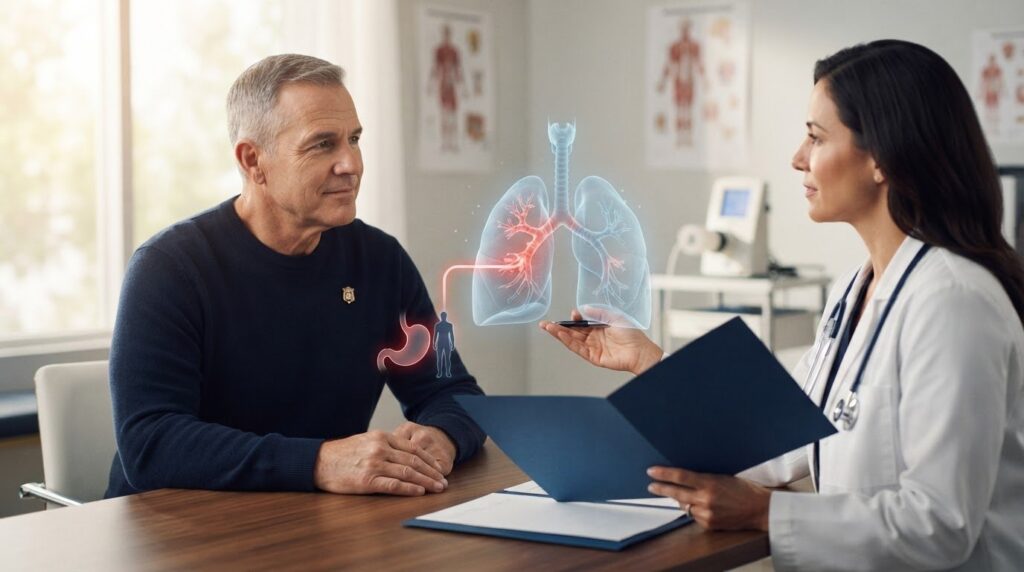
Gastroesophageal reflux disease (GERD) is a frequent catalyst for secondary lung issues due to micro-aspiration. When stomach acid refluxes into the trachea, it creates constant irritation of the vocal cords and bronchial tubes. This chronic inflammation often creates secondary asthma symptoms or aggravates existing rhinitis. The VA evaluates these conditions using specific criteria found in the Schedule of Ratings for the Respiratory System.
Global Vets Consulting (GVC4Vets) is here to provide the secondary VA claims education you need to understand these complex medical links. We operate as a veteran-owned resource for our peers worldwide, though we don’t file claims or provide legal advice. Our 24/7 National Client Services Hotline and 24/7 AI Veteran Intake Specialist are available at (727) 350-8387 to assist you. 🇺🇸
Medical Evidence and DBQ Documentation Required for VA Approval
Proving a secondary connection requires moving from physiological reality to concrete paperwork. The VA relies on a specific sequence of medical records to evaluate Respiratory Secondary Claims. First, you must secure a formal, current diagnosis of your respiratory condition. Second, you must undergo objective diagnostic testing, such as spirometry or a sleep study, to establish baseline clinical data before submitting your file.
The Crucial Role of Pulmonary Function Tests (PFT)
For most lung conditions, the VA relies on objective pulmonary function testing to determine your rating percentage. Clinicians look at specific measurements like FEV-1 and FVC, recording both pre-bronchodilator and post-bronchodilator results to measure impairment. This objective medical data forms the core of your case. To understand how these clinical measurements translate to VA paperwork, check out our guide on what is a DBQ.
Structuring a Strong Medical Nexus Opinion
A current diagnosis is only half the battle. You also need an Independent Medical Opinion that explicitly bridges your conditions. The medical professional must state that your breathing disorder is “at least as likely as not” due to your primary service-connected disability. This opinion must provide a clear rationale based on your service records and current medical literature. Skipping this step often results in a VA claim denied for lack of evidence, which delays your access to VA Disability Compensation.
Organizing this clinical paperwork requires a meticulous approach. Global Vets Consulting (GVC4Vets) offers specialized education on medical evidence and DBQ preparation to help you build a comprehensive file. We don’t file claims or provide legal advice, but our peer support model is available to veterans worldwide. Contact our 24/7 National Client Services Hotline and 24/7 AI Veteran Intake Specialist at (727) 350-8387, or explore our educational resources at learn more. 🇺🇸
Navigating Your Claim with Global Vets Consulting (GVC4Vets): Veterans Helping Veterans 🇺🇸
Global Vets Consulting (GVC4Vets) is founded on the principle that no veteran should have to face the complexities of the VA system alone. As a veteran-owned and operated team established in 2021, we focus on a peer-to-peer support model that prioritizes your peace of mind and earned outcomes. We assist veterans globally in organizing documentation that accurately reflects respiratory limitations, ensuring that your file is ready for review. You can learn the overall procedure through our VA disability claims process step by step.
Standardized DBQ Preparation for Respiratory Claims
The most common reason for delays is missing or disorganized medical evidence. By using standardized Disability Benefits Questionnaires (DBQs) to document your symptoms, you provide VA adjudicators with a clear, predictable path to a decision. This objective paperwork details your symptom severity and functional loss, which is essential for successful Respiratory Secondary Claims. Our educational resources guide you through the meticulous details required for Respiratory Secondary Claims to avoid unnecessary scheduling hurdles at your C&P exam.
Worldwide Support and Accessible Communication Channels
Our mission-driven focus extends to the entire veteran community, regardless of geographic location. We understand that breathing conditions don’t follow a 9-to-5 schedule, which is why we maintain constant accessibility for veterans across the globe. We provide the educational tools and resource awareness necessary to navigate the system with steady confidence.
Contact Global Vets Consulting (GVC4Vets) 24/7
- 📞 24/7 National Client Services Hotline: (727) 350-8387
- 🤖 24/7 AI Veteran Intake Specialist: (727) 350-8387
- 🌐 Primary Digital Resource: learn more
Please note: Global Vets Consulting (GVC4Vets) provides educational resources and DBQ preparation. We don’t file claims, provide medical treatment, or offer legal representation.

Securing Your Earned Outcomes Through Precise Documentation
Building a successful case for Respiratory Secondary Claims requires a clear understanding of how your existing service-connected issues impact your lungs. Whether your breathing struggles stem from GERD-related micro-aspiration or mental health medications, the key lies in objective medical evidence and precise DBQ documentation. You have the right to ensure your rating accurately reflects your current physical limitations. Global Vets Consulting is a veteran-owned and operated peer-to-peer organization with a specialized focus on Disability Benefits Questionnaires.
We provide educational resources to help you organize your documentation with meticulousness and integrity. Our team does not file claims, provide medical treatment, or offer legal advice. Instead, we act as steady guides for veterans worldwide. Ready to document your secondary condition? Connect with Global Vets Consulting or call our 24/7 National Client Services Hotline and AI Veteran Intake Specialist at (727) 350-8387. You don’t have to face this complex system alone. We’re here to support your mission day or night. 🇺🇸
Frequently Asked Questions
Can sleep apnea be claimed as a secondary condition to PTSD?
Yes, you can claim sleep apnea as secondary to PTSD if you establish a clear medical link between the two conditions. PTSD often involves hyperarousal and disrupted sleep patterns that exacerbate airway collapse during the night. Additionally, medications prescribed for mental health conditions frequently cause weight gain, which is a primary risk factor for obstructive sleep apnea. A detailed nexus letter and DBQ help demonstrate how your mental health struggles directly caused these breathing issues.
What medical evidence is required to prove a secondary respiratory claim?
Successful Respiratory Secondary Claims require three specific pieces of evidence. First, you need a current, formal diagnosis of a chronic respiratory disorder from a qualified healthcare provider. Second, you must provide objective diagnostic testing results, such as a sleep study or pulmonary function test. Finally, a medical professional must provide a nexus opinion stating your condition is “at least as likely as not” caused by your primary service-connected disability, supported by clinical rationale.
Does the VA require pulmonary function testing for all respiratory disability claims?
The VA requires objective pulmonary function testing (PFT) for the majority of respiratory conditions to determine your rating percentage. These tests measure lung capacity through FEV-1 and FVC metrics. However, certain conditions like sleep apnea require a sleep study rather than a PFT. Sinusitis and rhinitis ratings are typically based on the frequency of infections or physical blockage rather than lung capacity. Always check the specific DBQ requirements for your diagnosed condition.
Can medication side effects from a service-connected injury justify a secondary claim?
Medication side effects are a valid basis for secondary service connection. If you take prescribed medicine for a service-connected physical trauma and that medication causes weight gain or respiratory depression, you can link the resulting breathing condition to your primary injury. This is a common pathway for veterans who develop sleep apnea after taking pain management drugs or psychotropic medications. Documenting these side effects in your medical records is essential for a successful claim.

Article by
Willie Daniel
Willie Daniel is the Founder and Chief Executive Officer (CEO) of Global Vets Consulting (GVC4Vets) – National Veterans Disability Services, a veteran-led educational and medical evidence support organization dedicated to helping veterans better understand VA disability rating increases, DBQ medical evidence, secondary claims education, and C&P examination preparation.
He is a retired U.S. Army Medical Service Corps Officer with more than 27 years of honorable military service, a decorated Iraq combat veteran, and a retired federal official with the U.S. Department of Veterans Affairs. Throughout his military and federal career, Willie Daniel served in leadership, healthcare administration, operational, and veteran-support roles focused on improving services and support systems for servicemembers, veterans, and their families.
Drawing from decades of military leadership, healthcare administration, veteran advocacy, and federal government experience, Willie Daniel brings a practical, veteran-centered perspective to Global Vets Consulting’s educational articles, AI-powered veteran resources, video education initiatives, and outreach programs. His experience navigating military systems, medical documentation processes, and veteran-related administrative operations provides valuable insight into many of the challenges veterans face when seeking to better understand VA disability rating criteria, medical evidence, documentation strategies, and secondary condition education.
Through GVC’s “Veterans Helping Veterans” mission, his focus is on delivering clear, educational, and easy-to-understand information designed to empower veterans with knowledge, resources, and educational tools that may help them make more informed decisions regarding their individual VA disability journeys.
The information provided through GVC is intended for educational and informational purposes only and should not be considered legal or medical advice.
Disclaimer
Disclaimer: Global Vets Consulting, LLC (“GVC”) is a veteran-led educational and medical evidence support organization. GVC is not a law firm, is not a Veterans Service Organization (VSO), and is not affiliated with the U.S. Department of Veterans Affairs (VA) or any government agency.
Global Vets Consulting does not provide legal advice, medical advice, medical treatment, or healthcare services. GVC does not prepare, file, or submit VA disability claims on behalf of veterans. All information provided through this website, blog articles, videos, educational materials, AI tools, dashboards, templates, and communications is intended solely for general educational and informational purposes.
Veterans are encouraged to consult with accredited representatives, licensed attorneys, qualified medical providers, or Veterans Service Organizations regarding their specific legal, medical, or VA-related matters. VA disability decisions, ratings, and outcomes are determined solely by the U.S. Department of Veterans Affairs based on applicable laws, regulations, medical evidence, and individual circumstances. Past results do not guarantee future outcomes.