
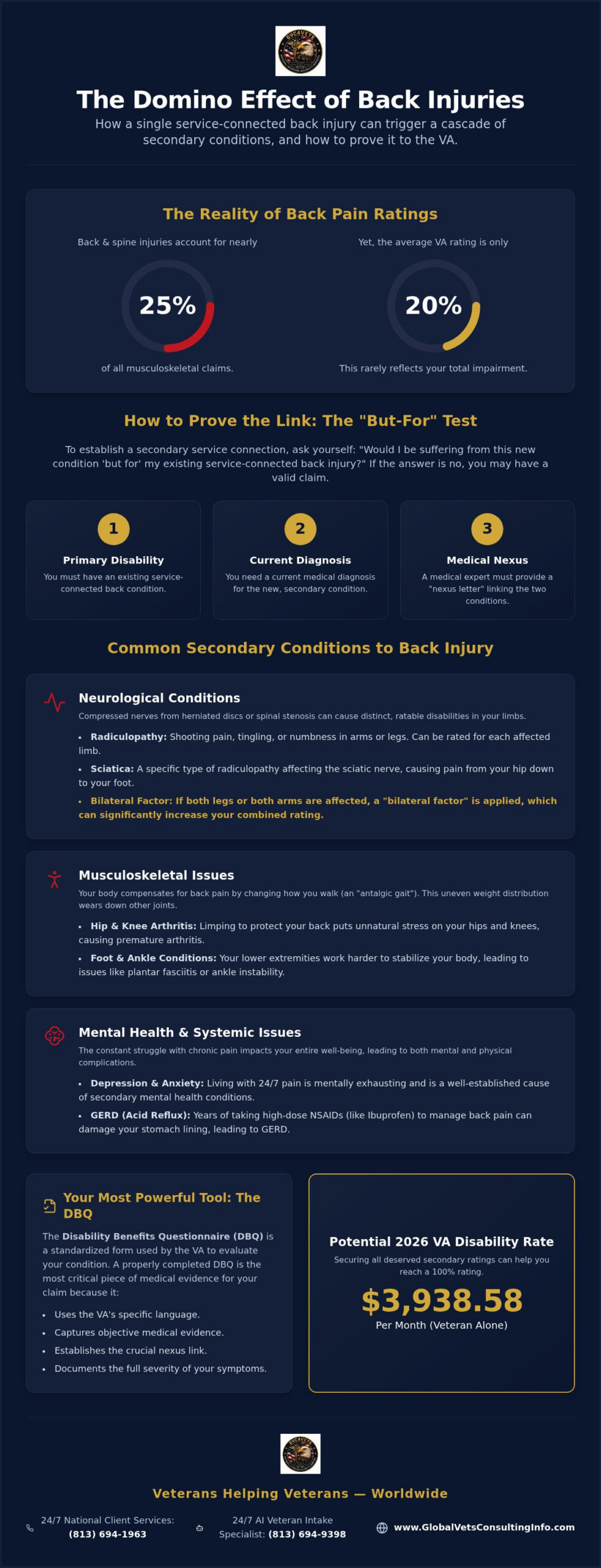
Did you know that back and spine injuries account for nearly 25% of all musculoskeletal claims, yet the average VA rating for back pain typically sits at just 20%? This rating rarely reflects the full reality of your daily struggle, especially when your injury triggers a “domino effect” throughout your body. Your spine is the anchor of your kinetic chain. When it’s damaged, it’s very likely you’ll develop common secondary conditions to back injury, such as radiculopathy in your limbs, hip issues, or even mental health struggles like anxiety and depression. 🇺🇸
We recognize the frustration of living with persistent pain only to receive a rating that feels like a clerical oversight. You’ve earned the right to a comprehensive evaluation that looks at your health as a whole. You’ll discover how to use medical evidence and Disability Benefits Questionnaires (DBQs) to prove these secondary links and secure the compensation you’re entitled to. This guide provides a full list of linkable conditions and an overview of the 2026 VA disability rates, where a 100% rating now offers $3,938.58 per month to support your recovery and peace of mind.
Key Takeaways
- Learn how to use the “But-For” test to prove your new disability is directly linked to an existing service-connected back injury.
- Identify common secondary conditions to back injury, such as radiculopathy and sciatica, that often qualify for additional compensation.
- Explore the connection between chronic physical pain and secondary mental health conditions like depression or anxiety.
- Discover why the Disability Benefits Questionnaire (DBQ) is your most powerful tool for capturing the medical evidence the VA requires.
- Find out how documenting these secondary links can help you secure a higher combined rating under the 2026 COLA adjustments.
Understanding Secondary Service Connection for Back Injuries
A secondary condition is any disability that is caused or aggravated by a service-connected primary injury. In 2026, filing for these links has become the most common path for veterans to reach a 100% VA rating. While a single back diagnosis often caps out at a low percentage, the total impact of that injury on your body is usually much higher. We look at your health through a lens of total impact rather than isolated symptoms.
To determine if you have a claim, we use the “But-For” test. Ask yourself a simple question: Would I be suffering from this nerve pain or hip instability “but for” my service-connected degenerative disc disease? If the answer is no, you are likely dealing with common secondary conditions to back injury. Proving this to the VA requires three specific pillars: a primary service-connected disability, a current medical diagnosis for your secondary condition, and a medical nexus that bridges the two.
The Domino Effect of Chronic Back Pain
Your body is an interconnected system. When you live with Low back pain, your musculoskeletal structure naturally compensates. You might limp to protect a sore side or sit in awkward positions to relieve pressure on your spine. This “domino effect” leads to misalignment in your hips, knees, and even your neck. Moving from a single back rating to a comprehensive “whole body” evaluation is the best way to ensure your compensation reflects your actual level of impairment. This approach shifts the focus from a localized injury to the reality of your daily physical struggle.
Aggravation is the legal standard used when a service-connected disability causes a non-service-connected condition to worsen beyond its natural progression. Documenting this shift is vital for your claim. By identifying how your primary injury has triggered new issues, you can build a stronger case for the rating increase you’ve earned through your service. 🇺🇸
Neurological and Musculoskeletal Secondary Conditions
Your spine is the central pillar of your kinetic chain. It doesn’t exist in a vacuum. When you suffer from a service-connected back injury, your body naturally shifts its weight to avoid pain. This adjustment leads to gait changes that eventually impact the joints in your lower half. As discussed by Johns Hopkins on Lower Back Pain, chronic issues like herniated discs or spinal stenosis often compress nerves, leading to several common secondary conditions to back injury.
Radiculopathy and Nerve Damage
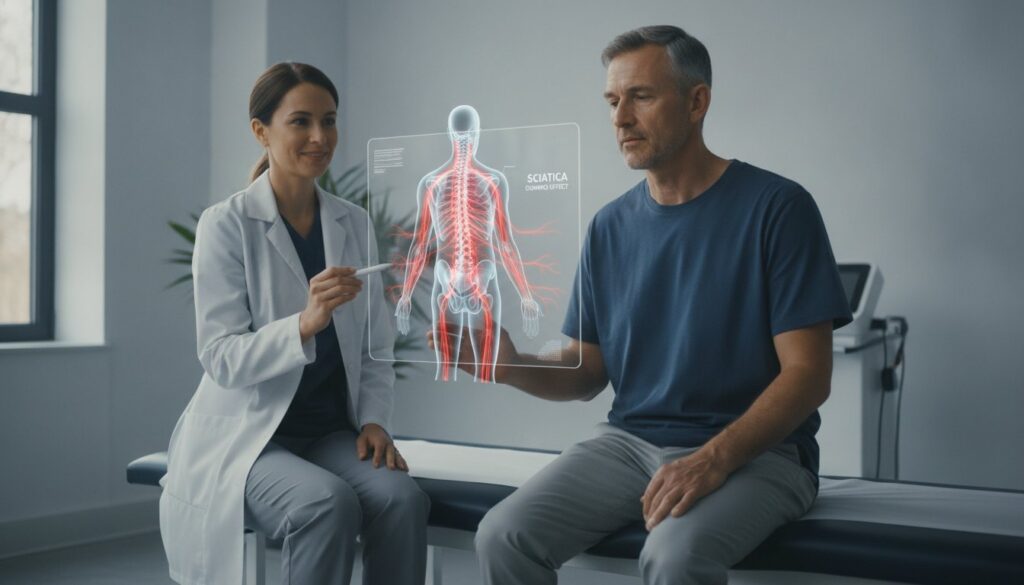
Radiculopathy is often dismissed by veterans as just a side effect of a “bad back,” but it’s a distinct neurological disability. It manifests as shooting pain, tingling, or numbness that travels down your arms or legs. The VA rates radiculopathy separately for each affected limb. If you experience nerve damage in both legs, the “bilateral factor” applies, which can significantly boost your combined disability rating. Sciatica is a specific type of radiculopathy involving the sciatic nerve, frequently triggered by lumbar strain or protruding discs. If you struggle with a burning sensation that radiates from your hip to your foot, you likely have a secondary claim.
Hip, Knee, and Foot Disabilities
Your “antalgic gait” is the medical term for walking with a limp to protect your back. While this helps you manage pain in the short term, it creates an uneven distribution of force that causes secondary arthritis in your hips and knees. Over time, even your ankles and feet may suffer as they work harder to stabilize your body. Documenting these movement patterns is essential for proving the nexus between your back and your lower extremities. Understanding musculoskeletal claims education can help you prepare the necessary evidence to show how your primary injury has physically degraded your other joints. 🇺🇸
Mental Health and Systemic Issues Secondary to Back Injury
Living with 24/7 chronic physical pain is an exhausting experience that impacts far more than just your range of motion. The WHO fact sheet on low back pain highlights that this condition is a leading cause of disability worldwide, often triggering a cascade of systemic health issues. Many veterans don’t realize that internal complications like Gastroesophageal Reflux Disease (GERD) are common secondary conditions to back injury. If you’ve spent years taking high-dose NSAIDs to manage back inflammation, the resulting damage to your stomach lining is a linkable secondary claim. Identifying these common secondary conditions to back injury is the first step toward securing a rating that actually matches your daily reality.
In more severe cases, spinal injuries can affect the autonomic nervous system. Conditions like Cauda Equina syndrome can lead to bladder or bowel dysfunction. These are high-value claims because they represent a significant loss of quality of life and require meticulous documentation of the neurological connection to your service-connected spine. You shouldn’t have to suffer in silence when the system is designed to compensate for these systemic failures.
Chronic Pain Syndrome and Mental Health
The psychological toll of chronic pain is often as debilitating as the physical injury itself. When your back pain prevents you from sleeping, working, or engaging with your family, it’s natural to develop depression or anxiety. The VA recognizes this link under the umbrella of Chronic Pain Syndrome. To secure a fair rating, you need medical evidence that clearly connects your mental health struggles to your physical limitations. Reviewing our DBQ for Mental Health Conditions can help you understand how to document these symptoms for your claim.
The Role of Obesity as an ‘Intermediary’ Step
Obesity can serve as a legal “bridge” to connect your back injury to conditions like sleep apnea or hypertension. If your service-connected back pain prevents you from exercising, leading to weight gain, that weight gain then becomes the cause of your sleep apnea. This is a complex but effective path to a rating increase. You must provide medical evidence showing that your sedentary lifestyle was a direct result of your back injury. If you’re ready to learn how to bridge these gaps, our Secondary VA Claims Education can guide you through the process of building a stronger case. 🇺🇸
How to Document Secondary Conditions Using DBQs
Securing a rating increase for secondary conditions requires more than just a diagnosis. It requires the right paperwork. The Disability Benefits Questionnaire (DBQ) is the gold standard for medical evidence in 2026. This form allows your provider to document the exact severity of your symptoms in a format the VA recognizes. For common secondary conditions to back injury, your physician must clearly capture the nexus. This link proves your radiculopathy or depression is “at least as likely as not” caused by your primary service-connected back injury. Proving these common secondary conditions to back injury is much easier when your evidence is organized correctly. To learn more about these forms, read our guide on What is a DBQ for VA Claims?
A formal Nexus Letter serves as a vital supplement to your secondary claim package. While the DBQ records the current state of your health, the Nexus Letter provides the detailed medical rationale that bridges the gap between your primary and secondary disabilities. Having both ensures the VA has a complete picture of your health.
Step-by-Step Evidence Gathering
- Identify all symptoms outside of your primary back pain, such as leg numbness, mood changes, or digestive distress.
- Schedule an evaluation with a provider who understands VA secondary connection standards and DBQ requirements.
- Submit a “Fully Developed Claim” (FDC) to accelerate the VA’s decision process and reduce the need for more exams.
Partnering with Global Vets Consulting
Global Vets Consulting provides the educational resources you need to navigate the complex DBQ process. We focus on ensuring your medical evidence is thorough and accurate. Our team is dedicated to simplifying the bureaucratic hurdles so you can focus on your health. 🇺🇸
- 📞 24/7 National Client Services Hotline
- 🌎 Worldwide support for your documentation needs
- 🌐 GlobalVetsConsultingInfo.com
Get the documentation you need for your secondary claim
Secure the VA Rating You’ve Earned
Your service-connected back injury is often just the beginning of a complex health journey. By recognizing how chronic pain triggers common secondary conditions to back injury, you can move toward a VA rating that reflects your daily physical and mental struggles. Whether you’re dealing with nerve damage, secondary joint issues, or the heavy weight of chronic pain syndrome, the path forward relies on precise medical evidence and a clear nexus.
We are a veteran-owned and operated team dedicated to simplifying this process for you. Our experts specialize in secondary service connection documentation, providing you with the educational resources needed to submit a strong claim. With our 24/7 AI Veteran Intake Specialist and round-the-clock support, you’re never navigating this bureaucratic system alone. 🇺🇸
📞 Contact Global Vets Consulting 24/7 for expert DBQ support
Don’t settle for a primary rating that ignores the full impact of your service. You’ve done the hard work of serving our country; now let’s work together to ensure your benefits reflect the total reality of your health. Your future stability is within reach. 🌎
Frequently Asked Questions
Can I claim sciatica secondary to my back injury?
Yes, you can claim sciatica secondary to a service-connected back injury if you have a current diagnosis and a medical link. Sciatica involves irritation of the sciatic nerve, often caused by lumbar strain or disc issues. It’s important to document specific symptoms like numbness or tingling during your evaluation. This ensures the VA rater understands the neurological impact on your extremities.
How does the VA rate depression secondary to chronic back pain?
The VA rates secondary depression by evaluating how your mental health symptoms interfere with your daily work and social life. Ratings can range from 0% to 100% based on the severity of your occupational and social impairment. You’ll need medical evidence that clearly connects your emotional distress to the 24/7 chronic physical pain caused by your service-connected back injury.
Is sleep apnea secondary to back pain a valid VA claim?
Sleep apnea is a valid secondary claim, especially when linked through an “intermediary” condition like obesity. If your back injury limits your mobility and leads to weight gain, and that weight gain causes sleep apnea, the VA recognizes this connection. These are common secondary conditions to back injury that require a strong nexus letter to explain the physiological progression from injury to respiratory issues.
Do I need a new nexus letter for every secondary condition?
You generally need a specific medical nexus for every condition to ensure the VA understands the unique link for each claim. While some symptoms overlap, each of the common secondary conditions to back injury requires a distinct medical rationale. Providing a dedicated nexus for each disability reduces the risk of a denial based on a lack of clear service connection.
What if the VA denies my secondary claim for lack of evidence?
You can file a Supplemental Claim if your initial filing was denied due to a lack of evidence. This involves submitting new and relevant documentation, such as a more detailed DBQ or a stronger nexus letter from a qualified provider. Many veterans find success by focusing on the “nexus” to clarify exactly how their primary back injury caused the secondary disability.

Article by
Willie Daniel
Willie Daniel is the Founder and Chief Executive Officer (CEO) of Global Vets Consulting (GVC) – National Veterans Disability Services, a veteran-led educational and medical evidence support organization dedicated to helping veterans better understand VA disability rating increases, DBQ medical evidence, secondary claims education, and C&P examination preparation.
He is a retired U.S. Army Medical Service Corps Officer with more than 27 years of honorable military service, a decorated Iraq combat veteran, and a retired federal official with the U.S. Department of Veterans Affairs. Throughout his military and federal career, Willie Daniel served in leadership, healthcare administration, operational, and veteran-support roles focused on improving services and support systems for servicemembers, veterans, and their families.
Drawing from decades of military leadership, healthcare administration, veteran advocacy, and federal government experience, Willie Daniel brings a practical, veteran-centered perspective to Global Vets Consulting’s educational articles, AI-powered veteran resources, video education initiatives, and outreach programs. His experience navigating military systems, medical documentation processes, and veteran-related administrative operations provides valuable insight into many of the challenges veterans face when seeking to better understand VA disability rating criteria, medical evidence, documentation strategies, and secondary condition education.
Through GVC’s “Veterans Helping Veterans” mission, his focus is on delivering clear, educational, and easy-to-understand information designed to empower veterans with knowledge, resources, and educational tools that may help them make more informed decisions regarding their individual VA disability journeys.
The information provided through GVC is intended for educational and informational purposes only and should not be considered legal or medical advice.
Disclaimer
Disclaimer: Global Vets Consulting, LLC (“GVC”) is a veteran-led educational and medical evidence support organization. GVC is not a law firm, is not a Veterans Service Organization (VSO), and is not affiliated with the U.S. Department of Veterans Affairs (VA) or any government agency.
Global Vets Consulting does not provide legal advice, medical advice, medical treatment, or healthcare services. GVC does not prepare, file, or submit VA disability claims on behalf of veterans. All information provided through this website, blog articles, videos, educational materials, AI tools, dashboards, templates, and communications is intended solely for general educational and informational purposes.
Veterans are encouraged to consult with accredited representatives, licensed attorneys, qualified medical providers, or Veterans Service Organizations regarding their specific legal, medical, or VA-related matters. VA disability decisions, ratings, and outcomes are determined solely by the U.S. Department of Veterans Affairs based on applicable laws, regulations, medical evidence, and individual circumstances. Past results do not guarantee future outcomes.

