
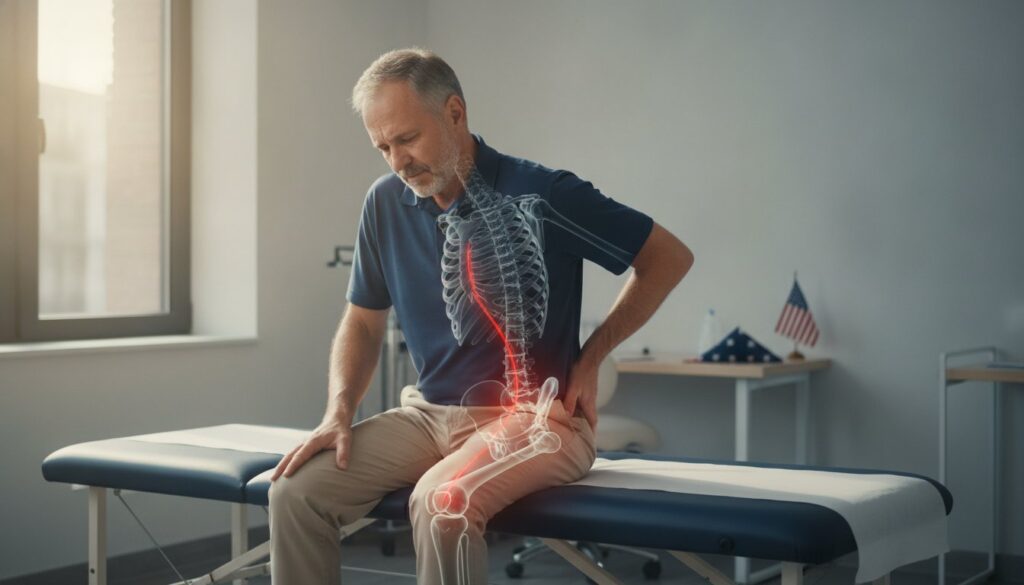
Did you know that your service-connected knee injury might be the hidden culprit behind the chronic back or hip pain you’ve been feeling for years? When you favor one leg to avoid pain, your body shifts its weight in ways that eventually wear down other joints. You aren’t alone in this struggle; over two million veterans currently receive VA compensation for knee-related issues. It’s frustrating when an initial rating feels like it only scratches the surface of your actual physical limitations, especially when you’re dealing with unexplained secondary pain that the VA hasn’t recognized yet. 🇺🇸
We understand that navigating 38 CFR § 3.310 and the rules for secondary service connection can feel overwhelming. This guide is designed to help you identify common secondary conditions to knee injury and explain how to document them for a successful claim. You’ll discover how your service-connected disability can lead to additional VA ratings and learn the specific steps to prove a medical nexus. We will also break down how a Disability Benefits Questionnaire (DBQ) supports your claim, ensuring your medical evidence reflects the total impact on your life and livelihood. Our goal is to provide the clarity you need to move forward with confidence.
Key Takeaways
- Understand the legal definitions under 38 CFR § 3.310, including how the VA distinguishes between conditions caused by or aggravated by your primary service-connected knee injury.
- Identify common secondary conditions to knee injury, such as lumbosacral strain and hip pain, which often result from a biomechanical chain reaction like an antalgic gait.
- Learn the connection between chronic knee pain and secondary issues like depression, anxiety, or gastrointestinal problems caused by long-term medication use.
- Discover why a detailed Disability Benefits Questionnaire (DBQ) is vital for providing the medical evidence and nexus required for a successful secondary claim.
- Explore how identifying these linked conditions can lead to a VA rating increase that more accurately reflects your total level of disability.
What Are VA Secondary Conditions to Knee Injuries?
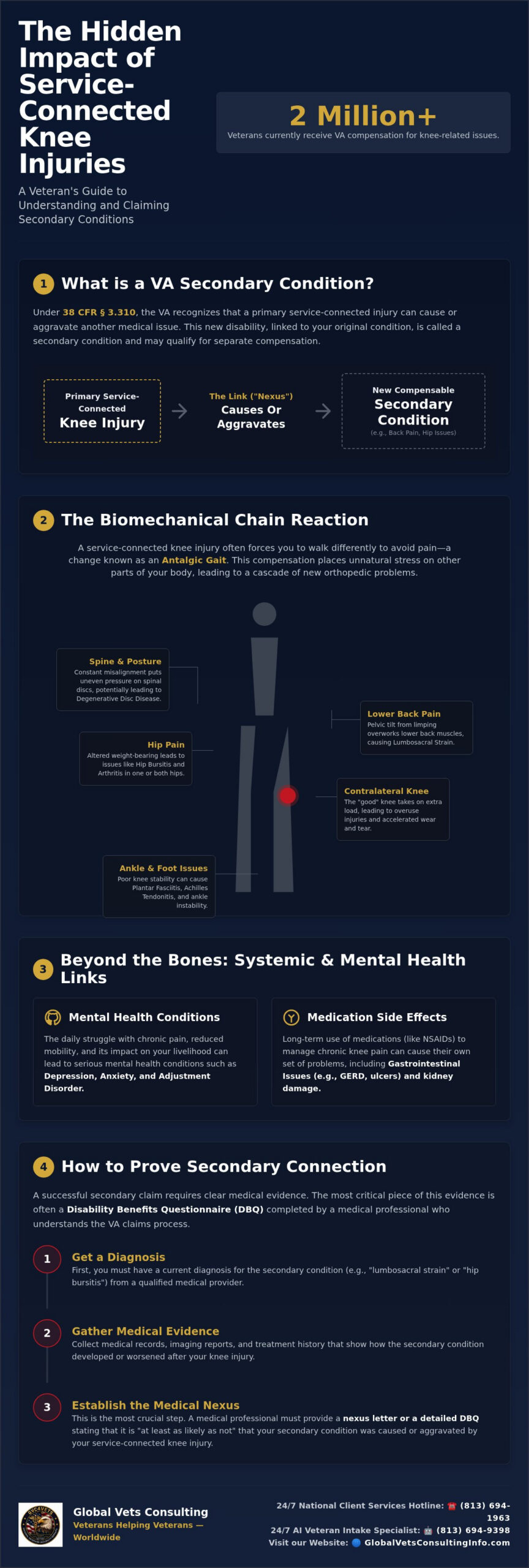
A secondary service connection allows you to receive compensation for a new disability that is linked to an existing, service-connected condition. Under 38 CFR § 3.310, the VA recognizes that a primary injury can cause or worsen another medical issue. For many, a service-connected knee isn’t just a leg problem; it’s the start of a physiological chain reaction. Identifying common secondary conditions to knee injury is often the key to moving toward a 100% P&T rating because it accounts for the total impact on your body. 🇺🇸
The VA looks for a clear “Chain of Causation” or a medical link between your knee and the new diagnosis. This link, known as a medical nexus, proves that your secondary condition wouldn’t exist, or wouldn’t be as severe, if it weren’t for your primary knee injury. For example, a veteran with chronic Patellofemoral Pain Syndrome might develop hip issues due to a change in their walking pattern. Establishing this link requires meticulous medical evidence to show how one condition triggered the other.
The Concept of Aggravation
You don’t always need the knee to cause the new condition from scratch. The VA also pays for “aggravation.” This means if you already had a minor back issue before service, but your service-connected knee injury made it significantly worse, you may qualify for a secondary rating. To succeed, you must provide medical evidence showing a clear increase in disability that goes beyond the natural progression of the original condition. Documentation is vital here to prove the knee was the specific factor that accelerated your pain.
Direct vs. Secondary Service Connection
The biggest advantage of a secondary claim is that you don’t need to prove a specific event happened during your time in uniform for the new condition. While a direct connection requires proof of an in-service injury, a secondary connection only requires proof that your current service-connected knee is the bridge to the new problem. Understanding this distinction is a vital part of the VA disability claims process step by step. 🇺🇸
Orthopedic Secondary Conditions: The Biomechanical Chain Reaction
When you suffer a service-connected knee injury, your body doesn’t just isolate the pain. It adapts. You start walking differently to protect the joint, a process medically known as an antalgic gait. This shift in mechanics is the primary reason for common secondary conditions to knee injury. By favoring one side, you place unnatural stress on your “good” leg, hips, and spine. Research into Altered Gait and Knee Osteoarthritis confirms that these biomechanical changes often lead to long-term joint degradation far from the original injury site.
The most frequent result of this overcompensation is lumbosacral strain, which is chronic lower back pain. As your pelvis tilts to accommodate a limp, your lower back muscles overwork to keep you upright. Similarly, your contralateral knee, the one you consider your “good” leg, often fails because it’s now performing the majority of the heavy lifting. Hip bursitis and arthritis are also frequent consequences of this altered weight-bearing. If you’re noticing these pains, learning about secondary claims education can help you understand how to link these new issues to your service-connected knee.
Lower Extremity Links: Foot and Ankle
Your feet are the foundation of your movement. When your knee doesn’t track correctly, you might develop plantar fasciitis or Achilles tendonitis. These aren’t separate, unrelated injuries; they’re direct results of your body trying to compensate for a lack of knee stability. Ankle instability also becomes a risk as your joints struggle to maintain balance on uneven ground while protecting a weak knee.
The Spine and Posture
Long-term gait changes can eventually lead to Degenerative Disc Disease in the spine. This occurs because the constant misalignment of your hips puts uneven pressure on your spinal discs. It’s a common scenario where a veteran with a 10% knee rating can eventually qualify for a 40% back rating once the full impact of their altered posture is properly documented. 🇺🇸
Systemic and Mental Health Conditions Secondary to Knee Pain
Chronic knee pain doesn’t stop at the joint. It often ripples through your entire system, affecting your mental health and internal organs. These are some of the most overlooked common secondary conditions to knee injury. When your mobility is restricted, the resulting isolation and frustration can lead to clinical depression or anxiety. If you’re struggling with the psychological impact of your physical limitations, using a DBQ for mental health conditions can help document how your service-connected injury has diminished your quality of life. 🇺🇸
Many veterans don’t realize that their digestive issues are actually linked to their knee pain. To manage chronic inflammation, you might rely on high doses of Non-Steroidal Anti-Inflammatory Drugs (NSAIDs) like ibuprofen or naproxen. Over time, these medications can irritate the gastrointestinal tract. This can lead to conditions like Gastroesophageal Reflux Disease (GERD) or Irritable Bowel Syndrome (IBS). The VA recognizes this connection, provided you can show a clear history of medication use for your service-connected knee.
There’s also a documented link between knee injuries and respiratory issues like sleep apnea. If your knee pain prevents you from maintaining an active lifestyle, it often leads to weight gain. This increase in body mass is a known risk factor for developing sleep apnea. By proving that your knee injury caused the weight gain that triggered your sleep apnea, you can establish a secondary service connection. If you’re ready to document these links, explore our secondary VA claims education to build a stronger case. 🇺🇸
The Medication Side Effect Path
To win a claim for digestive issues, your medical records must serve as a bridge. You need to show consistent, long-term use of prescribed pain relief. This documentation proves the medication wasn’t just for a one-time ailment, but a necessary treatment for your service-connected knee that ultimately caused secondary harm to your stomach or intestines.
Chronic Pain Syndrome
The VA also evaluates somatic symptom disorder or chronic pain syndrome. This happens when the brain’s response to persistent physical injury creates a separate, debilitating mental health condition. These cases are complex and require a professional medical opinion to explain the connection between the physical trauma and the psychological symptoms. Meticulous documentation is the only way to ensure the VA understands the full scope of your disability.
How to Prove Secondary Connection Using a DBQ
Evidence is the backbone of your case. A Disability Benefits Questionnaire (DBQ) is a standardized form designed to ensure that the VA receives the exact medical information needed to rate your condition accurately. When you’re documenting common secondary conditions to knee injury, a completed DBQ provides the ‘Fully Developed’ medical evidence that can prevent delays in your claim. If you’re unfamiliar with these forms, you can learn more about What is a DBQ for VA Claims? to see how they streamline the process. 🇺🇸
While the VA may schedule a Compensation and Pension (C&P) exam, a private DBQ is often more thorough. C&P examiners often work under tight schedules and might miss the subtle biomechanical links between your knee and your back pain. A private provider has the time to perform a detailed range-of-motion test using a goniometer, ensuring all common secondary conditions to knee injury are captured with precision. As of May 2026, the VA’s claims-processing accuracy has increased to 94.02%, but that accuracy depends entirely on the quality of the evidence you submit.
The Power of a Nexus Letter
A DBQ tells the VA what your current symptoms are, but a nexus letter explains why they exist. To win a secondary claim, a medical professional must state that your new condition is “at least as likely as not” caused or aggravated by your service-connected knee injury. This letter connects the dots, whether it’s explaining how your altered gait damaged your spine or how your prescribed NSAIDs caused GERD. Without this clear medical link, the VA may view your new diagnosis as an unrelated health issue.
Submitting Your Secondary Claim
Once your medical evidence is ready, you can file for a VA disability rating increase by adding your secondary conditions. The Fully Developed Claim (FDC) path allows you to submit all your medical evidence and nexus letters at the same time you file, which often leads to faster processing. This proactive approach shows the VA that you’ve done the heavy lifting, making it easier for them to grant the rating you’ve earned. 🇺🇸
Secure the VA Disability Rating You’ve Earned
Your service-connected knee injury is often just the beginning of a larger health struggle. By identifying common secondary conditions to knee injury, you can ensure your VA rating reflects the total impact on your body and quality of life. From the biomechanical strain on your hips and back to systemic issues like GERD or sleep apnea, these connections are medically valid and compensable. Success depends on submitting “Fully Developed” evidence that clearly links these new diagnoses to your primary injury through precise documentation and a strong medical nexus.
We are veteran-owned and operated, serving as specialists in secondary service connection documentation. Our team understands the hurdles you face and provides the education needed to navigate the system with confidence. You don’t have to wait for business hours to start; our 24/7 AI Veteran Intake Specialist is ready to assist you immediately. Get your DBQ started today with Global Vets Consulting and take the next step toward a more accurate disability rating. You’ve served your country with honor, and now it’s time to ensure your benefits reflect the full scope of your sacrifice.
Frequently Asked Questions
Can I claim back pain secondary to a knee injury?
Yes, you can claim back pain secondary to a knee injury if your service-connected condition has caused a change in your walking mechanics. This is often documented as an antalgic gait, which forces your lower back muscles to overcompensate for the lack of stability in your knee. Providing medical evidence of this biomechanical link is the most effective way to secure a secondary service connection for lumbosacral strain. 🇺🇸
What is the most common secondary condition to knee pain?
Lumbosacral strain is widely recognized as the most frequent among the common secondary conditions to knee injury because of the direct impact on pelvic alignment. When you favor one leg, your hips tilt, which places uneven pressure on your spinal discs and lower back muscles. Other frequent secondary conditions include hip arthritis and issues with the opposite knee, which often wears down from carrying the majority of your body weight. 🇺🇸
Do I need a new nexus letter for a secondary condition?
Yes, a new nexus letter is a critical requirement for any secondary condition claim to bridge the gap between your primary and secondary diagnoses. This letter must contain the specific phrase “at least as likely as not” to satisfy the VA’s legal standards for service connection. It should clearly explain the medical rationale, such as how chronic knee instability led to a specific secondary orthopedic or systemic issue.
Can GERD be service-connected to a knee injury?
Yes, GERD can be service-connected as a secondary condition if it results from the medications used to treat your primary knee injury. Chronic use of NSAIDs like naproxen or ibuprofen can cause significant damage to the lining of your stomach and esophagus. To win this claim, your medical records must show that these medications were prescribed or recommended for your service-connected knee and led to your current digestive symptoms. 🇺🇸
What if the VA denied my secondary claim for lack of evidence?
You should immediately review the VA’s Rating Decision letter to understand exactly why your claim was denied, as it usually points to a missing nexus or insufficient evidence. If the denial was due to a lack of evidence, you can submit a supplemental claim with a private DBQ or a more detailed medical opinion. This new evidence should explicitly address the “chain of causation” for common secondary conditions to knee injury that the initial examiner may have overlooked.

Article by
Willie Daniel
Willie Daniel is the Founder and Chief Executive Officer (CEO) of Global Vets Consulting (GVC) – National Veterans Disability Services, a veteran-led educational and medical evidence support organization dedicated to helping veterans better understand VA disability rating increases, DBQ medical evidence, secondary claims education, and C&P examination preparation.
He is a retired U.S. Army Medical Service Corps Officer with more than 27 years of honorable military service, a decorated Iraq combat veteran, and a retired federal official with the U.S. Department of Veterans Affairs. Throughout his military and federal career, Willie Daniel served in leadership, healthcare administration, operational, and veteran-support roles focused on improving services and support systems for servicemembers, veterans, and their families.
Drawing from decades of military leadership, healthcare administration, veteran advocacy, and federal government experience, Willie Daniel brings a practical, veteran-centered perspective to Global Vets Consulting’s educational articles, AI-powered veteran resources, video education initiatives, and outreach programs. His experience navigating military systems, medical documentation processes, and veteran-related administrative operations provides valuable insight into many of the challenges veterans face when seeking to better understand VA disability rating criteria, medical evidence, documentation strategies, and secondary condition education.
Through GVC’s “Veterans Helping Veterans” mission, his focus is on delivering clear, educational, and easy-to-understand information designed to empower veterans with knowledge, resources, and educational tools that may help them make more informed decisions regarding their individual VA disability journeys.
The information provided through GVC is intended for educational and informational purposes only and should not be considered legal or medical advice.
Disclaimer
Disclaimer: Global Vets Consulting, LLC (“GVC”) is a veteran-led educational and medical evidence support organization. GVC is not a law firm, is not a Veterans Service Organization (VSO), and is not affiliated with the U.S. Department of Veterans Affairs (VA) or any government agency.
Global Vets Consulting does not provide legal advice, medical advice, medical treatment, or healthcare services. GVC does not prepare, file, or submit VA disability claims on behalf of veterans. All information provided through this website, blog articles, videos, educational materials, AI tools, dashboards, templates, and communications is intended solely for general educational and informational purposes.
Veterans are encouraged to consult with accredited representatives, licensed attorneys, qualified medical providers, or Veterans Service Organizations regarding their specific legal, medical, or VA-related matters. VA disability decisions, ratings, and outcomes are determined solely by the U.S. Department of Veterans Affairs based on applicable laws, regulations, medical evidence, and individual circumstances. Past results do not guarantee future outcomes.