
What if the most powerful tool for your claim isn’t just your diagnosis, but the specific way your symptoms are translated onto paper? You’ve likely felt the frustration of being treated like a number in a bureaucratic system, fearing that a brief exam won’t capture the daily reality of your mental health. It’s common to worry that the VA might misunderstand your struggle. You might fear they’ll overlook the critical details in your dbq for anxiety, leading to a rating that doesn’t reflect your true functional impairment 🇺🇸.
We believe your medical evidence should speak as loudly as your service did. This guide teaches you how to use a Disability Benefits Questionnaire to accurately document your symptoms and secure the disability rating you’ve earned. You’ll learn how the 2026 Cost-of-Living Adjustments and updated rating criteria impact your compensation; we’ll also provide a step-by-step path to navigating the process with steady confidence. By understanding how to present thorough, professional documentation, you can reduce the stress of the evidence-gathering phase and move toward a fair result with peace of mind.
Key Takeaways
- Understand how a DBQ translates your mental health symptoms into the standardized medical evidence required for a successful VA claim.
- Identify the specific criteria the VA uses to evaluate social and occupational impairment to determine your rating percentage.
- Learn how a private dbq for anxiety can provide a more comprehensive view of your medical history than a standard C&P exam alone.
- Discover how medical evidence education empowers you to present a thorough and accurate case for the VA rating increase you earned.
What is a DBQ for Anxiety and Why Does it Matter? 🇺🇸
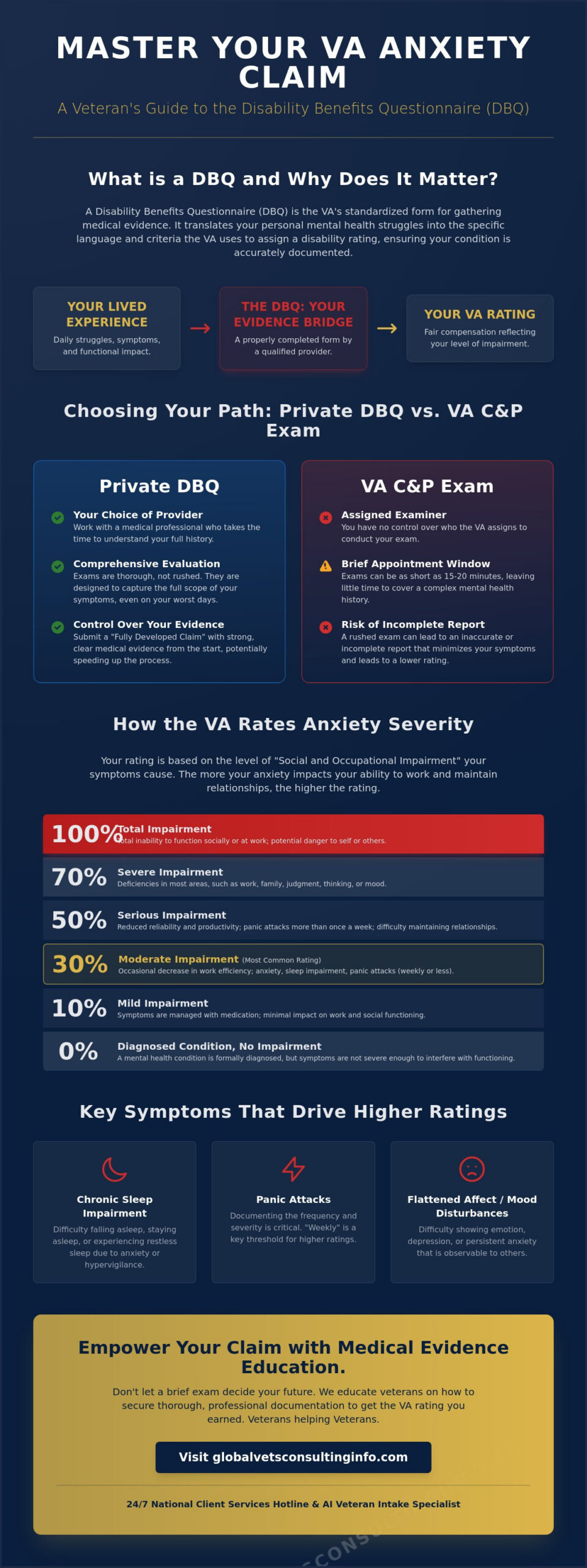
A Disability Benefits Questionnaire (DBQ) is a standardized document designed to streamline how medical evidence is collected and reviewed for your VA disability claim. Specifically, the dbq for anxiety acts as the primary evidence tool for mental health ratings by translating your personal struggles into a format the VA can process. It allows your healthcare provider to document symptoms, their frequency, and the overall severity of your condition using the clinical standards found in the DSM-5. This ensures the medical professional speaks the VA’s language, which is essential for a successful outcome.
When you file for benefits, the burden of proof rests on the quality of your documentation. The Veterans Benefits Administration (VBA) uses these forms to ensure every veteran is evaluated against the same criteria. Without a clear DBQ, your symptoms might be overlooked or minimized during the review process. A precise form ensures your story isn’t lost in the shuffle of a massive bureaucratic system.
The Role of the DBQ in Your VA Claim
The DBQ acts as a bridge between your clinical diagnosis and your final VA rating percentage. It provides a structured roadmap for the examiner to follow, ensuring they check for specific functional impairments that lead to higher ratings. If your dbq for anxiety is completed thoroughly before you submit your paperwork, it can support a “Fully Developed Claim” (FDC). This often results in faster processing times because the VA doesn’t have to spend months searching for missing medical records.
Anxiety Disorders Covered by the DBQ
The VA uses one general DBQ for most mental health conditions, excluding PTSD and eating disorders. This form covers a wide range of diagnoses, including:
- Generalized Anxiety Disorder (GAD)
- Panic Disorder and Agoraphobia
- Social Anxiety Disorder
- Specific Phobias
It’s vital to remember that the VA typically assigns one combined rating for mental health, even if you have multiple diagnoses. They focus on how your collective symptoms impact your daily life rather than the specific name of the disorder. This approach prioritizes your functional ability over a simple label.
Inside the Form: How the VA Rates Anxiety Severity
The VA doesn’t just want to know you have a diagnosis; they want to know how that diagnosis breaks your day. Your rating depends on the level of “Social and Occupational Impairment” documented by your provider. This is the core of the dbq for anxiety. The VA uses a specific scale: 0%, 10%, 30%, 50%, 70%, and 100%. While the most common rating for anxiety is 30%, your specific symptoms determine where you land on this spectrum. Ultimately, your ability to work and maintain a job is the number one driver of higher disability ratings.
The Social and Occupational Impairment Section
In this part of the form, the examiner selects a checkbox that describes your level of functioning. There’s a massive difference between “mild” impairment and “total” occupational and social impairment. It’s critical that your doctor documents your worst days. If you’re having a good day during the exam but normally struggle to leave the house, the form must reflect your typical severity. This ensures the dbq for anxiety accurately portrays your need for a VA rating increase.
Common Symptoms Documented for Anxiety
The VA looks for specific markers of distress. These include chronic sleep impairment, panic attacks, and a “flattened affect.” You can find more details in the VA’s information on anxiety disorders. When filling out the form, your provider should focus on the frequency, severity, and duration of these symptoms. For example, documenting that panic attacks occur weekly rather than “occasionally” provides the precise evidence needed for a fair evaluation. Understanding these nuances is a key part of mental health ratings education.
Private DBQs vs. C&P Exams: Choosing Your Path
When navigating a VA disability claim, you generally face two routes for medical evidence: the VA-ordered Compensation and Pension (C&P) exam or a private Disability Benefits Questionnaire. The VA typically assigns a contracted examiner for a C&P exam, and you often have no say in who reviews your case. These examiners may only spend 15 to 20 minutes with you, which is rarely enough time to discuss a complex mental health history. This brief window often leads to incomplete reports that fail to capture the full scope of your condition. Choosing a private dbq for anxiety allows you to work with a provider who takes the time to understand your complete history. You can learn more about the benefits of using a private DBQ for your VA claim to see how it strengthens your case.
Why Private Medical Evidence is Often Stronger
Continuity of care is the biggest advantage of private evidence. A provider who has reviewed your long-term records can offer a detailed narrative that a one-time VA examiner simply can’t match. Private DBQs help prevent common VA claim mistakes, such as a lack of evidence or vague symptom descriptions that lead to denials. By presenting a thorough document, you ensure the VA sees the reality of your worst days rather than just a snapshot of how you feel during a short appointment. If you’re looking for clarity on this process, our independent medical evidence education provides the roadmap you need.
What to Do if the VA Still Schedules a C&P Exam
Even if you submit a private dbq for anxiety, the VA might still schedule a C&P exam. You must attend this appointment. Failing to show up can result in an immediate denial of your claim. However, your private DBQ remains a critical piece of evidence in your file. If the C&P examiner’s report is unfavorable or misses key functional impairments, your private documentation serves as a formal rebuttal. It forces the VA to reconcile the conflicting medical opinions, which often gives more weight to the more thorough and detailed private report.
Securing Your DBQ: How Global Vets Consulting Supports You 🌎
We provide the medical documentation education you need to support your claim with confidence. Our “Veterans Helping Veterans” approach ensures your paperwork accurately reflects your service history because we’ve been in your boots. We focus on technical accuracy to ensure your evidence meets the VA’s high standards. By offering a clear path forward, we help you move from a place of confusion to a position of steady confidence. Our mission is to ensure no veteran feels like just another number in a bureaucratic system.
Streamlining the evidence-gathering phase is the most effective way to reduce the stress of the VA disability claims process. You don’t have to wait for traditional business hours to get the help you need. You can access support through our 24/7 National Client Services Hotline or engage with our AI Veteran Intake Specialist at any time. This constant availability ensures you can take action on your claim whenever you’re ready.
Expert Preparation for Mental Health Ratings
We focus on meticulousness to ensure your dbq for anxiety is compliant and thorough. A well-prepared form prevents common pitfalls like vague symptom descriptions that lead to lower ratings. If you’re linking anxiety to other service-connected conditions, we provide the necessary educational resources. For example, many veterans find success by understanding VA claims for depression secondary to tinnitus and how these conditions intersect on a medical level.
Ready to Take the Next Step?
Don’t leave your rating to chance with a rushed exam. Professional preparation for your dbq for anxiety is an investment in your long-term stability and peace of mind. We’re ready to help you document your symptoms accurately so you can secure the benefits you earned through your service. Reach out to our team today to start your journey with a partner who understands the mission.
🇺🇸 Global Vets Consulting: Worldwide Support
- 📞 24/7 National Client Services Hotline
- 🤖 24/7 AI Veteran Intake Specialist
- 🌐 Contact Global Vets Consulting Today
Secure the VA Rating You’ve Earned Today
Navigating the VA system doesn’t have to feel like an uphill battle against a faceless bureaucracy. By understanding how a dbq for anxiety translates your daily struggles into actionable medical evidence, you take control of your claim’s narrative. The VA prioritizes occupational and social impairment above all else. Providing a thorough, private document ensures that your examiner sees the full scope of your condition rather than a 15 minute snapshot. Meticulous preparation is the most effective way to reduce the stress of the evidence-gathering phase and move toward a fair rating.
As a veteran-owned and operated team since 2021, we specialize in mental health ratings education to help you navigate these complexities. We’re committed to your success and offer round-the-clock support through our 24/7 National Client Services Hotline and AI Veteran Intake Specialist. It’s time to stop feeling like a number and start getting the results your service deserves. Get Your Professional DBQ Started with Global Vets Consulting. You served your country with honor; now, let us help you secure your future with steady confidence.
Frequently Asked Questions
Can I fill out my own DBQ for anxiety?
No, you cannot fill out your own form. A licensed medical professional must complete the document to ensure it meets clinical and regulatory standards. While you can provide your doctor with personal notes about your worst days, the final medical assessment must come from their professional expertise. Submitting a self-completed form will result in the VA rejecting the document as valid medical evidence for your claim.
Will the VA accept a DBQ from a private doctor in 2026?
Yes, the VA is legally obligated to accept private DBQs in 2026. This requirement was established by the Isakson and Roe Act of 2020. However, the VA has implemented robust fraud detection to identify poorly documented submissions. Your dbq for anxiety must be meticulous and backed by your existing medical records to withstand this increased scrutiny. This ensures your private evidence remains a powerful tool for a fair rating.
What is the difference between a DBQ for anxiety and a DBQ for PTSD?
The distinction is found in the specific form and the evidentiary requirements. Anxiety is rated using the general Mental Disorders DBQ, while PTSD has a unique questionnaire. A PTSD claim requires a documented stressor event, whereas anxiety focuses on your clinical diagnosis and service connection. Despite these differences, the VA uses the same General Rating Formula for Mental Disorders to determine your final disability percentage based on functional impairment.
How much does it cost to get a private DBQ for an anxiety claim?
Private DBQ costs fluctuate based on the medical provider’s fees and the depth of your records. It’s important to remember that the VA won’t reimburse you for these private medical expenses. We advocate for transparency and use a flat-rate pricing model for our educational resources rather than a commission-based system. This approach protects your future benefits while ensuring you receive the high-quality documentation education necessary for a successful outcome.
What happens if my DBQ and C&P exam results are different?
If your private evidence and the VA’s exam results clash, the VA must evaluate which report is more convincing. A detailed dbq for anxiety from a doctor who knows your history often carries significant weight against a rushed C&P exam. If the evidence is in equipoise, meaning it’s equally balanced, VA regulations require the rater to decide in your favor. This is known as the benefit of the doubt rule.

Article by
Willie Daniel
Willie Daniel is the Founder and Chief Executive Officer (CEO) of Global Vets Consulting (GVC) – National Veterans Disability Services, a veteran-led educational and medical evidence support organization dedicated to helping veterans better understand VA disability rating increases, DBQ medical evidence, secondary claims education, and C&P examination preparation.
He is a retired U.S. Army Medical Service Corps Officer with more than 27 years of honorable military service, a decorated Iraq combat veteran, and a retired federal official with the U.S. Department of Veterans Affairs. Throughout his military and federal career, Willie Daniel served in leadership, healthcare administration, operational, and veteran-support roles focused on improving services and support systems for servicemembers, veterans, and their families.
Drawing from decades of military leadership, healthcare administration, veteran advocacy, and federal government experience, Willie Daniel brings a practical, veteran-centered perspective to Global Vets Consulting’s educational articles, AI-powered veteran resources, video education initiatives, and outreach programs. His experience navigating military systems, medical documentation processes, and veteran-related administrative operations provides valuable insight into many of the challenges veterans face when seeking to better understand VA disability rating criteria, medical evidence, documentation strategies, and secondary condition education.
Through GVC’s “Veterans Helping Veterans” mission, his focus is on delivering clear, educational, and easy-to-understand information designed to empower veterans with knowledge, resources, and educational tools that may help them make more informed decisions regarding their individual VA disability journeys.
The information provided through GVC is intended for educational and informational purposes only and should not be considered legal or medical advice.
Disclaimer
Disclaimer: Global Vets Consulting, LLC (“GVC”) is a veteran-led educational and medical evidence support organization. GVC is not a law firm, is not a Veterans Service Organization (VSO), and is not affiliated with the U.S. Department of Veterans Affairs (VA) or any government agency.
Global Vets Consulting does not provide legal advice, medical advice, medical treatment, or healthcare services. GVC does not prepare, file, or submit VA disability claims on behalf of veterans. All information provided through this website, blog articles, videos, educational materials, AI tools, dashboards, templates, and communications is intended solely for general educational and informational purposes.
Veterans are encouraged to consult with accredited representatives, licensed attorneys, qualified medical providers, or Veterans Service Organizations regarding their specific legal, medical, or VA-related matters. VA disability decisions, ratings, and outcomes are determined solely by the U.S. Department of Veterans Affairs based on applicable laws, regulations, medical evidence, and individual circumstances. Past results do not guarantee future outcomes.