

What if the most disabling part of your service-connected back injury isn’t the physical pain, but the mental weight it forces you to carry every single day? It’s exhausting to deal with the VA when they seem to treat your body and mind as two separate entities. You know that the sleepless nights and social isolation aren’t a separate issue. They’re a direct result of the constant, grinding agony in your joints or spine. Developing depression secondary to chronic pain is a reality for thousands of veterans, yet many feel like their mental health struggles are ignored during the claims process.
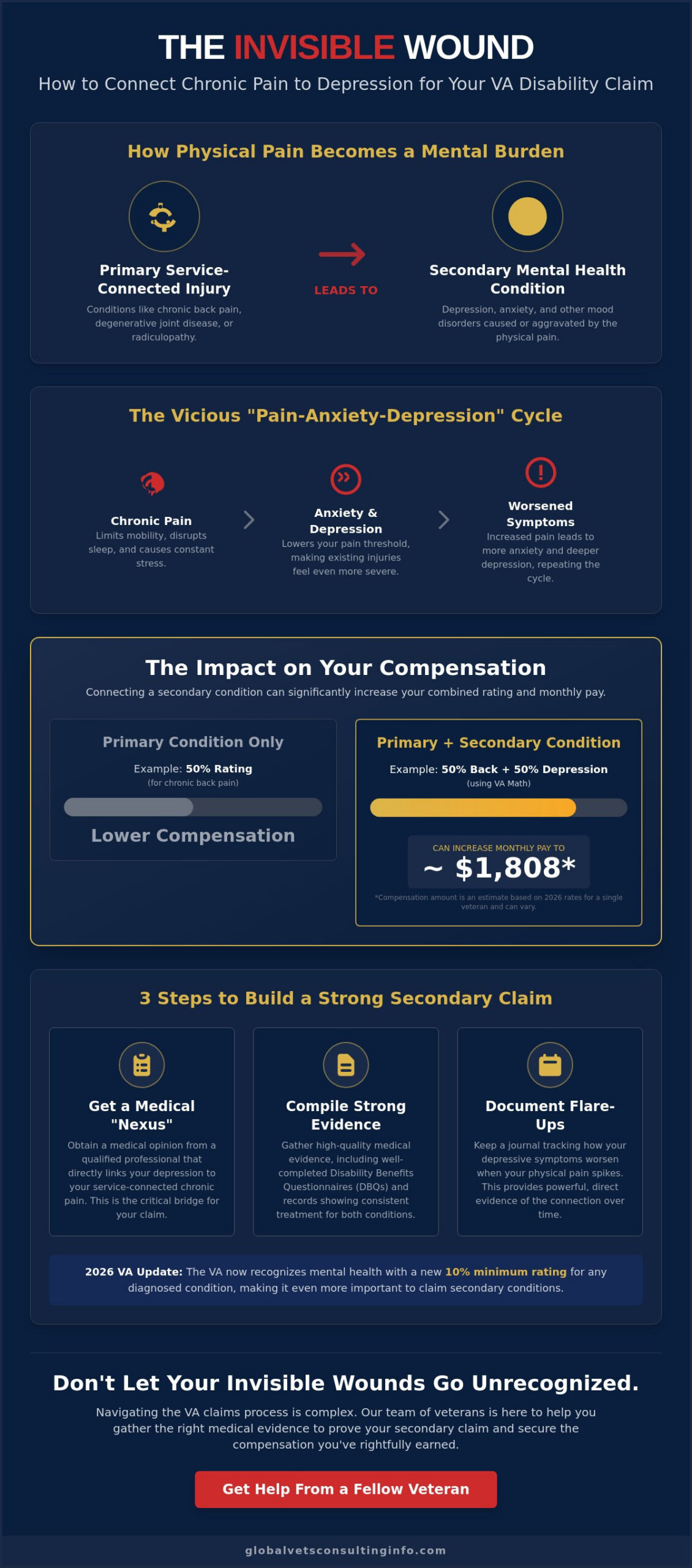
You can successfully link these conditions to secure the compensation you’ve earned. With the 2026 VA rating changes now in effect, including the new 10% minimum for diagnosed mental health conditions, there’s a clearer path to a higher combined rating. For instance, adding a 50% rating for depression secondary to a 50% back condition can increase your monthly compensation to approximately $1,808. This guide shows you how to use medical evidence and Disability Benefits Questionnaires (DBQs) to prove that secondary connection and use the updated 2026 regulations to your advantage.
Key Takeaways
- Understand how primary service-connected conditions like degenerative joint disease or radiculopathy can provide the foundation for a secondary mental health claim.
- Learn the essential steps to prove depression secondary to chronic pain by establishing a clear medical nexus between your physical and mental health.
- Discover how high-quality medical evidence and Disability Benefits Questionnaires (DBQs) can strengthen your case for a VA rating increase.
- Explore the 2026 shift toward rating mental health based on functional impairment and how this may lead to more accurate disability compensation.
- Find out how veteran-led consulting can help you navigate the complexities of documentation to ensure your claims reflect the full impact of your service.
Understanding the Link Between Chronic Pain and Depression
Living with constant physical agony does more than just hurt your joints; it fundamentally alters your brain’s chemistry. Medical research indicates that persistent pain signals can actually rewire the mood regulation centers of the brain, making it harder for your body to produce “feel-good” chemicals like dopamine. In the context of VA claims, secondary depression is a mental health condition that is caused or aggravated by a primary service-connected physical disability. When you are dealing with depression secondary to chronic pain, the VA is required to recognize that your mental health struggles are a direct consequence of your service-connected injury.
This connection is often called the “invisible wound.” When a back injury or knee condition limits your mobility, it naturally leads to social isolation. You might find yourself unable to participate in family activities, attend community events, or even maintain a regular work schedule. This loss of function creates a vacuum where clinical depressive symptoms thrive. Data suggests that veterans suffering from musculoskeletal injuries are at a much higher risk of developing mood disorders compared to those without chronic physical limitations. Understanding Chronic Pain and Depression is a vital step in acknowledging that your mental health is just as service-connected as the physical trauma that started the cycle.
The Bi-Directional Relationship
The link between physical pain and mental health is rarely a one-way street. Chronic pain frequently disrupts your ability to get restorative sleep, and chronic sleep deprivation is one of the fastest ways to trigger a depressive episode. This creates a “Pain-Anxiety-Depression” cycle that is difficult to break without professional intervention. The VA must look at the whole veteran because these symptoms don’t exist in a vacuum:
- Pain triggers anxiety about future mobility and financial stability.
- Anxiety leads to muscle tension, which increases physical pain levels.
- Depression lowers your overall pain threshold, making existing injuries feel more severe.
How the VA Views Depression as a Secondary Condition
The VA system acknowledges that a service-connected injury often leads to new, distinct medical issues over time. This is known as a secondary service connection. If your primary disability, such as degenerative joint disease, radiculopathy, or chronic back pain, causes your mental health to decline, that secondary condition is eligible for compensation. Establishing depression secondary to chronic pain requires a clear medical link. You must prove that your depression is at least as likely as not caused or worsened by your physical limitations.
A successful claim relies on a “Nexus,” which is the medical bridge between your physical pain and your mental health. Scientific research from leading institutions highlights the biological link between pain and depression, suggesting that chronic inflammation from injuries can trigger depressive symptoms. When you follow the VA disability claims process step by step, you can build a foundation of evidence that demonstrates this connection clearly to the rater.
Aggravation vs. Direct Causation
Many veterans worry that a pre-existing diagnosis will disqualify them from receiving benefits. This is a common misconception. If you struggled with mild depression before your military service, but your service-connected chronic pain has significantly worsened those symptoms, you can still qualify under the “aggravation” rule. The VA is responsible for the portion of your disability that was made worse by your service-connected physical injuries. Documenting your baseline health versus your current state is vital for this distinction.
Documenting the Flare-up Cycle
Your mental health often mirrors your physical health in a predictable cycle. When your back goes out or your nerve pain spikes, your mood likely drops alongside your mobility. Tracking these “flare-ups” provides powerful evidence for your claim. Showing that your depressive symptoms intensify exactly when your physical pain is at its worst helps the VA see the direct correlation. If you are unsure how to present this evidence, secondary VA claims education can help you organize your medical history effectively.
Gathering Medical Evidence for Your Secondary Claim
Winning a claim for depression secondary to chronic pain is rarely about your personal testimony alone. The VA rater needs objective, standardized data to approve a rating. This is where high-quality medical evidence becomes the backbone of your file. While your treatment records show you’re struggling, they often lack the specific formatting required for a disability rating. Using a private Disability Benefits Questionnaire (DBQ) is a strategic move because it allows a qualified provider to document your symptoms using the exact criteria the VA rater uses. You can learn how to use a DBQ for a VA disability rating increase to ensure your mental health symptoms are categorized correctly from the start.
While the DBQ rates the severity of your condition, an Independent Medical Opinion (IMO) establishes the legal link. Research from the NIH explains how chronic pain affects mental health by altering brain chemistry through constant physiological stress. An IMO uses this clinical science to state that your depression is “at least as likely as not” caused by your service-connected physical pain. Don’t overlook lay evidence, either. “Buddy statements” from a spouse or fellow veteran provide the human context that medical charts often miss. They can describe how you’ve withdrawn from your hobbies or how your pain-induced irritability affects your relationships.
The Power of a Mental Health DBQ
The VA evaluates mental health conditions based on “Social and Industrial Impairment.” A properly completed DBQ ensures every symptom, from sleep disturbances to difficulty with complex tasks, is clearly checked. It’s vital that this documentation reflects your worst days. If you tell a doctor you’re “doing okay” during an evaluation because you’re having a rare good day, you risk an inaccurate rating. The goal is to provide a comprehensive snapshot of your life when the pain is at its peak. If you’re ready to strengthen your medical file, explore our independent medical evidence education to get started.
Navigating the Rating Process with Global Vets Consulting 🌐
Navigating the VA’s bureaucracy can feel like a second full-time job. At Global Vets Consulting, we operate on a “Veterans Helping Veterans” ethos, meaning we understand the frustration of physical injuries that lead to mental health struggles. We specialize in providing the education and administrative support you need to prove depression secondary to chronic pain with precision. Our mission-driven approach focuses on high-quality medical documentation, ensuring your file speaks the language of the VA rater. This partnership aims to reduce your anxiety by offering a clear, predictable path toward the benefits you earned through your service.
We streamline the evidence-gathering process by helping you understand what is a DBQ and how it serves as a roadmap for your claim. By focusing on meticulousness, we help you avoid common pitfalls that lead to denials or underrated conditions. If you have questions at any stage or feel overwhelmed by the paperwork, our 24/7 National Client Services Hotline is always available. Support is only a phone call away 📞.
Your Path to an Accurate Rating
The journey to an accurate rating begins with a thorough assessment of how your conditions interact. Secondary claims require a high level of detail because you must demonstrate the direct link between your physical pain and your mental state. Our process is designed for clarity and efficiency. We use a 24/7 AI Veteran Intake Specialist to gather your initial information quickly, allowing us to move forward with your education and resource awareness without delay. This structured flow ensures that every piece of information leads toward a concrete next step in your VA disability claim.
Whether you are seeking a VA rating increase or filing for mental health ratings for the first time, our goal is to empower you with the right tools. We provide the educational resources needed for musculoskeletal claims and mental health documentation so you can approach your C&P exam with confidence. You’ve served your country; now let us help you secure the compensation you deserve.
🇺🇸 Global Vets Consulting
📞 24/7 National Client Services Hotline: 1-800-482-2173
🌐 Website: GlobalVetsConsultingInfo.com
Secure Your Earned Benefits Today 🇺🇸
Your physical injuries shouldn’t be the only thing the VA recognizes. By establishing a clear medical nexus and utilizing standardized documentation like DBQs, you can successfully link your mental health struggles to your service-connected injuries. The 2026 rating changes prioritize functional impairment, making it more important than ever to have meticulous medical evidence that accurately reflects your daily life. You’ve already done the hard work of serving; now it’s time to ensure your disability rating matches the reality of your health.
Global Vets Consulting is veteran-owned and operated since 2021. We specialize in Mental Health and Secondary Claim DBQs to ensure your medical file is comprehensive and technically accurate. If you’re struggling with depression secondary to chronic pain, don’t wait for the system to catch up to your needs. Our team is here to guide you through every step of the documentation process with the respect and expertise you deserve.
Start your intake with our 24/7 AI Veteran Specialist today to begin your journey toward an accurate rating. Our 24/7 National Client Services Hotline is always available if you have questions. You’ve fought for your country; now let us stand as your partner in securing the compensation you’ve earned.
Frequently Asked Questions
Can I claim depression secondary to back pain?
Yes, you can certainly claim depression as a secondary condition to back pain. The VA recognizes that chronic physical limitations from injuries like herniated discs or degenerative disc disease often lead to social isolation and a loss of quality of life. These factors are direct triggers for clinical depression, making the mental health condition eligible for service connection under 38 C.F.R. § 3.310.
What is the VA rating for depression secondary to chronic pain?
The VA rates depression secondary to chronic pain using the same General Rating Formula for Mental Disorders as primary conditions, with possible ratings of 10%, 30%, 50%, 70%, or 100%. As of the 2026 updates, the VA has eliminated the 0% rating for service-connected mental health conditions, meaning a 10% rating is now the minimum. Your specific percentage depends on the level of social and industrial impairment documented in your medical evidence.
Do I need a new C&P exam for a secondary depression claim?
You should expect the VA to schedule a new Compensation and Pension (C&P) examination specifically for your mental health claim. Even if you have a high rating for your physical pain, a mental health professional must evaluate the severity of your depressive symptoms separately. Submitting a private Disability Benefits Questionnaire (DBQ) beforehand can help ensure the VA examiner has a comprehensive view of your symptoms before the appointment begins.
How do I prove my depression is caused by my service-connected injury?
Proving the link requires a medical nexus, which is a professional opinion stating your depression is “at least as likely as not” caused by your physical pain. You must provide evidence showing that your mental health began to decline as a direct result of the limitations caused by your primary injury. This is often achieved through a combination of treatment records, an Independent Medical Opinion (IMO), and lay statements from family members who have witnessed your behavioral changes.
What happens if my primary pain condition rating increases?
An increase in your primary pain rating doesn’t automatically raise your secondary depression rating, but it does strengthen your overall case. When the VA acknowledges that your physical pain has worsened, it provides a logical basis for why your mental health may also be declining. If your physical condition becomes more debilitating, it’s often an appropriate time to submit evidence for a VA rating increase for your secondary depression as well.

Article by
Willie Daniel
Willie Daniel is the Founder and Chief Executive Officer (CEO) of Global Vets Consulting (GVC) – National Veterans Disability Services, a veteran-led educational and medical evidence support organization dedicated to helping veterans better understand VA disability rating increases, DBQ medical evidence, secondary claims education, and C&P examination preparation.
He is a retired U.S. Army Medical Service Corps Officer with more than 27 years of honorable military service, a decorated Iraq combat veteran, and a retired federal official with the U.S. Department of Veterans Affairs. Throughout his military and federal career, Willie Daniel served in leadership, healthcare administration, operational, and veteran-support roles focused on improving services and support systems for servicemembers, veterans, and their families.
Drawing from decades of military leadership, healthcare administration, veteran advocacy, and federal government experience, Willie Daniel brings a practical, veteran-centered perspective to Global Vets Consulting’s educational articles, AI-powered veteran resources, video education initiatives, and outreach programs. His experience navigating military systems, medical documentation processes, and veteran-related administrative operations provides valuable insight into many of the challenges veterans face when seeking to better understand VA disability rating criteria, medical evidence, documentation strategies, and secondary condition education.
Through GVC’s “Veterans Helping Veterans” mission, his focus is on delivering clear, educational, and easy-to-understand information designed to empower veterans with knowledge, resources, and educational tools that may help them make more informed decisions regarding their individual VA disability journeys.
The information provided through GVC is intended for educational and informational purposes only and should not be considered legal or medical advice.
Disclaimer
Disclaimer: Global Vets Consulting, LLC (“GVC”) is a veteran-led educational and medical evidence support organization. GVC is not a law firm, is not a Veterans Service Organization (VSO), and is not affiliated with the U.S. Department of Veterans Affairs (VA) or any government agency.
Global Vets Consulting does not provide legal advice, medical advice, medical treatment, or healthcare services. GVC does not prepare, file, or submit VA disability claims on behalf of veterans. All information provided through this website, blog articles, videos, educational materials, AI tools, dashboards, templates, and communications is intended solely for general educational and informational purposes.
Veterans are encouraged to consult with accredited representatives, licensed attorneys, qualified medical providers, or Veterans Service Organizations regarding their specific legal, medical, or VA-related matters. VA disability decisions, ratings, and outcomes are determined solely by the U.S. Department of Veterans Affairs based on applicable laws, regulations, medical evidence, and individual circumstances. Past results do not guarantee future outcomes.