
To establish service connection for a skin condition, VA generally looks for a current diagnosis, an in-service event, exposure, or onset, and a medical link between the condition and service, unless a presumption applies. An in-service diagnosis is not required: a skin condition diagnosed after active duty may still qualify. Dermatology VA claims may also involve presumptive rules for certain conditions and exposures, so both your service history and medical evidence matter.
It’s understandable to feel uncertain about how VA will evaluate a changing or difficult-to-document skin condition. This guide explains how service connection and ratings work, what to expect at a Compensation and Pension examination, and how appeals or requests for an increased rating may fit into the process. You’ll also learn how clear medical records and evidence of the condition’s severity can help present your claim.
Key Takeaways
- Understand the evidence that can connect a skin condition to military service, including when presumptive rules may apply.
- Learn which details of your condition and treatment can affect its VA rating.
- Prepare for a Compensation and Pension examination by knowing what the examiner may assess and why clear records matter.
- See how review options and rating increases may apply when a decision doesn’t reflect the condition’s documented severity.
How Does the VA Decide if a Skin Condition Is Service-Connected?
VA considers whether the evidence connects a diagnosed skin condition to military service or whether a presumption applies. Service connection and the rating are separate decisions: the rating reflects the condition’s severity.
Direct and Presumptive Service Connection
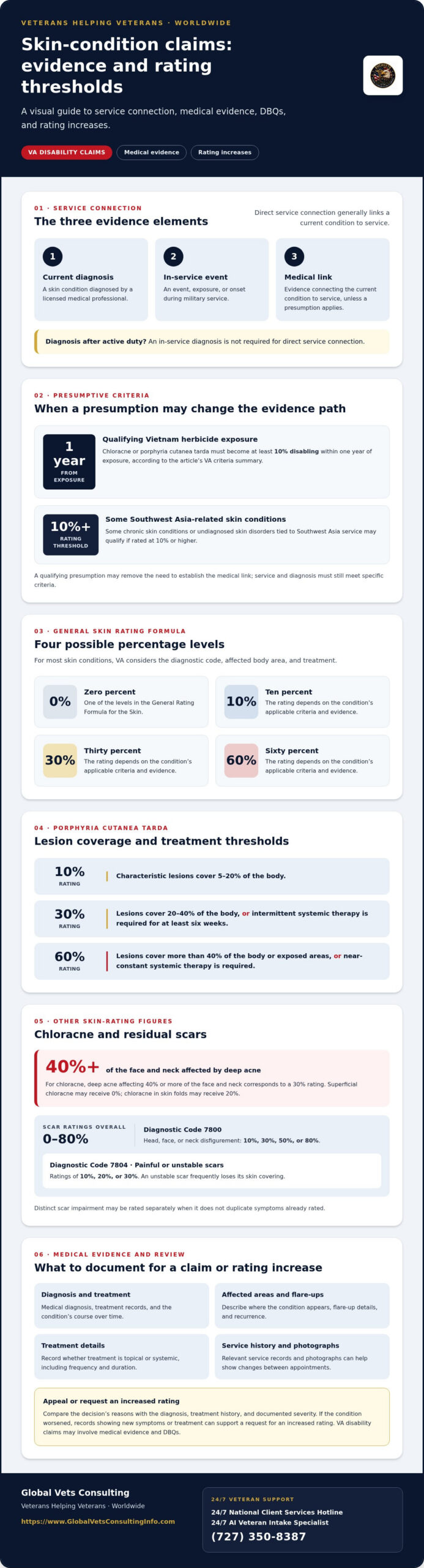
Direct service connection means evidence links a current disability to an event, exposure, or onset during service. This route can apply even when the skin condition was diagnosed after active duty. A presumptive rule may remove the need to establish that medical link when service and diagnosis meet specific criteria. For qualifying Vietnam herbicide exposure, the U.S. Department of Veterans Affairs states chloracne or porphyria cutanea tarda must become at least 10 percent disabling within one year of exposure. Some chronic skin conditions or undiagnosed skin disorders tied to Southwest Asia service may also qualify if rated at 10 percent or higher.
Medical Evidence for Skin Claims
A diagnosis from a licensed medical professional helps establish the condition, while treatment records can document its course and severity. Gather relevant service records, medical notes, and evidence describing flare-ups, affected areas, and treatment. Photographs can help show changes between appointments. To file, submit VA’s disability compensation application and identify the skin condition, then provide supporting medical and service evidence. There is no separate dermatology-only application form. VA may assign separate ratings to distinct conditions when their symptoms do not overlap, but generally cannot compensate the same manifestation twice.
Treatment and Body-Surface Rating Thresholds
VA rates most skin conditions under 38 C.F.R. § 4.118, with the diagnostic code and evidence shaping the rating. The General Rating Formula for the Skin uses 0, 10, 30, or 60 percent, considering affected body area and treatment. Record which areas are affected and whether treatment is topical or systemic, including its frequency and duration. According to the U.S. Department of Veterans Affairs, porphyria cutanea tarda may receive a 60% rating when characteristic lesions cover more than 40% of the body or exposed areas, or near-constant systemic therapy is required. Some skin diagnoses, including cancer or infections, follow condition-specific criteria.
Can You Appeal or Increase Your Rating?
Acne, vitiligo, fungal infections, hives, psoriasis, eczema, dermatitis, and porphyria cutanea tarda may qualify when the evidence meets the applicable criteria. A review or request for an increase focuses on the diagnosis, service connection, and documented severity.
Ratings for Acne, Vitiligo, Fungal Infections, and Hives
Diagnostic codes assess acne and other conditions by symptoms and affected areas, so diagnosis alone doesn’t set the percentage. The U.S. Department of Veterans Affairs describes a 30% rating for chloracne with deep acne affecting 40% or more of the face and neck. Superficial chloracne may receive 0%, while chloracne in skin folds may receive 20%. Vitiligo, fungal infections, and hives are evaluated under applicable criteria; document recurrence and treatment.
Ratings for Psoriasis, Eczema, and Dermatitis
Psoriasis ratings may take the severity and frequency of symptoms and the treatment required into account. Eczema and dermatitis ratings consider affected area and treatment. For porphyria cutanea tarda, lesions covering 5-20% may correspond to 10%; lesions covering 20-40%, or intermittent systemic therapy for at least six weeks, may correspond to 30%.
Scar Ratings and Diagnostic Codes
Residual scars may receive a rating when they cause distinct impairment rather than duplicating symptoms already rated. VA scar ratings range from 0 to 80 percent, depending on the diagnostic code. Code 7800 covers head, face, or neck disfigurement, with 10, 30, 50, or 80 percent levels. Code 7804 addresses painful or unstable scars, rated at 10, 20, or 30 percent. An unstable scar frequently loses its skin covering.
For an appeal, compare the decision’s stated reasons with the diagnosis, treatment history, and evidence of severity. If the condition has worsened, records showing new symptoms or treatment can support a request for an increased rating. Skin-condition claim education can help you understand how evidence relates to rating criteria.
Acne, residual scarring, burns, and skin cancer
VA evaluates acne under Diagnostic Code (DC) 7828, while residual scars may be rated separately under applicable scar codes. The evidence should distinguish active acne from lasting marks, pain, or skin damage. Describe where lesions appear, how often they recur, and what treatment records show. For chloracne, the affected area and depth of acne matter. Deep acne affecting 40% or more of the face and neck corresponds to a 30% rating.
Scarring can remain disabling after the original acne, burn, or skin condition improves. VA scar ratings range from 0 to 80 percent, depending on the diagnostic code and documented effects. DC 7800 addresses disfigurement of the head, face, or neck, with ratings of 10, 30, 50, or 80 percent. DC 7804 covers painful or unstable scars, with ratings of 10, 20, or 30 percent. An unstable scar frequently loses its skin covering.
Burn residuals are evaluated under DC 7801-7805. Record the burn’s location and resulting scar symptoms, including pain, instability, or disfigurement. A clear medical history can connect the current residual to the original injury during military service. Photographs taken during healing or flare-ups may help show changes over time, while clinical notes can document persistent effects and treatment.
Skin cancer uses DC 7818 and DC 7833 in the VA skin-condition schedule. Active treatment, such as surgery or chemotherapy, can qualify for a temporary 100% VA rating during treatment. Keep records identifying the cancer, treatment dates, procedures, and affected areas. After active treatment, evidence of residual scars or continuing effects may be relevant to the evaluation. For melanoma, document the diagnosis and treatment history; the code and remaining effects guide how VA considers the disability.
Compensation and Pension examinations
A Compensation and Pension (C&P) examination helps VA assess a skin condition and its effects. The examiner considers your diagnosis, reported symptoms, treatment, and examination findings. For a chronic condition, explain how it changes over time, including periods when a flare is less visible. VA may consider this medical evidence alongside the records already in your disability benefits file when making its rating decision.
Describe the condition clearly and specifically. Explain where it appears, how often symptoms occur, and whether itching, pain, or skin breakdown affects daily activities. Bring an accurate medication history that distinguishes topical treatment from systemic therapy, including how often each was used. A documented eczema example describes prednisone use three times per year, involvement of approximately 40% of total body surface area, and 60% of exposed areas. These details illustrate the kind of treatment and area information that may be recorded, not a guaranteed rating.
Fluctuating symptoms need context. If your skin looks different on examination day than during a severe flare, describe the pattern and refer to relevant treatment notes or dated photographs. Explain what triggers a flare, how long it lasts, and what happens when treatment stops. For example, records showing recurring lesions and medication changes give the examiner more context than a general statement that symptoms come and go.
Before the appointment, organize your medical records, medication names, and a concise timeline of the condition. During the examination, answer directly and don’t minimize symptoms that affect sleep, work, or routine tasks. If asked about function, give concrete examples, such as difficulty wearing clothing over a painful rash. Review the examination report and decision for material gaps in the documented symptoms or treatment.
Use the appointment to describe the condition accurately, not to seek treatment. For focused help understanding what to expect, explore C&P examination preparation education and organize your evidence before the exam.
Global Vets Consulting (GVC4Vets): Disability Benefits Questionnaires (DBQ)
Global Vets Consulting (GVC4Vets) offers Disability Benefits Questionnaires (DBQ) and education on independent medical evidence for veterans organizing skin-condition documentation. A DBQ can help describe a condition’s symptoms and severity, while medical evidence education can help you understand how records relate to your claim. Turn to these resources when you’re preparing supporting documentation or reviewing what evidence may clarify your condition’s effects.
GVC4Vets also provides C&P Examination Preparation Education and Secondary VA Claims Education. These resources can help you prepare to discuss your symptoms and understand how a secondary condition may relate to an already service-connected disability. They provide education, not medical treatment or legal representation.
For information, contact the 24/7 National Client Services Hotline or 24/7 AI Veteran Intake Specialist at (727) 350-8387, or visit Global Vets Consulting online.
Take the Next Step With a Clear Plan
Make your next move deliberate. For dermatology VA claims, keep a record that connects each document to the question it helps answer: what condition you have, how it relates to service, and how it affects you now. This can help you prepare for an examination, review a decision, or consider whether a rating increase fits your circumstances. Keep the information accurate, relevant, and consistent with your medical records.
Global Vets Consulting (GVC4Vets) offers Disability Benefits Questionnaires (DBQ), Independent Medical Evidence Education, and Secondary VA Claims Education. These educational resources may help you understand how documentation relates to your claim and identify questions to discuss with qualified professionals.
If you’d like support with your next step, contact Global Vets Consulting (GVC4Vets). Keep moving forward with care and confidence.
Frequently Asked Questions
Does the Diagnosis Have to Happen While You’re Still in Uniform?
No. A skin condition diagnosed after active duty may still be connected to service. For example, a veteran may develop a documented condition after discharge and use service records, later medical records, and a medical opinion to explain the connection. The timing of diagnosis matters for certain presumptive rules, but an in-service diagnosis is not required for every direct service-connection claim.
How Does VA Rate Scars?
VA evaluates scars based on their characteristics and effects, including location, pain, instability, disfigurement, or functional limitation. A facial scar may be assessed differently from a painful scar elsewhere. For a useful evidence record, note where each scar is, whether it hurts or repeatedly breaks down, and whether it restricts movement. Medical notes and clear photographs can help document these features.
What Evidence Carries the Most Weight in a Skin Condition Claim?
For Dermatology VA Claims, useful evidence clearly addresses the diagnosis, connection to service, and severity over time. A treatment note identifying a flare, medication, and affected areas can provide more detail than a general symptom description. Service records may help establish an exposure or event, while later clinical records can document persistence. Organize documents by date to make the history easy to follow.
Who Has to Diagnose the Condition?
A licensed medical professional must provide the skin-condition diagnosis as competent medical evidence. You can describe your symptoms and submit photographs, but these do not replace a medical diagnosis. For example, records identifying chronic dermatitis and documenting treatment give VA a clinical basis to evaluate the condition. Keep the diagnosis consistent across medical records, especially when several providers have treated the same skin problem.
How does the VA rate dermatological conditions under its rating schedule?
VA evaluates most skin conditions under 38 C.F.R. § 4.118, using the diagnostic code that matches the condition. In Dermatology VA Claims, the assessment may consider affected body area, treatment type and frequency, and condition-specific symptoms. Scars and disfigurement have separate criteria from many active skin diseases. Identify the diagnosis and describe its distinct effects so the evidence corresponds to the relevant rating criteria.
What are the VA disability rating criteria for eczema and dermatitis?
Eczema and dermatitis ratings consider affected areas and treatment, including whether systemic medication is required. The rating schedule describes levels of 10%, 30%, and 60%, with evidence of treatment and severity informing the applicable level. For example, records showing recurring symptoms, medication use, and affected areas help distinguish an occasional flare from persistent symptoms requiring more intensive treatment.

Article by
Willie Daniel
Willie Daniel is the Founder and Chief Executive Officer (CEO) of Global Vets Consulting (GVC4Vets) – National Veterans Disability Services, a veteran-led educational and medical evidence support organization dedicated to helping veterans better understand VA disability rating increases, DBQ medical evidence, secondary claims education, and C&P examination preparation.
He is a retired U.S. Army Medical Service Corps Officer with more than 27 years of honorable military service, a decorated Iraq combat veteran, and a retired federal official with the U.S. Department of Veterans Affairs. Throughout his military and federal career, Willie Daniel served in leadership, healthcare administration, operational, and veteran-support roles focused on improving services and support systems for servicemembers, veterans, and their families.
Drawing from decades of military leadership, healthcare administration, veteran advocacy, and federal government experience, Willie Daniel brings a practical, veteran-centered perspective to Global Vets Consulting’s educational articles, AI-powered veteran resources, video education initiatives, and outreach programs. His experience navigating military systems, medical documentation processes, and veteran-related administrative operations provides valuable insight into many of the challenges veterans face when seeking to better understand VA disability rating criteria, medical evidence, documentation strategies, and secondary condition education.
Through GVC’s “Veterans Helping Veterans” mission, his focus is on delivering clear, educational, and easy-to-understand information designed to empower veterans with knowledge, resources, and educational tools that may help them make more informed decisions regarding their individual VA disability journeys.
The information provided through GVC is intended for educational and informational purposes only and should not be considered legal or medical advice.
Disclaimer
Disclaimer: Global Vets Consulting, LLC (“GVC”) is a veteran-led educational and medical evidence support organization. GVC is not a law firm, is not a Veterans Service Organization (VSO), and is not affiliated with the U.S. Department of Veterans Affairs (VA) or any government agency.
Global Vets Consulting does not provide legal advice, medical advice, medical treatment, or healthcare services. GVC does not prepare, file, or submit VA disability claims on behalf of veterans. All information provided through this website, blog articles, videos, educational materials, AI tools, dashboards, templates, and communications is intended solely for general educational and informational purposes.
Veterans are encouraged to consult with accredited representatives, licensed attorneys, qualified medical providers, or Veterans Service Organizations regarding their specific legal, medical, or VA-related matters. VA disability decisions, ratings, and outcomes are determined solely by the U.S. Department of Veterans Affairs based on applicable laws, regulations, medical evidence, and individual circumstances. Past results do not guarantee future outcomes.