
Choosing the wrong appeal lane can cost you another year of waiting and a continued denial of the benefits you earned. While it’s tempting to just pick the form that looks easiest, the difference between supplemental claim and higher-level review comes down to one single factor: do you have more evidence to show the VA right now? If you try to argue a legal error when you actually need a fresh DBQ, or submit new records to a senior reviewer who isn’t allowed to look at them, you’re essentially starting a clock that leads back to a denial.
We know how exhausting it is to decode “VA math” and dense legal jargon while staring at a decision letter that feels like a slap in the face. It’s frustrating to feel like a number in a system that should be serving you. This guide will show you exactly how to choose the right lane based on your current medical evidence so you can finally secure the disability rating you’ve earned. We’ll break down the 2026 processing timelines, the specific forms you need, and how independent medical evidence changes the game for your claim strategy.
Key Takeaways
- Identify the specific medical evidence needed to satisfy the “new and relevant” standard required for a successful Supplemental Claim.
- Understand why the difference between supplemental claim and higher-level review hinges on whether you are submitting new documentation or arguing a legal error.
- Learn how to use a private Disability Benefits Questionnaire (DBQ) to address missing information or inaccuracies in your previous C&P exam.
- Determine if an Informal Conference is the right strategic move to help a senior reviewer identify factual mistakes in your denial letter.
VA Appeal Lanes Explained: Supplemental Claim vs. Higher-Level Review
The Veterans Appeals Improvement and Modernization Act of 2017 (AMA) completely changed the way we handle VA disability claim disputes. This law created a faster, more transparent system that allows you to choose the best strategy for your specific situation. Understanding the difference between supplemental claim and higher-level review is vital for any veteran who receives a denial letter.
- 🇺🇸 Supplemental Claim: This lane is used to submit “new and relevant” medical evidence. It allows you to reopen a claim that was previously denied because it lacked a nexus or a clear DBQ.
- 🇺🇸 Higher-Level Review: This lane is for veterans who believe the VA rater reached the wrong conclusion based on the evidence already in the file. A senior rater reviews the claim to find legal or factual errors.
Timing is everything in the VA appeals process. You must follow these critical deadlines to stay in the game:
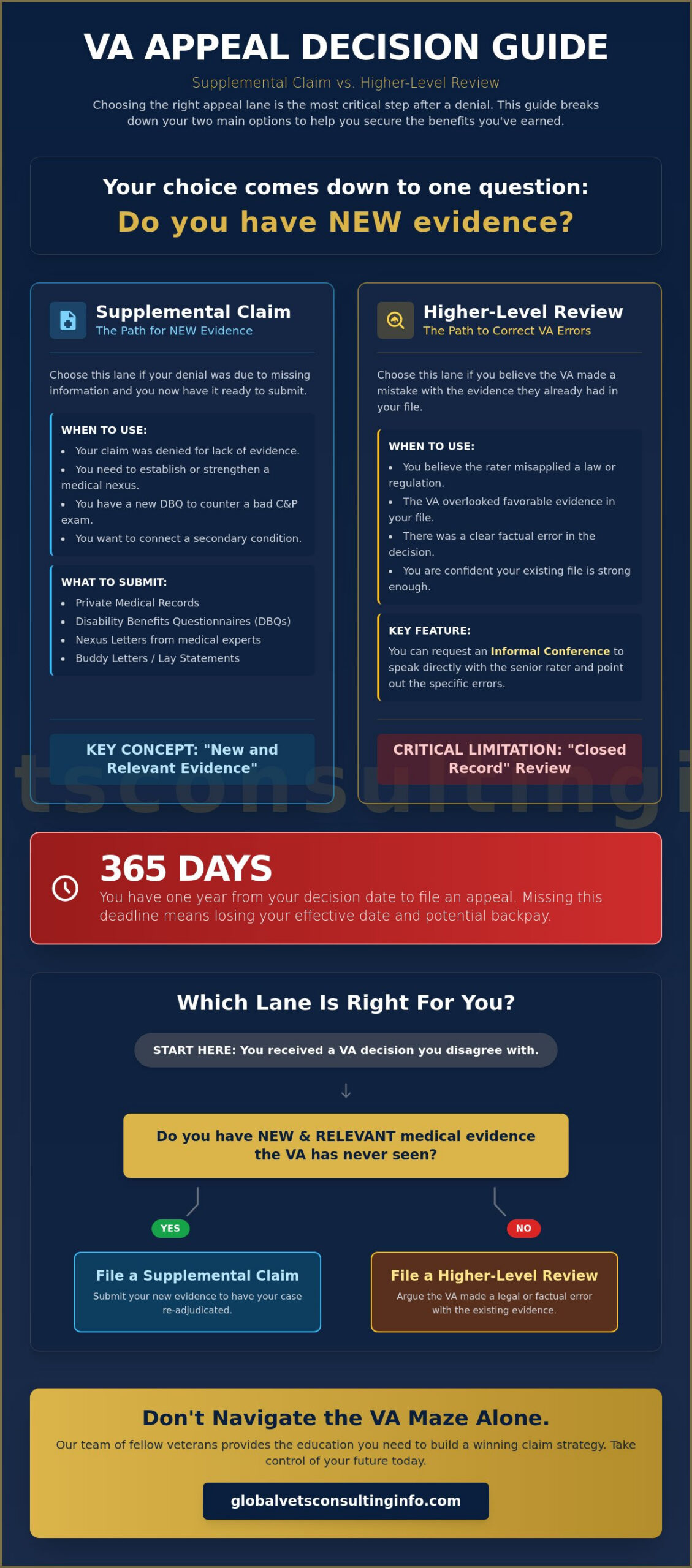
- You have 365 days from the date of your decision letter to file an appeal.
- Filing within this window protects your original effective date.
- Protecting your effective date ensures you receive every penny of backpay you’re owed.
- Missing the one-year deadline often requires starting the entire process over from scratch.
The Core Difference: Evidence vs. Argument
The main difference between supplemental claim and higher-level review centers on the evidence you want the VA to consider. One lane allows for growth, while the other is a static review. Use these points to guide your decision:
- Supplemental Claims are designed for adding fresh medical evidence that wasn’t in your original file.
- HLRs are strictly for arguing that the VA misapplied the law or ignored existing facts.
- The HLR lane is a “Closed Record” review where no new medical documentation can be introduced.
When to Choose a Supplemental Claim: The Power of New Evidence
Choosing a Supplemental Claim is the right strategic move when you have fresh information that was not available to the VA during the initial review. According to the VA Decision Reviews and Appeals guidelines, your evidence must meet the “new and relevant” standard. In 2026, this means the documentation must prove a fact that was not previously established, such as a higher level of symptom severity or a direct service connection. If your VA claim is denied for lack of evidence, filing a Supplemental Claim allows you to reopen the case with the missing pieces in hand.
This lane is particularly effective for linking secondary conditions that were previously overlooked. For instance, if you have service-connected tinnitus and have developed anxiety as a result, you need a medical nexus and a DBQ to bridge that gap. The primary difference between supplemental claim and higher-level review is that the Supplemental lane allows you to submit these critical medical records, while the HLR lane is strictly limited to the evidence already in your file.
Strategic Use of Private Medical Documentation
A private Disability Benefits Questionnaire (DBQ) serves as a powerful tool to counter a negative C&P exam. While the VA has a “duty to assist,” examiners often miss nuances in your medical history or fail to record the full scope of your limitations. A professionally completed DBQ ensures your symptoms are documented accurately using the specific 2026 VA criteria. This proactive approach helps you take control of the narrative rather than relying on a potentially flawed government exam.
- Accuracy: Independent medical evidence provides a thorough record that a rushed C&P examiner might overlook.
- Compliance: It is vital to ensure your doctor uses the most current 2026 versions of VA forms to avoid administrative rejections.
- Clarity: A clear medical nexus letter explains exactly how your current disability relates to your military service, satisfying the VA’s requirements for service connection.
If you are unsure if your current documentation meets the “new and relevant” threshold, exploring independent medical evidence education can help you understand what a winning file looks like before you submit your form.
The Higher-Level Review (HLR): Fixing VA Legal and Factual Errors
If you believe the VA reached the wrong conclusion despite having all the necessary medical evidence, the Higher-Level Review is your best option. A major difference between supplemental claim and higher-level review is that the HLR is a “closed record” review. This means you cannot submit new DBQs, nexus letters, or medical records for consideration. Instead, you are asking for a Senior Rating Specialist to find mistakes in the previous decision.
- 🇺🇸 Senior Oversight: Your file is reviewed by a more experienced rater who did not participate in the original decision.
- 🇺🇸 Error Identification: The reviewer looks for “Clear and Unmistakable Errors” (CUE) or misinterpretations of VA law.
- 🇺🇸 Duty to Assist: If the reviewer finds the VA failed to gather a required record, they will identify a “Duty to Assist” error.
- 🇺🇸 Lane Reversion: When a Duty to Assist error is found, the HLR is closed and the claim reverts to a Supplemental Claim so the VA can fix the mistake.
The VA official Higher-Level Review process is designed to catch administrative failures without requiring you to start a brand-new claim from scratch.
The Informal Conference: Your Chance to Speak
The informal conference is a scheduled phone call that allows you to point out specific errors directly to the senior reviewer. This is not the time to describe new symptoms, as new evidence is prohibited. This lane focuses on existing facts, which highlights the primary difference between supplemental claim and higher-level review: you are arguing the law, not adding new medical proof.
- Prepare a bulleted list of the specific evidence the previous rater ignored.
- Focus on how your existing documentation on mental health conditions meets a higher rating percentage.
- Cite the specific page numbers or dates of medical notes that support your case.
- Be concise and professional while explaining why the previous rater’s decision was legally or factually incorrect.
🇺🇸 Expert Education Matters. If you need to understand how your medical evidence aligns with current VA rating schedules before your conference, connect with Global Vets Consulting for specialized resource awareness.
Decision Matrix: Which Lane Wins Your Rating Increase?
Choosing your appeal path isn’t a guessing game. It’s a strategic calculation based on what’s currently in your C-file versus what the VA claims is missing. The difference between supplemental claim and higher-level review essentially boils down to whether you need to talk to the VA or show them something new. If you’re looking for the fastest resolution, Supplemental Claims in 2026 are averaging about 61 days, while Higher-Level Reviews can take up to 125 days to complete.
- Supplemental Claim (VA Form 20-0995): Use this when you have a new private DBQ or Nexus letter. It’s the most common path for a rating increase.
- Higher-Level Review (VA Form 20-0996): Use this when the evidence is perfect but the rater made a clear mistake. No new evidence is allowed here.
To make the right choice, follow this three-step framework. First, scrutinize your denial letter to see exactly why you were turned down. Second, determine if you can secure an independent medical opinion or a fresh DBQ to fill that specific gap. Finally, only opt for an HLR if you’re certain the rater overlooked existing evidence that already proves your case.
Maximizing Success with Professional DBQ Support
Accurate, high-quality documentation is the absolute foundation of the VA disability claims process. Many veterans lose their appeals because they submit “new” evidence that isn’t actually “relevant” to the VA’s specific rating criteria. Global Vets Consulting specializes in educating veterans on how to gather the precise medical evidence needed to satisfy these high standards, ensuring your appeal has the strongest possible start.
Before you hit submit on your 2026 appeal form, run through this final checklist:
- Did you use the correct 2026 version of the VA form?
- Does your new evidence directly address the reasons for denial listed in your letter?
- If filing a Supplemental Claim, is your DBQ completed by a qualified professional who understands VA terminology?
- If filing an HLR, have you prepared a bulleted list of the specific legal errors for your informal conference?
🇺🇸 Ready to take the next step? For expert guidance on medical evidence and rating increases, visit Global Vets Consulting today.
Take Control of Your VA Appeal Strategy
Choosing the correct lane is the most significant tactical decision you will make after receiving a denial. By understanding the difference between supplemental claim and higher-level review, you can ensure your appeal is based on solid medical evidence rather than guesswork. Whether you are adding a new secondary link or challenging a rater’s legal oversight, your path to a higher rating depends on matching your strategy to your current documentation.
Global Vets Consulting is a veteran-owned and operated firm established in 2021. We specialize in Disability Benefits Questionnaires (DBQ) and independent medical evidence education to help you navigate the VA system with confidence. We are a mission-driven, tech-forward partner ready to assist you immediately through our modern support tools.
🇺🇸 Global Vets Consulting | Worldwide
- 📞 24/7 National Client Services Hotline: Immediate support for your claim questions.
- 🤖 24/7 AI Veteran Intake Specialist: Get started with your evidence review anytime.
- 🌐 Web: GlobalVetsConsultingInfo.com
🇺🇸 Get the Medical Documentation You Need to Win Your Claim — Contact Global Vets Today
You served with honor, and you deserve a disability rating that reflects the true impact of your service. Don’t let a complex bureaucratic process stand between you and your earned benefits. We are here to provide the steady guidance and professional expertise you need to secure a successful outcome.
Frequently Asked Questions
Can I file a Higher-Level Review and a Supplemental Claim at the same time?
You cannot file both an HLR and a Supplemental Claim for the same specific issue at the same time. The VA requires you to choose one lane for each contested decision. However, if your decision letter covered multiple conditions, you could potentially file a Supplemental Claim for one disability while requesting an HLR for another.
How long does a Supplemental Claim take compared to a Higher-Level Review in 2026?
Supplemental Claims are currently the faster option, with processing times averaging 60.7 days as of February 2026. In contrast, the VA’s goal for completing most Higher-Level Reviews is approximately 125 days. Knowing this timing difference between supplemental claim and higher-level review can help you plan your finances while waiting for a decision.
What counts as “new and relevant” evidence for a VA Supplemental Claim?
Evidence is considered “new” if the VA did not have it in their possession when they made the previous decision. It’s “relevant” if it tends to prove or disprove a matter at issue in your claim, such as a missing nexus or the severity of your symptoms. A private DBQ or a fresh medical opinion from a specialist are standard examples of evidence that meets this threshold.
Can I submit a private DBQ during a Higher-Level Review?
No, you cannot submit a private DBQ or any other new records during an HLR. This lane is a “closed record” review, meaning the senior specialist only looks at what the VA already had on file. If you have a new DBQ that addresses the reason for your denial, you must choose the Supplemental Claim lane to get that evidence in front of a rater.
What happens if my Higher-Level Review is denied?
If your Higher-Level Review is denied, your next step is typically to file a Supplemental Claim with new and relevant evidence. You have one year from the date of the HLR denial to submit this new claim and preserve your original effective date for backpay. This multi-layered approach is an essential part of the difference between supplemental claim and higher-level review strategies used to win a rating increase.

Article by
Willie Daniel
Willie Daniel is the Founder and Chief Executive Officer (CEO) of Global Vets Consulting (GVC) – National Veterans Disability Services, a veteran-led educational and medical evidence support organization dedicated to helping veterans better understand VA disability rating increases, DBQ medical evidence, secondary claims education, and C&P examination preparation.
He is a retired U.S. Army Medical Service Corps Officer with more than 27 years of honorable military service, a decorated Iraq combat veteran, and a retired federal official with the U.S. Department of Veterans Affairs. Throughout his military and federal career, Willie Daniel served in leadership, healthcare administration, operational, and veteran-support roles focused on improving services and support systems for servicemembers, veterans, and their families.
Drawing from decades of military leadership, healthcare administration, veteran advocacy, and federal government experience, Willie Daniel brings a practical, veteran-centered perspective to Global Vets Consulting’s educational articles, AI-powered veteran resources, video education initiatives, and outreach programs. His experience navigating military systems, medical documentation processes, and veteran-related administrative operations provides valuable insight into many of the challenges veterans face when seeking to better understand VA disability rating criteria, medical evidence, documentation strategies, and secondary condition education.
Through GVC’s “Veterans Helping Veterans” mission, his focus is on delivering clear, educational, and easy-to-understand information designed to empower veterans with knowledge, resources, and educational tools that may help them make more informed decisions regarding their individual VA disability journeys.
The information provided through GVC is intended for educational and informational purposes only and should not be considered legal or medical advice.
Disclaimer
Disclaimer: Global Vets Consulting, LLC (“GVC”) is a veteran-led educational and medical evidence support organization. GVC is not a law firm, is not a Veterans Service Organization (VSO), and is not affiliated with the U.S. Department of Veterans Affairs (VA) or any government agency.
Global Vets Consulting does not provide legal advice, medical advice, medical treatment, or healthcare services. GVC does not prepare, file, or submit VA disability claims on behalf of veterans. All information provided through this website, blog articles, videos, educational materials, AI tools, dashboards, templates, and communications is intended solely for general educational and informational purposes.
Veterans are encouraged to consult with accredited representatives, licensed attorneys, qualified medical providers, or Veterans Service Organizations regarding their specific legal, medical, or VA-related matters. VA disability decisions, ratings, and outcomes are determined solely by the U.S. Department of Veterans Affairs based on applicable laws, regulations, medical evidence, and individual circumstances. Past results do not guarantee future outcomes.

