
The VA doesn’t grant a higher rating simply because your pain has increased; they award it because you’ve proven your ability to function has decreased. This is a frustrating reality for many veterans who feel their current compensation no longer matches the daily physical or mental toll of their service-connected conditions. You might feel like your doctor isn’t truly hearing you, or you may fear a C&P examiner will downplay your struggle during a brief appointment. At Global Vets Consulting, we understand that documenting worsening symptoms for va increase feels like a second full-time job, especially when the system seems built to find reasons for a denial.
You deserve a rating that reflects your current life, not the version of you from years ago. This guide provides a clear, step-by-step path to bridge the functional gap between your old rating and your current reality. You’ll learn exactly how to use Disability Benefits Questionnaires (DBQs) and medical evidence to build a bulletproof claim for 2026. We’ll show you how to track your symptoms with precision and prepare for your C&P exam with steady confidence. By the end of this article, you will have a predictable roadmap to secure the accurate documentation and higher monthly compensation you’ve earned through your service.
Key Takeaways
- Identify whether your condition is static or reviewable and why filing an “Intent to File” immediately is critical for protecting your effective date and back pay.
- Learn why Disability Benefits Questionnaires (DBQs) are the most powerful tool for documenting worsening symptoms for VA increase to ensure your evidence matches specific VA rating criteria.
- Transition from general descriptions to specific “functional impact” language that clearly illustrates how your symptoms interfere with work, social life, and daily self-care.
- Utilize the Fully Developed Claim (FDC) process to expedite your decision by submitting all medical evidence and Nexus letters upfront with VA Form 21-526EZ.
Recognizing When Your Service-Connected Condition Qualifies for an Increase
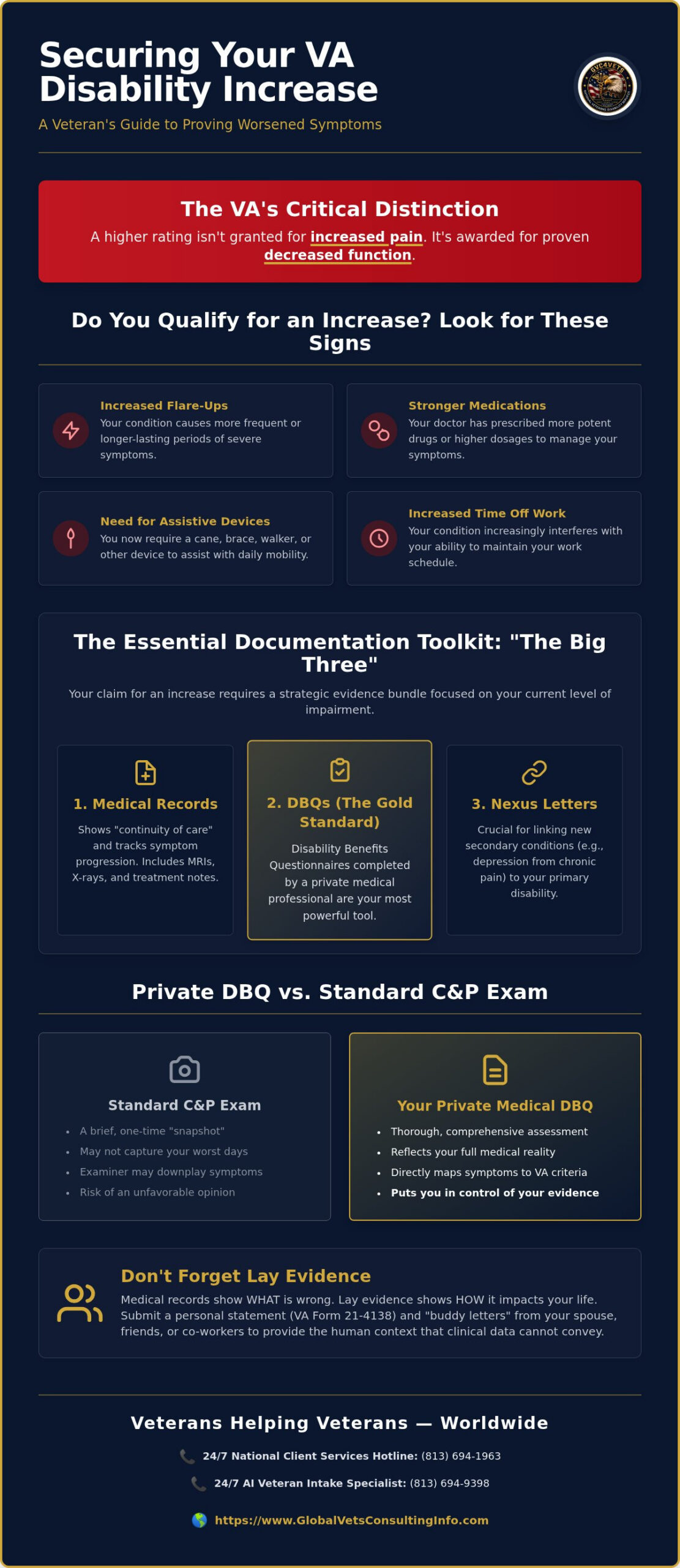
A VA rating increase is a formal claim submitted when a service-connected disability has progressed in severity since your last rating decision. It isn’t enough to just feel worse; you must prove that your condition now meets the higher criteria defined by the VA. Before you begin documenting worsening symptoms for va increase, check your code sheet to see if your disability is “static” or “reviewable.” Static disabilities aren’t expected to improve, while reviewable ones might be scheduled for future exams. Understanding this status helps you plan your evidence strategy with confidence. 🇺🇸
You should consider filing for an increase if you notice these specific signs of progression:
- Increased frequency and duration of flare-ups.
- New requirements for stronger prescription medications.
- The recent need for assistive devices like canes, braces, or walkers.
- Increased time taken off work due to symptom severity.
Mapping Your Symptoms to the VA Schedule for Rating Disabilities (VASRD)
The VASRD is the rulebook the VA uses to assign percentages. It relies on objective criteria to distinguish between rating levels. For example, a 10% rating for a knee condition might be based on pain, while a 30% or 50% rating often requires specific measurements of limited range of motion in degrees. We recommend looking up your specific diagnostic code to compare your current limitations against the requirements for the 30%, 50%, or 70% levels. This process of documenting worsening symptoms for va increase requires matching your daily reality to the VA’s technical language. 🌎
Identifying Secondary Conditions That May Have Developed
Worsening conditions rarely stay isolated. A primary back injury often leads to radiculopathy, which is nerve pain or numbness in the legs. Similarly, chronic physical pain can frequently cause or aggravate mental health conditions like depression or anxiety. Documenting these as secondary claims alongside your increase request can lead to a significant combined rating boost. Instead of just asking for more on one item, you are showing the VA the total impact the service-connected condition has on your entire life. 📞
The Essential Documentation Toolkit for Proving Worsened Symptoms
Securing a higher rating requires a strategic evidence bundle often called the “Big Three.” While your initial claim established service connection, documenting worsening symptoms for va increase focuses entirely on your current level of impairment. You must demonstrate a consistent “continuity of care” by showing regular treatment. 🇺🇸
Your evidence toolkit should include:
- Updated medical records showing ongoing treatment and symptom progression.
- Disability Benefits Questionnaires (DBQs) that reflect your current severity levels.
- Nexus letters to link any new secondary conditions to your primary disability.
The VA looks for a clear paper trail. Objective evidence like MRIs, X-rays, or blood tests provides the hard data needed to validate your subjective reports of daily pain. 📞
Why Private DBQs Are the Gold Standard for Evidence
A private medical professional often provides a more thorough assessment than a standard C&P examiner. This is why understanding what is a dbq is essential for your increase strategy. A professionally prepared DBQ ensures every specific symptom is captured and mapped directly to VA rating criteria. It prevents the “snapshot” problem where a brief exam fails to reflect your worst days. When documenting worsening symptoms for va increase, accuracy is your best defense. For veterans seeking accuracy, our DBQ education resources can help you present a complete medical picture. 🌎
The Power of Lay Evidence: Buddy Letters and Personal Statements
Medical records tell the “what,” but lay evidence tells the “how.” Use VA Form 21-4138 to provide a personal statement describing how your life has changed since your last rating decision. If your spouse now helps you dress or friends notice you have become socially withdrawn, their “buddy letters” serve as vital secondary evidence. These statements provide the human context that medical data alone cannot convey. They turn clinical notes into a relatable narrative of your daily struggle.
Step-by-Step Guide: Documenting Symptoms for Maximum Impact
Effective documentation isn’t just about listing your diagnoses; it’s about proving how they limit your life. When you’re documenting worsening symptoms for va increase, a systematic approach ensures your evidence is undeniable. Many veterans fail because they provide vague descriptions that don’t match the VA’s technical requirements. Use these steps to build a stronger case. 🇺🇸
- Start a Functional Impact Log. Track how symptoms interfere with work, social life, and self-care daily.
- Use specific, descriptive language. Instead of saying “my back hurts,” describe “sharp, stabbing pain that prevents standing for more than 10 minutes.”
- Document Flare-Ups. The VA rates you on your “average” day, but flare-ups define the true upper limit of your disability.
- Quantify everything. Track the exact number of headaches per month or the specific days missed from work.
This methodical way of documenting worsening symptoms for va increase bridges the gap between your physical reality and the examiner’s report. If you need professional assistance in translating your daily log into high-quality medical evidence, explore our VA rating increase resources today. 📞
Capturing Your ‘Worst Days’ for the Record
The VA often looks for “incapacity” criteria when determining higher ratings. Document every instance where you’re confined to bed-rest or simply unable to function. If your condition has physical manifestations like swelling or skin lesions, take photos or videos to provide visual proof for your file. These visual records are hard to dispute during a review. 🌎
Bridging the Gap Between Pain and Function
Functional loss is the most critical element of a musculoskeletal claim. It isn’t just that it hurts; it’s what the pain prevents you from doing. In a musculoskeletal claim, functional loss refers to the inability of a joint or muscle to perform its normal working movements with normal excursion, strength, speed, coordination, or endurance. Focus your documentation on these specific limitations to show the rater exactly how your mobility has decreased since your last exam.
Submitting Your Claim for Increase with Confidence
Submitting your application is the final step in a long journey of preparation. Your first priority must be submitting an Intent to File (VA Form 21-0966). This simple action preserves your effective date, ensuring any potential back pay starts from today even if it takes months to finish documenting worsening symptoms for va increase. When you’re ready to submit the formal application, you’ll use VA Form 21-526EZ. 🇺🇸
We highly recommend utilizing the Fully Developed Claim (FDC) program. By submitting your private DBQs and medical records upfront, you signal to the VA that your file is complete. This proactive approach often results in faster decision times because the rater has everything they need to make a determination. Before hitting send, perform a final consistency check. Ensure the dates, symptoms, and functional limitations match across your personal statement, medical records, and DBQs. 📞
You might still be scheduled for a C&P exam despite providing a private DBQ. You should always attend these appointments to avoid an automatic denial. Use your private documentation as a guide to stay focused on your worst days during the exam. Being consistent is key to avoiding “contradictory evidence” notes in your file. 🌎
Avoiding Common Evidence Gaps That Lead to Denials
The primary reason for an increase denial is a lack of recent medical evidence. The VA wants to see how you’re suffering right now, not two years ago. Records older than 12 months are often considered “stale” and insufficient for a rating boost. If you find your VA claim denied for lack of evidence, the best recovery strategy is to obtain a current DBQ that reflects your present limitations. 🇺🇸
How Global Vets Consulting Streamlines Your Increase Claim
Our team understands the stress of documenting worsening symptoms for va increase while managing daily pain. We provide expert DBQ preparation and education to ensure your medical evidence is formatted exactly how the VA needs to see it. We operate with a “Veterans Helping Veterans” ethos, focusing on accuracy and meticulousness to help you secure the benefits you earned. 🌎
Get started with Global Vets today for your VA rating increase!
Secure Your Earned Benefits with Precise Documentation
Your journey toward an accurate disability rating depends on how effectively you translate your daily struggle into the VA’s technical language. By mapping your symptoms to the VASRD and maintaining a detailed functional impact log, you provide the rater with the objective evidence they need to approve an increase. Success in documenting worsening symptoms for va increase requires a methodical approach to ensure no limitation is overlooked. 🇺🇸
Global Vets Consulting is here to guide you through every step of this process. As a veteran-owned and operated team, we specialize in expert DBQ preparation education to help you submit a Fully Developed Claim with confidence. Our 24/7 AI Veteran Intake Specialist is available right now to help you take the first step toward the compensation you deserve. 🌎
Contact Global Vets Consulting for Professional DBQ Support 📞
You served your country with honor, and you deserve a rating that reflects your current life. Stay focused on the path ahead; we’re proud to stand with you as you secure the benefits you’ve earned. 🇺🇸
Frequently Asked Questions
Can the VA decrease my rating if I file for an increase?
Yes, filing for an increase opens your entire disability file for review. If the medical evidence shows your condition has significantly improved, the VA can legally propose a rating reduction. However, this is unlikely if you’re consistently documenting worsening symptoms for va increase. Most veterans who file have a clear paper trail showing their symptoms have become more severe and restrictive over time.
How long does it take for a VA disability rating increase to be approved in 2026?
As of June 2026, the average processing time for a disability-related claim is approximately 71.3 days. This is a notable improvement from the 81.1 days reported in late 2025. You can potentially speed up this process by filing a Fully Developed Claim (FDC) with your private DBQs included. Providing all necessary documentation upfront allows the VA to make a decision without requesting additional records.
Do I need a new Nexus letter if my condition is already service-connected?
You typically don’t need a new Nexus letter if you’re filing for an increase on a condition that is already service-connected. The VA has already conceded that the injury or illness was caused by your service. However, if your worsening primary condition has caused a new secondary issue, you’ll need a Nexus letter to establish that medical link for the new claim to be successful.
What happens if I miss my C&P exam for an increase claim?
Missing your Compensation and Pension (C&P) exam usually results in an immediate denial of your claim. The VA views your attendance as a requirement for validating your current symptoms. If an emergency occurs, you must contact the VA or the third-party examiner immediately to reschedule. Consistently documenting worsening symptoms for va increase through private records is helpful, but it doesn’t excuse you from the mandatory exam.
How much medical evidence is ‘enough’ to prove my condition got worse?
There isn’t a specific page count, but quality and recency are the most important factors. You should aim for at least 12 months of consistent medical records showing your symptoms have progressed. A single, well-prepared Disability Benefits Questionnaire (DBQ) that clearly maps your limitations to the next highest rating level is often more effective than hundreds of pages of irrelevant treatment notes that don’t address functional loss.

Article by
Willie Daniel
Willie Daniel is the Founder and Chief Executive Officer (CEO) of Global Vets Consulting (GVC4Vets) – National Veterans Disability Services, a veteran-led educational and medical evidence support organization dedicated to helping veterans better understand VA disability rating increases, DBQ medical evidence, secondary claims education, and C&P examination preparation.
He is a retired U.S. Army Medical Service Corps Officer with more than 27 years of honorable military service, a decorated Iraq combat veteran, and a retired federal official with the U.S. Department of Veterans Affairs. Throughout his military and federal career, Willie Daniel served in leadership, healthcare administration, operational, and veteran-support roles focused on improving services and support systems for servicemembers, veterans, and their families.
Drawing from decades of military leadership, healthcare administration, veteran advocacy, and federal government experience, Willie Daniel brings a practical, veteran-centered perspective to Global Vets Consulting’s educational articles, AI-powered veteran resources, video education initiatives, and outreach programs. His experience navigating military systems, medical documentation processes, and veteran-related administrative operations provides valuable insight into many of the challenges veterans face when seeking to better understand VA disability rating criteria, medical evidence, documentation strategies, and secondary condition education.
Through GVC’s “Veterans Helping Veterans” mission, his focus is on delivering clear, educational, and easy-to-understand information designed to empower veterans with knowledge, resources, and educational tools that may help them make more informed decisions regarding their individual VA disability journeys.
The information provided through GVC is intended for educational and informational purposes only and should not be considered legal or medical advice.
Disclaimer
Disclaimer: Global Vets Consulting, LLC (“GVC”) is a veteran-led educational and medical evidence support organization. GVC is not a law firm, is not a Veterans Service Organization (VSO), and is not affiliated with the U.S. Department of Veterans Affairs (VA) or any government agency.
Global Vets Consulting does not provide legal advice, medical advice, medical treatment, or healthcare services. GVC does not prepare, file, or submit VA disability claims on behalf of veterans. All information provided through this website, blog articles, videos, educational materials, AI tools, dashboards, templates, and communications is intended solely for general educational and informational purposes.
Veterans are encouraged to consult with accredited representatives, licensed attorneys, qualified medical providers, or Veterans Service Organizations regarding their specific legal, medical, or VA-related matters. VA disability decisions, ratings, and outcomes are determined solely by the U.S. Department of Veterans Affairs based on applicable laws, regulations, medical evidence, and individual circumstances. Past results do not guarantee future outcomes.