
Did you know the VA processed over 2 million disability claims by June 2026, yet thousands of veterans still feel their current rating doesn’t match their daily reality? It’s frustrating when the 2.8 percent COLA increase doesn’t reflect the true severity of your worsening health. You need a clear, professional strategy to understand what evidence is needed for a va rating increase to secure the compensation you’ve earned through your service. If you feel underrated or anxious about an upcoming C&P exam, our peer-to-peer community is here to support you.
This guide covers the three pillars of evidence, the power of private DBQs, and how to organize your claim for success. We are a veteran-owned team standing by to help you navigate this complex system with steady confidence. For immediate assistance with your documentation or medical evidence education, connect with our 24/7 National Client Services Hotline at 📞 800-484-0551 or visit GlobalVetsConsultingInfo.com. 🇺🇸 Worldwide.
Key Takeaways
- 🇺🇸 Identify the specific “new and relevant” medical documentation required to prove your service-connected condition has intensified since your last rating decision.
- 📞 Understand exactly what evidence is needed for a va rating increase, focusing on contemporary medical records and treatment notes from the last 12 months.
- 🌐 Discover how professional Disability Benefits Questionnaires (DBQs) act as the missing link by documenting your functional limitations in a VA-standardized format.
- 🛡️ Learn a step-by-step strategy to review rating schedules and identify the specific symptom thresholds needed to secure a higher disability percentage.
Understanding the VA Rating Increase Criteria in 2026 🇺🇸
A VA rating increase is a claim filed when your service-connected condition has intensified over time. To succeed, you must provide “new and relevant” evidence that was not considered during your previous rating decision. The Veterans Benefits Administration uses a standardized schedule to measure your symptoms against specific percentage thresholds. Understanding what evidence is needed for a va rating increase starts with identifying your current functional loss and matching it to the law.
The VA focuses on how your condition limits your daily life. Focus on these key elements when preparing your evidence:
- Schedule for Rating Disabilities: This manual dictates which symptoms qualify for specific disability percentages.
- Functional Loss: This measures your inability to perform daily tasks or maintain steady employment due to your condition.
- Symptom Thresholds: You must prove your condition has crossed the line into a higher-rated category through documented medical facts.
When Should You File for an Increase?
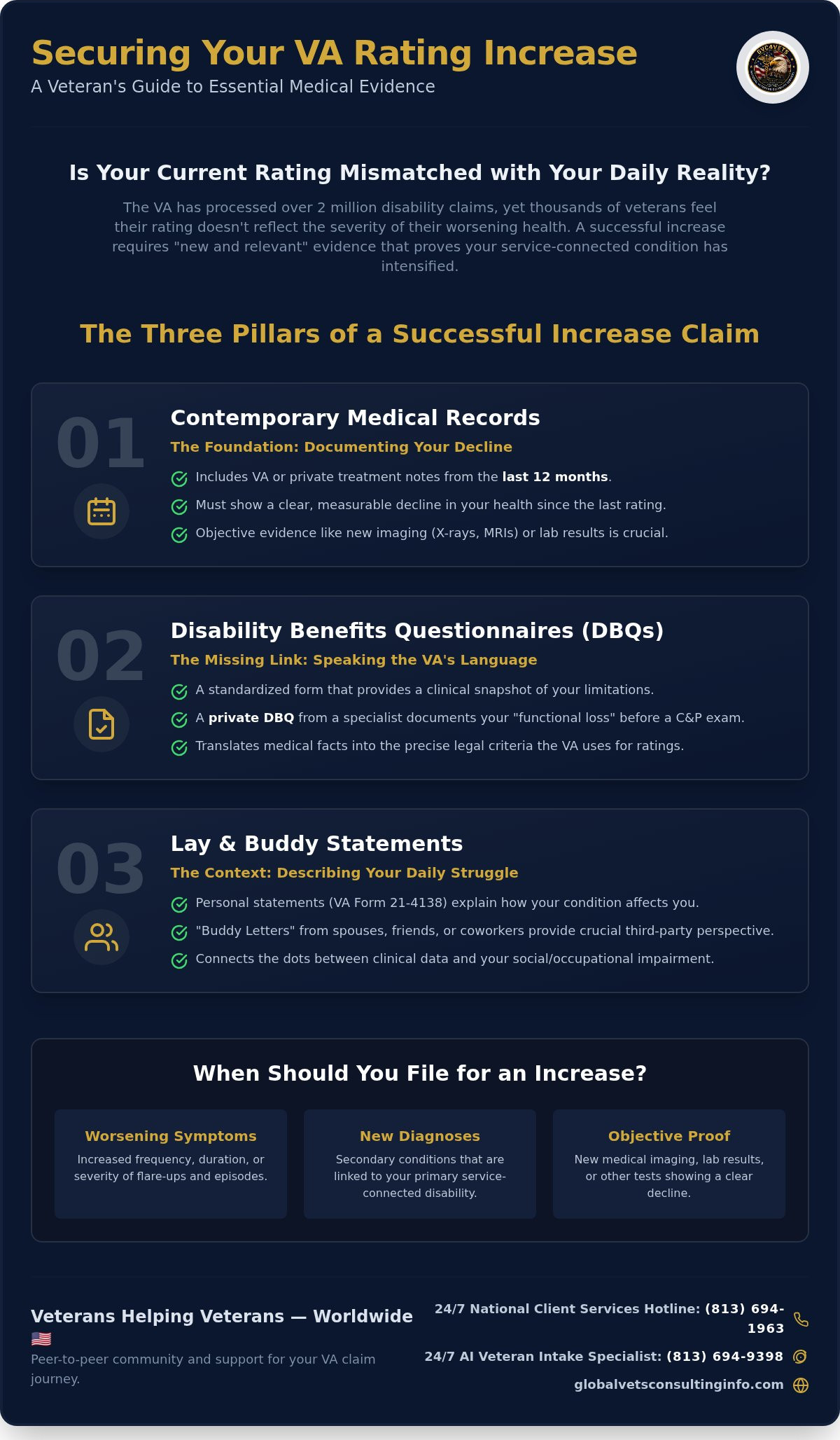
You should consider filing an increase claim as soon as your symptoms reach the next bracket in the VA schedule. Look for these specific indicators in your medical history:
- Increased frequency, duration, and severity of your condition’s flare-ups or episodes.
- New medical diagnoses that are directly linked to your service-connected injury.
- Objective evidence like new imaging or lab results showing a clear decline in your health.
Direct vs. Secondary Service Connection in Increases
A worsening primary condition often acts as a catalyst for new secondary claims. If your service-connected knee injury has led to back pain or depression, you can claim these as secondary disabilities. Learning the VA disability claims process step by step helps you identify these critical links early. Documenting these connections accurately is essential for securing the total compensation you deserve. 🇺🇸 Worldwide. GlobalVetsConsultingInfo.com.
The Three Pillars of Evidence for a Successful Increase 📞
To build a winning case, you must understand the specific architecture of a claim. When veterans ask what evidence is needed for a va rating increase, the answer lies in three distinct pillars: contemporary medical records, Disability Benefits Questionnaires (DBQs), and lay evidence. Relying solely on VA medical records can be risky. VA clinicians often focus on treatment rather than documenting the specific “functional loss” required for a rating adjustment. This is why gathering independent evidence is vital for your success.
- Pillar 1: Contemporary Medical Records. These include VA or private treatment notes from the last 12 months that show a clear decline in health.
- Pillar 2: DBQs. These forms provide a clinical snapshot of your current limitations using the VA’s own language.
- Pillar 3: Lay Evidence. Personal or buddy statements that describe how the condition affects your daily life and ability to work.
The Power of the Private DBQ
A Disability Benefits Questionnaire is a standardized tool designed to document the severity of a service-connected condition according to precise legal criteria. While VA examiners use these during C&P exams, a private DBQ allows you to present a thorough snapshot of your symptoms before you even walk into the room. It ensures that every limitation, from range of motion to cognitive fog, is recorded accurately. For a deep dive into these forms, check out our guide on what is a DBQ?. Our specialists offer Independent Medical Evidence Education to help you understand how these forms bridge the gap in your claim.
Lay Evidence: Using VA Form 21-10210
Clinical data tells the “what,” but lay evidence tells the “how.” Buddy Letters from spouses or coworkers provide the necessary context for social and occupational impairment. When you file your VA Form 21-526EZ, including a “Statement in Support of Claim” (Form 21-4138) allows you to explain how your condition affects your daily life. This narrative connects the dots between a doctor’s notes and your actual reality.
How to Gather Evidence That Wins Your Claim 🌐
Winning an increase claim requires a methodical approach to your documentation. When determining what evidence is needed for a va rating increase, you must move beyond general doctor notes to high-value, symptom-specific data. Follow these steps to build a bulletproof evidence chain:
- Analyze the Rating Schedule: Identify the specific criteria and symptom thresholds required for the next percentage level.
- Obtain a Professional DBQ: Ensure your current limitations are documented in a format the VA recognizes and respects.
- Secure a Nexus Letter: Use this for secondary condition increases to establish the medical connection between your disabilities.
- Organize Chronologically: Arrange your records to show a clear, documented decline in your health over time.
The process of Filing an Increased Claim is most successful when you provide a complete picture of your current daily reality. Don’t leave it to a VA rater to hunt through your files for the truth. You must present the facts clearly and concisely to avoid unnecessary delays.
Documenting Mental Health vs. Physical Conditions
Mental health claims for PTSD, anxiety, or depression require evidence of social and occupational impairment. Unlike physical range-of-motion tests, these claims rely on proving how symptoms disrupt your life. Focus on these areas:
- Documented instances of social isolation or relationship strain.
- Records of workplace conflicts, performance issues, or inability to maintain employment.
- Review our guide on DBQ for mental health conditions for the latest 2026 evidence requirements.
Preparing for the C&P Exam with Existing Evidence
A pre-completed DBQ acts as your personal script during a VA-contracted exam. It prevents you from forgetting critical symptoms during a high-stress evaluation. Submitting this level of thorough documentation upfront often leads to a Fully Developed Claim. This can result in faster decisions and may even bypass the need for a new exam entirely. For expert assistance in organizing your medical evidence, connect with Global Vets Consulting today. 🇺🇸 Worldwide. 📞 800-484-0551.
Next Steps: Professional Support for Your Rating Increase
The most common reason for a claim denial is a “lack of evidence.” Many veterans assume their worsening symptoms are obvious, but the VA requires specific clinical proof to trigger an adjustment. Understanding what evidence is needed for a va rating increase is only the first step. Executing that plan with precision is what actually secures a successful outcome. Global Vets Consulting streamlines this process by providing Independent Medical Evidence Education. We help you translate your daily pain into the technical language the VA raters use to determine compensation levels.
Avoiding Common Evidence Mistakes
A common error is submitting hundreds of pages of medical history that don’t address your current symptoms. This forces the rater to hunt for facts, which often leads to oversight or denial. Don’t drown the VA in paperwork. Instead, focus on high-value documentation that clearly shows functional loss. You must also ensure your provider uses the current version of the DBQ form. Using outdated forms is a fast track to a procedural delay, regardless of how severe your condition has become.
Contact Global Vets Consulting Today
You don’t have to navigate the complex VA bureaucracy alone. Our team provides the educational resources you need to document condition severity with accuracy and integrity. Before you submit your claim, run through this final checklist. Is your evidence:
- New: Was it generated after your last rating decision?
- Relevant: Does it directly relate to your service-connected condition?
- Symptom-Specific: Does it match the criteria for the next level in the rating schedule?
If you’re unsure about your documentation, reach out to our 24/7 National Client Services Hotline for immediate support. We are a veteran-owned and operated partner dedicated to helping you secure the benefits you earned. Visit GlobalVetsConsultingInfo.com to learn more about our mission and how we can support your journey toward a fair rating.
Securing the Rating Your Service Deserves 🇺🇸
Successfully increasing your VA disability rating in 2026 requires a shift from simply reporting symptoms to documenting functional loss through precise medical evidence. You now understand that a winning claim involves combining contemporary records with specialized Disability Benefits Questionnaires. By organizing your documentation chronologically, you can clearly demonstrate the severity of your condition to the VA. Knowing what evidence is needed for a va rating increase is the first step toward closing the gap between your current compensation and the support you actually need.
Global Vets Consulting is a veteran-owned and operated partner dedicated to helping you navigate these hurdles. We specialize in DBQ preparation and medical evidence education to ensure your claim is accurate and thorough. Don’t face the bureaucracy alone when help is just a phone call away. Connect with Global Vets Consulting for Professional DBQ Education and Support or call our 24/7 National Client Services Hotline at 📞 800-484-0551. We’re ready to help you secure your earned benefits today.
Frequently Asked Questions
What is the single most important piece of evidence for a VA increase?
The most critical piece of documentation is a Disability Benefits Questionnaire (DBQ) that specifically highlights your functional loss. While treatment notes show you’re seeing a doctor, a DBQ translates your symptoms into the VA’s legal criteria. It proves that your condition has worsened since your last decision. This document serves as the primary link between your current medical state and the higher rating bracket you’re seeking.
Can I use a private doctor’s notes instead of a VA doctor’s notes?
You can absolutely use private medical records to support your claim. In many cases, private treatment notes are more comprehensive than VA records because they often include more specific details about your daily limitations. When considering what evidence is needed for a va rating increase, private DBQs and records from specialists are highly valued. Just ensure your private provider uses standardized VA forms to maintain technical accuracy.
How much ‘new’ evidence do I need to file for an increase?
The VA requires “new and relevant” evidence that wasn’t part of your previous rating decision. Generally, you should provide medical documentation from the last 12 months that clearly shows a decline in your health. This could include recent imaging results, treatment logs, or a new specialist diagnosis. The goal is to provide a current snapshot that proves your service-connected disability has intensified beyond its original rating level.
Will the VA automatically increase my rating if I show I’m taking more medication?
An increase in medication does not trigger an automatic rating increase. The VA evaluates claims based on functional impairment and how your symptoms affect your ability to work or perform daily tasks. While a higher dosage proves your condition is active, it doesn’t necessarily prove it has reached the next rating threshold. You must still provide a DBQ or medical statement that details the worsening of your physical or mental limitations.
What happens if my claim is denied for lack of evidence?
If your claim is denied for lack of evidence, it isn’t the end of the road. You can file a Supplemental Claim by submitting the missing documentation, such as a private DBQ or a Nexus Letter. Understanding what evidence is needed for a va rating increase helps you identify the gaps in your initial filing. Alternatively, a Higher-Level Review is an option if you believe the evidence was already there but overlooked.

Article by
Willie Daniel
Willie Daniel is the Founder and Chief Executive Officer (CEO) of Global Vets Consulting (GVC4Vets) – National Veterans Disability Services, a veteran-led educational and medical evidence support organization dedicated to helping veterans better understand VA disability rating increases, DBQ medical evidence, secondary claims education, and C&P examination preparation.
He is a retired U.S. Army Medical Service Corps Officer with more than 27 years of honorable military service, a decorated Iraq combat veteran, and a retired federal official with the U.S. Department of Veterans Affairs. Throughout his military and federal career, Willie Daniel served in leadership, healthcare administration, operational, and veteran-support roles focused on improving services and support systems for servicemembers, veterans, and their families.
Drawing from decades of military leadership, healthcare administration, veteran advocacy, and federal government experience, Willie Daniel brings a practical, veteran-centered perspective to Global Vets Consulting’s educational articles, AI-powered veteran resources, video education initiatives, and outreach programs. His experience navigating military systems, medical documentation processes, and veteran-related administrative operations provides valuable insight into many of the challenges veterans face when seeking to better understand VA disability rating criteria, medical evidence, documentation strategies, and secondary condition education.
Through GVC’s “Veterans Helping Veterans” mission, his focus is on delivering clear, educational, and easy-to-understand information designed to empower veterans with knowledge, resources, and educational tools that may help them make more informed decisions regarding their individual VA disability journeys.
The information provided through GVC is intended for educational and informational purposes only and should not be considered legal or medical advice.
Disclaimer
Disclaimer: Global Vets Consulting, LLC (“GVC”) is a veteran-led educational and medical evidence support organization. GVC is not a law firm, is not a Veterans Service Organization (VSO), and is not affiliated with the U.S. Department of Veterans Affairs (VA) or any government agency.
Global Vets Consulting does not provide legal advice, medical advice, medical treatment, or healthcare services. GVC does not prepare, file, or submit VA disability claims on behalf of veterans. All information provided through this website, blog articles, videos, educational materials, AI tools, dashboards, templates, and communications is intended solely for general educational and informational purposes.
Veterans are encouraged to consult with accredited representatives, licensed attorneys, qualified medical providers, or Veterans Service Organizations regarding their specific legal, medical, or VA-related matters. VA disability decisions, ratings, and outcomes are determined solely by the U.S. Department of Veterans Affairs based on applicable laws, regulations, medical evidence, and individual circumstances. Past results do not guarantee future outcomes.