

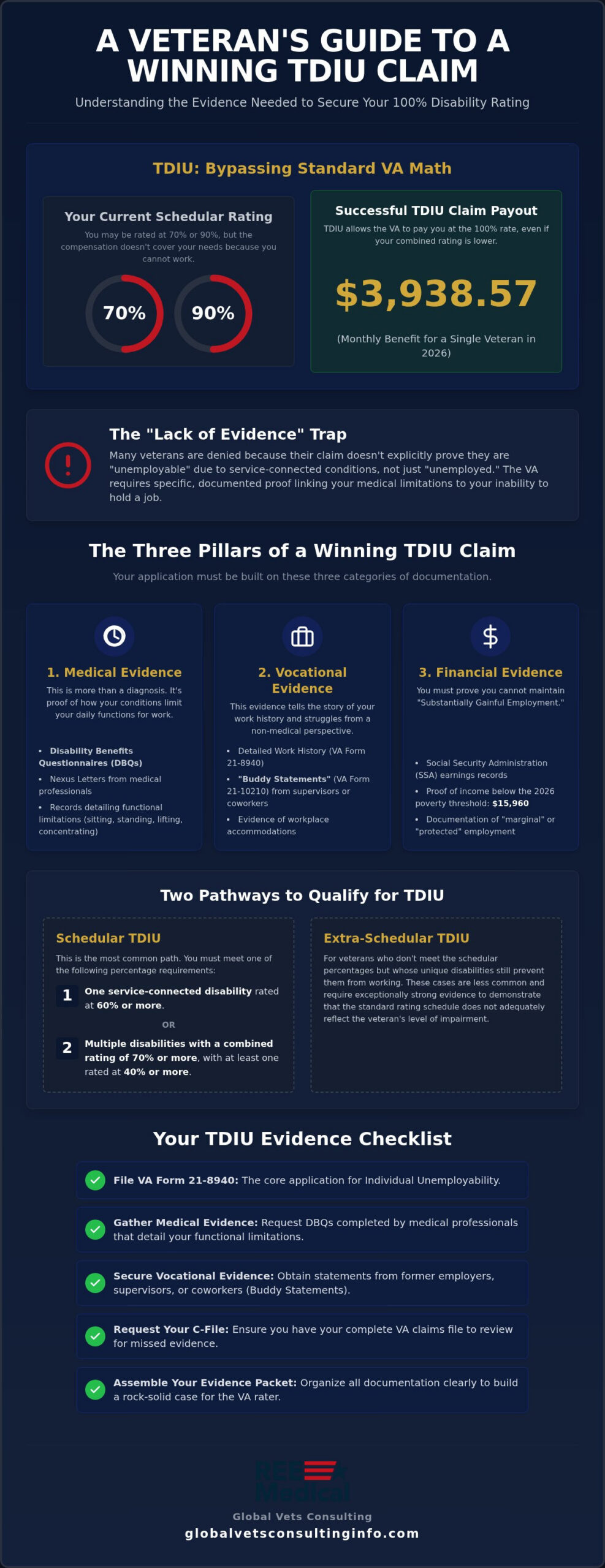
Winning a TDIU claim isn’t just about proving you have a disability; it’s about proving that your service-connected conditions make it impossible to keep a job. Many veterans find themselves trapped in the confusion of VA math, where a 70% or 90% rating simply doesn’t cover the bills, yet the VA still denies their request for 100% pay due to a lack of evidence. Understanding the specific evidence needed for tdiu claim approval is the difference between continued financial strain and the $3,938.57 monthly benefit you’ve earned.
As veterans ourselves, we understand the frustration of feeling like a number in a bureaucratic machine. You’ve served your country, and now you’re just looking for the stability you deserve. In this guide, you’ll discover the exact medical, vocational, and financial documentation required to secure Total Disability Based on Individual Unemployability in 2026. We’ll explore how to use Disability Benefits Questionnaires (DBQs) to create a clear medical-vocational link, explain the current $15,960 income threshold, and provide a step-by-step path to achieving peace of mind through professional documentation.
Key Takeaways
- Learn how TDIU bypasses standard VA math to pay you at the 100% disability rate, regardless of your current combined percentage.
- Identify the specific medical and vocational evidence needed for tdiu claim approval to overcome common “lack of evidence” denials.
- Discover how a properly completed Disability Benefits Questionnaire (DBQ) translates your symptoms into the “occupational impairment” language VA raters require.
- Understand the 2026 income thresholds and how to successfully document “marginal employment” if you are still working in a limited capacity.
- Get a step-by-step checklist for assembling your evidence packet, from requesting your C-File to securing professional medical documentation.
Understanding TDIU Evidence Requirements in 2026 🇺🇸
Total Disability Based on Individual Unemployability, or TDIU, is a lifeline for veterans who cannot maintain a job because of their service-connected disabilities. Even if your combined rating is only 70% or 80%, a successful claim allows the Department of Veterans Affairs (VA) to pay you at the 100% disability rate. For 2026, this means receiving $3,938.57 per month for a single veteran. The goal of your claim isn’t just to show you are “unemployed,” but to prove you are “unemployable” due to medical limitations. Knowing the exact evidence needed for tdiu claim success is your first step toward financial security.
There are two primary pathways to qualify for these benefits:
- Schedular TDIU: You have one disability rated at 60% or a combined rating of 70% with at least one condition at 40%.
- Extra-schedular TDIU: This is for veterans who don’t meet those percentages but have unique disabilities that clearly prevent them from working.
Many veterans fall into the “lack of evidence” trap. They assume the VA will see their unemployment and connect the dots. In reality, the VA often denies claims because the medical records don’t explicitly explain why a veteran can’t maintain “substantially gainful employment.” You must bridge that gap with specific documentation.
The 5103 Notice: What the VA Legally Requires
When you file, the VA sends a 5103 Notice, also called a “Duty to Assist” letter. It outlines what they need from you. While the VA has a legal obligation to help gather records, you shouldn’t leave your future in their hands. They often miss private medical files or employer statements that could win your case. Taking a proactive approach to your evidence needed for tdiu claim ensures nothing is left to chance.
Economic Impact: Defining Substantially Gainful Employment
To win, you must show you cannot earn above the federal poverty level, which is approximately $15,960 for a single person in 2026. If you earn less than this, the VA considers your work “marginal.” You might also qualify if you work in a “protected environment,” such as a family business where your limitations are accommodated in ways a typical employer wouldn’t allow. Clear financial records and employer letters are vital here.
The Three Pillars of Evidence Needed for TDIU Claims
Winning your claim requires more than just submitting a form and hoping for the best. You must build a rock-solid case that connects your medical conditions to your inability to work. Every successful application relies on three specific categories of documentation. When you understand the evidence needed for tdiu claim approval, you can stop guessing and start building a winning packet.
- Pillar 1: Medical Evidence. This includes Disability Benefits Questionnaires (DBQs) and nexus letters that document your functional limitations.
- Pillar 2: Vocational Evidence. This covers your work history, employer statements, and evidence of workplace accommodations.
- Pillar 3: Financial Evidence. The VA uses Social Security Administration (SSA) earnings records to verify you are below the 2026 poverty threshold of $15,960.
The foundation of this process is VA Form 21-8940, the Application for Individual Unemployability. This form is where you list your service-connected disabilities and explain how they prevent you from working. It acts as the roadmap for the VA rater. If the information on this form doesn’t match your medical records, your claim will likely face a denial.
Medical Evidence: Beyond the Diagnosis
A diagnosis alone won’t win your case. The VA doesn’t just care that you have “degenerative disc disease” or “PTSD”; they care about how those conditions stop you from performing a job. You must show the impact on your ability to sit, stand, lift, or concentrate for an eight-hour workday. A Disability Benefits Questionnaire (DBQ) serves as the primary medical tool for translating your physical or mental symptoms into the specific functional limitations that VA raters use to determine vocational impairment. Understanding how to present this medical evidence education is vital for a successful outcome.
Vocational and Lay Evidence
Your work history tells a story that medical records sometimes miss. Use “Buddy Statements” (VA Form 21-10210) from former supervisors or coworkers who witnessed your struggles. They can document how often you had to leave early due to pain or how your mental health affected your productivity. In complex cases, a Vocational Expert opinion can be the deciding factor, as they provide a professional analysis of why your specific limitations make you unemployable in the current labor market.
Finally, your financial records must be clear. The VA will scrutinize your earnings to ensure you aren’t engaged in “substantially gainful employment.” If you’re still working but earning less than $15,960 in 2026, you must prove the work is marginal or performed in a protected environment. Meticulous documentation here prevents the VA from using your small income against you. 🇺🇸
Bridging the Gap: Using DBQs to Prove Unemployability
The primary reason the VA denies TDIU claims is the disconnect between a medical diagnosis and how it actually stops you from working. A properly prepared Disability Benefits Questionnaire (DBQ) bridges this gap by focusing on “occupational impairment.” This is the specific language VA raters use to justify a VA rating increase to the 100% level. Your DBQ acts as the primary evidence needed for tdiu claim success by translating symptoms into workplace barriers:
- Physical Limitations: Translating chronic pain into specific restrictions on sitting, standing, or lifting for an eight-hour shift.
- Mental Health Barriers: Documenting how symptoms like anxiety or PTSD disrupt workplace social interactions and task concentration.
- Objective Data: Providing the specific clinical findings that a vocational expert requires to prove you are unemployable in the current labor market.
Evidence strategies differ based on your condition. For example, a dbq for mental health conditions emphasizes social and economic impairment rather than physical range of motion. Speaking the VA’s language ensures your file clearly demonstrates why you cannot maintain substantially gainful employment. 🇺🇸
Private DBQs vs. C&P Exams
While the VA schedules C&P exams, these are often too brief to capture your true medical evidence. A private DBQ allows you to submit a “Fully Developed Claim” that is meticulous and accurate before it reaches the rater’s desk. This proactive approach prevents the “lack of evidence” denial and speeds up your 2026 decision. Our team provides expert Disability Benefits Questionnaire (DBQ) preparation to help you document the full severity of your service-connected conditions. 🌎
Documenting Secondary Conditions
Secondary conditions, such as depression caused by chronic back pain, significantly strengthen your claim. When these conditions are linked, they provide a more comprehensive picture of your total disability. Following the va disability claims process step by step ensures you document every service-connected issue that contributes to your unemployability. 🇺🇸
Step-by-Step: Assembling Your TDIU Evidence Packet 📞
Organizing the evidence needed for tdiu claim approval is a methodical process that requires attention to detail. You cannot rely on the VA to find the documents that prove your case; you must take the lead. Building a packet that leaves no room for doubt ensures your file is ready for a favorable 2026 decision. Follow these steps to prepare your submission.
- Step 1: Obtain your C-File. Your claims file contains your entire history with the VA. Reviewing it allows you to see exactly what medical evidence the rater already has and where the gaps are.
- Step 2: Secure professional DBQs. Obtain updated Disability Benefits Questionnaires that accurately reflect your current limitations. This is the most effective way to document the need for a VA rating increase to the 100% level.
- Step 3: Collect SSA earnings reports and 21-4192 forms. You must verify that your income is below the 2026 threshold. Ensure your past employers complete Form 21-4192 to explain why your disabilities made continued work impossible.
- Step 4: Submit a Fully Developed Claim (FDC). By providing all documentation upfront, you bypass the standard gathering phase and move straight to the decision phase.
Avoiding Common Mistakes
The most frequent error veterans make is under-reporting their symptoms. Many of us were trained to “tough it out,” but downplaying your pain during an exam leads to a denial. If your evidence needed for tdiu claim doesn’t reflect your worst days, the rater will assume you are capable of working. If you’ve already faced a setback, learn how to move forward if your va claim denied for lack of evidence recently. 🇺🇸
How Global Vets Consulting Supports Your Mission
You don’t have to navigate this complex system alone. We specialize in professional DBQ preparation to ensure your medical evidence is meticulous and accurate. Our team focuses on reflecting your actual medical limitations so the VA sees the full picture of your disability. We provide immediate assistance through our 24/7 National Client Services Hotline and our 24/7 AI Veteran Intake Specialist. 🌎
Contact Global Vets Consulting today for expert DBQ support and take the next step toward the 100% rating you’ve earned. 📞
Securing Your Financial Stability in 2026 🇺🇸
Winning your TDIU claim is about more than just filling out forms; it’s about building a narrative of unemployability through meticulous documentation. By now, you understand how to navigate the 2026 economic benchmarks and how to use DBQs to speak the VA’s language. Organizing the specific evidence needed for tdiu claim success ensures that your service-connected conditions are evaluated fairly, moving you away from the “lack of evidence” trap and toward the 100% rate you deserve.
Global Vets Consulting, Worldwide, is dedicated to this mission. We provide the veteran-owned expertise and detailed DBQ documentation required to bring clarity to your case. Whether you’re just beginning or have faced previous denials, our 24/7 National Client Services Hotline and tech-forward resources are here to guide you. Our commitment to accuracy and peer-to-peer support means you don’t have to fight the system alone.
Ready to secure the benefits you earned? 🇺🇸 Get started with Global Vets Consulting today!
You’ve served your country with honor; now let’s work together to secure the stability you’ve earned for your future. 🌎
Frequently Asked Questions
Can I get TDIU if my rating is less than 60%?
Yes, you can qualify through an extra-schedular pathway if your disabilities prevent work despite not meeting the 60% or 70% schedular thresholds. The VA reviews these cases to see if your service-connected conditions present an exceptional disability picture that makes substantially gainful employment impossible. This process requires very specific medical documentation to prove that your situation is unique.
What happens if the VA denies my TDIU claim for lack of evidence?
Receiving a denial for a lack of evidence needed for tdiu claim approval doesn’t mean your journey is over. You can file a Supplemental Claim by submitting new and relevant documentation, such as a private DBQ that more accurately reflects the severity of your symptoms. This allows you to address the specific gaps the rater identified in your initial decision letter.
Do I need a vocational expert to win my TDIU claim in 2026?
A vocational expert isn’t a legal requirement for your claim, but their testimony is often the “missing link” in complex cases. These professionals evaluate how your medical restrictions interact with your specific job skills. They provide a professional conclusion on whether any “substantially gainful” work is truly available to you in the current national economy.
How much can I earn while receiving TDIU benefits?
Your annual earned income must generally remain below the 2026 federal poverty threshold of approximately $15,960 for a single veteran. If you earn more than this, you must prove the work is “marginal” or performed in a protected environment. A protected environment is one where your employer provides special accommodations that wouldn’t be found in a typical workplace.
Can I use Social Security Disability (SSDI) evidence for my VA claim?
You can and should use SSDI evidence to support your VA claim. Although the two agencies have different standards for disability, the VA is required to consider Social Security records if the disabilities involved are the same ones you’re claiming. This evidence provides a strong third-party perspective on your inability to maintain employment.
Article by
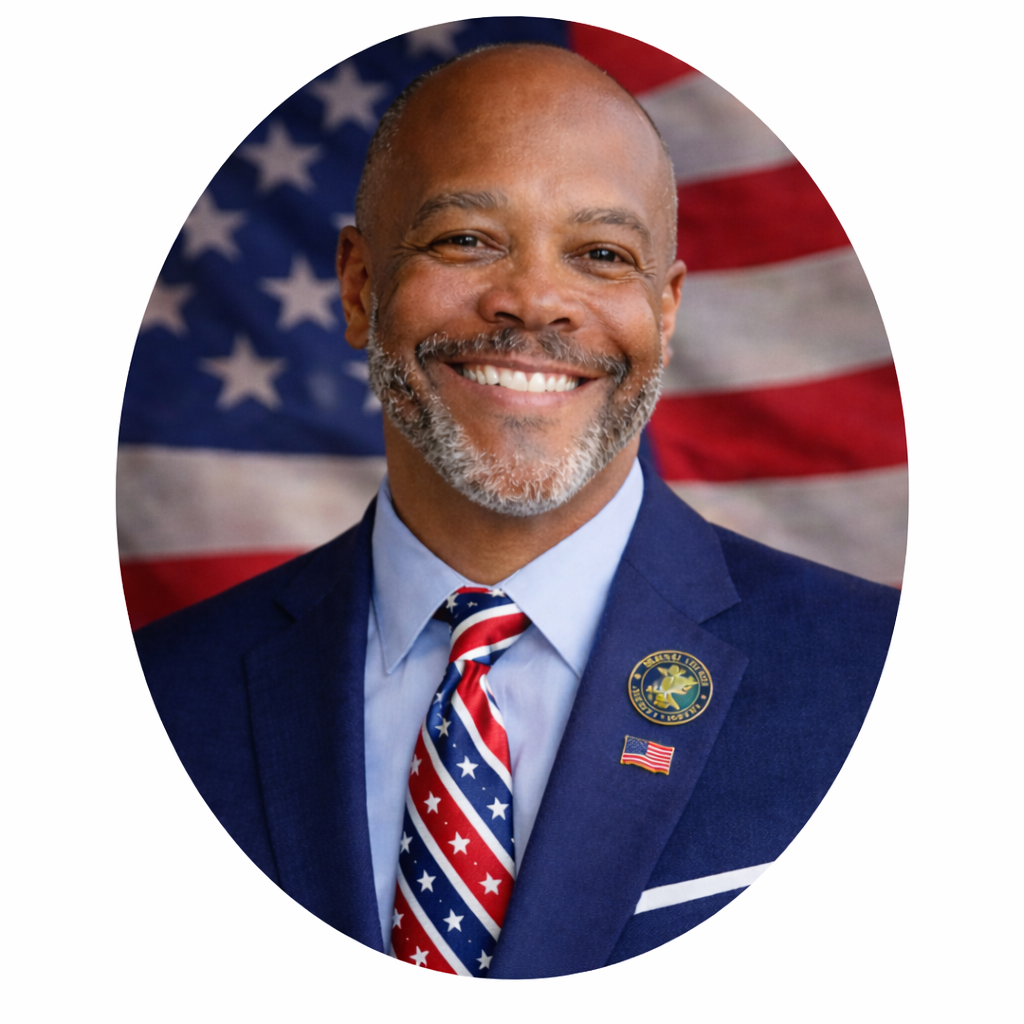
Willie Daniel
Willie Daniel is the Founder and Chief Executive Officer (CEO) of Global Vets Consulting (GVC) – National Veterans Disability Services, a veteran-led educational and medical evidence support organization dedicated to helping veterans better understand VA disability rating increases, DBQ medical evidence, secondary claims education, and C&P examination preparation.
He is a retired U.S. Army Medical Service Corps Officer with more than 27 years of honorable military service, a decorated Iraq combat veteran, and a retired federal official with the U.S. Department of Veterans Affairs. Throughout his military and federal career, Willie Daniel served in leadership, healthcare administration, operational, and veteran-support roles focused on improving services and support systems for servicemembers, veterans, and their families.
Drawing from decades of military leadership, healthcare administration, veteran advocacy, and federal government experience, Willie Daniel brings a practical, veteran-centered perspective to Global Vets Consulting’s educational articles, AI-powered veteran resources, video education initiatives, and outreach programs. His experience navigating military systems, medical documentation processes, and veteran-related administrative operations provides valuable insight into many of the challenges veterans face when seeking to better understand VA disability rating criteria, medical evidence, documentation strategies, and secondary condition education.
Through GVC’s “Veterans Helping Veterans” mission, his focus is on delivering clear, educational, and easy-to-understand information designed to empower veterans with knowledge, resources, and educational tools that may help them make more informed decisions regarding their individual VA disability journeys.
The information provided through GVC is intended for educational and informational purposes only and should not be considered legal or medical advice.
Disclaimer
Disclaimer: Global Vets Consulting, LLC (“GVC”) is a veteran-led educational and medical evidence support organization. GVC is not a law firm, is not a Veterans Service Organization (VSO), and is not affiliated with the U.S. Department of Veterans Affairs (VA) or any government agency.
Global Vets Consulting does not provide legal advice, medical advice, medical treatment, or healthcare services. GVC does not prepare, file, or submit VA disability claims on behalf of veterans. All information provided through this website, blog articles, videos, educational materials, AI tools, dashboards, templates, and communications is intended solely for general educational and informational purposes.
Veterans are encouraged to consult with accredited representatives, licensed attorneys, qualified medical providers, or Veterans Service Organizations regarding their specific legal, medical, or VA-related matters. VA disability decisions, ratings, and outcomes are determined solely by the U.S. Department of Veterans Affairs based on applicable laws, regulations, medical evidence, and individual circumstances. Past results do not guarantee future outcomes.

