

What if the VA’s version of addition is intentionally designed to make your total rating smaller than the sum of its parts? It’s a confusing reality for many who discover that a 50% rating and a 30% rating somehow result in a 65% score, which the VA then rounds down to 60%. If you feel like the system is shortchanging your service, you aren’t alone. Learning how to calculate combined va disability rating is the first step toward ensuring you receive every dollar you’ve earned in 2026. 🇺🇸
We understand the frustration of feeling like a number in a bureaucratic machine. This guide will help you master the complexities of VA Math so you can accurately predict your compensation and plan for your future. We’ll explain the “efficient person” theory, show you how the 2.8% COLA increase impacts your monthly check, and provide clear strategies for using medical evidence to secure a rating increase. You’ll gain a transparent view of the combined ratings table and the tools needed to advocate for yourself effectively.
Key Takeaways
- Understand the “Efficient Person” theory and why the VA views your body as a diminishing percentage of health rather than a simple sum of conditions.
- Learn exactly how to calculate combined va disability rating using a step-by-step method that prioritizes your most severe disabilities first.
- Discover how the Bilateral Factor provides a 10% mathematical boost for paired conditions affecting both sides of your body.
- Find out how high-quality Disability Benefits Questionnaires (DBQs) and medical evidence ensure your individual ratings are high enough to move the needle on your total compensation.
- Gain the clarity needed to navigate 2026 COLA increases and verify if your current monthly check matches the benefits you’ve actually earned.
What is VA Math? Understanding the ‘Efficient Person’ Concept
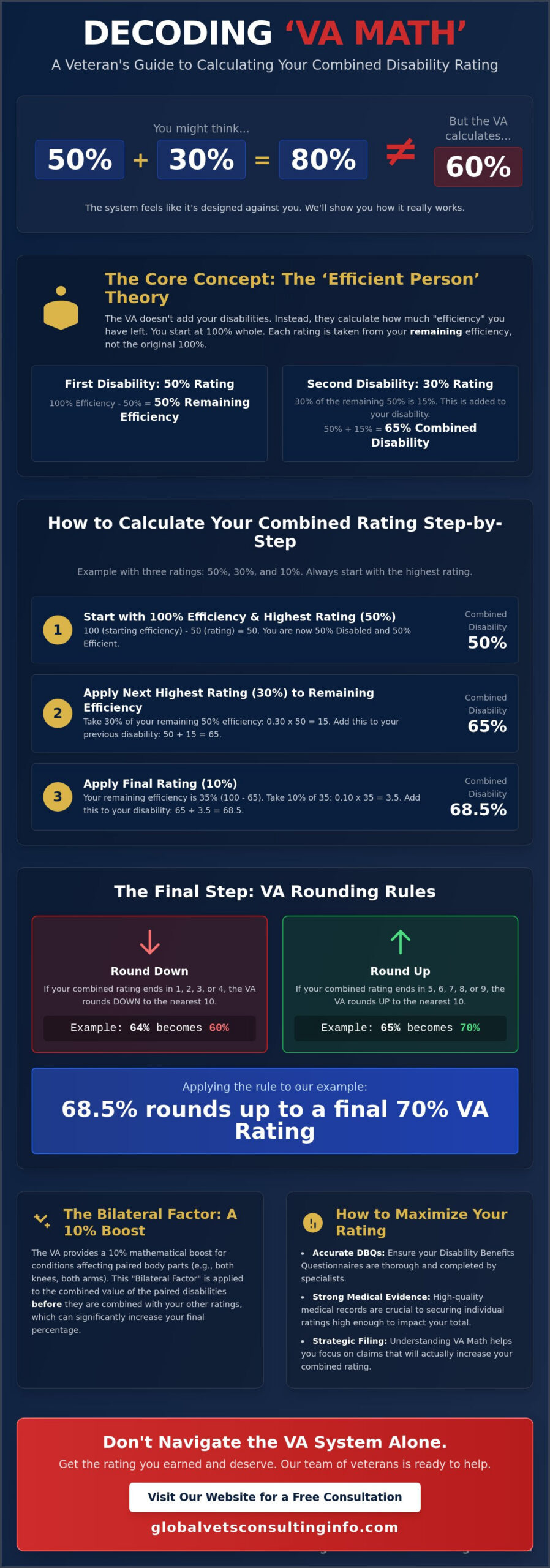
VA Math is the specific formula the Department of Veterans Affairs uses to determine your total disability level when you have more than one service-connected condition. It isn’t standard arithmetic, and it often feels counterintuitive to veterans who expect their ratings to be added together. To understand how to calculate combined va disability rating, you must first grasp the “Efficient Person” theory. The VA assumes every veteran begins as 100% efficient. When you receive a rating, it isn’t subtracted from a bottomless pool. Instead, it reduces your remaining efficiency. 🇺🇸
Think of your body as a pie. If you have a 50% rating for a respiratory condition, the VA considers you 50% disabled and 50% efficient. If you later receive a 30% rating for a secondary condition, the VA doesn’t add 30 to 50. They take 30% of your remaining 50% efficiency. That calculation equals 15%. Your total combined rating becomes 65% (50 + 15), which the VA then rounds to the nearest 10% to determine your monthly payment.
Why the VA Doesn’t Just Add Percentages
The logic behind this system is rooted in 38 CFR Part 4. The law states that a person cannot be more than 100% disabled. If the VA simply added percentages, many veterans would quickly exceed 100%, which the system doesn’t allow. This is why 50% plus 50% equals 75% (rounded to 80%) rather than 100%. The system treats your body as a finite resource. Each new claim takes a smaller bite out of the efficiency you have left, making it progressively harder to reach that 100% mark.
The Role of Rounding in Your Final Rating
Your calculated percentage is rarely a clean number ending in zero. The VA rounds combined ratings to the nearest 10%, meaning a calculated 45% becomes a 50% rating. If your math lands on a four, such as 64%, the VA rounds down to 60%. If it lands on a five, such as 65%, it rounds up to 70%. This rounding threshold is a critical part of knowing how to calculate combined va disability rating accurately, as a single percentage point can change your 2026 compensation bracket.
How to Calculate Your Combined VA Disability Rating Step-by-Step
Knowing how to calculate combined va disability rating manually is the only way to be certain the VA hasn’t made a clerical error in your file. While automated tools provide quick estimates, understanding the logic empowers you to audit your own decision letters. To begin, you must gather all your service-connected ratings. Don’t just look at the total; look at each individual percentage assigned to your specific conditions. 🇺🇸
The process follows a strict sequence. You must always start with your highest rating and work your way down to the lowest. This isn’t just a suggestion; it’s how the math maintains its internal logic. By starting with the largest “bite” out of your 100% efficiency, the remaining percentages are applied to a smaller and smaller balance. This is why a 10% rating added at the end of a high claim often feels like it does nothing to your total number.
Using the VA Combined Rating Table
The VA uses a grid system to help simplify these calculations. You locate your highest rating on the left-hand column and your second-highest rating on the top row. The intersection of these two numbers is your combined score. If you have more than two disabilities, you take that new combined score and find it on the left column, then find your third disability on the top row. This iterative approach is a core part of the va disability claims process step by step. If you find the table difficult to navigate, our educational resources offer a clear path forward.
A Practical Calculation Example
Let’s look at a veteran with three ratings: 50%, 30%, and 10%.
- Step 1: 100% minus 50% leaves 50% remaining efficiency.
- Step 2: 30% of that remaining 50% is 15. 50 minus 15 leaves 35% efficiency.
- Step 3: 10% of that remaining 35% is 3.5. 35 minus 3.5 leaves 31.5% efficiency.
The final calculated disability is 68.5% (100 minus 31.5). Following the rounding rules, the VA rounds 68.5% up to 70%. You can then cross-reference this with the official VA compensation rates to determine your exact 2026 monthly payment.
The Bilateral Factor: A 10% Boost for Paired Conditions
The VA acknowledges that suffering from disabilities on both sides of your body creates a unique level of hardship. To account for this, they apply what is known as the Bilateral Factor. This is a 10% increase applied to the combined rating of disabilities that affect paired extremities, such as both knees or both shoulders. When you’re figuring out how to calculate combined va disability rating, identifying these pairings is vital. It often provides the mathematical nudge needed to cross into a higher compensation bracket. 🇺🇸
Identifying Extremity vs. Non-Extremity Disabilities
The bilateral factor only applies to the arms, legs, and paired skeletal muscles. Internal conditions or systemic issues don’t qualify for this specific boost. For instance, while a dbq for mental health conditions is essential for securing a high rating in that category, it won’t trigger bilateral math. Common qualifying pairings include:
- Ankles, feet, and toes
- Knees and hip joints
- Shoulders, elbows, and wrists
How the 10% Boost is Calculated
The math for bilateral conditions happens in its own silo before the rest of your ratings are considered. First, you combine your bilateral disabilities using the standard table. Next, you calculate 10% of that combined value and add it back to the original bilateral sum. This total is then treated as one single disability when you combine it with non-bilateral conditions like tinnitus or sleep apnea.
The VA’s official guide to disability ratings explains that this extra 10% is added to the combined value, not your total whole person rating. If you suspect your current rating hasn’t accounted for your bilateral conditions, our team can help you understand the medical evidence education required to correct your file. This small mathematical adjustment often results in thousands of dollars of additional tax-free compensation over a veteran’s lifetime.
Maximizing Your Combined Rating with Accurate DBQs
The formula for how to calculate combined va disability rating is fixed, but the numbers you feed into that formula are not. Your final compensation depends entirely on the individual ratings assigned to your service-connected conditions. If your medical evidence is incomplete or fails to capture the full severity of your symptoms, the “VA Math” will always result in a lower monthly check. Securing a professional dbq for va disability rating increase ensures that the VA has the precise data needed to award the highest accurate percentage for each claim. 🇺🇸
Beyond primary conditions, you should focus on documenting Secondary Service Connections. These are disabilities caused or aggravated by an existing service-connected issue, such as sleep apnea secondary to PTSD or radiculopathy secondary to a back injury. Each secondary condition adds another percentage to your “pie,” helping you climb the ladder toward a 100% rating. Without thorough documentation, these critical percentages are often left off the table.
The Impact of Evidence on Rounding
Precision in your medical evidence is the difference between thousands of dollars in annual benefits. Consider a veteran whose calculated rating sits at 64%. Because of the rounding rule, the VA rounds this down to 60%. However, if a more detailed DBQ captures a few additional symptoms, that calculated rating might move to 66%. This small 2% shift triggers the rounding rule to jump the veteran up to a 70% total rating. Over a lifetime, the financial gap between a 60% and 70% rating is massive, making every piece of medical evidence vital.
Why Professional Medical Documentation Matters
Standard C&P examinations are often brief and may not document the full extent of your daily struggles. In contrast, a comprehensive, private what is a dbq provides a structured way to present your medical history and current limitations clearly. At Global Vets Consulting, our “Veterans Helping Veterans” mission drives us to provide the educational resources you need to submit a fully developed claim. We’re here to ensure your documentation is meticulous and your outcomes are earned.
🌎 Worldwide
🌐 GlobalVetsConsultingInfo.com
📞 24/7 National Client Services Hotline
🤖 24/7 AI Veteran Intake Specialist
Take Control of Your Disability Rating in 2026
Navigating the “Whole Person” theory is a challenge, but you now have the tools to audit your own file. You understand that VA Math isn’t about simple addition. It’s about how each condition impacts your remaining efficiency. By identifying bilateral factors and ensuring your medical evidence is precise, you can move the needle on your final percentage. Learning how to calculate combined va disability rating is the first step toward securing the compensation you’ve earned through your service. 🇺🇸
Don’t let a rounding error or a poorly documented symptom keep you from your full benefits. Global Vets Consulting has been veteran-owned and operated since 2021, and we’re dedicated to your success. We specialize in professional DBQ preparation and medical evidence education to ensure your claim is accurate from the start. You’ve served your country; now let us serve you.
🇺🇸 Get the Medical Evidence You Need. Consult with Global Vets Now
🌎 Worldwide
🌐 GlobalVetsConsultingInfo.com
📞 24/7 National Client Services Hotline: 800-484-0551
🤖 24/7 AI Veteran Intake Specialist
Frequently Asked Questions
Does the VA always round up to the nearest 10%?
No, the VA rounds to the nearest 10% increment, which can result in your rating being rounded either up or down. If your calculated combined rating ends in a 5% or higher, the VA rounds up to the next 10% level. However, if your rating ends in a 4% or lower, it’s rounded down. For example, a 74% rating results in 70% compensation, while a 75% rating jumps you to the 80% pay rate.
Can I have a combined rating of more than 100%?
No, it’s impossible to have a combined rating that exceeds 100%. The VA logic dictates that a veteran is a single entity, and you cannot be more than 100% disabled. Once your math reaches a 95% threshold, it rounds to 100%. Any additional service-connected conditions beyond that point won’t increase your percentage, though they may help you qualify for Special Monthly Compensation (SMC) in specific circumstances.
How does the bilateral factor affect my total VA rating?
The bilateral factor adds a 10% bonus to the combined value of disabilities affecting both sides of your body. This boost is applied to the sub-total of those specific paired conditions before that number is combined with your other, non-paired ratings. Understanding this specific rule is vital when you’re learning how to calculate combined va disability rating, as it often provides the extra points needed to reach a higher rounding threshold.
Is there a difference between combined rating and ‘VA Math’?
There’s no functional difference between the two terms. “Combined rating” is the official language used by the Department of Veterans Affairs in your decision letters. “VA Math” is the common term used within the veteran community to describe the non-traditional addition used to reach that total. Both terms refer to the same process of applying percentages to your remaining efficiency rather than simply adding them together.
What happens to my combined rating if I add a new secondary condition?
Adding a new secondary condition increases your rating by taking a percentage of the efficiency you have left. If you’re currently 60% disabled, you have 40% efficiency remaining. A new 20% secondary condition would take 20% of that remaining 40%, which adds 8% to your total. This demonstrates why knowing how to calculate combined va disability rating is so important when you’re seeking a VA rating increase through secondary claims.

Article by
Willie Daniel
Willie Daniel is the Founder and Chief Executive Officer (CEO) of Global Vets Consulting (GVC) – National Veterans Disability Services, a veteran-led educational and medical evidence support organization dedicated to helping veterans better understand VA disability rating increases, DBQ medical evidence, secondary claims education, and C&P examination preparation.
He is a retired U.S. Army Medical Service Corps Officer with more than 27 years of honorable military service, a decorated Iraq combat veteran, and a retired federal official with the U.S. Department of Veterans Affairs. Throughout his military and federal career, Willie Daniel served in leadership, healthcare administration, operational, and veteran-support roles focused on improving services and support systems for servicemembers, veterans, and their families.
Drawing from decades of military leadership, healthcare administration, veteran advocacy, and federal government experience, Willie Daniel brings a practical, veteran-centered perspective to Global Vets Consulting’s educational articles, AI-powered veteran resources, video education initiatives, and outreach programs. His experience navigating military systems, medical documentation processes, and veteran-related administrative operations provides valuable insight into many of the challenges veterans face when seeking to better understand VA disability rating criteria, medical evidence, documentation strategies, and secondary condition education.
Through GVC’s “Veterans Helping Veterans” mission, his focus is on delivering clear, educational, and easy-to-understand information designed to empower veterans with knowledge, resources, and educational tools that may help them make more informed decisions regarding their individual VA disability journeys.
The information provided through GVC is intended for educational and informational purposes only and should not be considered legal or medical advice.
Disclaimer
Disclaimer: Global Vets Consulting, LLC (“GVC”) is a veteran-led educational and medical evidence support organization. GVC is not a law firm, is not a Veterans Service Organization (VSO), and is not affiliated with the U.S. Department of Veterans Affairs (VA) or any government agency.
Global Vets Consulting does not provide legal advice, medical advice, medical treatment, or healthcare services. GVC does not prepare, file, or submit VA disability claims on behalf of veterans. All information provided through this website, blog articles, videos, educational materials, AI tools, dashboards, templates, and communications is intended solely for general educational and informational purposes.
Veterans are encouraged to consult with accredited representatives, licensed attorneys, qualified medical providers, or Veterans Service Organizations regarding their specific legal, medical, or VA-related matters. VA disability decisions, ratings, and outcomes are determined solely by the U.S. Department of Veterans Affairs based on applicable laws, regulations, medical evidence, and individual circumstances. Past results do not guarantee future outcomes.