

The VA doesn’t rate you on your panic attacks alone; they rate you on how those attacks disrupt your ability to work and maintain a life. It’s a frustrating reality for many who feel their symptoms are dismissed or misunderstood by examiners during a C&P exam. Filing a va claim for panic attacks often feels like a complex administrative hurdle rather than a path to support. You deserve a process that recognizes the impact of your service without causing additional stress or confusion over how mental health percentages are calculated.
This guide provides a clear roadmap for documenting your symptoms and securing the disability rating you’ve earned through proper medical evidence. You’ll learn the exact steps to build a high-quality DBQ that accurately reflects your social and industrial impairment. We will walk through the specific criteria used in 2026 to ensure your evidence matches the VA’s requirements for a fair evaluation. By the end of this article, you’ll have the tools to move forward with steady confidence and a plan to achieve the rating that reflects your true level of impairment.
Key Takeaways
- Understand how the VA applies the General Rating Formula for Mental Disorders to evaluate your level of social and industrial impairment.
- Identify the specific medical evidence needed to establish a direct service connection and build a successful va claim for panic attacks.
- Learn why a detailed Symptom Journal is vital for providing the objective data that supports a higher disability rating.
- Prepare for your C&P exam with strategies to communicate your “worst days” effectively using the standard DBQ format.
- Gain a clear roadmap for navigating the complex 2026 rating criteria so you can secure the compensation you’ve earned.
Understanding the VA Rating for Panic Disorder in 2026
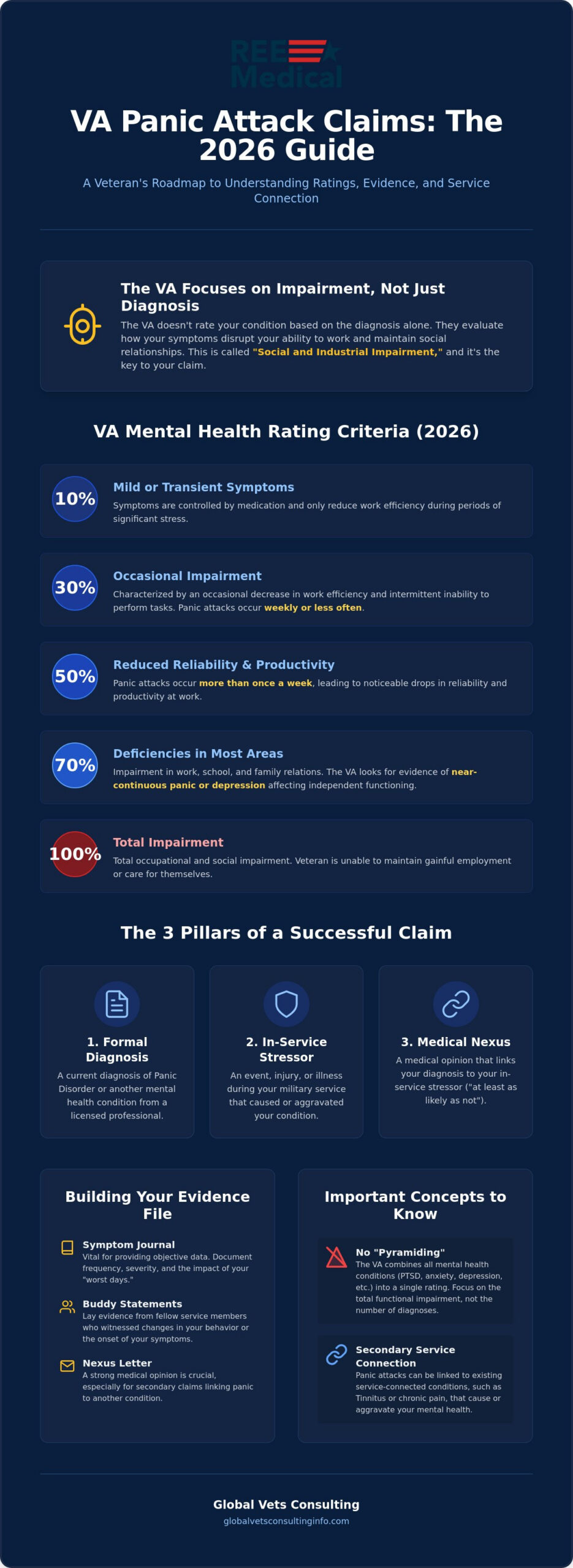
The VA evaluates your condition based on the General Rating Formula for Mental Disorders, which is found in 38 CFR § 4.130. This schedule ranges from 0%, which acknowledges a service connection without monthly compensation, up to 100% for total disability. When you file a va claim for panic attacks, the examiner isn’t just looking for a name for your symptoms; they’re looking for how those symptoms prevent you from functioning in a workplace or a community setting. Social and industrial impairment is the primary metric the VA uses to determine how much your mental health condition interferes with your ability to earn a living and maintain relationships.
The 2026 Mental Health Rating Criteria
The rating you receive depends on the frequency and severity of your symptoms. As of 2026, the VA looks for specific markers of impairment to assign a percentage:
- 10% Rating: Symptoms are transient or controlled by continuous medication; they only decrease work efficiency during periods of significant stress.
- 30% Rating: Characterized by an occasional decrease in work efficiency and intermittent periods of inability to perform tasks. Panic attacks typically occur weekly or less often.
- 50% Rating: This level involves reduced reliability and productivity. Symptoms like panic attacks occur more than once a week.
- 70% Rating: Deficiencies in most areas, such as work, school, and family relations. The VA looks for evidence of near-continuous panic or depression affecting your ability to function independently.
- 100% Rating: Total occupational and social impairment. This is the threshold for veterans who cannot maintain gainful employment or care for themselves.
Documenting “near-continuous” panic attacks is essential for those seeking a 70% rating or higher. Without clear evidence of how often these attacks occur, the VA may default to a lower percentage that doesn’t reflect your daily reality.
Panic Disorder vs. PTSD vs. Anxiety
Veterans often ask if they should file for Panic Disorder specifically or a broader anxiety condition. The VA has a strict rule against “pyramiding,” which means you can only receive one rating for all mental health conditions combined. Whether your records show PTSD, depression, or panic attacks, the VA groups them together under one umbrella. Your specific diagnosis matters much less than the functional evidence of impairment documented in your DBQ for mental health conditions. Focusing on how the attacks stop you from finishing tasks or interacting with others is the most effective way to build a strong va claim for panic attacks.
Establishing Service Connection for Your Panic Attack Claim
To win your va claim for panic attacks, you must satisfy the “Big Three” requirements. This isn’t just about showing you have symptoms; it’s about proving a direct line from your military service to your current health. First, you need a formal diagnosis from a licensed professional. Second, you must identify an in-service event or stressor. Third, you need a medical nexus, which is the link between your service and your diagnosis. The VA uses the General Rating Formula for Mental Disorders to evaluate these claims, but the foundation is always the service connection.
Proving an In-Service Stressor
You need credible evidence that something happened during your service to trigger these attacks. This might be found in your personnel records or deployment logs. Sometimes, a sharp decline in performance reviews can indicate the onset of mental health struggles. If medical records from your time in service are thin, “Buddy Statements” from fellow service members who witnessed your first attacks provide essential lay evidence. These statements help paint a picture of how your behavior or personality changed during your time in uniform.
Secondary Service Connection Strategies
Many veterans find success by linking panic disorder to existing service-connected conditions. For example, the constant ringing of Tinnitus or the grinding exhaustion of chronic back pain can lead to severe anxiety and sudden panic. Securing a successful va claim for panic attacks as a secondary condition requires showing that your physical health is the driving force behind your mental health symptoms. The VA often denies these secondary claims because they lack a strong medical opinion. A Nexus Letter from a qualified provider acts as the bridge, explaining why your physical disability “is at least as likely as not” causing your panic attacks. If you’re unsure where to start with your documentation, exploring veteran benefits education can help you understand the requirements for secondary conditions.
How to Gather Winning Evidence: The Step-by-Step Guide
Winning a va claim for panic attacks requires a structured evidence trail that leaves no room for interpretation. You must move beyond general descriptions of your symptoms and provide the VA with objective data. Follow these four essential steps to build your case:
- Step 1: Secure a formal diagnosis. You need a current diagnosis of Panic Disorder from a licensed mental health professional. Without this, your claim will fail before it starts.
- Step 2: Maintain a Symptom Journal. Track every attack, including the date, duration, triggers, and the severity of the physical symptoms. This provides the “frequency” data the VA requires for higher ratings.
- Step 3: Utilize a Disability Benefits Questionnaire (DBQ). Use a standardized form to ensure your medical evidence is presented in the specific format VA raters expect.
- Step 4: Collect lay evidence. Gather statements from people who see your symptoms firsthand, such as family members or coworkers, to document your daily struggles.
The Power of a Private DBQ
A private DBQ is often the most critical piece of evidence in a Fully Developed Claim (FDC). Unlike a rushed C&P exam where an examiner might miss key details, a private evaluation allows for a thorough review of your history. Understanding what is a dbq helps you realize that this document is your primary tool for communication with the Rater. A DBQ is the specific language the VA uses to determine your rating percentage based on the General Rating Formula for Mental Disorders. By submitting a high-quality DBQ upfront, you provide the evidence needed to support your claim from day one.
Using Lay Evidence and Buddy Letters
Lay evidence provides the “human” side of your va claim for panic attacks. While medical records prove the diagnosis, buddy letters from spouses, supervisors, or fellow veterans prove the impact. These statements should focus entirely on observable behavior. Instead of having a spouse say “he has panic attacks,” they should describe how you “suddenly become pale, start shaking, and have to leave the room for twenty minutes three times a week.” This level of detail helps the VA rater see the actual industrial and social impairment you face. If you need help organizing your evidence, you can get started with expert DBQ education today.
Navigating the C&P Exam and Next Steps
The Compensation and Pension (C&P) exam is often the most stressful part of a va claim for panic attacks. This is a forensic evaluation where an examiner uses the same DBQ format you’ve already prepared. It isn’t a therapy session; it’s a structured interview designed to document your level of impairment. You must be completely honest about your symptoms. Don’t tell the examiner how you’re feeling at the moment of the exam. Instead, describe your “worst days.” If you’re having a rare good day during the appointment, failing to mention your most severe symptoms can lead to an inaccurate and lower rating.
Common C&P Exam Pitfalls
Downplaying your symptoms is the most frequent reason for a low rating. Many veterans have a habit of saying they’re “doing fine” when asked how they are. In a C&P exam, that habit can cost you the benefits you’ve earned. Another pitfall is arriving unprepared. Bring a copy of your private DBQ to the exam. It serves as a vital reference to ensure you don’t forget to mention specific triggers, the frequency of your attacks, or how your condition affects your work performance.
What to Do After the Decision
Once you receive your Rating Decision letter, read the “Reasons for Decision” section carefully. This section explains exactly why the VA assigned a specific percentage. If you find your VA claim denied for lack of evidence, it’s often because the link between your service and your panic attacks wasn’t clear enough. You can recover by submitting supplemental evidence or a more detailed medical nexus.
Always verify that all VA disability claims process steps were followed to prevent administrative delays. If your condition worsens over time, you can request a VA disability rating increase to match your current level of impairment. We are here to support you through every step of this journey.
🇺🇸 Global Vets Consulting
📞 24/7 National Client Services Hotline: [Insert Number]
🌐 24/7 AI Veteran Intake Specialist: GlobalVetsConsultingInfo.com
🌎 Worldwide Support for Veterans
Secure Your Earned Disability Benefits
Winning a va claim for panic attacks requires a strategic approach to medical evidence that clearly demonstrates your level of social and industrial impairment. You’ve learned that the VA doesn’t just look for a diagnosis; they look for proof of how your symptoms disrupt your ability to work and maintain relationships. By documenting your “worst days” and using a structured DBQ, you provide the rater with the objective data needed for a fair evaluation. Don’t let a lack of clarity result in a rating that fails to reflect your daily reality.
Global Vets Consulting is veteran-owned and operated since 2021, specializing in mental health DBQ education and resource awareness. We offer 24/7 National Client Services support to guide you through every step of this process with duty and respect. Get the Professional DBQ Documentation You Need for Your Panic Attack Claim today and start your journey toward a successful outcome. You’ve done the hard work of serving; now let’s ensure you receive the benefits you’ve earned. 🇺🇸
Frequently Asked Questions
Can I get VA disability for panic attacks without a PTSD diagnosis?
Yes, you can receive disability benefits for panic disorder even if you don’t have a PTSD diagnosis. The VA evaluates mental health conditions based on the level of social and industrial impairment rather than just the clinical label. As long as you have a formal diagnosis of panic disorder and evidence of a service connection, you can move forward with your va claim for panic attacks.
How much does the VA pay for a 50% panic disorder rating in 2026?
As of July 2026, the monthly compensation rate for a veteran with a 50% disability rating and no dependents is $1,132.90. This amount is designed to compensate for reduced reliability and productivity caused by your symptoms. If your condition includes panic attacks that occur more than once a week, this rating level may accurately reflect your current level of social impairment.
What is the difference between a panic attack and an anxiety attack in the eyes of the VA?
The VA primarily focuses on how your symptoms impact your daily life rather than the clinical distinction between panic and anxiety attacks. While panic attacks are often sudden and intense, the VA rates both under the same General Rating Formula for Mental Disorders. Your rating depends on the frequency and severity of your symptoms and how they interfere with your ability to work and maintain relationships.
Do I have to go to the VA’s C&P exam if I already submitted a private DBQ?
You should attend your C&P exam even if you’ve already submitted a private DBQ to avoid a summary denial of your benefits. While a high-quality private DBQ provides strong medical evidence, the VA often requires their own examiner to verify the findings. Attending the exam ensures your va claim for panic attacks stays on track and gives you another opportunity to document your symptoms effectively.
Can panic attacks be claimed as secondary to a physical injury?
Yes, panic attacks can be claimed as a secondary condition if they are caused or aggravated by a service-connected physical injury. For example, living with the constant ringing of tinnitus or the limitations of a musculoskeletal condition often leads to severe anxiety and panic. You’ll need a medical nexus letter to prove that your mental health symptoms are at least as likely as not related to your physical disability.

Article by
Willie Daniel
Willie Daniel is the Founder and Chief Executive Officer (CEO) of Global Vets Consulting (GVC) – National Veterans Disability Services, a veteran-led educational and medical evidence support organization dedicated to helping veterans better understand VA disability rating increases, DBQ medical evidence, secondary claims education, and C&P examination preparation.
He is a retired U.S. Army Medical Service Corps Officer with more than 27 years of honorable military service, a decorated Iraq combat veteran, and a retired federal official with the U.S. Department of Veterans Affairs. Throughout his military and federal career, Willie Daniel served in leadership, healthcare administration, operational, and veteran-support roles focused on improving services and support systems for servicemembers, veterans, and their families.
Drawing from decades of military leadership, healthcare administration, veteran advocacy, and federal government experience, Willie Daniel brings a practical, veteran-centered perspective to Global Vets Consulting’s educational articles, AI-powered veteran resources, video education initiatives, and outreach programs. His experience navigating military systems, medical documentation processes, and veteran-related administrative operations provides valuable insight into many of the challenges veterans face when seeking to better understand VA disability rating criteria, medical evidence, documentation strategies, and secondary condition education.
Through GVC’s “Veterans Helping Veterans” mission, his focus is on delivering clear, educational, and easy-to-understand information designed to empower veterans with knowledge, resources, and educational tools that may help them make more informed decisions regarding their individual VA disability journeys.
The information provided through GVC is intended for educational and informational purposes only and should not be considered legal or medical advice.
Disclaimer
Disclaimer: Global Vets Consulting, LLC (“GVC”) is a veteran-led educational and medical evidence support organization. GVC is not a law firm, is not a Veterans Service Organization (VSO), and is not affiliated with the U.S. Department of Veterans Affairs (VA) or any government agency.
Global Vets Consulting does not provide legal advice, medical advice, medical treatment, or healthcare services. GVC does not prepare, file, or submit VA disability claims on behalf of veterans. All information provided through this website, blog articles, videos, educational materials, AI tools, dashboards, templates, and communications is intended solely for general educational and informational purposes.
Veterans are encouraged to consult with accredited representatives, licensed attorneys, qualified medical providers, or Veterans Service Organizations regarding their specific legal, medical, or VA-related matters. VA disability decisions, ratings, and outcomes are determined solely by the U.S. Department of Veterans Affairs based on applicable laws, regulations, medical evidence, and individual circumstances. Past results do not guarantee future outcomes.

