
Receiving a decision letter stating your va claim denied due to lack of nexus isn’t a final verdict on your health; it’s a signal that your documentation failed to bridge the gap between your service and your current diagnosis. It’s incredibly frustrating to feel like a C&P examiner ignored your history or that complex VA jargon has locked you out of the benefits you earned. You know your condition started in uniform, and having the VA tell you there’s no link can feel like a dismissal of your entire service record.
We understand the anxiety that comes with missing appeal deadlines and the confusion of navigating the VA’s shifting requirements. This guide will show you exactly how to identify the specific gaps in your medical evidence and the step-by-step process to rebuild your claim using professional documentation. We’ll explore how to navigate the new “but for” causation standards implemented in 2026, the critical role of Disability Benefits Questionnaires (DBQs), and how to secure a solid medical opinion that proves your condition is at least as likely as not related to your service before your 365 day appeal window closes.
Key Takeaways
- Understand why a va claim denied due to lack of nexus is often a failure of documentation rather than a lack of medical truth, and how you can bridge that gap.
- Identify the four most common reasons the VA rejects nexus evidence, including vague medical rationale and a doctor’s failure to review your complete C-File.
- Learn the methodical process of requesting your records to pinpoint exactly where a C&P examiner’s report fell short of the required legal standards.
- Discover how standardized Disability Benefits Questionnaires (DBQs) provide the objective clinical data points necessary to satisfy the VA’s 2026 “but for” causation requirements.
- Determine whether a Supplemental Claim or a Higher-Level Review is the most effective strategic path to preserve your original effective date and secure your benefits.
What Does a VA Denial for ‘Lack of Nexus’ Actually Mean?
In the VA benefits system, a nexus is the essential medical bridge that connects your current health condition to your time in uniform. When a veteran receives a notification that their va claim denied due to lack of nexus, it signifies that the VA acknowledges you have a medical condition, but they don’t believe your military service caused it. Essentially, a “Lack of Nexus” is a failure to provide sufficient medical rationale linking service to a current diagnosis.
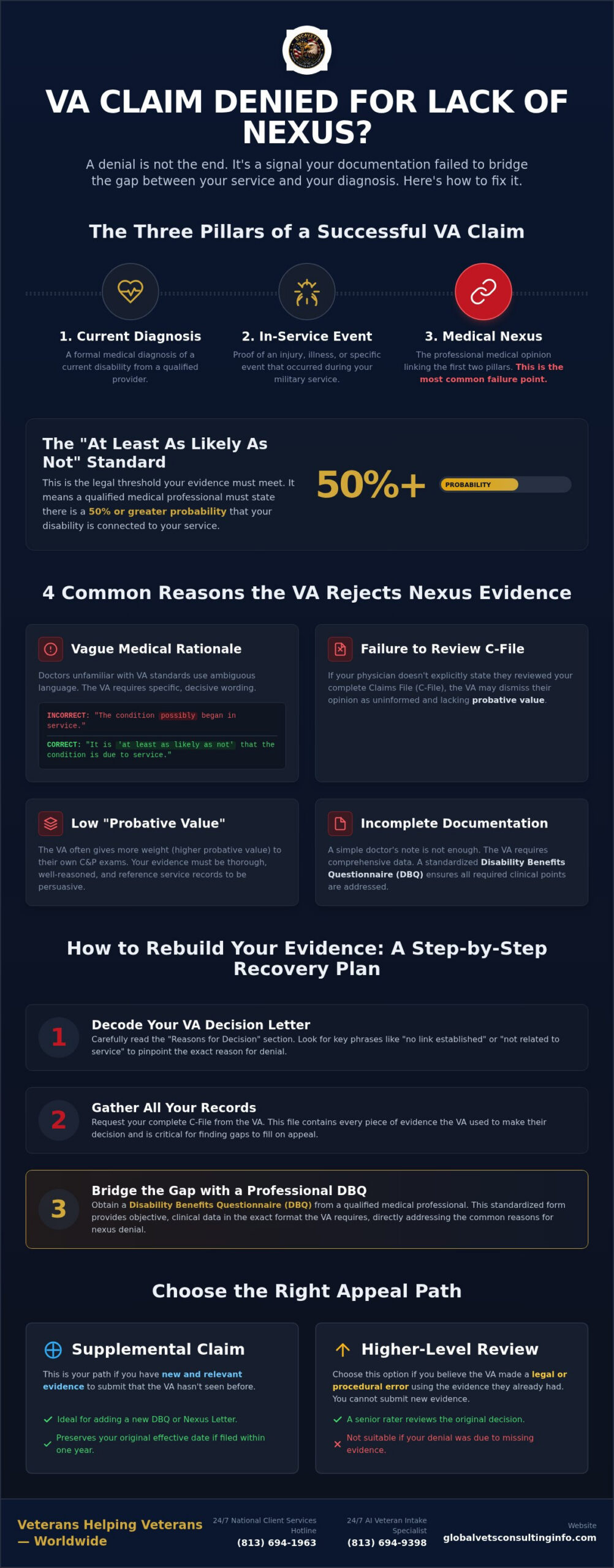
To win your case, your medical evidence must meet the “at least as likely as not” standard. This means a qualified medical professional must state there is a 50% probability or greater that your disability resulted from your service. Without this specific link, the VA cannot legally grant service connection, regardless of how severe your symptoms are today. In 2026, the VA has increased its scrutiny of these links, often requiring a more detailed explanation of how your service history directly led to your current diagnosis.
The Three Pillars of a Successful VA Disability Claim
Every successful claim rests on three foundational elements. First, you need a formal medical diagnosis of a current disability from a qualified provider. Second, you must prove an in-service event, injury, or stressor occurred while you were on active duty. Third, you need the medical nexus, which is the professional opinion that ties the first two pillars together. If any one of these is missing or weak, the claim will fail. Most denials happen at the third pillar because the connection isn’t clearly explained in medical terms.
Decoding Your VA Rating Decision Letter
Understanding why your va claim denied due to lack of nexus starts with a close reading of your decision letter. Turn to the “Reasons for Decision” section. Look for specific phrases like “no link established,” “not related to service,” or “not incurred in or aggravated by service.” These phrases tell you exactly where the bridge collapsed.
You should also carefully examine the “Evidence” list at the beginning of the document. If you submitted a private nexus letter or a buddy statement that doesn’t appear in this list, the rater may have overlooked it entirely. This oversight is a common administrative error. Identifying which documents the VA actually reviewed is your first step toward rebuilding a stronger case for your appeal.
4 Common Reasons the VA Rejects Medical Nexus Evidence
Understanding why your va claim denied due to lack of nexus is the first step toward a successful appeal. The VA applies strict standards to the medical evidence you provide, and even a small oversight can result in a denial. Most rejections boil down to how the information is presented and whether it carries enough weight to counter a negative C&P exam.
- Vague Medical Rationale: Doctors unfamiliar with the VA disability compensation system often use words like “suggests” or “possibly.” The VA requires the specific phrase “at least as likely as not.”
- Lack of Records Review: If your physician does not explicitly state they reviewed your entire Claims File (C-File), the VA may dismiss their opinion as uninformed.
- Standard of Proof Issues: Your evidence must have high “probative value” to be considered valid.
- Incomplete Documentation: A simple letter on a prescription pad rarely suffices. Using a standardized Disability Benefits Questionnaire (DBQ) ensures all required clinical data points are addressed.
The ‘Probative Value’ Trap in C&P Exams
Probative value refers to the ‘weight’ or ‘persuasiveness’ of a piece of evidence. The VA frequently favors the reports of their own C&P examiners over your private physician because they assume their examiners have a more complete understanding of your military history. If your private medical evidence lacks specific clinical findings or fails to reference your service treatment records, the rater will likely assign it low probative value. This allows the VA to dismiss your evidence in favor of a negative C&P exam report.
Inadequate Medical Rationale and Vague Language
A nexus opinion is only as strong as the logic behind it. The VA looks for a clear “logical path” that explains how an event years ago led to a diagnosis today. If your doctor fails to explain the biological or clinical mechanism connecting the two, the nexus will be rejected. Learning how to present independent medical evidence correctly can help you avoid these common pitfalls and strengthen your appeal strategy.
How to Rebuild Your Evidence: A Step-by-Step Recovery Plan
Fixing a va claim denied due to lack of nexus requires a methodical approach to evidence collection. You can’t simply resubmit the same documents and expect a different result. Instead, you must systematically address the specific medical and legal deficiencies identified in your decision letter. This process begins with understanding exactly what the VA believes is missing from your file.
- Step 1: Request your C-File. You need to see the exact wording the C&P examiner used to justify their negative opinion. This allows your private physician to provide a targeted rebuttal.
- Step 2: Choose your appeal lane. Decide between a Supplemental Claim or a Higher-Level Review based on whether you have new medical evidence to present.
- Step 3: Secure ‘New and Relevant’ evidence. This is the key to reopening a denied claim under the current appeals framework.
- Step 4: Standardize your documentation. Use professional clinical records to ensure your evidence meets strict VA documentation standards.
Filing a Supplemental Claim vs. Higher-Level Review
Choosing the right appeal lane is a strategic decision. If you believe the VA rater ignored evidence already in your file, a Higher-Level Review (HLR) allows a senior rater to take a second look. However, you cannot submit new evidence in this lane. If your va claim denied due to lack of nexus because your doctor’s letter was too vague or lacked clinical depth, you should file a Supplemental Claim. This lane allows you to submit a fresh medical opinion or a completed DBQ to bridge the service connection gap. For a detailed breakdown of these timelines, review the VA disability claims process step by step.
Gathering ‘New and Relevant’ Medical Evidence
Under the Appeals Modernization Act (AMA), ‘new’ evidence is information the VA hasn’t seen before, while ‘relevant’ evidence is data that tends to prove or disprove a matter at issue. A fresh nexus opinion from a specialist often qualifies. You should also consider lay statements, often called buddy letters, from those you served with. These statements can verify the in-service event that your medical records might have missed. When evidence is approximately equal, 38 C.F.R. § 3.102 dictates that the veteran should receive the benefit of the doubt. Providing clear, objective clinical data makes it much easier for a rater to apply this rule in your favor.
If you’re ready to take the next step in your appeal, our team at Global Vets Consulting is here to help you understand the medical documentation required to substantiate your claim.
How Professional DBQs Bridge the Nexus Gap
A Disability Benefits Questionnaire (DBQ) is the VA’s own language. When a va claim denied due to lack of nexus occurs, it’s often because the medical evidence didn’t translate into the specific boxes a rater needs to check. A professional DBQ includes objective clinical findings, such as range of motion measurements or specific diagnostic test results, that C&P examiners sometimes overlook during a rushed exam. By using standardized documentation, you reduce the VA’s ability to dismiss your evidence as “vague” or “inadequate.”
Standardized forms ensure that the medical rationale is presented in a format the VA recognizes and trusts. This meticulous approach ensures all boxes are checked, literally and figuratively, when you are pursuing VA rating increases. Using the right documentation changes the conversation from a subjective opinion to an objective clinical fact.
Strengthening Secondary Service Connections
Secondary claims are a powerful way to secure benefits without needing a direct in-service event for every single condition. For example, many veterans develop depression secondary to tinnitus or chronic physical pain. A DBQ can clearly outline the medical link between your primary service-connected disability and the new secondary condition. This documentation bypasses the need for service treatment records from decades ago by focusing on the current clinical relationship between your conditions. It provides the “but for” causation standard required by the VA in 2026.
Why Independent Medical Evidence Education Matters
Navigating the VA system is a mission that requires the right intelligence. Independent medical evidence education empowers you to understand what a rater is looking for and how to speak the “VA language” during your exams. At Global Vets Consulting, we streamline the evidence-gathering process so you don’t have to guess which forms matter or how to present your history. Our goal is to provide a clear, predictable path forward for every veteran we serve.
📞 24/7 National Client Services Hotline: Contact us for immediate assistance with your documentation needs. Our 24/7 AI Veteran Intake Specialist is also available to help you start the process of rebuilding your evidence today. 🇺🇸
🌐 GlobalVetsConsultingInfo.com — Worldwide Support for Veterans
Secure Your Earned Benefits with Stronger Medical Evidence
A va claim denied due to lack of nexus is a significant hurdle, but it is not the end of your journey toward securing the benefits you earned. By identifying the specific gaps in your medical records and replacing vague language with precise clinical data, you can build a bridge that the VA cannot ignore. Success in 2026 depends on your ability to provide standardized evidence that meets both the “but for” causation standard and the “at least as likely as not” probability threshold.
Whether you are filing a supplemental claim or seeking a higher-level review, the quality of your documentation is the deciding factor. As a veteran-owned and operated team, we specialize in standardized DBQ documentation designed to meet the VA’s rigorous requirements. You don’t have to navigate this complex system alone. Our 24/7 AI Veteran Intake Specialist is ready to help you begin rebuilding your evidence right now.
Don’t Let a ‘Lack of Nexus’ Stop Your Claim; Get Started with Global Vets Consulting Today
You served with honor, and your health matters. Take the next step today with confidence, knowing that a stronger and more accurate claim is within your reach.
Frequently Asked Questions
Is a nexus letter the same as a DBQ?
No, a nexus letter and a Disability Benefits Questionnaire (DBQ) serve different primary functions in your claim file. A nexus letter is a narrative medical report where a physician explains the clinical reasoning linking your disability to your military service. A DBQ is a standardized form used by the VA to document the severity of your symptoms and determine your rating percentage. Both documents are essential tools to fix a va claim denied due to lack of nexus.
Can I submit a new nexus letter after my VA claim was denied?
Yes, you can submit a new nexus letter by filing a Supplemental Claim within your one year appeal window. This lane allows you to introduce “new and relevant” evidence that the VA hasn’t previously considered. A fresh medical opinion that specifically addresses the 2026 “but for” causation standard can directly refute the findings of a negative C&P exam. This is often the most effective way to bridge the documentation gap and win your appeal.
What happens if my doctor refuses to sign a nexus letter or DBQ?
If your doctor refuses to sign your paperwork, you should seek an independent medical opinion from a provider familiar with VA documentation standards. Many primary care physicians are hesitant to sign these forms because they aren’t trained in forensic medical writing or VA jargon. Obtaining professional medical evidence education can help you identify specialists who understand how to review a C-File and provide the detailed clinical rationale required to substantiate your service connection.
How long do I have to appeal a VA denial for lack of nexus?
You have exactly one year, or 365 days, from the date listed on your VA decision notification letter to file an appeal. Filing within this timeframe is vital because it preserves your original effective date, which determines your back pay. If you miss this one year window, the decision becomes final and you’ll lose your original effective date. If your case has already reached the Board of Veterans’ Appeals, you only have 120 days to appeal to the CAVC.
Can the VA ignore a private medical opinion?
The VA cannot legally ignore a private medical opinion, but they can assign it “low probative value” if it lacks specific clinical depth. If a private doctor fails to state they reviewed your service treatment records or uses vague language, the rater will likely favor the C&P examiner’s report. This is a common reason why a va claim denied due to lack of nexus occurs. Ensuring your private evidence is objective and standardized makes it much harder for the VA to dismiss.
Article by
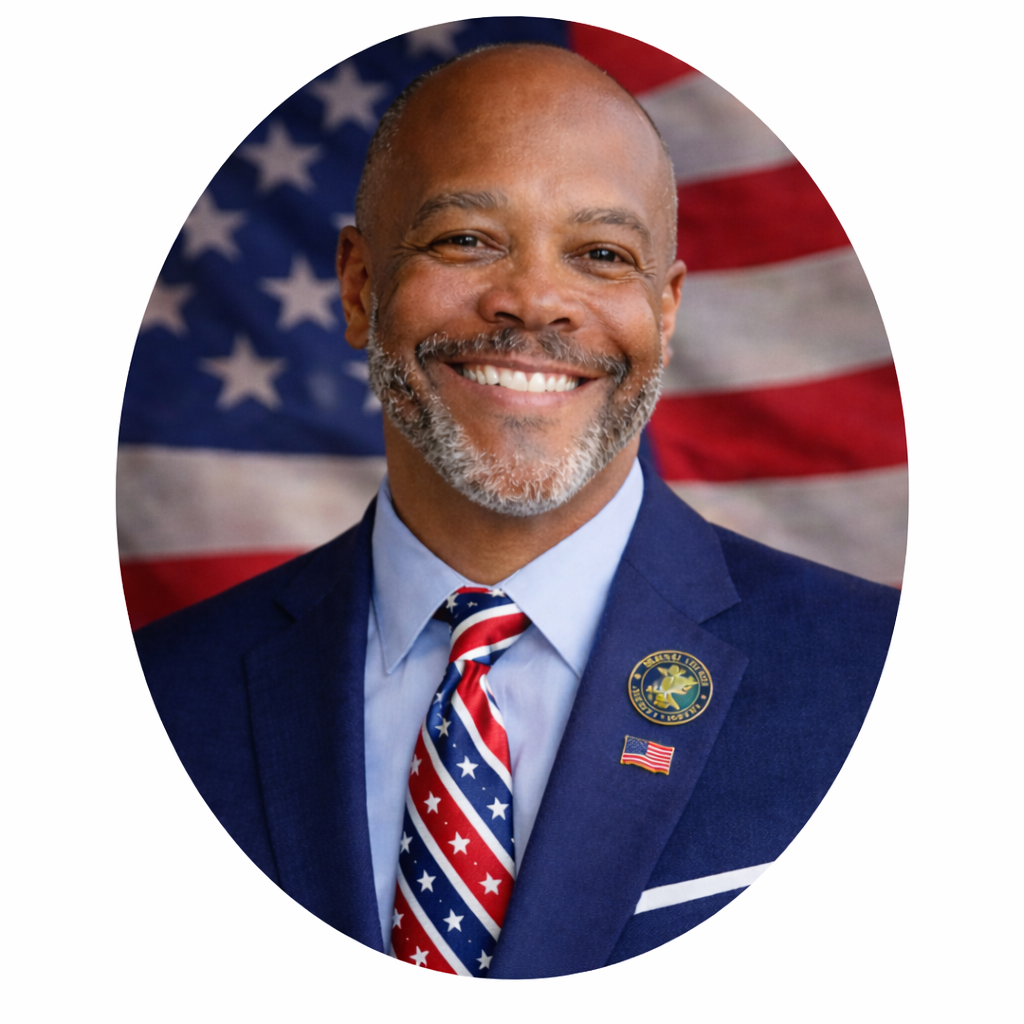
Willie Daniel
Willie Daniel is the Founder and Chief Executive Officer (CEO) of Global Vets Consulting (GVC4Vets) – National Veterans Disability Services, a veteran-led educational and medical evidence support organization dedicated to helping veterans better understand VA disability rating increases, DBQ medical evidence, secondary claims education, and C&P examination preparation.
He is a retired U.S. Army Medical Service Corps Officer with more than 27 years of honorable military service, a decorated Iraq combat veteran, and a retired federal official with the U.S. Department of Veterans Affairs. Throughout his military and federal career, Willie Daniel served in leadership, healthcare administration, operational, and veteran-support roles focused on improving services and support systems for servicemembers, veterans, and their families.
Drawing from decades of military leadership, healthcare administration, veteran advocacy, and federal government experience, Willie Daniel brings a practical, veteran-centered perspective to Global Vets Consulting’s educational articles, AI-powered veteran resources, video education initiatives, and outreach programs. His experience navigating military systems, medical documentation processes, and veteran-related administrative operations provides valuable insight into many of the challenges veterans face when seeking to better understand VA disability rating criteria, medical evidence, documentation strategies, and secondary condition education.
Through GVC’s “Veterans Helping Veterans” mission, his focus is on delivering clear, educational, and easy-to-understand information designed to empower veterans with knowledge, resources, and educational tools that may help them make more informed decisions regarding their individual VA disability journeys.
The information provided through GVC is intended for educational and informational purposes only and should not be considered legal or medical advice.
Disclaimer
Disclaimer: Global Vets Consulting, LLC (“GVC”) is a veteran-led educational and medical evidence support organization. GVC is not a law firm, is not a Veterans Service Organization (VSO), and is not affiliated with the U.S. Department of Veterans Affairs (VA) or any government agency.
Global Vets Consulting does not provide legal advice, medical advice, medical treatment, or healthcare services. GVC does not prepare, file, or submit VA disability claims on behalf of veterans. All information provided through this website, blog articles, videos, educational materials, AI tools, dashboards, templates, and communications is intended solely for general educational and informational purposes.
Veterans are encouraged to consult with accredited representatives, licensed attorneys, qualified medical providers, or Veterans Service Organizations regarding their specific legal, medical, or VA-related matters. VA disability decisions, ratings, and outcomes are determined solely by the U.S. Department of Veterans Affairs based on applicable laws, regulations, medical evidence, and individual circumstances. Past results do not guarantee future outcomes.