
Your C&P exam shouldn’t be the foundation of your disability claim; it should be the confirmation of it. Many veterans feel a deep sense of anxiety, worrying that a single brief appointment will determine their financial future. It’s frustrating to deal with complex jargon and “VA math” while trying to figure out how to gather medical evidence for your va claim. You shouldn’t have to rely solely on the VA’s internal records to tell your story.
We believe in veterans helping veterans, and that starts with taking control of your medical narrative. This guide teaches you the exact steps to identify and organize the documentation needed to secure the maximum rating you’ve earned. With the VA processing over 3 million claims in 2025 and maintaining a 94.02% accuracy rate, the quality of your documentation is more important than ever. We’ll walk you through identifying key documents, utilizing private doctors for Disability Benefits Questionnaires (DBQs), and organizing your files into a “Fully Developed Claim” that the VA can’t ignore. 🇺🇸
Key Takeaways
- Learn the three essential pillars, including your diagnosis, in-service event, and the medical nexus, that form the foundation of every successful claim.
- Discover the step-by-step process for how to gather medical evidence for your va claim by securing your military personnel files and private treatment records.
- Understand how to use Disability Benefits Questionnaires (DBQs) to let your private doctor document your symptoms using the VA’s specific rating criteria.
- Master the use of VA Form 21-4138 to provide a personal statement that connects your medical data to your daily life.
- Gain the confidence to submit a Fully Developed Claim that prepares you for your C&P exam and reduces the risk of a denial.
Understanding the Three Pillars of VA Medical Evidence 🇺🇸
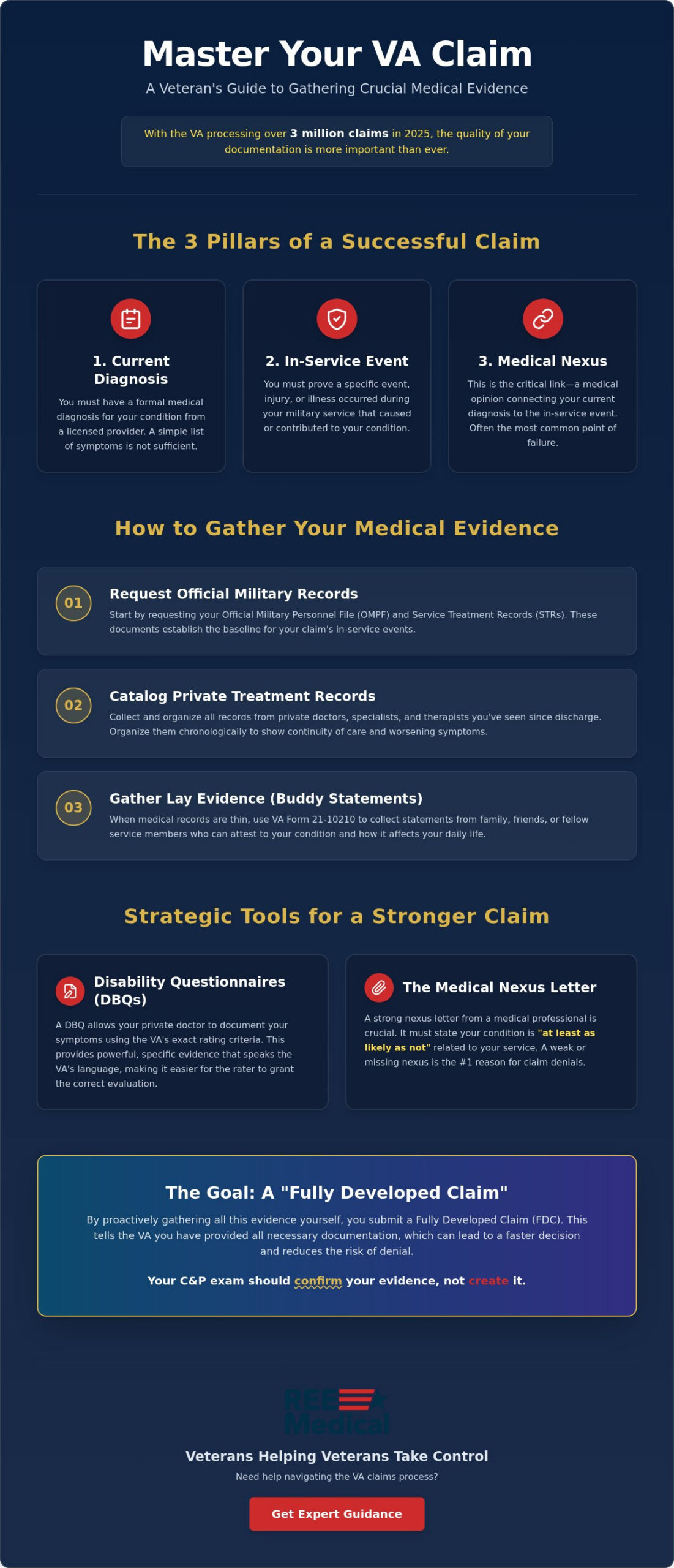
The VA doesn’t grant benefits simply because you served. They require a specific legal and medical framework to approve a claim. This framework is built on what many call the “Three Pillars” of a successful case. If you’re learning how to gather medical evidence for your va claim, you must ensure these three elements are present before you hit submit. Without them, even a severe disability might be denied.
- A Current Diagnosis: You need a formal medical diagnosis from a licensed provider for the condition you’re claiming. A simple list of symptoms isn’t enough.
- An In-Service Event or Injury: You must prove that a specific event, injury, or illness occurred during your military service.
- A Medical Nexus: This is the medical opinion that connects your current diagnosis to the in-service event.
You also need to distinguish between your Service Treatment Records (STRs) and your post-service private medical records. STRs are the records created while you were in uniform. Private medical records are those from doctors you’ve seen since your discharge. While the VA has access to your STRs, they don’t automatically see your private records. You have to be proactive in collecting these to show the continuity of your treatment and the worsening of your symptoms over time.
Direct vs. Secondary Service Connection
Direct service connection is straightforward. It involves injuries or illnesses that began or were clearly documented during active duty. However, many veterans suffer from conditions that developed years later as a result of their original injuries. Secondary service connection is a condition caused or aggravated by a primary service-connected disability. For example, if you have a service-connected back injury that eventually leads to nerve damage in your legs, that nerve damage is a secondary condition. Proving this requires a clear trail of medical evidence showing how the first injury led to the second.
The Crucial Role of the Medical Nexus
The Nexus is the bridge that connects your current health to your military service. It’s the most common point of failure for many veterans. For complex claims, such as those involving VA benefits for PTSD, the nexus provides the necessary medical logic to satisfy the VA’s requirements. A lack of a clear nexus is the #1 reason for a VA claim denied for lack of evidence. To succeed, you need a medical professional to state that your condition is “at least as likely as not” related to your service.
Step-by-Step: How to Gather Your Medical Documentation
Gathering documentation is often the most time-consuming part of the process, but it’s where your claim is won or lost. If you’ve been out of the service for a decade or more, tracking down every visit can feel overwhelming. Start by requesting your Official Military Personnel File (OMPF) and Service Treatment Records (STRs) through the NPRC or your VA.gov account. These documents establish your baseline. However, the official list of Evidence Needed For Your Disability Claim often requires more than just military records to prove current severity.
Catalog every private doctor, specialist, or physical therapist you’ve seen since discharge. You should organize these records chronologically. This simple step makes the rater’s job easier, which can lead to a faster decision. If you find gaps in your treatment history, don’t panic. You can bridge these timelines using lay evidence. If you’re unsure where to start, seeking veteran benefits education can help you identify exactly which pieces are missing.
Requesting Records from the VA and Private Providers
You can use VA Form 21-4142 and 21-4142a to authorize the VA to gather records for you. While this seems convenient, we recommend obtaining and uploading them yourself. This ensures that a busy clerk doesn’t miss a critical page that proves your nexus. If a provider no longer has your records due to retention policies, ask them for a formal letter stating that the records were destroyed. This protects you from the VA assuming the treatment never happened. Understanding how to gather medical evidence for your va claim means being the primary manager of your own file.
The Importance of Lay Evidence (Buddy Statements)
When medical records are thin, lay evidence is your strongest tool. Use VA Form 21-10210 to gather witness statements from those who know you best. A spouse can describe your sleep apnea episodes, or a fellow soldier can recount the specific blast that caused your TBI. These statements provide the ‘severity’ and ‘impact’ that a clinical chart might miss. Learning how to gather medical evidence for your va claim effectively means combining clinical data with the human story of your service.
Strategic Evidence: The Power of DBQs and Nexus Letters
When you are looking for how to gather medical evidence for your va claim, you’ll quickly find that not all evidence is created equal. A Disability Benefits Questionnaire (DBQ) is a standardized form designed to capture the specific medical data needed for the VA Schedule for Rating Disabilities (VASRD). While the VA often relies on internal C&P exams, Submitting Private Medical Evidence through a private DBQ allows your own doctor to document your symptoms using the VA’s own criteria. This is a critical strategy because it ensures your symptoms are not overlooked during a brief, high-pressure C&P exam.
In 2026, with the VA processing over 3 million claims and maintaining a 94.02% accuracy rate, the precision of your forms is paramount. A private DBQ gives you the opportunity to present a complete picture of your disability before a rater ever sees your file. This proactive approach turns a standard claim into a “Fully Developed Claim,” which can help you avoid the long wait times associated with the VA gathering evidence on your behalf.
Why Private DBQs are the Key to Rating Increases
For many conditions, the difference between a 30% and a 70% rating comes down to specific checkboxes on a form. A DBQ for mental health conditions, for example, ensures that symptoms like social impairment or panic attacks are properly documented according to VA standards. Using a specialist who understands your specific condition provides a tactical advantage. They can provide the granular detail that general practitioners often miss, ensuring your rating reflects the true impact on your life. 🇺🇸
Bridging the Gap with Independent Medical Opinions
A Nexus Letter is much more than a standard doctor’s note. It is a professional Independent Medical Opinion (IMO) that provides the scientific rationale for your service connection. A private DBQ provides a detailed medical snapshot that aligns directly with the VA’s Schedule for Rating Disabilities. If you have a complex case or a previous denial, an IMO can provide the evidence needed to overturn a rater’s decision. Learning how to gather medical evidence for your va claim effectively means being proactive rather than reactive. If you need help understanding these forms, we offer Independent Medical Evidence Education to guide you through the process.
Final Review and Submission: Ensuring Your Claim is Bulletproof 🇺🇸
Before you hit the final submit button, you must verify that every condition you’ve listed is supported by the three pillars we discussed. A claim that is “bulletproof” doesn’t necessarily mean it’s the longest; it means it’s the most accurate. When you look at how to gather medical evidence for your va claim, the final step is ensuring your diagnosis, in-service event, and medical nexus are clearly identifiable for the rater. If they have to hunt for the connection, you’re increasing the risk of a technical denial.
Your “Statement in Support of Claim” (VA Form 21-4138) is where you provide the personal context that medical codes can’t capture. Use this form to explain how your injuries affect your daily life and your ability to work. When uploading your files to VA.gov, ensure they are in PDF format and under the size limits. Clear, legible scans of your private DBQs and nexus letters are essential for a smooth “Evidence Gathering, Review, and Decision” phase.
Avoiding Common Evidence Mistakes
Veterans often make the mistake of submitting thousands of pages of irrelevant records, thinking volume equals success. It doesn’t. Focus on the medical evidence that directly addresses the rating criteria for your specific disability. Additionally, ensure every DBQ is fully signed and dated by your provider. A missing signature on a critical form can cause months of delays or force a rater to ignore the evidence entirely during the decision process.
Take Control of Your VA Journey Today
Don’t leave your financial future to chance by waiting for the VA to track down your records. Global Vets Consulting provides the educational resources you need to master the VA disability claims process step by step. We’re here to help you present a professional, fully developed claim from the very beginning.
- 📞 24/7 National Client Services Hotline: Call us for immediate assistance.
- 🤖 24/7 AI Veteran Intake Specialist: Get instant guidance on your documentation.
- 🌐 Worldwide Support: GlobalVetsConsultingInfo.com
Secure Your Maximum Rating with Precision 🇺🇸
Success in the VA claims process is rarely about luck; it’s about the meticulous organization of your medical history. You now understand the importance of the three pillars and the strategic advantage of using private DBQs to speak the VA’s language. By taking a proactive stance on how to gather medical evidence for your va claim, you shift from a passive participant to a knowledgeable advocate for your own health and financial security.
Global Vets Consulting has been veteran-owned and operated since 2021, specializing in DBQ preparation to ensure your evaluations are accurate and thorough. We understand the stress of managing complex administrative systems, which is why we provide a 24/7 National Client Services Hotline to support you at every turn. Our team offers the steady guidance and professional resources you need to submit a claim with confidence. Get the medical documentation you need—speak with our AI Veteran Intake Specialist today!
You’ve served your country with honor, and it’s time to ensure you receive the benefits you’ve earned. Take the first step today toward a clearer, more predictable path forward. 🇺🇸
Frequently Asked Questions
What is the most important piece of medical evidence for a VA claim?
The medical nexus is the most critical piece of evidence because it establishes the essential link between your current diagnosis and your military service. While a diagnosis proves you’re currently ill and service records prove you served, the nexus is the professional medical opinion that ties them together. Without this bridge, the VA cannot grant service connection, making it the primary focus when learning how to gather medical evidence for your va claim.
Can I use medical evidence from a private doctor for my VA claim?
Yes, you can and should use private medical evidence to strengthen your claim. Private doctors can complete Disability Benefits Questionnaires (DBQs) that often provide more granular detail than a standard C&P exam. Submitting these records yourself ensures that the VA has a complete picture of your treatment history. This proactive approach is a cornerstone of a “Fully Developed Claim” and helps prevent the VA from missing key details in your file.
How do I get my service treatment records if I’ve been out for a long time?
You can request your Service Treatment Records (STRs) and Official Military Personnel File (OMPF) through the National Personnel Records Center (NPRC) or online via VA.gov. If your records are missing or were part of the 1973 fire, you’ll need to rely on alternative evidence. This includes secondary records like morning reports, unit logs, or buddy statements to reconstruct the timeline of your service-connected injury and provide the necessary proof for the rater.
What happens if the VA says there is ‘no evidence’ of my injury in my service records?
If your official records are silent, you must use lay evidence and buddy statements to prove the in-service event occurred. VA Form 21-10210 allows friends, family, or fellow service members to provide witness testimony regarding your injury or the onset of your symptoms. This documentation is vital for veterans who didn’t seek medical attention while on active duty due to operational requirements or the prevailing military culture at the time.
Is a Nexus Letter required for every VA disability claim?
A formal Nexus Letter isn’t legally required for presumptive conditions, but it’s highly recommended for almost every other type of claim. For conditions that aren’t on the VA’s presumptive list, you must provide a medical opinion stating your condition is “at least as likely as not” caused by your service. Understanding how to gather medical evidence for your va claim involves knowing when an Independent Medical Opinion is necessary to prevent a frustrating denial.
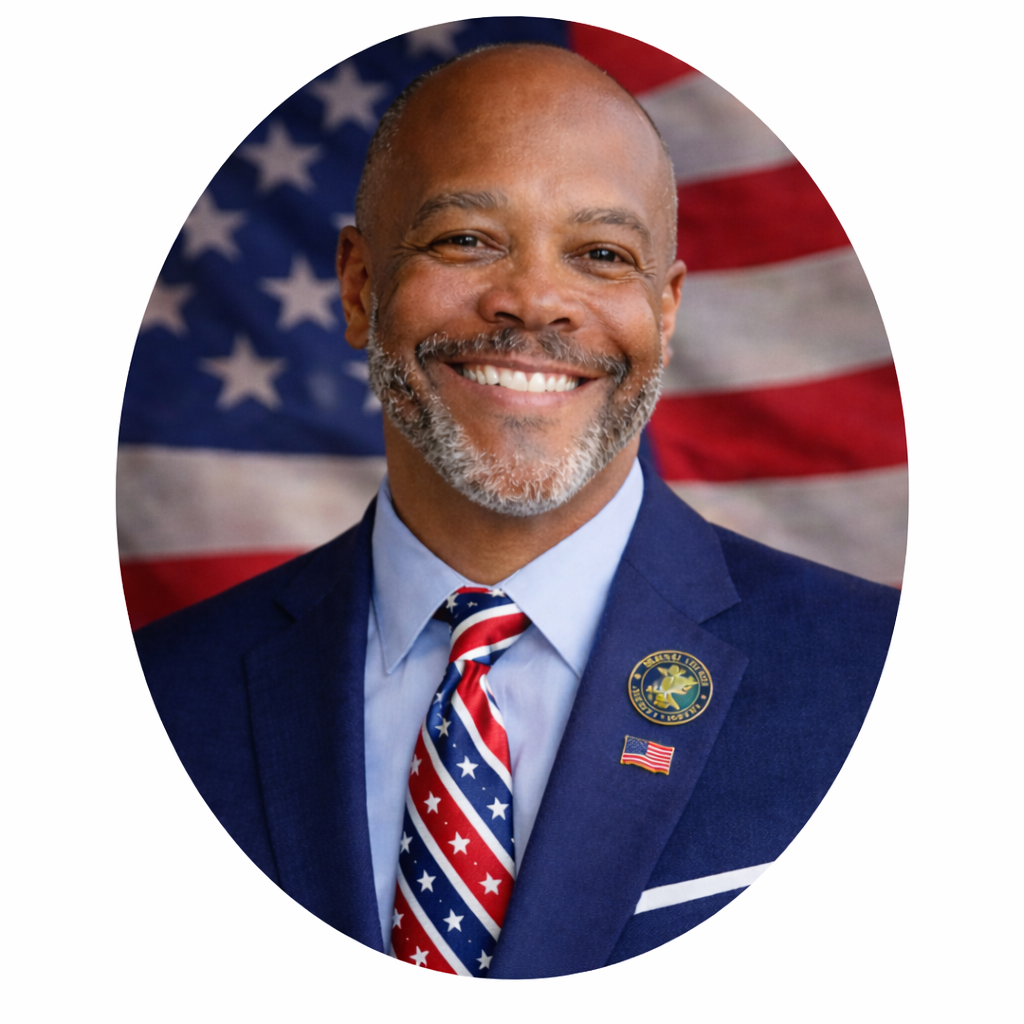
Article by
Willie Daniel
Willie Daniel is the Founder and Chief Executive Officer (CEO) of Global Vets Consulting (GVC) – National Veterans Disability Services, a veteran-led educational and medical evidence support organization dedicated to helping veterans better understand VA disability rating increases, DBQ medical evidence, secondary claims education, and C&P examination preparation.
He is a retired U.S. Army Medical Service Corps Officer with more than 27 years of honorable military service, a decorated Iraq combat veteran, and a retired federal official with the U.S. Department of Veterans Affairs. Throughout his military and federal career, Willie Daniel served in leadership, healthcare administration, operational, and veteran-support roles focused on improving services and support systems for servicemembers, veterans, and their families.
Drawing from decades of military leadership, healthcare administration, veteran advocacy, and federal government experience, Willie Daniel brings a practical, veteran-centered perspective to Global Vets Consulting’s educational articles, AI-powered veteran resources, video education initiatives, and outreach programs. His experience navigating military systems, medical documentation processes, and veteran-related administrative operations provides valuable insight into many of the challenges veterans face when seeking to better understand VA disability rating criteria, medical evidence, documentation strategies, and secondary condition education.
Through GVC’s “Veterans Helping Veterans” mission, his focus is on delivering clear, educational, and easy-to-understand information designed to empower veterans with knowledge, resources, and educational tools that may help them make more informed decisions regarding their individual VA disability journeys.
The information provided through GVC is intended for educational and informational purposes only and should not be considered legal or medical advice.
Disclaimer
Disclaimer: Global Vets Consulting, LLC (“GVC”) is a veteran-led educational and medical evidence support organization. GVC is not a law firm, is not a Veterans Service Organization (VSO), and is not affiliated with the U.S. Department of Veterans Affairs (VA) or any government agency.
Global Vets Consulting does not provide legal advice, medical advice, medical treatment, or healthcare services. GVC does not prepare, file, or submit VA disability claims on behalf of veterans. All information provided through this website, blog articles, videos, educational materials, AI tools, dashboards, templates, and communications is intended solely for general educational and informational purposes.
Veterans are encouraged to consult with accredited representatives, licensed attorneys, qualified medical providers, or Veterans Service Organizations regarding their specific legal, medical, or VA-related matters. VA disability decisions, ratings, and outcomes are determined solely by the U.S. Department of Veterans Affairs based on applicable laws, regulations, medical evidence, and individual circumstances. Past results do not guarantee future outcomes.