Reporting a bad C&P examiner is not just a complaint; it is a tactical maneuver to preserve the integrity of your medical evidence and your future rating. You’ve likely spent years building your medical records, only to have a ten-minute “rushed” exam threaten everything. It’s frustrating when an examiner ignores your symptoms or fails to review your history. If you feel your appointment was substandard, learning how to report a bad c&p examiner is the most effective way to ensure the VA doesn’t rely on an inaccurate medical opinion to deny your benefits.
We understand the anxiety that comes with a poor examination. You deserve an objective review of your service-connected conditions, and you don’t have to accept an inadequate report as the final word. In this 2026 guide, we’ll walk you through the exact steps to flag a deficient exam, from drafting a Memorandum for Record to submitting a formal statement using the July 2024 version of VA Form 21-4138. We’ll show you how to request a new exam with a different provider and keep your claim on the path to the rating you’ve earned.
Key Takeaways
- Identify the critical warning signs of a substandard appointment, including rushed five-minute exams and examiners who ignore your medical history.
- Follow a structured, step-by-step process for how to report a bad c&p examiner to both the private contractor and the VA National Inquiry Line.
- Learn to draft a factual rebuttal using the latest VA Form 21-4138 to formally flag inadequate medical opinions in your C-file.
- Understand how to use private medical evidence and Disability Benefits Questionnaires (DBQs) to create “equipoise” and protect your claim from denial.
What Qualifies as a ‘Bad’ C&P Exam? 📄
You walked into the clinic expecting a thorough review of your service-connected conditions, but you left feeling dismissed. Many veterans experience this frustration, but it’s vital to distinguish between a personality clash and a technical failure. The Veterans Benefits Administration (VBA) relies on these exams to determine your rating, so knowing how to report a bad c&p examiner starts with identifying specific errors that jeopardize your claim. If your examiner spent more time looking at their watch than your medical records, you’ve likely encountered a substandard exam.
A “bad” exam isn’t just one that results in a negative opinion; it’s one where the process itself is flawed. Common technical failures include:
- Failure to review records: The examiner admits they haven’t looked at your C-File or relevant medical evidence before the appointment.
- The “Speed-Run” exam: A complex mental health or TBI assessment that lasts only 5 to 10 minutes.
- Missing equipment: The provider fails to use a goniometer to measure range of motion during a musculoskeletal exam.
- Incorrect documentation: The examiner uses an outdated or entirely wrong DBQ for your specific condition.
Inadequate vs. Unprofessional Exams
It’s important to separate an examiner’s “bedside manner” from their medical competence. An examiner can be rude or dismissive, which is unprofessional, but a claim is much easier to challenge if the exam is technically “inadequate.” Under VA M21-1 adjudication standards, an inadequate medical opinion is one that lacks the clinical data or reasoned explanation necessary for a rating official to make a decision. Focus your energy on documenting where the provider failed to follow VA procedures, as this provides the strongest grounds for a new exam.
The ‘Worst Day’ Standard
Many examiners only document how you look the moment you sit in their office. If you’re having a “good day” during the appointment, a bad examiner might ignore your history of flare-ups. You must ensure your “worst day” symptoms are recorded. If the provider refuses to listen to how your condition affects your daily life during a flare-up, they’ve failed to capture the full picture of your disability. Understanding these nuances is the foundation of how to report a bad c&p examiner and protect your hard-earned benefits.
How to Report a Bad C&P Examiner: Step-by-Step 📞
Once you’ve identified that your exam didn’t meet VA standards, you must move quickly. The goal is to get your objections on the record before a rater makes a final decision based on flawed data. You shouldn’t wait for a denial letter to arrive before speaking up. Knowing how to report a bad c&p examiner involves a multi-channel approach to ensure your complaint is visible to the rater and documented in your permanent file.
Contractor Contact Information for 2026
If your exam was scheduled through a third-party vendor like Leidos QTC, Veterans Evaluation Services (VES), or OptumServe, your first call should be to their respective customer service departments. When you call, don’t just air your grievances; specifically ask the representative for a “reference number” or “case number” for your complaint. This number is your paper trail, proving you notified the vendor of the provider’s conduct or technical failures immediately after the appointment.
Logging the Complaint with the VA
After notifying the contractor, call the VA National Inquiry Line at 1-800-827-1000. Tell the representative you need to log a formal complaint regarding a substandard C&P exam. Use the specific term “inadequate medical opinion” to describe the exam. This ensures the complaint is categorized correctly in the system. Timing is critical here. Aim to report the issue within 24 to 48 hours so the VA is alerted before the examiner’s report is fully processed and uploaded.
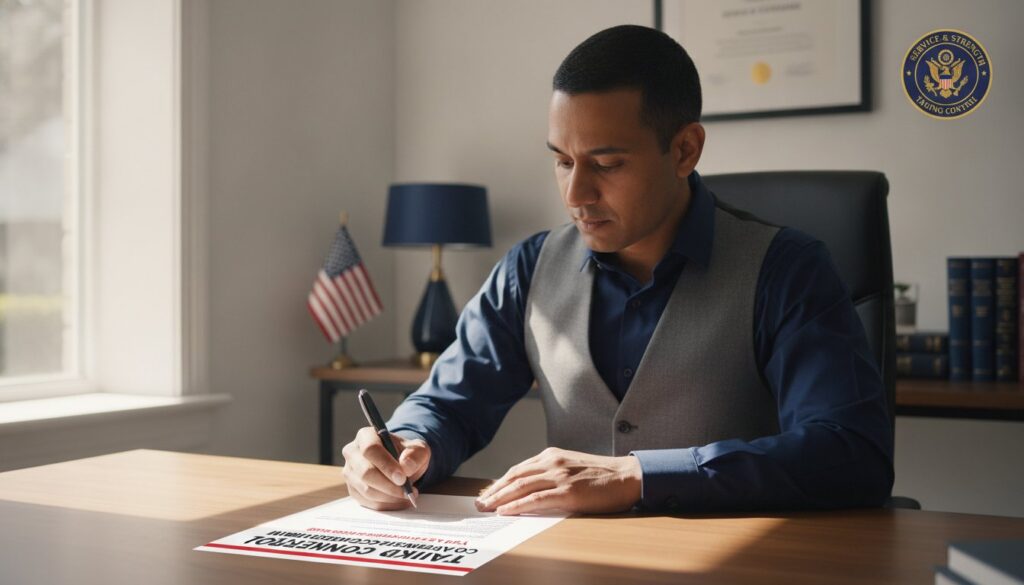
To formalize this process, you must submit a written rebuttal using the VA Form 21-4138 Statement in Support of Claim. As of 2026, the July 2024 version of this form is the current standard for these submissions. In your statement, detail the exact deficiencies, such as the examiner’s failure to review your C-file or their refusal to document your flare-ups. If you have a VSO or accredited agent, ask them to flag the exam in the Veterans Benefits Management System (VBMS) to ensure the rater sees your objection. Reviewing C&P Examination Preparation Education before your next appointment can help you identify these red flags while they are happening.

Writing a Rebuttal: Using VA Form 21-4138 Effectively ✍️
Submitting a written rebuttal is the most critical phase of how to report a bad c&p examiner. While your phone calls create a temporary alert, a formal statement ensures your objections are permanently etched into your C-File. You’ve likely felt the urge to vent your frustrations, but your success depends on sticking to objective facts. A rater can’t throw out an exam because the doctor was “mean,” but they must address an exam that’s technically deficient. Using the VA Form 21-4138 (Statement in Support of Claim), you can systematically dismantle a flawed medical opinion.
The Memorandum for Record (MFR) Structure
Organize your statement like a military Memorandum for Record. Start with the basics: the date, time, and location of the exam, along with the examiner’s name. List specific procedural failures instead of personal attacks. For example, document that the examiner didn’t use a goniometer for joint measurements or failed to ask about your frequency of panic attacks. If the exam only lasted seven minutes for a complex PTSD claim, put that time stamp in writing. Keeping the tone professional and focused on the DBQ requirements makes it easier for the VA to justify granting you a new appointment.
Linking to Existing Evidence
Your rebuttal should remind the rater of the va claim evidence requirements you’ve already satisfied. Mention specific medical records, such as an MRI report or a private doctor’s treatment notes, that the examiner admitted they didn’t read. This creates a vital “paper trail” for a Higher-Level Review (HLR) if your claim is initially denied. By showing that the examiner’s opinion contradicts the established evidence, you’ve provided the rater with a legal reason to order a “de novo” examination by a different provider. If you need help understanding what evidence was missed, you can explore more about Independent Medical Evidence Education to strengthen your rebuttal.
Always conclude your statement with a clear, direct request. Explicitly state: “I am requesting a new examination with a different provider because the previous exam was inadequate and failed to consider the totality of the medical evidence.” This simple sentence forces the VA to make a choice: ignore a documented procedural error or fix the problem by giving you a fair shot at a proper exam.
Protecting Your Claim with Private DBQs and Medical Evidence 🛡️
While mastering how to report a bad c&p examiner is a vital defensive move, your strongest offensive strategy is presenting superior medical evidence. You shouldn’t rely solely on a contractor who may only see you for a few minutes. Obtaining a private Disability Benefits Questionnaire (DBQ) allows you to submit a thorough, accurate assessment from a provider who takes the time to understand your full clinical picture. This documentation serves as a shield, ensuring that one substandard exam doesn’t derail your entire VA disability claim.
A key legal concept every veteran should understand is “Equipoise.” When the evidence in your file is balanced, meaning there is one negative medical opinion and one positive medical opinion of equal weight, the VA must grant the “benefit of the doubt” to the veteran. By submitting high-quality private evidence, you create this balance. Even if you’ve already filed a rebuttal regarding how to report a bad c&p examiner, having a secondary, favorable medical opinion makes it much harder for a rater to justify a denial based on a single “rushed” exam.
Private DBQ vs. C&P Exam
The difference in quality between a contractor “mill” and a dedicated private assessment is often stark. This is especially true for a dbq for mental health conditions, where nuanced symptoms like occupational impairment and social withdrawal require deep discussion rather than a checklist approach. Private medical evidence levels the playing field against examiners who may be incentivized to move through appointments as quickly as possible. Global Vets Consulting specializes in evidence education to help you identify these gaps before they result in a lower rating.
Next Steps for Veterans 🇺🇸
Don’t let a single bad experience define the future of your benefits. You have the right to challenge inaccurate reports and the power to strengthen your file with credible, independent evidence. If you’ve just walked out of a substandard appointment, take action immediately while the details are fresh in your mind. Our team is ready to guide you through the complexities of the system and help you secure the rating you’ve earned through your service.
- 24/7 AI Veteran Intake Specialist: Visit our website to start your evidence review anytime. 🌐
- Direct Resource Awareness: Explore our educational resources on VA rating increases and secondary claims.
- Global Support: Reach out to us at GlobalVetsConsultingInfo.com for immediate assistance.
Your mission didn’t end when you hung up the uniform, and our mission is to ensure you aren’t left behind by a bureaucratic process. Take control of your medical evidence today and protect your claim from the impact of a bad C&P examiner. 📞
Secure Your Future Rating with Stronger Evidence
You’ve worked hard to document your service-connected conditions, and you shouldn’t let a single inadequate medical opinion derail your progress. By identifying technical failures and following the specific steps on how to report a bad c&p examiner, you protect the integrity of your file. Remember that a formal rebuttal using the latest VA Form 21-4138 is your voice in the system, and private medical evidence is your most effective counter-measure against rushed contractor evaluations. Taking these actions ensures that your rater sees the full truth of your disability.
Since 2021, Global Vets Consulting has operated as a veteran-owned and operated partner dedicated to helping you navigate these administrative hurdles. We specialize in providing professional DBQ documentation and offer a 24/7 National Client Services Hotline to ensure you never have to face the VA alone. Our mission is to provide the clarity and support you need to win your claim despite a substandard exam experience. We focus on meticulousness so you can focus on your well-being.
🇺🇸 Get the Accurate Medical Evidence You Deserve—Contact Global Vets Consulting Today
You earned your benefits through your service and sacrifice. Don’t let a ten-minute appointment stand in the way of the compensation you deserve. We’re here to help you take the next step toward a fair rating with steady confidence and expert guidance. Your path forward is clear, and we’re ready to walk it with you.
Frequently Asked Questions
Can I refuse to go to a C&P exam if I have a private DBQ?
You should not refuse a C&P exam even if you have a private DBQ already in your file. If you fail to show up, the VA may deny your claim immediately for “failure to report.” It’s better to attend the appointment and bring a copy of your private medical evidence with you. If the examiner ignores your symptoms, follow the protocol for how to report a bad c&p examiner immediately after you leave the clinic.
What happens if I report an examiner and the VA still uses their report?
If the VA issues a decision based on a report you flagged as inadequate, your next step is usually a Higher-Level Review (HLR). Your formal rebuttal on VA Form 21-4138 serves as evidence that the rater relied on a flawed medical opinion. This allows you to argue that the VA failed its duty to assist by not providing a competent exam. Your documented complaint becomes the foundation for overturning a denial and securing a new evaluation.
How do I get a copy of my C&P exam results to see what they wrote?
Obtaining your C&P exam results requires a formal request using VA Form 20-10206, also known as a Freedom of Information Act request. If your exam was done at a VA facility, you might see the notes on your My HealtheVet Blue Button report after a short waiting period. However, contractor exams from VES or QTC aren’t posted online. You’ll need to request your full C-File to see exactly what the examiner documented about your condition.
Will reporting a bad examiner delay my VA disability claim decision?
Filing a complaint about a substandard exam can lead to a delay in your final rating decision. This happens because the VA must review your statement and potentially schedule a new exam with a different provider. While a delay is frustrating, it’s a tactical choice to prevent an inaccurate denial. Knowing how to report a bad c&p examiner ensures that the final decision is based on thorough medical evidence rather than a rushed, five-minute evaluation.
Is it possible to request a specific examiner for my next VA claim exam?
The VA does not allow veterans to choose a specific doctor for their compensation and pension exams. You can, however, request that a specialist performs the exam if your condition is complex. For example, you can ask that a psychiatrist conducts your mental health evaluation instead of a general nurse practitioner. While you can’t pick the person, you can insist that the provider has the appropriate clinical expertise to complete your DBQ accurately.

Article by
Willie Daniel
Willie Daniel is the Founder and Chief Executive Officer (CEO) of Global Vets Consulting (GVC) – National Veterans Disability Services, a veteran-led educational and medical evidence support organization dedicated to helping veterans better understand VA disability rating increases, DBQ medical evidence, secondary claims education, and C&P examination preparation.
He is a retired U.S. Army Medical Service Corps Officer with more than 27 years of honorable military service, a decorated Iraq combat veteran, and a retired federal official with the U.S. Department of Veterans Affairs. Throughout his military and federal career, Willie Daniel served in leadership, healthcare administration, operational, and veteran-support roles focused on improving services and support systems for servicemembers, veterans, and their families.
Drawing from decades of military leadership, healthcare administration, veteran advocacy, and federal government experience, Willie Daniel brings a practical, veteran-centered perspective to Global Vets Consulting’s educational articles, AI-powered veteran resources, video education initiatives, and outreach programs. His experience navigating military systems, medical documentation processes, and veteran-related administrative operations provides valuable insight into many of the challenges veterans face when seeking to better understand VA disability rating criteria, medical evidence, documentation strategies, and secondary condition education.
Through GVC’s “Veterans Helping Veterans” mission, his focus is on delivering clear, educational, and easy-to-understand information designed to empower veterans with knowledge, resources, and educational tools that may help them make more informed decisions regarding their individual VA disability journeys.
The information provided through GVC is intended for educational and informational purposes only and should not be considered legal or medical advice.
Disclaimer
Disclaimer: Global Vets Consulting, LLC (“GVC”) is a veteran-led educational and medical evidence support organization. GVC is not a law firm, is not a Veterans Service Organization (VSO), and is not affiliated with the U.S. Department of Veterans Affairs (VA) or any government agency.
Global Vets Consulting does not provide legal advice, medical advice, medical treatment, or healthcare services. GVC does not prepare, file, or submit VA disability claims on behalf of veterans. All information provided through this website, blog articles, videos, educational materials, AI tools, dashboards, templates, and communications is intended solely for general educational and informational purposes.
Veterans are encouraged to consult with accredited representatives, licensed attorneys, qualified medical providers, or Veterans Service Organizations regarding their specific legal, medical, or VA-related matters. VA disability decisions, ratings, and outcomes are determined solely by the U.S. Department of Veterans Affairs based on applicable laws, regulations, medical evidence, and individual circumstances. Past results do not guarantee future outcomes.