
You might think that securing a higher rating requires a legal team, but the truth is that a successful claim is built on medical evidence, not legal arguments. Many of us know the frustration of living with a rating that doesn’t match the reality of our worsening health. Whether it’s the confusion of VA “math” or the anxiety of an upcoming C&P exam, the process often feels like it’s designed to keep you stuck. It’s difficult to focus on recovery when you’re worried about how your conditions impact your ability to provide for your family.
This guide explains how to secure a VA Disability Rating Increase by using high-quality medical documentation and DBQs to reflect the true severity of your symptoms. We’ll walk you through the steps to ensure the VA recognizes your total disability, whether that’s through a 100% P&T rating or TDIU. With the VA processing over 1.9 million claims in 2026, your evidence must be undeniable. You’ll learn how to present a clear, documented case that moves you toward the higher monthly compensation you’ve earned through your service.
Key Takeaways
- Understand why your current rating isn’t set in stone and how the VA expects conditions to change over time.
- Discover how to secure a VA Disability Rating Increase by aligning your claim with specific medical evidence that the VA cannot ignore.
- Learn the importance of using current Disability Benefits Questionnaires (DBQs) to document the true severity of your symptoms.
- Follow a logical step-by-step plan to gather records and schedule professional evaluations that support your request for a higher rating.
- Identify how evidence education helps you bridge the gap between your physical reality and the VA’s complex rating criteria.
Understanding the VA Disability Rating Increase Process in 2026
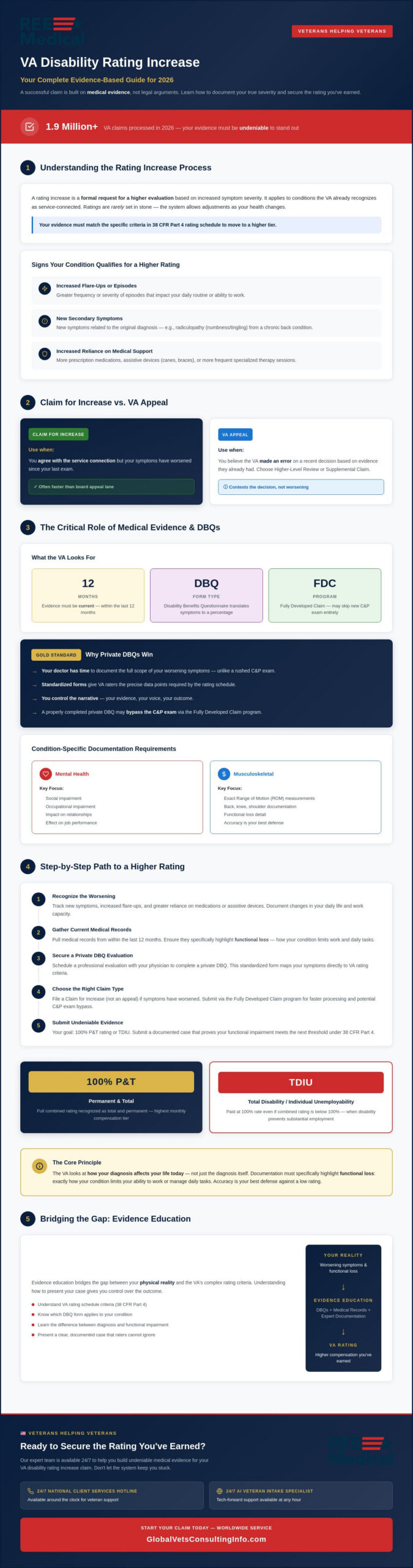
A VA rating increase is a formal request for a higher evaluation based on increased symptom severity. This process is specifically for conditions that the VA already recognizes as service-connected. While your current percentage might have been accurate when you first filed, the VA understands that many injuries and illnesses worsen as we age. Ratings are rarely “set in stone,” and the system allows for adjustments as your health changes. To successfully secure a VA Disability Rating Increase, you must provide current medical evidence showing your condition meets the higher criteria defined in the 38 CFR Part 4 rating schedule.
Securing the compensation you’ve earned is about matching your medical records to the VA’s specific requirements. With the VA processing over 1.9 million claims in 2026, clarity in your documentation is essential. If you don’t prove that your functional impairment has reached the next threshold, the VA will likely maintain your current rating. This is why understanding the history and structure of VA disability benefits is so important for every veteran seeking a fair evaluation.
Signs Your Condition Qualifies for a Higher Rating
Recognizing the shift in your health is the first step toward a successful claim. You may qualify for a higher rating if you experience any of the following changes in your daily life:
- 🇺🇸 Increased frequency or severity of “flare-ups” or episodes that impact your daily routine or ability to work.
- 🇺🇸 New symptoms related to the original diagnosis, such as radiculopathy (numbness or tingling) caused by a chronic back condition.
- 🇺🇸 An increased reliance on prescription medications, assistive devices like canes or braces, or more frequent specialized therapy.
Claim for Increase vs. VA Appeal: Knowing the Difference
It’s vital to choose the correct administrative path to avoid unnecessary delays. You should file for an increase if you agree with the service connection but your symptoms have worsened since your last exam. However, if you believe the VA made an error on a recent decision based on the evidence they already had, an appeal like a Higher-Level Review or Supplemental Claim is the better choice. Strategically, filing for an increase is often faster than the board appeal lane, helping you get results and peace of mind much sooner.
The Critical Role of Medical Evidence and DBQs in Rating Increases
The VA doesn’t just look at a diagnosis; they look at how that diagnosis affects your life today. To secure a VA Disability Rating Increase, your medical evidence must be current, which generally means records from within the last 12 months. The department relies heavily on Disability Benefits Questionnaires (DBQs) to translate your medical symptoms into a percentage. You can learn more about what is a dbq to understand how these forms bridge the gap between a doctor’s visit and a rater’s decision. Documentation must specifically highlight functional loss, detailing exactly how your condition limits your ability to work or manage daily tasks.
Why Private DBQs are the Gold Standard for Evidence
Private DBQs offer a level of detail that a standard C&P exam often lacks. When you see your own doctor, they can take the time needed to document the full scope of your worsening symptoms. These standardized forms ensure the VA rater receives the precise data points required by the rating schedule. If you provide a properly completed private DBQ, you might even bypass the need for a new C&P exam through the Fully Developed Claim (FDC) program. This approach puts you in control of the narrative and ensures your voice is heard.
Documenting Mental Health and Musculoskeletal Severity
Different conditions require different types of proof. For mental health increases, the focus is on social and occupational impairment. The VA needs to see how your condition affects your relationships and your job performance. You can review our specific guide on dbq for mental health conditions for more targeted documentation tips. In contrast, musculoskeletal increases for your back, knees, or shoulders require exact range of motion (ROM) measurements. Accuracy is your best defense against a low rating.
Following the official steps on How to Successfully File for a Higher VA Rating is a good start, but having the right evidence is what wins the case. If you’re unsure if your current records meet the standard, exploring medical evidence education can help you identify gaps before you submit your paperwork.
How to Successfully File for a Higher VA Rating Step-by-Step
Filing for a VA Disability Rating Increase requires a methodical approach to ensure the VA sees the full picture of your health. You’ve already earned your service connection; now you must prove that your symptoms have progressed to a higher level of impairment. This process isn’t about hope. It’s about data. By following a structured plan, you reduce the risk of a denial and move closer to the compensation you deserve. Accuracy matters here more than anywhere else in the claim process.
- 🇺🇸 Step 1: Obtain a copy of your current rating decision and the specific DBQ for your condition.
- 🇺🇸 Step 2: Schedule an evaluation with a medical professional to document your current symptom severity.
- 🇺🇸 Step 3: Submit your claim as a “Fully Developed Claim” (FDC) for the fastest processing time.
- 🇺🇸 Step 4: Track your claim progress through the VA.gov portal or the official mobile app.
Utilizing the Fully Developed Claim (FDC) Program for Speed
The FDC program is your fastest route to a decision because it tells the VA you’ve already gathered all necessary Medical Evidence and DBQs. By submitting a private DBQ upfront, you reduce the need for the VA to search for your records. You should follow the va disability claims process step by step to ensure no critical forms are missing. This proactive strategy often leads to a decision in 70 to 100 days. Standard claims often take much longer, especially if the VA has to schedule multiple exams.
The Importance of Timing and Back Pay
Your “effective date” is the foundation of your back pay. This date is typically when you file your claim or submit an “Intent to File” (ITF). If your increase is granted, the VA pays you the difference between your old and new ratings, calculated back to that effective date. In 2026, with the VA processing millions of claims, every day you wait is a day of lost compensation. Don’t delay your filing while waiting for perfect records. Use an ITF to lock in your date today. If you need help understanding your evidence, our team offers VA rating increase education to help you prepare a stronger filing.
Global Vets Consulting: Empowering Veterans with Evidence Education
We are a veteran-owned and operated firm dedicated to the principle of “Veterans Helping Veterans” 🇺🇸. Our team focuses on providing the educational resources and DBQ documentation required to support your claim effectively. Navigating the bureaucracy is difficult alone. We act as a steady guide to help you understand how to use medical evidence to reflect your true level of disability. Discover how to use a dbq for a va disability rating increase with our specialized education. If you have immediate documentation questions, our 24/7 National Client Services Hotline 📞 is available to provide clarity.
Navigating the C&P Exam with Confidence
The Compensation and Pension (C&P) exam is a high-stakes moment for any veteran. We offer detailed education on what to expect during an exam for an increase to ensure you are never caught off guard. You will learn how to use your private medical evidence to guide the conversation. This ensures the examiner doesn’t overlook key symptoms or functional limitations that are present in your daily life. Preparation is the key to reducing anxiety during the VA examination process. When you walk into that room with a clear understanding of your own medical history, you can advocate for yourself with confidence.
Comprehensive Support for Complex Ratings
Securing a VA Disability Rating Increase often involves a nuanced approach to documentation. We provide education on secondary service connections, which are vital when one condition causes or aggravates another. For example, many veterans seek an increase by documenting sleep apnea secondary to PTSD or mental health conditions. We also offer assistance with the complex documentation required for Total Disability Individual Unemployability (TDIU) claims. These resources help you prove that your service-connected conditions prevent you from maintaining substantial gainful employment. Visit GlobalVetsConsultingInfo.com to start your intake with our 24/7 AI Veteran Specialist 🌐.
Take the Next Step Toward Your Earned Benefits
Securing a VA Disability Rating Increase is a journey that requires meticulous documentation and a clear understanding of the VA’s rating criteria. You’ve learned that current medical evidence and properly completed DBQs are your strongest tools in proving that your condition has worsened. By utilizing the Fully Developed Claim (FDC) program and preparing thoroughly for your C&P exam, you can navigate the system with confidence and speed. This proactive approach ensures the VA sees the true impact of your service-connected conditions on your daily life and work.
At Global Vets Consulting, we’ve been veteran-owned and operated since 2021. We specialize in providing the evidence education and DBQ resources you need to present a strong case to the VA. Our 24/7 National Client Services Hotline ensures you’re never left without answers during this critical process. Ready to secure the rating you deserve? Connect with our 24/7 Veteran Intake Specialist at Global Vets Consulting today. You served your country with honor; now it’s time to ensure your benefits reflect the reality of your health. We’re here to help you move forward with peace of mind.
Frequently Asked Questions
Can the VA decrease my rating if I ask for an increase?
Yes, the VA has the authority to decrease your rating if the medical evidence shows your condition has significantly improved. This is why it’s vital to ensure your records clearly document worsening symptoms before filing. When you open a claim for a VA Disability Rating Increase, the VA reviews the entire condition’s history. Providing thorough, current medical evidence helps protect your existing rating while demonstrating the need for a higher percentage.
How long does a VA disability rating increase take in 2026?
In 2026, a VA disability rating increase typically takes between 70 and 160 days to process. A Fully Developed Claim (FDC) is the fastest path, often resulting in a decision within 70 to 100 days. If your claim requires a new C&P exam, the timeline usually extends to 120 or 160 days. Using a Decision Ready Claim (DRC) can sometimes reduce this wait to 30 days or less, depending on the complexity of your evidence.
Do I need a new Nexus Letter for a rating increase?
You generally don’t need a new Nexus Letter for a rating increase because the VA already acknowledges your condition is service-connected. Instead, your focus should be on medical evidence that proves your symptoms have worsened. The VA uses Disability Benefits Questionnaires (DBQs) to measure this change in severity. While a Nexus Letter links a condition to your service, an increase claim relies on current clinical findings and functional loss documentation from the last 12 months.
What is the best evidence for a VA rating increase?
The best evidence for a VA Disability Rating Increase is a combination of current medical records and a private Disability Benefits Questionnaire (DBQ). Your documentation must show functional impairment, such as how a musculoskeletal condition limits your range of motion or how mental health symptoms impact your social life. Evidence is considered “current” if it’s from within the last year. Precise clinical data that matches the VA’s rating schedule is the most effective way to secure a higher evaluation.
Can I get a 100% rating through an increased claim?
Yes, you can achieve a 100% rating if your medical evidence shows your symptoms meet the highest criteria in the rating schedule. If your service-connected conditions prevent you from maintaining a job but don’t reach a total schedular rating, you might qualify for Total Disability Individual Unemployability (TDIU). Both paths require clear documentation of how your worsening health impacts your daily life. Achieving 100% P&T or TDIU provides the highest level of monthly compensation and recognition of total disability.
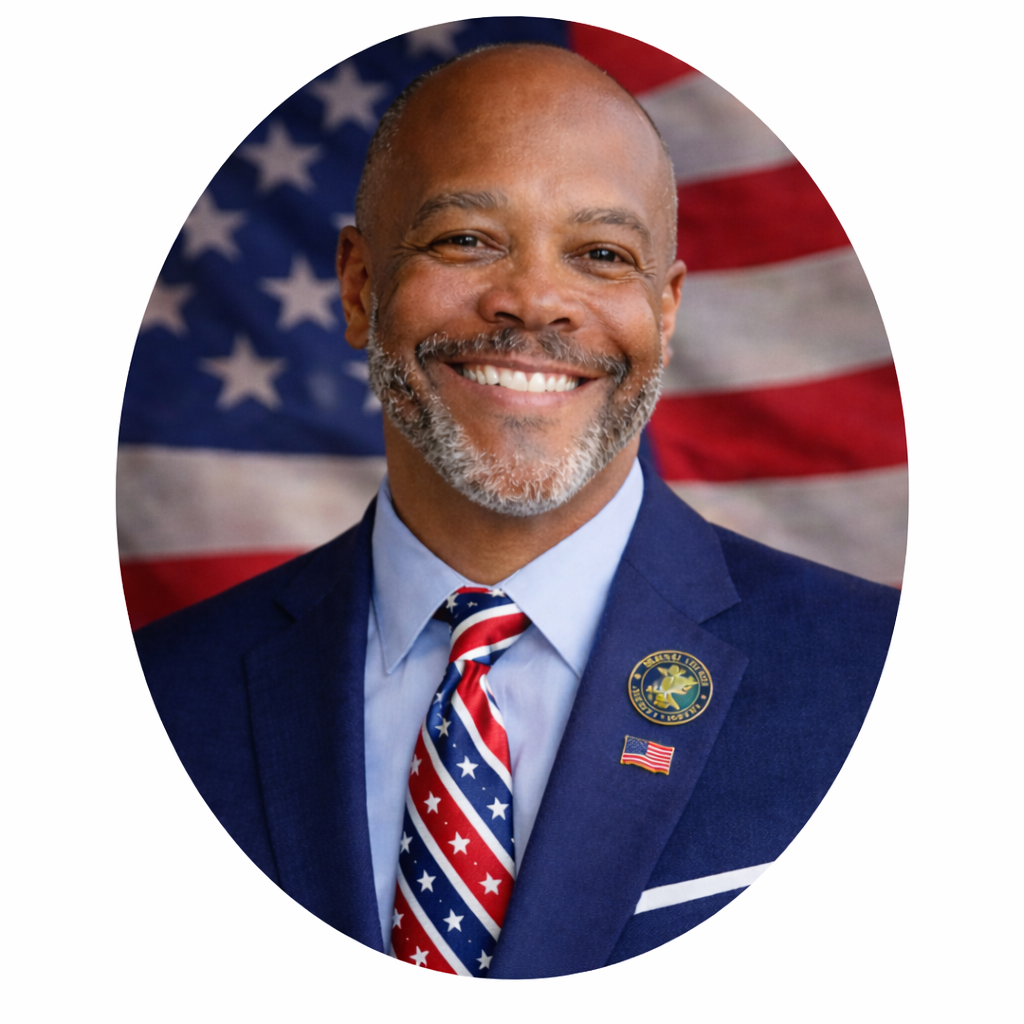
Article by
Willie Daniel
Willie Daniel is the Founder and Chief Executive Officer (CEO) of Global Vets Consulting (GVC) – National Veterans Disability Services, a veteran-led educational and medical evidence support organization dedicated to helping veterans better understand VA disability rating increases, DBQ medical evidence, secondary claims education, and C&P examination preparation.
He is a retired U.S. Army Medical Service Corps Officer with more than 27 years of honorable military service, a decorated Iraq combat veteran, and a retired federal official with the U.S. Department of Veterans Affairs. Throughout his military and federal career, Willie Daniel served in leadership, healthcare administration, operational, and veteran-support roles focused on improving services and support systems for servicemembers, veterans, and their families.
Drawing from decades of military leadership, healthcare administration, veteran advocacy, and federal government experience, Willie Daniel brings a practical, veteran-centered perspective to Global Vets Consulting’s educational articles, AI-powered veteran resources, video education initiatives, and outreach programs. His experience navigating military systems, medical documentation processes, and veteran-related administrative operations provides valuable insight into many of the challenges veterans face when seeking to better understand VA disability rating criteria, medical evidence, documentation strategies, and secondary condition education.
Through GVC’s “Veterans Helping Veterans” mission, his focus is on delivering clear, educational, and easy-to-understand information designed to empower veterans with knowledge, resources, and educational tools that may help them make more informed decisions regarding their individual VA disability journeys.
The information provided through GVC is intended for educational and informational purposes only and should not be considered legal or medical advice.
Disclaimer
Disclaimer: Global Vets Consulting, LLC (“GVC”) is a veteran-led educational and medical evidence support organization. GVC is not a law firm, is not a Veterans Service Organization (VSO), and is not affiliated with the U.S. Department of Veterans Affairs (VA) or any government agency.
Global Vets Consulting does not provide legal advice, medical advice, medical treatment, or healthcare services. GVC does not prepare, file, or submit VA disability claims on behalf of veterans. All information provided through this website, blog articles, videos, educational materials, AI tools, dashboards, templates, and communications is intended solely for general educational and informational purposes.
Veterans are encouraged to consult with accredited representatives, licensed attorneys, qualified medical providers, or Veterans Service Organizations regarding their specific legal, medical, or VA-related matters. VA disability decisions, ratings, and outcomes are determined solely by the U.S. Department of Veterans Affairs based on applicable laws, regulations, medical evidence, and individual circumstances. Past results do not guarantee future outcomes.