
Your military service records alone are rarely enough to secure the disability rating you deserve. It’s a hard truth many veterans face when they open a denial letter citing a “lack of evidence” for a condition that clearly started in uniform. We understand the deep frustration of feeling like a number in a system that doesn’t see the full picture of your health. The importance of a well-documented medical history for va claim success is the difference between a confusing denial and the benefits you’ve earned through your service. 🇺🇸
You already know that the VA process can feel like an uphill battle, especially when you’re worried your C&P exam won’t capture your daily reality. We’re here to show you how precise medical documentation serves as the legal backbone of your claim, bridging the gap between your discharge date and your current symptoms. You’ll learn exactly how to build a bulletproof claim file and how to use a Disability Benefits Questionnaire (DBQ) to summarize your history effectively. By the end of this guide, you’ll have a clear path forward to secure a fair disability rating that reflects your true physical and mental health status.
Key Takeaways
- Learn why the VA legally treats unrecorded symptoms as non-existent and how to build a chronological record from active duty to today.
- Identify the specific “Anatomy of Quality” documentation, focusing on the frequency and severity raters use to determine your social and industrial impact.
- Understand the importance of a well-documented medical history for va claim success when bridging multi-year treatment gaps to establish a solid service nexus.
- Discover how to use Disability Benefits Questionnaires (DBQs) to translate your personal medical history into the standardized language used for VA rating increases.
What is a Well-Documented Medical History in the VA Context?
A well-documented medical history is much more than a collection of old doctor visits. It’s a chronological narrative of every symptom, diagnosis, and treatment you’ve received from your first day of active duty to your life today as a veteran. The Veterans Benefits Administration (VBA) relies on this timeline to verify that your current health issues are actually related to your time in uniform. Without a clear trail, you’re essentially asking a rater to take your word for it, which rarely leads to a successful outcome.
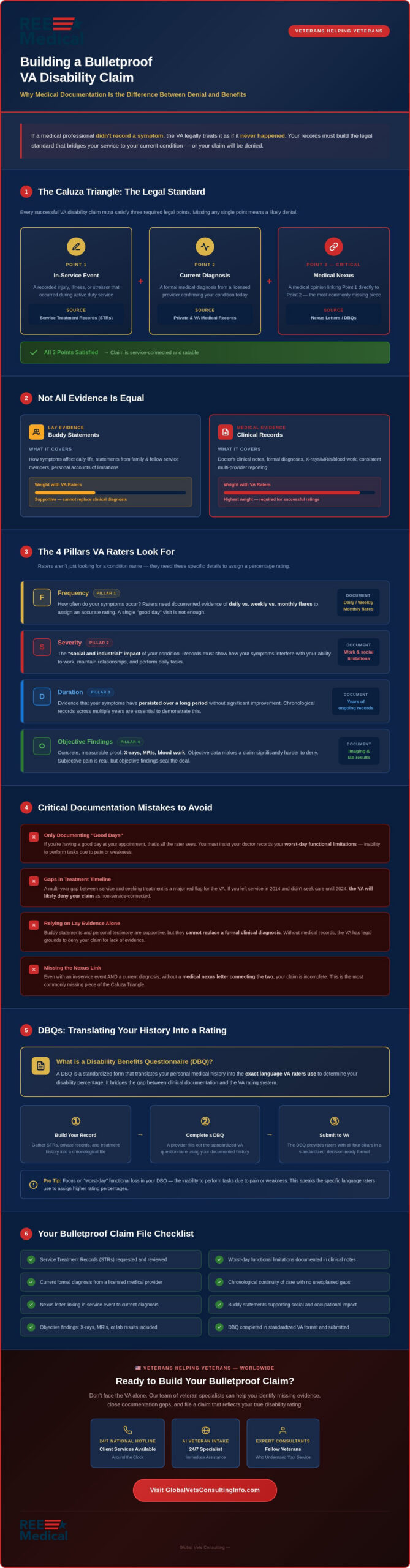
The VA operates under a strict “Paper Trail” rule. If a medical professional didn’t record a symptom or a complaint, the VA legally treats it as if it never happened. This is why the importance of a well-documented medical history for va claim success is so critical. Your records must build what’s known as the “Caluza Triangle.” This legal standard requires three specific points: a recorded in-service event or injury, a current medical diagnosis, and a medical nexus that links the two together. Your Service Treatment Records (STRs) serve as the foundation of this triangle, providing the initial proof that your condition started during your service.
The Difference Between Lay Evidence and Medical Evidence
It’s vital to understand that not all evidence is viewed equally by the VA. Lay evidence includes “Buddy Statements” from family or fellow service members. These are excellent for describing how your symptoms impact your daily routine, but they can’t replace a formal diagnosis. A doctor’s clinical notes carry significantly more weight than your own self-report during a C&P exam. When your medical history shows consistent reporting across multiple providers, it creates a level of credibility that is difficult for the VA to ignore. This consistency eliminates contradictions that raters often use as grounds for a denial. Ensuring your medical history is thorough and accurate is the most effective way to protect your claim from being dismissed due to a lack of evidence.
The Anatomy of Quality Documentation: What VA Raters Look For
When a VA rater reviews your file, they aren’t just looking for the name of a condition; they’re looking for the specific details that justify a certain percentage. Many veterans find it helpful to submit their private medical records to fill in the blanks often left by standard VA care. The importance of a well-documented medical history for va claim success lies in these four critical pillars:
- Frequency: How often do you experience symptoms? Raters need to know if your flares occur daily, weekly, or monthly to assign an accurate rating.
- Severity: This measures the “social and industrial” impact of your condition. Documentation should clearly state how your symptoms interfere with your ability to work and maintain relationships at home.
- Duration: Raters look for evidence that your symptoms have persisted over a long period without significant improvement.
- Objective Findings: While your subjective pain is real, objective data like X-rays, MRIs, and blood work provide the concrete proof that makes a claim much harder to deny.
If you’re unsure whether your current records meet these high standards, seeking veteran benefits education can help you identify exactly what’s missing before you hit submit.
Capturing the “Worst Days” in Your History
A common mistake is only documenting how you feel during a scheduled doctor’s appointment. If you’re having a “good day” when you see your provider, that’s often the only information that makes it into your file. You must insist that your doctor records your functional limitations during your worst flares. Functional loss is the inability to perform a task due to pain or weakness. When your medical history focuses on these specific limitations rather than just a general pain scale, it speaks the language that VA raters use to determine your rating. This level of detail is essential for anyone pursuing VA rating increases for chronic conditions.
Bridging the Gap: Continuity of Care and the Nexus
A major hurdle for many veterans is the “gap in treatment” problem. If you left the service in 2014 and didn’t seek formal medical care for your knee until 2024, the VA will likely deny your claim. Raters often assume that if the pain was truly service-connected, you would have sought professional help sooner. This highlights the importance of a well-documented medical history for va claim success; it provides the continuous thread that keeps your claim alive. Without this thread, establishing a nexus, or a direct link between your current condition and a specific service event, becomes significantly harder.
If you’ve already faced a rejection, our guide on VA Claim Denied for Lack of Evidence: How to Recover in 2026 🇺🇸 offers a roadmap for your next steps. Beyond primary conditions, your history also proves secondary service connections. For example, chronic musculoskeletal pain frequently leads to mental health challenges like depression or sleep disturbances. A documented history shows the logical progression of these symptoms, making it clear that one condition caused the other.
How Independent Medical Evidence Can Fix a Broken History
Private medical opinions are often the only way to explain why a gap in treatment occurred. Perhaps you treated your symptoms with over-the-counter medication or simply “pushed through” the pain for years. A qualified professional can review your records and provide a clinical explanation that reactivates a dormant issue. In many cases, proving “Continuity of Symptomatology” — showing you’ve had the symptoms consistently even if you weren’t in a doctor’s office — can save a claim. Utilizing official Disability Benefits Questionnaires (DBQs) during this process ensures your private evidence is formatted exactly how the VA requires. If your history has gaps, you can start building a stronger case today through our Secondary VA Claims Education resources.
Using DBQs to Translate Your History into a VA Rating
A Disability Benefits Questionnaire (DBQ) serves as a vital translator between your medical records and the VA’s complex rating schedule. It is a standardized form that forces the VA to see your history through the lens of their specific legal requirements. This is where the importance of a well-documented medical history for va claim success becomes tangible. Instead of a rater searching through hundreds of pages of raw clinical notes, a DBQ summarizes your symptoms and functional limitations into a format that is clear and easy to process.
Using a private DBQ offers several advantages over relying solely on a standard Compensation and Pension (C&P) exam. These exams often last only 15 to 20 minutes, which is rarely enough time to capture a condition that has impacted your life for years. A private DBQ ensures your full history is considered before a decision is made. For a deeper look at how these forms work, read our pillar article: What is a DBQ? A Veteran’s Guide to Disability Benefits Questionnaires in 2026.
Maximizing Your Rating with Accurate Documentation
A well-filled DBQ prevents rater error by highlighting key evidence milestones throughout your medical timeline. It ensures that the evaluation focuses on your “worst days” and the specific symptoms that align with the rating schedule. Our mission at Global Vets Consulting is to provide the education and resources veterans need to gather this medical documentation accurately. 🌎 We believe that every veteran deserves a rating that reflects the true impact of their service-connected conditions.
We provide a predictable path forward by helping you understand exactly what evidence is required for a successful claim. This structured approach reduces the anxiety often associated with the bureaucratic process. If you are ready to take the next step toward a fair disability rating, you can start your intake process immediately by engaging with our 24/7 AI Veteran Intake Specialist at GlobalVetsConsultingInfo.com. 🌐
Secure the Rating You Have Earned 🇺🇸
Navigating the VA system requires more than just filling out forms; it requires a strategic approach to your medical evidence. We’ve explored how a chronological record serves as the legal foundation for your claim, bridging the gap between your active duty service and your current health status. By focusing on the frequency and severity of your symptoms, you provide the specific data points that VA raters need to justify a higher rating. The importance of a well-documented medical history for va claim success is the difference between a frustrating denial and the benefits you’ve rightfully earned.
Global Vets Consulting is veteran-owned and operated since 2021. We specialize in Disability Benefits Questionnaires (DBQ) designed to ensure your full history is accurately represented. If you’re ready to move forward with confidence, our 24/7 National Client Services Hotline is available for immediate assistance. 📞
Get the medical documentation you need to support your claim at Global Vets Consulting. You served your country with honor, and we’re here to ensure you receive the recognition and support you deserve. Your mission continues, and we’re proud to be your partner on this journey.
Frequently Asked Questions
What counts as a “well-documented” medical history for a VA claim?
A well-documented history is a chronological record that includes your service treatment records, private clinical notes, and diagnostic test results like X-rays or MRIs. It must clearly show the progression of your condition over time. High-quality documentation specifically notes the frequency of your symptoms and how they limit your ability to work. The importance of a well-documented medical history for va claim success is that it removes the guesswork for the rater.
Can I win a VA claim if I don’t have service treatment records?
Yes, you can still secure a service connection even if your original records are missing or incomplete. You will need to rely on “lay evidence,” such as buddy statements from fellow service members who witnessed the injury or event. Additionally, a medical nexus letter from a private provider can help bridge the gap. This letter must state that your current condition is “at least as likely as not” related to your time in uniform.
How long of a gap in medical history will cause a VA claim denial?
There is no specific number of years that triggers an automatic denial; however, gaps longer than a few years often raise red flags for raters. If you went a decade without treatment, the VA may argue your condition isn’t service-connected. You can overcome this by providing evidence of “continuity of symptomatology.” This shows you were experiencing symptoms consistently even if you weren’t actively seeking professional medical care during that period.
Does the VA check my private medical records during the claims process?
The VA will only review your private medical records if you specifically authorize them to do so or if you submit the records yourself. It’s often faster and more reliable to gather and submit these records personally. This ensures that the rater sees the specific clinical notes that highlight your functional limitations. Private medical evidence is a powerful tool for establishing the current severity of your disability and supporting your claim.
What is the most important piece of medical evidence for a VA rating increase?
A fully completed Disability Benefits Questionnaire (DBQ) is often the most critical piece of evidence for a rating increase. While raw doctor’s notes are helpful, a DBQ translates your symptoms directly into the VA’s rating criteria. It focuses on specific functional loss and the “social and industrial” impairment required for a higher percentage. This standardized format makes it much easier for a rater to approve an increase without requesting redundant examinations.

Article by
Willie Daniel
Willie Daniel is the Founder and Chief Executive Officer (CEO) of Global Vets Consulting (GVC) – National Veterans Disability Services, a veteran-led educational and medical evidence support organization dedicated to helping veterans better understand VA disability rating increases, DBQ medical evidence, secondary claims education, and C&P examination preparation.
He is a retired U.S. Army Medical Service Corps Officer with more than 27 years of honorable military service, a decorated Iraq combat veteran, and a retired federal official with the U.S. Department of Veterans Affairs. Throughout his military and federal career, Willie Daniel served in leadership, healthcare administration, operational, and veteran-support roles focused on improving services and support systems for servicemembers, veterans, and their families.
Drawing from decades of military leadership, healthcare administration, veteran advocacy, and federal government experience, Willie Daniel brings a practical, veteran-centered perspective to Global Vets Consulting’s educational articles, AI-powered veteran resources, video education initiatives, and outreach programs. His experience navigating military systems, medical documentation processes, and veteran-related administrative operations provides valuable insight into many of the challenges veterans face when seeking to better understand VA disability rating criteria, medical evidence, documentation strategies, and secondary condition education.
Through GVC’s “Veterans Helping Veterans” mission, his focus is on delivering clear, educational, and easy-to-understand information designed to empower veterans with knowledge, resources, and educational tools that may help them make more informed decisions regarding their individual VA disability journeys.
The information provided through GVC is intended for educational and informational purposes only and should not be considered legal or medical advice.
Disclaimer
Disclaimer: Global Vets Consulting, LLC (“GVC”) is a veteran-led educational and medical evidence support organization. GVC is not a law firm, is not a Veterans Service Organization (VSO), and is not affiliated with the U.S. Department of Veterans Affairs (VA) or any government agency.
Global Vets Consulting does not provide legal advice, medical advice, medical treatment, or healthcare services. GVC does not prepare, file, or submit VA disability claims on behalf of veterans. All information provided through this website, blog articles, videos, educational materials, AI tools, dashboards, templates, and communications is intended solely for general educational and informational purposes.
Veterans are encouraged to consult with accredited representatives, licensed attorneys, qualified medical providers, or Veterans Service Organizations regarding their specific legal, medical, or VA-related matters. VA disability decisions, ratings, and outcomes are determined solely by the U.S. Department of Veterans Affairs based on applicable laws, regulations, medical evidence, and individual circumstances. Past results do not guarantee future outcomes.