

Why does the VA seem to value a plastic ruler more than the actual pain you feel every time you climb a flight of stairs? If you’ve ever walked out of a C&P exam feeling like the examiner didn’t see your physical limitations, you’re not alone. Many veterans find “Range of Motion” tests frustrating because they often miss the reality of chronic joint issues. Securing a fair Knee Pain VA Rating requires more than just showing up. It demands a strategy built on objective medical evidence that speaks the VA’s language.
At Global Vets Consulting, we’re dedicated to veterans helping veterans 🇺🇸. We’ll show you how the VA evaluates knee conditions under the 38 CFR schedules, covering flexion, extension, and instability. You’ll learn how to use a DBQ to provide the objective evidence needed for 10%, 20%, or 30% ratings. Our goal is to help you move past the confusion and increase your disability percentage. For support, our AI Veteran Intake Specialist is available 24/7 at (727) 350-8387 📞 or visit https://www.GlobalVetsConsultingInfo.com 🌐.
Key Takeaways
- 🇺🇸 Learn how the VA uses objective measurements like range of motion to determine your Knee Pain VA Rating under current 2026 standards.
- Identify the specific diagnostic codes for flexion and extension limitations to see how your symptoms align with VA criteria.
- Discover why a private Disability Benefits Questionnaire (DBQ) is a vital piece of medical evidence for a successful claim.
- Gain a clear, step-by-step strategy for pursuing a VA rating increase using thorough documentation and professional guidance.
Understanding the VA Knee Pain Rating Criteria in 2026
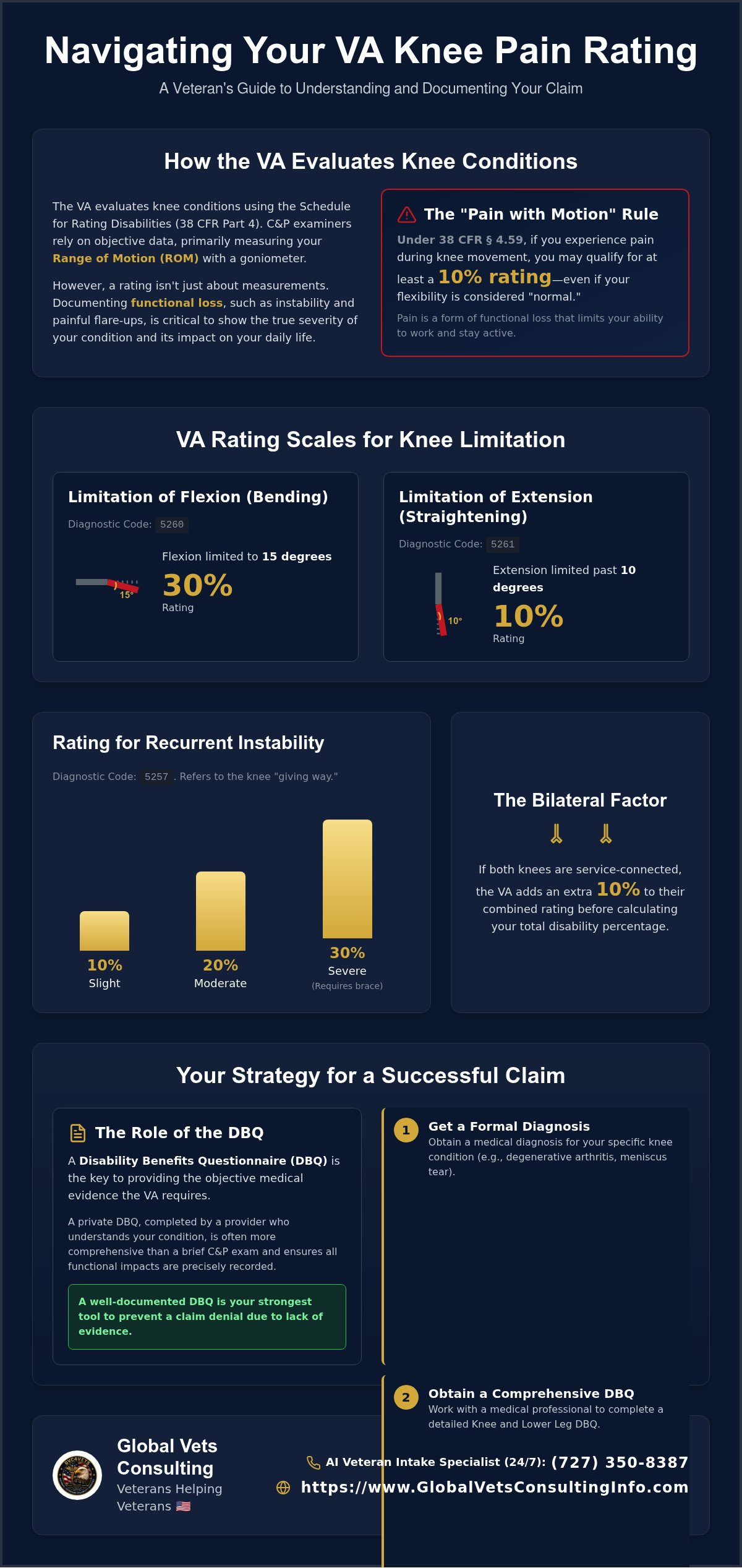
The VA evaluates knee conditions using the Schedule for Rating Disabilities found in 38 CFR Part 4. When you attend a C&P exam, the Veterans Benefits Administration relies heavily on objective data. This usually means a provider uses a goniometer to measure your Range of Motion (ROM). However, your Knee Pain VA Rating isn’t just about how far you can bend your leg. It’s about how that movement impacts your daily life.
Functional loss, including flare-ups and instability, must be documented to show the true severity of your condition. The “Pain with Motion” rule is a vital tool for many veterans. If you feel pain during movement, even if you have “normal” flexibility, the VA should recognize that as a disability. Pain is a form of functional loss that limits your ability to work or stay active. This rule ensures that your subjective experience is factored into your VA disability claim.
The Minimum Compensable Rating for Pain
Under 38 CFR § 4.59, the VA policy states that joints should be rated based on painful motion. This means if you experience pain while bending or straightening your knee, you should qualify for at least a 10% rating. This is true even if your measurements fall within the “normal” range. It’s a critical protection for veterans who suffer from chronic discomfort but don’t meet strict ROM cutoffs. Using DBQs to document this pain can be the difference between a denial and a successful rating.
Common Knee Conditions the VA Recognizes
The VA commonly grants service connection for conditions like degenerative arthritis, patellofemoral pain syndrome, and meniscus tears. Securing a fair Knee Pain VA Rating often depends on having a formal diagnosis before filing for a VA rating increase. Without solid medical evidence, your claim lacks the foundation it needs to succeed. If you need help gathering this evidence, our AI Veteran Intake Specialist is available 24/7 at (727) 350-8387 📞 or visit https://www.GlobalVetsConsultingInfo.com 🌐.
How the VA Rates Knee Limitation and Instability
The VA uses specific diagnostic codes to evaluate your claim. These are outlined in the Schedule of Ratings – Musculoskeletal System. Most ratings focus on mechanical limitations. If your knee locks or gives way, you’re looking at different criteria than if you just have trouble bending it. Understanding these codes is the first step toward a fair Knee Pain VA Rating.
Flexion vs. Extension Rating Scales
The VA measures how well you can move your leg using two main categories. Limitation of flexion (Code 5260) tracks how much you can bend your knee toward your body. For a 30% rating, flexion must be limited to 15 degrees. Limitation of extension (Code 5261) measures how well you can straighten it. If you can’t straighten your leg past 10 degrees, you’ll likely receive a 10% rating. These measurements must be captured during a physical exam using a goniometer to ensure the data is objective and accurate.
Rating for Recurrent Instability
Instability (Code 5257) refers to the “giving way” sensation or lateral laxity in the joint. The VA classifies this as slight (10%), moderate (20%), or severe (30%). Severe instability typically requires the use of a prescribed brace and an assistive device for walking. To prove this in a VA disability claim, you’ll need objective medical evidence from joint laxity tests. If you’re unsure if your documentation meets these standards, reviewing your medical evidence with experts can help.
🇺🇸 If both knees are affected, the VA applies the Bilateral Factor. This adds an extra 10% to the combined rating of those disabilities before they’re factored into your total percentage. This can significantly impact your overall compensation. For help with a VA rating increase, call our AI Veteran Intake Specialist 24/7 at (727) 350-8387 📞.
The Role of the DBQ in Your Knee Disability Claim
The Disability Benefits Questionnaire (DBQ) is the primary tool used to determine your Knee Pain VA Rating. While the VA uses these forms during Compensation and Pension (C&P) exams, a private DBQ often provides a much more comprehensive view of your physical limitations. Many veterans find that standard exams are too brief to capture the true impact of their injury. A detailed DBQ ensures that every measurement, from flexion to instability, is recorded with precision according to the VA’s Official Schedule of Ratings for Knee Conditions.
Why Medical Evidence Prevents Denials
A common reason for a claim rejection is a lack of objective data. If you’ve found your VA claim denied for lack of evidence: how to recover in 2026 🇺🇸, a properly completed DBQ can be your path forward. It acts as the “missing link” between your service history and your current diagnosis. By providing clear, standardized documentation, you reduce the chance of an examiner overlooking critical functional loss or repetitive use exhaustion.
Musculoskeletal Claims Education
A thorough knee DBQ must include measurements taken during flare-ups and after repetitive use. This is where the “DeLuca Criteria” become essential. Your doctor must record how your range of motion changes when you’re in pain or fatigued. Capturing this data is vital because your knee might move fine on a “good day” but lock up after a short walk. Global Vets Consulting specializes in helping you navigate these requirements through Musculoskeletal Claims Education. We prioritize accuracy to help you secure the rating you’ve earned. If you’re ready to strengthen your evidence, explore our DBQ educational resources or call our AI Specialist 24/7 at (727) 350-8387 📞.
Steps to Increase Your Knee Pain VA Rating
Do you feel like your current percentage doesn’t reflect your daily struggle? Increasing your Knee Pain VA Rating is a methodical process that relies on updated documentation. Unlike a primary claim, a claim for increase assumes service connection is already established. You’re simply proving the condition has worsened over time. Following a logical path ensures your medical evidence is ready for review.
- Step 1: Obtain a formal diagnosis. You can’t increase a rating for a condition that isn’t clearly identified in your current records. A fresh diagnosis from a medical professional serves as the anchor for your claim.
- Step 2: Use a DBQ to document severity. This form translates your physical limitations into the specific degrees and codes the VA requires to justify a higher percentage.
- Step 3: Submit evidence through VA.gov. Uploading your private DBQ and medical records directly to the portal ensures your evidence is part of your file before your C&P exam begins.
- Step 4: Prepare for the C&P exam. Review your documentation so you can accurately describe your symptoms and functional loss to the examiner.
Filing for a Rating Increase
Learning how to use a DBQ for a VA disability rating increase in 2026 is the most efficient way to secure the compensation you’ve earned. A fresh DBQ provides the VA with a clear snapshot of your current functional loss. This objective evidence makes it much harder for the agency to deny your request based on outdated medical records from years ago.
Preparation for the C&P Exam
When you attend your exam, it’s vital to describe your “worst day.” Examiners often see you after you’ve rested, but your rating should reflect the days you can’t climb stairs or stand for long periods. Insist that the examiner uses a goniometer for every measurement. If they don’t, your Knee Pain VA Rating might be based on guesswork rather than facts. Ready to get started? Contact our 24/7 National Client Services Hotline at (727) 350-8387 📞 or visit https://www.GlobalVetsConsultingInfo.com 🌐. Our AI Veteran Intake Specialist is ready to help you take the next step in your journey 🇺🇸.
Take Command of Your Knee Disability Claim
Securing a fair Knee Pain VA Rating doesn’t have to be a source of constant frustration. Success comes down to moving beyond simple diagnoses and providing the VA with objective medical evidence that documents your functional loss. By using detailed DBQs and understanding how the DeLuca criteria apply to your flare-ups, you can ensure your rating accurately reflects your physical reality. You’ve earned these benefits through your service, and it’s time your compensation matches the limitations you face every day.
Do you need assistance gathering the right evidence for your claim? Global Vets Consulting is a veteran-owned and operated partner dedicated to musculoskeletal claims education. We’re ready to guide you through every step of the process with our “Veterans Helping Veterans” mission 🇺🇸. 📞 Speak with a Global Vets Consultant Today by calling our 24/7 National Client Services Hotline at (727) 350-8387. You can also visit us at 🌐 https://www.GlobalVetsConsultingInfo.com to begin your journey toward a successful VA rating increase.
Frequently Asked Questions
Can I get a VA rating for knee pain if my X-rays are normal?
Yes, you can still receive a 10% Knee Pain VA Rating even if your X-rays don’t show structural damage. Under 38 CFR § 4.59, the VA recognizes “painful motion” as a valid form of functional loss. If you experience pain during a physical exam while bending or straightening your leg, you meet the minimum compensable criteria. Providing medical evidence through a private DBQ can help document this pain objectively for your claim.
What is the maximum VA disability rating for knee pain?
The maximum rating varies by the specific diagnostic code used. For ankylosis (complete stiffening) of the knee, the rating can reach 60%. Limitation of extension can be rated up to 50% if the leg is stuck at a severe angle. Additionally, a total knee replacement provides a temporary 100% rating for the first four months post-surgery. Our specialized musculoskeletal claims education can help you identify which codes apply to your condition.
Does the VA rate knee pain and instability separately?
Yes, the VA can rate limitation of motion and instability separately if the symptoms are distinct. For example, you might receive one rating for limited flexion and another for recurrent instability under Code 5257. This allows you to secure a higher combined Knee Pain VA Rating without violating pyramiding rules. Ensuring your medical evidence clearly separates these functional losses is the key to a successful VA disability claim for multiple symptoms.
How does the bilateral factor affect my knee rating?
The bilateral factor provides an additional 10% boost to your combined rating when you have service-connected disabilities in both knees. This adjustment is applied to the combined percentage of the bilateral conditions before that number is factored into your total VA rating. It recognizes that injuries to both legs create a greater overall impact on your mobility. Our AI Veteran Intake Specialist is available 24/7 at (727) 350-8387 📞 to discuss your claim.
What should I do if the C&P examiner didn’t use a goniometer?
If your examiner didn’t use a goniometer, you should submit a formal statement to the VA challenging the adequacy of the exam. The VA requires objective measurements for range of motion, and a visual estimate is often inaccurate. You can counter a flawed C&P exam by submitting a private DBQ from a qualified professional. For help gathering thorough medical evidence, visit https://www.GlobalVetsConsultingInfo.com 🌐 or call our national hotline 24/7 at (727) 350-8387 📞.

Article by
Willie Daniel
Willie Daniel is the Founder and Chief Executive Officer (CEO) of Global Vets Consulting (GVC4Vets) – National Veterans Disability Services, a veteran-led educational and medical evidence support organization dedicated to helping veterans better understand VA disability rating increases, DBQ medical evidence, secondary claims education, and C&P examination preparation.
He is a retired U.S. Army Medical Service Corps Officer with more than 27 years of honorable military service, a decorated Iraq combat veteran, and a retired federal official with the U.S. Department of Veterans Affairs. Throughout his military and federal career, Willie Daniel served in leadership, healthcare administration, operational, and veteran-support roles focused on improving services and support systems for servicemembers, veterans, and their families.
Drawing from decades of military leadership, healthcare administration, veteran advocacy, and federal government experience, Willie Daniel brings a practical, veteran-centered perspective to Global Vets Consulting’s educational articles, AI-powered veteran resources, video education initiatives, and outreach programs. His experience navigating military systems, medical documentation processes, and veteran-related administrative operations provides valuable insight into many of the challenges veterans face when seeking to better understand VA disability rating criteria, medical evidence, documentation strategies, and secondary condition education.
Through GVC’s “Veterans Helping Veterans” mission, his focus is on delivering clear, educational, and easy-to-understand information designed to empower veterans with knowledge, resources, and educational tools that may help them make more informed decisions regarding their individual VA disability journeys.
The information provided through GVC is intended for educational and informational purposes only and should not be considered legal or medical advice.
Disclaimer
Disclaimer: Global Vets Consulting, LLC (“GVC”) is a veteran-led educational and medical evidence support organization. GVC is not a law firm, is not a Veterans Service Organization (VSO), and is not affiliated with the U.S. Department of Veterans Affairs (VA) or any government agency.
Global Vets Consulting does not provide legal advice, medical advice, medical treatment, or healthcare services. GVC does not prepare, file, or submit VA disability claims on behalf of veterans. All information provided through this website, blog articles, videos, educational materials, AI tools, dashboards, templates, and communications is intended solely for general educational and informational purposes.
Veterans are encouraged to consult with accredited representatives, licensed attorneys, qualified medical providers, or Veterans Service Organizations regarding their specific legal, medical, or VA-related matters. VA disability decisions, ratings, and outcomes are determined solely by the U.S. Department of Veterans Affairs based on applicable laws, regulations, medical evidence, and individual circumstances. Past results do not guarantee future outcomes.

