
Did you know that over 93% of veterans diagnosed with PTSD also struggle with chronic insomnia? If you’re lying awake at night, you already know that poor sleep isn’t just a minor side effect. It’s a heavy burden that impacts your performance at work and your relationships at home. You might feel frustrated by the VA’s pyramiding rules, which often make it feel like your sleep issues are being overlooked or folded into a single rating that doesn’t reflect your daily reality. We understand that proving insomnia secondary to PTSD can feel like navigating a complex maze without a map.
In this guide, you’ll learn exactly how to link these conditions through professional medical documentation to secure the VA disability rating you deserve. We’ll show you how to use Disability Benefits Questionnaires (DBQs) to document your symptoms with the precision the VA requires. By understanding the specific evidence needed to overcome common hurdles, you can move toward a fair rating increase and the peace of mind that comes with being properly heard by the system you served.
Key Takeaways
- Understand how hyperarousal and nightmares establish Insomnia Secondary to PTSD as a valid secondary service connection.
- Learn how to navigate the VA’s pyramiding rules to ensure your sleep disturbances are properly reflected in your mental health rating.
- Discover why a professional Nexus Letter is essential for proving the medical link between your primary and secondary conditions.
- Master the use of Disability Benefits Questionnaires (DBQs) to provide the technical medical evidence required for a successful claim.
- Follow a clear, step-by-step process for filing a Fully Developed Claim (FDC) to achieve a faster decision on your rating increase.
Understanding the Link: Why Insomnia is Secondary to PTSD
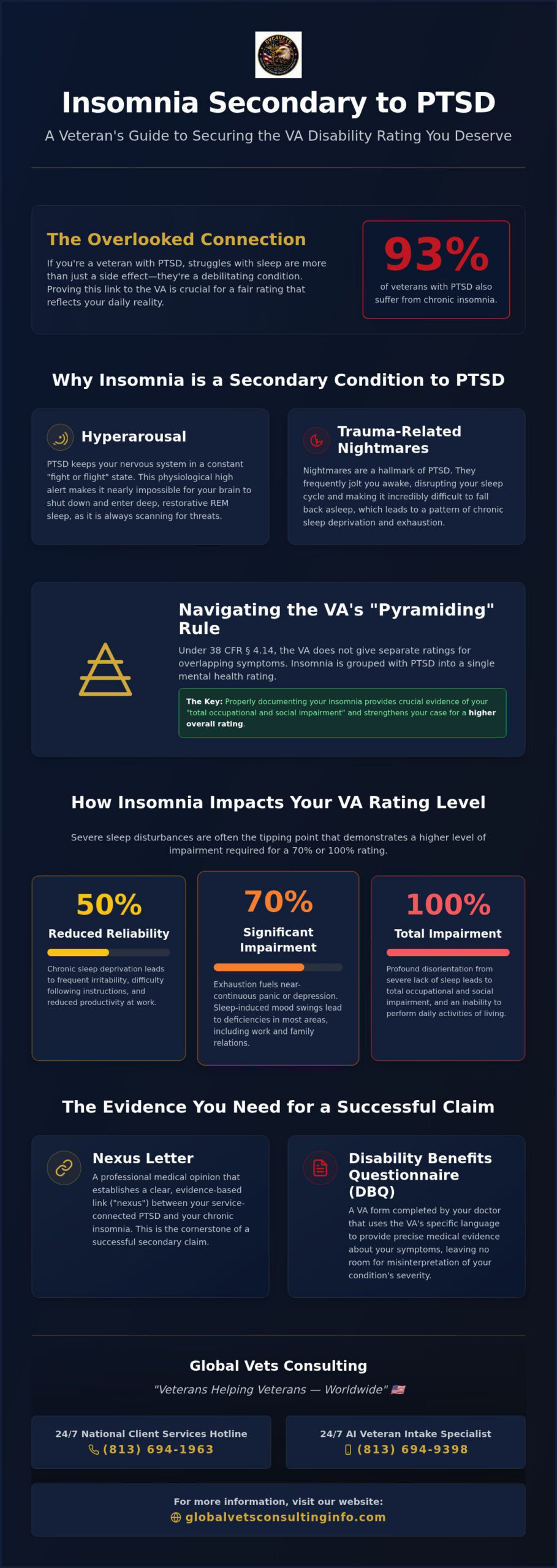
Establishing a secondary service connection is a powerful way to ensure your VA disability rating accurately reflects your health. 🇺🇸 A secondary condition is any illness or injury that is caused or aggravated by a primary service-connected disability. In this case, Insomnia Secondary to PTSD is one of the most common links we see. Research indicates that over 93% of veterans with PTSD also suffer from significant sleep disturbances. It is important to distinguish between acute sleep issues, which might last a few days, and chronic insomnia disorder, which is a persistent medical condition that requires professional documentation for a successful claim.
The Clinical Connection: Hyperarousal and Sleep
The link between these two conditions is rooted in biology. PTSD forces your nervous system into a state of constant hyperarousal, often referred to as the “fight or flight” response. This state makes it incredibly difficult for your brain to transition into deep REM sleep. When your mind is always scanning for threats, it won’t let your guard down long enough to rest. Trauma-related nightmares further complicate this cycle, often jolting you awake and making it nearly impossible to fall back asleep. This chronic insomnia isn’t just a minor frustration; it is a physiological result of your service-connected trauma that impacts every hour of your day.
Why a Secondary Claim Matters for Your Rating
You might wonder why you should file if the VA often groups mental health symptoms together. The answer lies in the “total picture” of your disability. Secondary conditions are just as valid as direct ones. Documenting your insomnia provides critical medical evidence regarding your social and industrial impairment. It proves to the VA that your PTSD isn’t just affecting your mood; it’s destroying your ability to function during the day due to exhaustion. This level of detail is often what pushes a claim toward a higher VA rating increase. By showing the full scope of your symptoms, you make it much harder for the VA to minimize your experience.
How the VA Rates PTSD with Insomnia: The Pyramiding Rule
When you file for Insomnia Secondary to PTSD, it’s vital to understand how the VA evaluates these overlapping symptoms. Under 38 CFR § 4.14, the VA strictly prohibits “pyramiding,” which is the practice of rating the same symptom under two different diagnoses. Because the VA classifies insomnia as a mental health condition under Diagnostic Code 9411, it won’t provide two separate checks. Instead, the rater looks at your “total occupational and social impairment” and assigns a single percentage that encompasses all your mental health symptoms. While this might feel like your sleep issues are being sidelined, documenting them correctly actually strengthens your case for a higher tier in the General Rating Formula for Mental Disorders.
The following table illustrates how sleep-related symptoms often influence the VA’s determination of your rating level:
| Rating % | Key Insomnia-Related Criteria |
|---|---|
| 50% | Reduced reliability and productivity; chronic sleep deprivation causing frequent irritability and difficulty following instructions. |
| 70% | Deficiencies in most areas; near-continuous panic or depression fueled by exhaustion; inability to maintain relationships due to sleep-induced mood swings. |
| 100% | Total occupational and social impairment; profound disorientation; inability to perform activities of daily living due to severe cognitive decline from lack of sleep. |
The 70% vs. 100% Threshold
Moving from a 70% to a 100% rating is a significant jump that requires evidence of “total” impairment. Severe insomnia often serves as the tipping point. When you haven’t slept more than two hours a night for weeks, you might experience near-continuous panic attacks or suicidal ideation. According to the VA on PTSD and sleep, chronic sleep issues are deeply intertwined with the most severe mental health symptoms. If your fatigue has reached a point where you can no longer manage your own finances or maintain hygiene, your insomnia documentation is the key to proving you meet the 100% criteria.
Secondary Service Connection vs. Direct Connection
It’s rare for insomnia to be rated as a standalone direct service connection unless it was specifically diagnosed during your time in uniform. For most of us, it’s more effective to claim it as secondary. This approach bolsters your existing PTSD claim by providing a more comprehensive picture of your daily struggles. If you’re unsure where to start, reviewing the VA disability claims process step by step can help you frame your secondary claim correctly. Understanding these nuances ensures you don’t leave money on the table. You can explore our educational resources to learn more about substantiating these complex links.
Gathering Evidence: The Role of a Nexus Letter and DBQ
Securing a rating for Insomnia Secondary to PTSD requires more than just telling a story; it requires a bulletproof paper trail. You can’t rely on a VA examiner to connect the dots for you. Instead, you should take a proactive approach to build your case before your file ever reaches a rater’s desk. This process starts with clinical verification and ends with a clear medical link that the VA cannot ignore. Following a methodical path ensures your evidence is thorough and technically accurate.
- Step 1: Clinical Diagnosis. You must have a formal diagnosis of chronic insomnia from a qualified medical professional. Without this, your claim is just a list of symptoms without a medical foundation.
- Step 2: The Nexus Letter. This is the bridge. Your doctor needs to state that your insomnia is “at least as likely as not” caused or aggravated by your service-connected PTSD. This specific legal language is non-negotiable for success.
- Step 3: The DBQ. A Disability Benefits Questionnaire (DBQ) provides the VA with a standardized look at your symptoms. It documents how often you’re awake and how that lack of sleep destroys your daily focus.
- Step 4: Lay Evidence. Buddy statements from a spouse or roommate are invaluable. They can describe the nightmares and restless nights they witness, providing a human element to the medical data.
Why Private Medical Evidence is Critical
Many veterans make the mistake of walking into a C&P exam with nothing but their own testimony. These exams are often rushed, and the examiner might only spend ten minutes reviewing your history. In contrast, obtaining private medical evidence allows you to work with a provider who takes the time to document every nuance of your condition. Understanding what is a DBQ is essential because it’s the primary tool the VA uses to determine your rating level. According to the VA on PTSD and Sleep Problems, the relationship between these conditions is complex, so having a detailed report that mirrors VA requirements is a major advantage.
Common Evidence Mistakes That Lead to Denials
The number one reason claims for Insomnia Secondary to PTSD get denied is a missing nexus. You might clearly have both conditions, but if there isn’t a medical professional explicitly linking them, the VA will treat them as unrelated. Don’t fall into the trap of self-diagnosis. Even if you’ve done your research, the VA only values clinical backing from a licensed provider. Another common error is submitting vague statements that don’t address “social and industrial impairment.” If your evidence doesn’t show how your sleep issues affect your job or family life, it won’t help your rating increase. If you need help organizing your documentation, get started with our DBQ preparation education today.
Taking Action: How to File for an Increase in 2026
Filing for a VA rating increase is the final step in securing the compensation you’ve earned. In 2026, the average time to complete a disability-related claim is approximately 71.3 days. You can significantly influence this timeline by submitting a Fully Developed Claim (FDC). This means you provide all necessary medical evidence, including your diagnosis and Nexus Letter, at the moment you apply. When you log into VA.gov to submit your application for Insomnia Secondary to PTSD, you should ensure every document is uploaded clearly to avoid back-and-forth requests for more information.
C&P examinations for secondary mental health conditions can be stressful. The examiner will likely ask how your sleep disturbances impact your daily life and work performance. Because you’ve already documented these symptoms in your private DBQ, you’ll be prepared to speak with confidence. You won’t have to hope the examiner “notices” the link; you’ll have the evidence right in front of them. This preparation turns a high-pressure interview into a simple verification of existing facts.
The Power of a Fully Developed Claim (FDC)
An FDC is your best defense against the long wait times often associated with standard claims. By submitting your private DBQ upfront, you’re essentially handing the VA a completed roadmap for your rating. This proactive approach reduces the need for the VA to schedule multiple follow-up exams. For a detailed breakdown of this strategy, you can learn how to use a DBQ for a VA disability rating increase to maximize your chances of a first-time approval.
Partnering with Global Vets for Success
At Global Vets Consulting, our mission is “Veterans Helping Veterans” 🇺🇸. We specialize in Independent Medical Evidence Education and secondary VA claims education to help you navigate this bureaucratic system. We don’t just provide forms; we provide the clarity and peace of mind you need to move forward. If you’re ready to take the next step, our 24/7 AI Veteran Intake Specialist is available right now to help you begin the process. Contact Global Vets Consulting today to ensure your documentation is meticulous, accurate, and ready for submission.
Secure the VA Rating You’ve Earned Today
Your service-connected trauma shouldn’t keep you awake at night without the recognition and support you deserve. By establishing Insomnia Secondary to PTSD through meticulous medical evidence, you can move past the confusion of pyramiding rules and secure a fair disability rating. Success in 2026 depends on being proactive. A formal diagnosis, a strong Nexus Letter, and a detailed DBQ are the tools that transform a frustrating claim into a successful outcome. You’ve already done the hard work of serving; now it’s time to ensure your records reflect the true impact of that service on your daily life.
Global Vets Consulting is a Veteran-Owned & Operated partner dedicated to your success. 🇺🇸 We provide specialized mental health DBQ education and independent medical evidence resources designed to simplify the complex VA system. You don’t have to navigate this path alone. Our team is ready to help you document the full impact of your symptoms so you can achieve the rating increase you’ve earned through your dedication and sacrifice.
Take the first step toward a predictable path forward. 📞 24/7 National Client Services Hotline: 800-484-0557. Get Started with Your DBQ Preparation Today and find the peace of mind that comes with professional documentation. You’ve served your country with honor; let us help you secure the benefits you deserve.
Frequently Asked Questions
Can insomnia be rated separately from PTSD?
No, the VA typically does not rate insomnia as a separate condition if you already have a service-connected mental health diagnosis. Under Diagnostic Code 9411, the VA views sleep disturbances as a symptom rather than a distinct disability. This means your sleep issues are factored into your overall PTSD percentage to reflect your total social and industrial impairment. Documenting these issues is vital because they show the rater how your condition limits your daily life.
What is the VA rating for insomnia secondary to PTSD?
There is no dedicated percentage specifically for Insomnia Secondary to PTSD. Instead, your insomnia symptoms help determine your placement within the General Rating Formula for Mental Disorders. These ratings range from 0% to 100% based on the severity of your symptoms. Severe insomnia that leads to near-continuous panic or total occupational impairment is often the clinical evidence needed to reach the 70% or 100% rating tiers in 2026.
Do I need a new C&P exam for a secondary insomnia claim?
You should expect the VA to request a new C&P exam when you file for an increase or a secondary condition. The examiner needs to verify the current severity of your symptoms and confirm the medical link. You can make this process more predictable by submitting a private Disability Benefits Questionnaire (DBQ) upfront. This ensures the examiner has a thorough record of your sleep struggles before you even walk into the room.
What is the ‘pyramiding rule’ in VA disability claims?
The pyramiding rule is a regulation under 38 CFR § 4.14 that prevents the VA from “double counting” the same symptom. For example, if both PTSD and insomnia cause you to be irritable and exhausted, the VA cannot give you two separate ratings for those symptoms. They must combine the conditions into a single mental health rating that covers all your psychological and sleep-related symptoms to ensure an accurate evaluation.
How do I prove my insomnia is caused by my PTSD?
Proving the connection requires three specific pieces of medical evidence. First, you need a formal diagnosis of chronic insomnia from a licensed professional. Second, you must obtain a Nexus Letter where a medical professional explicitly links your sleep disorder to your PTSD using the phrase “at least as likely as not.” Finally, you should use a DBQ to document the frequency and severity of your symptoms. These documents provide the technical proof the VA requires.
Can a private doctor fill out a DBQ for my insomnia claim?
Yes, a private doctor can absolutely complete a DBQ for your claim. In fact, many veterans find that private providers offer a more detailed and accurate reflection of their symptoms than a rushed VA examiner. Using a private DBQ allows you to submit a Fully Developed Claim (FDC), which can lead to a faster decision. Just ensure your doctor uses the most current VA forms available, such as those released in late 2025.

Article by
Willie Daniel
Willie Daniel is the Founder and Chief Executive Officer (CEO) of Global Vets Consulting (GVC4Vets) – National Veterans Disability Services, a veteran-led educational and medical evidence support organization dedicated to helping veterans better understand VA disability rating increases, DBQ medical evidence, secondary claims education, and C&P examination preparation.
He is a retired U.S. Army Medical Service Corps Officer with more than 27 years of honorable military service, a decorated Iraq combat veteran, and a retired federal official with the U.S. Department of Veterans Affairs. Throughout his military and federal career, Willie Daniel served in leadership, healthcare administration, operational, and veteran-support roles focused on improving services and support systems for servicemembers, veterans, and their families.
Drawing from decades of military leadership, healthcare administration, veteran advocacy, and federal government experience, Willie Daniel brings a practical, veteran-centered perspective to Global Vets Consulting’s educational articles, AI-powered veteran resources, video education initiatives, and outreach programs. His experience navigating military systems, medical documentation processes, and veteran-related administrative operations provides valuable insight into many of the challenges veterans face when seeking to better understand VA disability rating criteria, medical evidence, documentation strategies, and secondary condition education.
Through GVC’s “Veterans Helping Veterans” mission, his focus is on delivering clear, educational, and easy-to-understand information designed to empower veterans with knowledge, resources, and educational tools that may help them make more informed decisions regarding their individual VA disability journeys.
The information provided through GVC is intended for educational and informational purposes only and should not be considered legal or medical advice.
Disclaimer
Disclaimer: Global Vets Consulting, LLC (“GVC”) is a veteran-led educational and medical evidence support organization. GVC is not a law firm, is not a Veterans Service Organization (VSO), and is not affiliated with the U.S. Department of Veterans Affairs (VA) or any government agency.
Global Vets Consulting does not provide legal advice, medical advice, medical treatment, or healthcare services. GVC does not prepare, file, or submit VA disability claims on behalf of veterans. All information provided through this website, blog articles, videos, educational materials, AI tools, dashboards, templates, and communications is intended solely for general educational and informational purposes.
Veterans are encouraged to consult with accredited representatives, licensed attorneys, qualified medical providers, or Veterans Service Organizations regarding their specific legal, medical, or VA-related matters. VA disability decisions, ratings, and outcomes are determined solely by the U.S. Department of Veterans Affairs based on applicable laws, regulations, medical evidence, and individual circumstances. Past results do not guarantee future outcomes.