
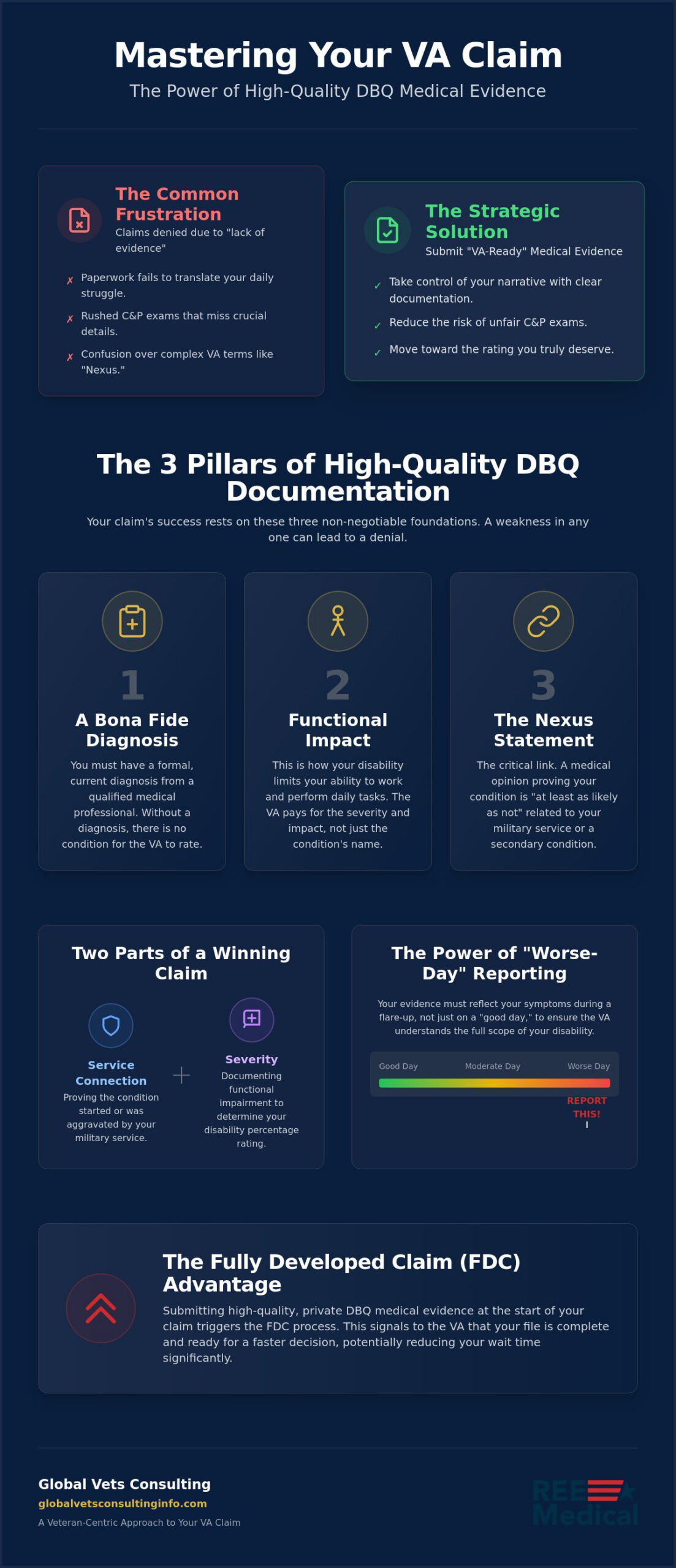
Most VA claim denials aren’t actually a rejection of your injury. They’re a failure of the paperwork to translate your daily struggle into the specific language the VA requires for dbq medical evidence. You’ve likely felt the sting of a “lack of evidence” letter or the frustration of a rushed C&P exam where the doctor barely looked up from their screen. It’s confusing to deal with complex terms like “Nexus” and “Functional Impact” when you’re just trying to access the benefits you earned through your service.
We understand that frustration because we’ve been in your boots. The good news is that you can take control of your narrative by leveraging high-quality documentation to substantiate your claim. When your medical evidence is thorough and “VA-ready,” you reduce the risk of unfair exams and move toward the rating you truly deserve. This guide provides a clear path to understanding how these forms work, how to document your symptoms effectively, and what it takes to secure a successful service connection or rating increase. Let’s get your claim on the right track for a smoother, faster process.
Key Takeaways
- Understand how high-quality dbq medical evidence serves as a strategic narrative that translates your daily limitations into the VA’s specific rating language.
- Identify the “Three Pillars” of documentation, including why a bona fide diagnosis is the non-negotiable starting point for any successful claim.
- Learn the strategic advantage of submitting private medical documentation to trigger the Fully Developed Claim (FDC) process for faster results.
- Discover how a veteran-centric approach ensures your evidence is meticulous and reflects the true severity of your service-connected conditions. 🇺🇸
Understanding DBQ Medical Evidence: Why Your VA Claim Depends on It
dbq medical evidence refers to the standardized Disability Benefits Questionnaires used by the VA to evaluate the severity of your conditions. In 2026, the VA has increasingly recognized the value of private medical documentation. This shift allows you to take a more active role in your claim by providing evidence from providers who actually understand your medical history. Accurate dbq medical evidence bridges the gap between your service treatment records (STRs) and your current functional state.
Remember that a DBQ isn’t a treatment plan. It’s a specific snapshot of your disability for rating purposes. While your regular doctor focuses on getting you better, a provider completing a DBQ focuses on documenting your limitations according to the VA Schedule for Rating Disabilities. This documentation ensures that the rater sees the full scope of your daily struggle without relying solely on a rushed C&P exam.
The Purpose of Standardized Documentation
The VA uses these forms to ensure every veteran is evaluated against the same legal standards. Narrative medical notes often lack the specific technical language required by the Rating Board. A structured Disability Benefits Questionnaire translates your symptoms into checkboxes and data points that raters can easily process. This reduces the chance of human error during the review process.
- 🇺🇸 Standardized evaluation across all states.
- 📋 Direct alignment with VA rating criteria.
- 🌐 Faster processing for Fully Developed Claims.
Service Connection vs. Severity
Winning a claim requires two distinct steps. First, you must prove service connection, meaning the condition started or was aggravated by your time in uniform. Second, you must prove severity, which determines your actual percentage. Under 38 CFR Part 4, medical evidence is the objective clinical data used to determine the degree of functional impairment caused by your service-connected disability. Precise documentation ensures the VA doesn’t just acknowledge your condition but rates it correctly.
The 3 Pillars of High-Quality DBQ Documentation
High-quality dbq medical evidence isn’t just a collection of random medical notes. It’s a strategic legal document that must speak the VA’s language. To secure a successful rating, your documentation must stand on three essential pillars. If any of these are weak or missing, the VA has a clear path to deny your claim. Many veterans face immediate denials simply because their paperwork lacked one of these foundational elements.
- Pillar 1: A Bona Fide Diagnosis. You must have a formal diagnosis from a qualified medical professional. Without a clear diagnosis, there’s no condition for the VA to rate.
- Pillar 2: Functional Impact. This is the most overlooked element. The VA doesn’t just pay for the name of a disability; they pay for how that disability limits your ability to work and perform daily tasks.
- Pillar 3: The Nexus Statement. This is the critical bridge. It proves your condition is “at least as likely as not” related to your military service.
Documenting Symptoms and Severity
The checkboxes on the Public Disability Benefits Questionnaires (DBQs) capture the frequency, duration, and intensity of your symptoms. It’s vital to use “worse-day” reporting during your evaluation. If you only describe how you feel on a “good” day, the rater will assume that’s your constant state. Accurate dbq medical evidence must reflect your symptoms during a flare-up to ensure the VA sees the full scope of your disability.
The Power of the Nexus
A professional medical opinion on the Nexus is the gold standard for complex claims. This is especially true for secondary service connections, such as linking radiculopathy to back pain. When a doctor provides a clear, evidence-based opinion on this connection, it removes the guesswork for the VA rater. If you’re feeling overwhelmed by the jargon, exploring educational resources for VA claims can provide the clarity you need to move forward. 🇺🇸
Private vs. VA Evidence: How to Submit Your DBQ Successfully
Submitting a Fully Developed Claim (FDC) is one of the most effective ways to speed up your results. By providing high-quality dbq medical evidence at the start, you signal to the VA that your file is complete. Recent data from June 2026 shows that average claim processing times have dropped to 80.7 days, down from 141.5 days. A well-prepared private DBQ is the engine that drives this efficiency and helps you avoid the “standard” lane where claims often languish for months.
The VA provides official Public Disability Benefits Questionnaires (DBQs) for a reason. They need standardized data to make a decision. However, working with private providers who understand the nuances of VA rating criteria ensures your symptoms aren’t minimized. Once your provider completes the form, the next step is uploading it to VA.gov to officially enter it into your C-file.
Bypassing the C&P Exam Trap
If your private dbq medical evidence is deemed adequate for rating purposes, the VA should not order a separate C&P exam. This is a critical protection for you. Your private documentation acts as a safeguard against rushed or unfair examinations. If a VA examiner later provides a contradictory report after a brief session, your comprehensive private evidence provides the legal grounds needed to challenge that finding during a Higher-Level Review.
Organizing Your Medical Records
A strong claim requires a continuous paper trail. You should gather all post-service medical records to show how your condition has progressed over time. It’s vital that your DBQ evidence matches your “Statement in Support of Claim” exactly. When your personal account and your doctor’s clinical findings tell the same story, the rater has a much harder time denying the connection. If you’re ready to take the next step in your claims journey, contact Global Vets Consulting today for expert education on gathering VA-ready evidence. 🇺🇸
Winning Your Claim with Global Vets Consulting 🇺🇸
Global Vets Consulting operates with a mission-driven focus, rooted in the “Veterans Helping Veterans” ethos. We understand that the bureaucratic maze of the VA can feel like a cold transaction, but we view our work as a partnership. Our goal is to ensure your documentation is meticulous and reflects the true severity of your conditions. We help veterans break the cycle of being previously denied by the VA due to insufficient paperwork. By streamlining the evidence-gathering process, we provide the specific education and resources you need for high-quality dbq medical evidence.
Our support is available around the clock to meet your needs. Whether you are stateside or living OCONUS, our team is ready to assist. We offer a 24/7 National Client Services Hotline and a 24/7 AI Veteran Intake Specialist to ensure you never have to wait for the guidance you deserve. This methodical approach reduces anxiety by offering a clear, predictable path forward.
Our Professional DBQ Preparation Service
Accuracy and compliance are the cornerstones of a successful claim. We educate veterans on how to ensure their questionnaires accurately reflect their medical status and functional limitations. Using standardized forms correctly is the most reliable path to securing a VA rating increase. When your dbq medical evidence is thorough and compliant with 2026 standards, you remove the guesswork for the VA rater and increase your chances of a favorable outcome.
Ready to Take the Next Step? 📞
You don’t have to navigate this complex system alone. We provide a grounded, hardworking partnership for veterans worldwide. If you are ready to secure the benefits you’ve earned, connect with our team today. You can engage with our AI Intake Specialist right now or call our hotline for immediate assistance.
- 🇺🇸 24/7 National Client Services Hotline
- 🤖 24/7 AI Veteran Intake Specialist
- 🌐 Worldwide Support for OCONUS Veterans
- 💻 Visit us at: GlobalVetsConsultingInfo.com
Take Control of Your Disability Claim Today
Your journey toward a fair VA rating depends on the quality of your documentation. By focusing on the “Three Pillars” of a bona fide diagnosis, clear functional impact, and a strong nexus, you transform your paperwork into a strategic asset. High-quality dbq medical evidence ensures the VA rater sees the full scope of your service-connected conditions without the need for guesswork. Whether you’re submitting a new claim or seeking a rating increase, standardized evidence is your best defense against unfair denials or rushed examinations.
Global Vets Consulting has been veteran-owned and operated since 2021. We specialize in complex secondary and mental health claims, providing the meticulous support you need to succeed. Our team is ready to assist you at any hour through our 24/7 National Client Services Hotline 📞. Don’t let a lack of evidence stand between you and the benefits you’ve earned through your service.
Secure Your VA Rating with Professional DBQ Documentation Support
You’ve served your country with honor; now it’s time to ensure the system works for you. We’re here to guide you every step of the way toward the outcome you deserve.
Frequently Asked Questions
Can the VA ignore medical evidence from a private doctor?
No, the VA is legally required to consider all private medical evidence you submit as part of your claim file. If your private documentation is “adequate for rating purposes,” the VA should rely on it to make a decision. If they choose to favor a conflicting C&P exam over your private records, they must provide a detailed explanation in your decision letter regarding why the private evidence was less persuasive.
Is a private DBQ better than a VA C&P exam?
A private DBQ is often superior because it’s completed by a provider who has reviewed your entire medical history and has the time to document your symptoms accurately. VA C&P exams are frequently conducted by contractors who may only spend fifteen minutes evaluating you. Providing your own dbq medical evidence ensures the rater sees a comprehensive view of your disability rather than a rushed snapshot.
What happens if my DBQ is missing a Nexus statement?
Your claim will likely be denied for lack of service connection if the Nexus statement is missing. While the DBQ documents the current severity of your condition, the Nexus provides the critical link proving your military service caused the issue. Without this “bridge,” the VA may acknowledge your disability but won’t grant compensation because the legal connection to your service hasn’t been established.
How much medical evidence is enough for a 100% VA rating?
There’s no specific page count, but you must prove your symptoms meet the exact criteria for a 100% rating in the VA’s Schedule for Rating Disabilities. For instance, a 100% mental health rating requires evidence of “total occupational and social impairment.” Your dbq medical evidence must clearly reflect the specific checkboxes and clinical findings that match those high-level legal thresholds to be successful.
Can I submit a DBQ for a secondary condition like sleep apnea?
Yes, you can submit a DBQ for any condition that was caused or aggravated by an existing service-connected disability. For sleep apnea, the documentation must explain how your primary condition, such as a respiratory issue or weight gain caused by a limited range of motion, led to the secondary disorder. This requires a clear medical opinion that explains the physiological connection between the two conditions.
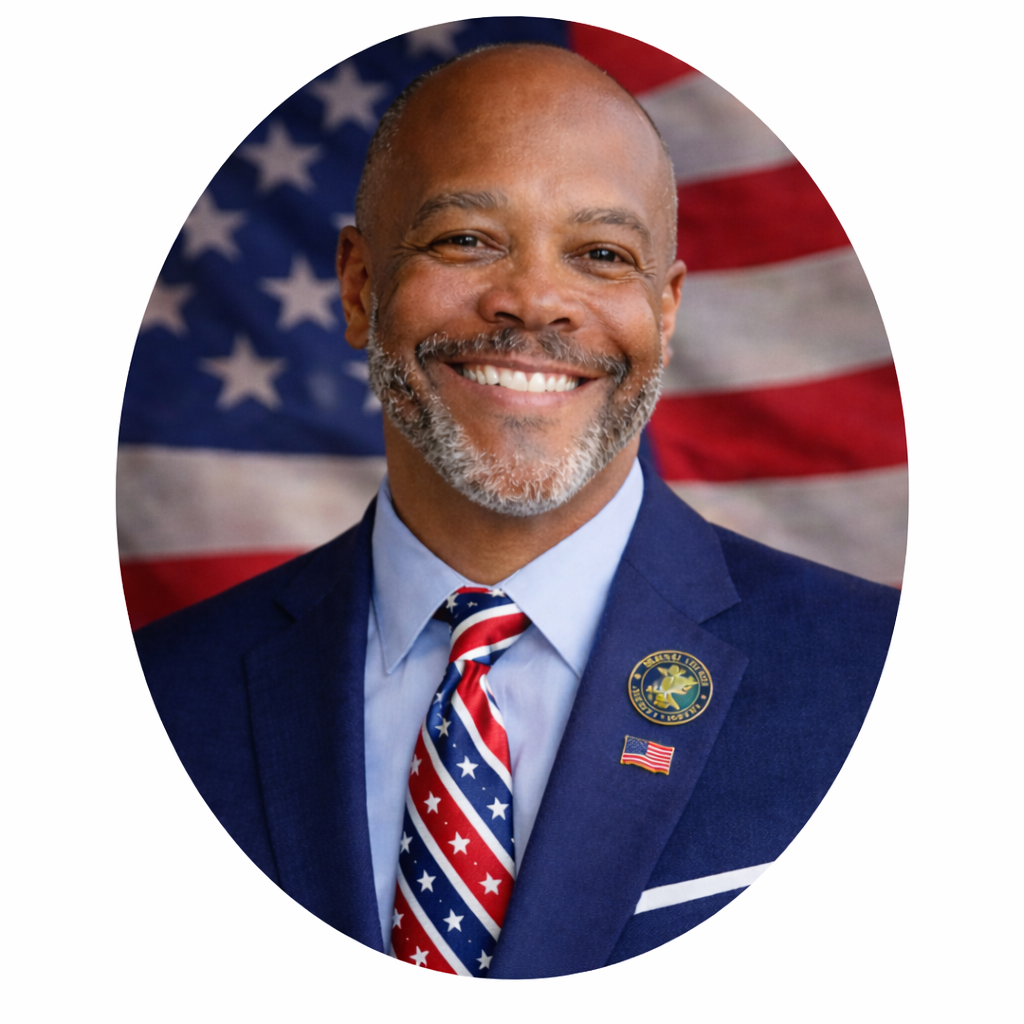
Article by
Willie Daniel
Willie Daniel is the Founder and Chief Executive Officer (CEO) of Global Vets Consulting (GVC) – National Veterans Disability Services, a veteran-led educational and medical evidence support organization dedicated to helping veterans better understand VA disability rating increases, DBQ medical evidence, secondary claims education, and C&P examination preparation.
He is a retired U.S. Army Medical Service Corps Officer with more than 27 years of honorable military service, a decorated Iraq combat veteran, and a retired federal official with the U.S. Department of Veterans Affairs. Throughout his military and federal career, Willie Daniel served in leadership, healthcare administration, operational, and veteran-support roles focused on improving services and support systems for servicemembers, veterans, and their families.
Drawing from decades of military leadership, healthcare administration, veteran advocacy, and federal government experience, Willie Daniel brings a practical, veteran-centered perspective to Global Vets Consulting’s educational articles, AI-powered veteran resources, video education initiatives, and outreach programs. His experience navigating military systems, medical documentation processes, and veteran-related administrative operations provides valuable insight into many of the challenges veterans face when seeking to better understand VA disability rating criteria, medical evidence, documentation strategies, and secondary condition education.
Through GVC’s “Veterans Helping Veterans” mission, his focus is on delivering clear, educational, and easy-to-understand information designed to empower veterans with knowledge, resources, and educational tools that may help them make more informed decisions regarding their individual VA disability journeys.
The information provided through GVC is intended for educational and informational purposes only and should not be considered legal or medical advice.
Disclaimer
Disclaimer: Global Vets Consulting, LLC (“GVC”) is a veteran-led educational and medical evidence support organization. GVC is not a law firm, is not a Veterans Service Organization (VSO), and is not affiliated with the U.S. Department of Veterans Affairs (VA) or any government agency.
Global Vets Consulting does not provide legal advice, medical advice, medical treatment, or healthcare services. GVC does not prepare, file, or submit VA disability claims on behalf of veterans. All information provided through this website, blog articles, videos, educational materials, AI tools, dashboards, templates, and communications is intended solely for general educational and informational purposes.
Veterans are encouraged to consult with accredited representatives, licensed attorneys, qualified medical providers, or Veterans Service Organizations regarding their specific legal, medical, or VA-related matters. VA disability decisions, ratings, and outcomes are determined solely by the U.S. Department of Veterans Affairs based on applicable laws, regulations, medical evidence, and individual circumstances. Past results do not guarantee future outcomes.