
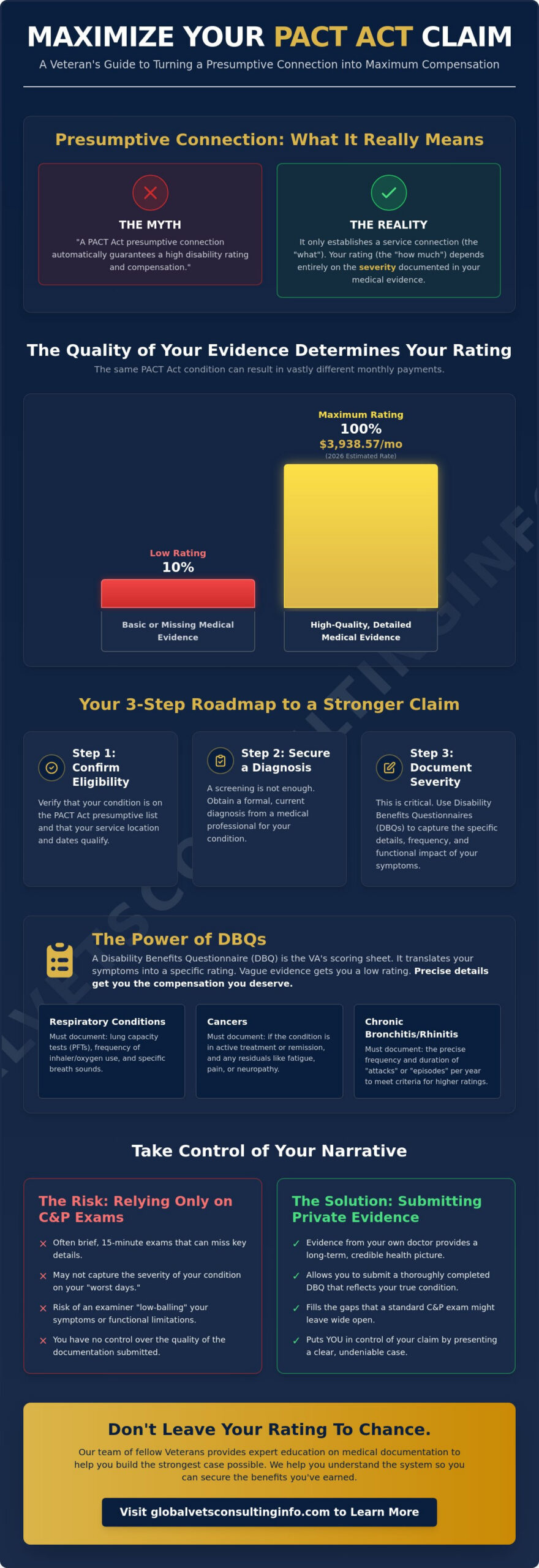
A presumptive service connection doesn’t mean a maximum disability rating is guaranteed; it simply means the VA admits your illness was caused by your service. To actually receive the compensation you deserve, the quality of your medical evidence for PACT Act claims is what determines whether you receive a 10 percent rating or the 2026 100 percent rate of $3,938.57 per month. It’s frustrating to feel like you’re doing everything right only to be met with confusing paperwork or the fear that a C&P examiner will low-ball your symptoms during a brief exam.
We understand the stress of navigating this bureaucratic system, and we’re here to act as your steady guide through the process. This article will show you how to gather high-quality medical evidence and leverage Disability Benefits Questionnaires (DBQs) to secure the rating you’ve earned. We’ll provide a clear, step-by-step roadmap of the 2026 requirements and explain exactly how to document your symptoms to streamline your claim for the best possible outcome.
Key Takeaways
- Learn why “presumptive” service connection is only the first step and how specific documentation determines your actual monthly compensation.
- Discover the vital role of Disability Benefits Questionnaires (DBQs) in capturing the precise symptom severity needed for a 2026 rating increase.
- Master the process of gathering high-quality medical evidence for PACT Act claims by confirming your eligibility and securing a formal diagnosis.
- Identify the technical details and functional limitations that must be present in your records to ensure a fair evaluation during a C&P exam.
- Explore how expert education on medical documentation helps you present a clear, undeniable case for the maximum benefits you’ve earned.
Understanding the PACT Act: Why Medical Evidence is Still Critical in 2026
The Honoring our PACT Act of 2022 stands as the largest expansion of benefits for veterans exposed to toxic substances in American history. It opens doors for nearly 3.5 million veterans who served in locations like Iraq and Afghanistan. While this law is a massive victory, it’s often misunderstood by the community it serves. A common misconception is that the presumptive status of a condition like asthma or chronic sinusitis guarantees a high check every month. In reality, presumptive status only solves the problem of proving a nexus or service connection. It doesn’t tell the VA how much to pay you. Without high-quality medical evidence for pact act claims, many veterans find themselves with a 0% non-compensable rating. This means the VA acknowledges your illness but decides it isn’t severe enough to warrant monthly compensation.
The Difference Between Service Connection and Disability Rating
Think of service connection as the “What.” For over 20 conditions, including various cancers and respiratory illnesses, the VA now assumes your service caused the issue. However, your disability rating is the “How Much,” and that depends entirely on the severity of your symptoms. For example, a veteran with a presumptive respiratory condition might get a 10% rating based on basic records, while another veteran with the same condition receives a 60% rating because they provided detailed evidence of their lung function. The rating you receive is a direct reflection of the medical documentation you submit.
Why a Toxic Exposure Screening Isn’t Enough
The VA’s toxic exposure screening is a vital tool for your health, but it isn’t a substitute for a disability claim. These screenings are designed to identify potential health risks rather than document the specific functional losses required for a rating. While a screening might flag a concern, understanding what is a dbq is essential because these questionnaires are what the VA uses to measure your actual impairment. Medical evidence for pact act claims serves as the bridge between your exposure history and the actual compensation you receive for your functional limitations.
Presumptive Conditions vs. Documenting Severity: The Role of DBQs
Understanding The PACT Act and Your VA Benefits is the first step toward securing your compensation. Once you’ve confirmed your condition is on the presumptive list, the focus shifts to Disability Benefits Questionnaires (DBQs). These forms act as the scoring sheet for your rating. For instance, the VA doesn’t just need to know you have asthma; they need to see the specific respiratory volume measurements that dictate whether you get a 30% or 60% rating. High-quality medical evidence for pact act claims must be precise to ensure your rating matches your actual level of impairment.
Relying solely on a VA-contracted C&P examiner can be risky. These exams are often brief and might not capture the worst days of your condition. If an examiner misses a key symptom or fails to record the frequency of your flare-ups, your rating could be significantly lower than what you’ve earned. You have the right to counter this by providing your own documentation that reflects the full scope of your health challenges.
Key PACT Act Conditions That Require Detailed DBQs
- Respiratory conditions: Success depends on documenting breath sounds, lung capacity tests, and the frequency of inhaler or oxygen use.
- Cancers: Records must clearly state whether the condition is in active treatment or remission, along with any residuals like fatigue or neuropathy.
- Chronic Bronchitis and Rhinitis: You must precisely record the frequency of “attacks” or “episodes” to meet the criteria for higher compensation levels.
The Power of Private Medical Evidence
You have the legal right to submit private medical evidence from your own healthcare providers. A doctor who has treated you for months or years provides a much clearer picture of your health than an examiner who meets you once for fifteen minutes. Providing independent medical evidence for pact act claims allows you to fill the gaps that a standard C&P exam might leave wide open. Private DBQs ensure your functional limitations are documented thoroughly before your claim is even reviewed. If you want to feel more confident before your next exam, exploring educational resources for disability documentation can help you prepare a stronger, evidence-based case.
Gathering High-Quality Medical Evidence for PACT Act Claims
Organizing your medical evidence for pact act claims requires a methodical strategy to ensure nothing is overlooked. Your goal is to present a package so clear that the VA rater can easily identify the severity of your condition. Following these four steps will put you on the right path toward the rating you’ve earned.
- Step 1: Confirm eligibility. This depends on where and when you served, covering Vietnam, the Gulf War, and Post-9/11 eras. You can verify your specific status by Understanding PACT Act eligibility and benefits through official VA channels.
- Step 2: Obtain a formal diagnosis. You can’t claim a condition that hasn’t been officially named by a licensed medical professional.
- Step 3: Collect lay statements. These buddy letters from family or fellow service members document the daily impact of your symptoms.
- Step 4: Secure a professionally completed DBQ. This ensures your symptoms are translated into the specific language the 2026 VA rating schedule requires.
Prioritizing Your Medical Records
Not every page in your medical file carries the same weight. When gathering medical evidence for pact act claims, focus on records that show chronicity. The VA needs to see that your condition has persisted over time. Even more important is documenting functional loss. This refers to your inability to perform work duties or daily tasks. Records that mention missed work, the need for assistive devices, or a reduced range of motion are essential for a successful claim.
The Role of Lay Evidence in Toxic Exposure Claims
Lay evidence bridges the gap between a clinical diagnosis and your lived experience. By following a va disability claims process step by step approach, you can integrate personal statements that describe symptoms not visible during a quick exam. For example, if your respiratory issues are worse at night or during physical exertion, a lay statement is the best place to document those details. If you need help understanding how to present this data effectively, we provide expert medical evidence education to help you build a stronger case.
Maximizing Your PACT Act Claim with Global Vets Consulting
Securing the disability rating you’ve earned requires more than just submitting a form; it requires a strategy built on precision and thoroughness. Global Vets Consulting is a veteran-owned resource dedicated to helping you navigate this complex landscape through specialized DBQ education and preparation. We help you take control of your future by providing the tools needed to submit a “Fully Developed Claim” (FDC). By presenting the VA with comprehensive medical evidence for pact act claims from the start, you reduce the likelihood of long delays or unnecessary denials. If you have immediate questions about your evidence package, our 24/7 National Client Services Hotline is available to provide the support you need.
🇺🇸 Global Vets Consulting Worldwide
📞 24/7 National Client Services Hotline: 1-800-484-0642
🌐 GlobalVetsConsultingInfo.com
Why Professional DBQ Preparation Matters
The most common reason for a claim denial is a “lack of evidence” regarding the severity of a condition. Our educational resources ensure that every symptom is documented according to the VA’s 2026 rating criteria, leaving no room for ambiguity. This is especially critical when toxic exposure leads to secondary issues. For example, we guide veterans through the dbq for mental health conditions if their physical illness has caused secondary psychological distress. Proper medical evidence for pact act claims must cover the full spectrum of your health to ensure your compensation reflects your total disability.
Take the Next Step Toward Your Deserved Benefits
Our “Veterans Helping Veterans” mission-driven approach means we treat your claim with the respect and meticulousness it deserves. We aren’t just a service; we’re a partner in your journey toward stability and peace of mind. You don’t have to feel overwhelmed by VA paperwork or fear being low-balled by a brief C&P examination. Visit our website today to access a free intake evaluation and begin the process of documenting your health with steady confidence. You’ve served your country with honor, and now it’s time to ensure the system works for you.
💻 Ready to start? Connect with our 24/7 AI Veteran Intake Specialist at GlobalVetsConsultingInfo.com to evaluate your medical evidence needs.
Take Command of Your PACT Act Rating Today
You’ve earned the right to compensation through your service and sacrifice. While the PACT Act removes the hurdle of proving service connection, the final rating depends entirely on the strength of your medical evidence for pact act claims. By focusing on Disability Benefits Questionnaires that capture the true severity of your symptoms, you move closer to the maximum deserved rating. Comprehensive documentation ensures that your functional limitations are clearly understood by the VA rater from the very beginning.
Global Vets Consulting has been veteran-owned and operated since 2021, focusing on specialized DBQ education that puts the power back in your hands. We provide the meticulousness and integrity required to navigate the VA’s 2026 standards with steady confidence. Our 24/7 AI Veteran Intake Specialist is available right now to help you identify the gaps in your current records so you can move forward with peace of mind.
Secure the medical evidence you need for your PACT Act claim with Global Vets Consulting 🇺🇸
Your health and your history matter. You’ve served your country with honor; take the next step today to secure every benefit you’ve rightfully earned.
Frequently Asked Questions
What medical evidence is required for a PACT Act claim if my condition is presumptive?
You must provide a formal medical diagnosis and evidence of the condition’s current severity. While the VA assumes your service caused the illness, they don’t assume how much it disables you. High-quality medical evidence for pact act claims includes treatment records, lab results, and imaging that prove you meet the specific criteria for a compensable rating rather than a 0 percent non-compensable one.
Do I still need a nexus letter for a PACT Act presumptive condition?
No, a nexus letter is not required for conditions specifically listed as presumptive under the PACT Act. The law already establishes the legal link between your service locations and your diagnosis. Your primary goal should be documenting your functional limitations. Instead of proving the “why,” you are now proving the “how much” by showing the VA exactly how the condition impacts your daily life.
Can I use a private doctor to fill out my PACT Act DBQ?
Yes, you have the right to have a private physician complete your Disability Benefits Questionnaire. A private doctor who understands your long-term medical history often provides a more thorough account of your limitations than a C&P examiner. Submitting a private DBQ helps you build a “Fully Developed Claim,” which can lead to a more predictable outcome and a faster decision from the VA rater.
How does the VA determine my rating for a PACT Act respiratory condition?
The VA assigns ratings based on specific clinical findings such as Pulmonary Function Tests (PFTs) and your medication requirements. For conditions like asthma or COPD, they specifically look at your Forced Expiratory Volume (FEV-1) levels or whether you require daily oral bronchodilators. Precise documentation of these values is what determines if you receive a 10 percent rating or a much higher 60 percent rating.
What happens if my PACT Act claim is denied for lack of medical evidence?
If your claim is denied, you can file a Supplemental Claim by submitting new and relevant medical evidence for pact act claims. This is the time to address the specific gaps identified in your denial letter, such as a missing formal diagnosis or insufficient proof of symptom frequency. Securing a detailed DBQ or providing lay statements can often provide the missing data needed to overturn the initial decision.

Article by
Willie Daniel
Willie Daniel is the Founder and Chief Executive Officer (CEO) of Global Vets Consulting (GVC) – National Veterans Disability Services, a veteran-led educational and medical evidence support organization dedicated to helping veterans better understand VA disability rating increases, DBQ medical evidence, secondary claims education, and C&P examination preparation.
He is a retired U.S. Army Medical Service Corps Officer with more than 27 years of honorable military service, a decorated Iraq combat veteran, and a retired federal official with the U.S. Department of Veterans Affairs. Throughout his military and federal career, Willie Daniel served in leadership, healthcare administration, operational, and veteran-support roles focused on improving services and support systems for servicemembers, veterans, and their families.
Drawing from decades of military leadership, healthcare administration, veteran advocacy, and federal government experience, Willie Daniel brings a practical, veteran-centered perspective to Global Vets Consulting’s educational articles, AI-powered veteran resources, video education initiatives, and outreach programs. His experience navigating military systems, medical documentation processes, and veteran-related administrative operations provides valuable insight into many of the challenges veterans face when seeking to better understand VA disability rating criteria, medical evidence, documentation strategies, and secondary condition education.
Through GVC’s “Veterans Helping Veterans” mission, his focus is on delivering clear, educational, and easy-to-understand information designed to empower veterans with knowledge, resources, and educational tools that may help them make more informed decisions regarding their individual VA disability journeys.
The information provided through GVC is intended for educational and informational purposes only and should not be considered legal or medical advice.
Disclaimer
Disclaimer: Global Vets Consulting, LLC (“GVC”) is a veteran-led educational and medical evidence support organization. GVC is not a law firm, is not a Veterans Service Organization (VSO), and is not affiliated with the U.S. Department of Veterans Affairs (VA) or any government agency.
Global Vets Consulting does not provide legal advice, medical advice, medical treatment, or healthcare services. GVC does not prepare, file, or submit VA disability claims on behalf of veterans. All information provided through this website, blog articles, videos, educational materials, AI tools, dashboards, templates, and communications is intended solely for general educational and informational purposes.
Veterans are encouraged to consult with accredited representatives, licensed attorneys, qualified medical providers, or Veterans Service Organizations regarding their specific legal, medical, or VA-related matters. VA disability decisions, ratings, and outcomes are determined solely by the U.S. Department of Veterans Affairs based on applicable laws, regulations, medical evidence, and individual circumstances. Past results do not guarantee future outcomes.