

A VA re-evaluation notice isn’t a signal that you’re about to lose your benefits; it’s actually an opportunity to solidify your medical evidence and lock in your rating for the long term. If you’ve received a letter from the Department of Veterans Affairs, you likely feel a familiar sense of anxiety regarding your financial stability. It’s completely normal to feel frustrated when the system you served asks you to prove your disability all over again. However, preparing for a va rating re-evaluation with a clear strategy can turn that stress into confidence. 🇺🇸
You’ve earned these benefits through your service, and we’re here to help you protect them. In this guide, you’ll learn exactly how to document your condition using Disability Benefits Questionnaires (DBQs) to ensure your medical evidence is undeniable. We’ll cover the 2026 COLA updates, including the 2.8% increase, and explain how to navigate your C&P exam without fear. By the end of this article, you’ll have a step-by-step roadmap to maintain or even increase your current disability rating. We’re standing by to ensure you have the resources you need to succeed.
Key Takeaways
- Identify the difference between Routine Future Exams (RFEs) and triggered reviews to anticipate when the VA might re-evaluate your status.
- Master the use of private medical evidence and DBQs to provide the exact data points VA Raters require to maintain your rating.
- Follow a methodical approach when preparing for a va rating re-evaluation by reviewing your original award letter and tracking symptom frequency.
- Protect your benefits by understanding the 60-day response window and the procedural steps necessary to fight a proposed rating reduction.
What is a VA Rating Re-evaluation and Why is it Happening?
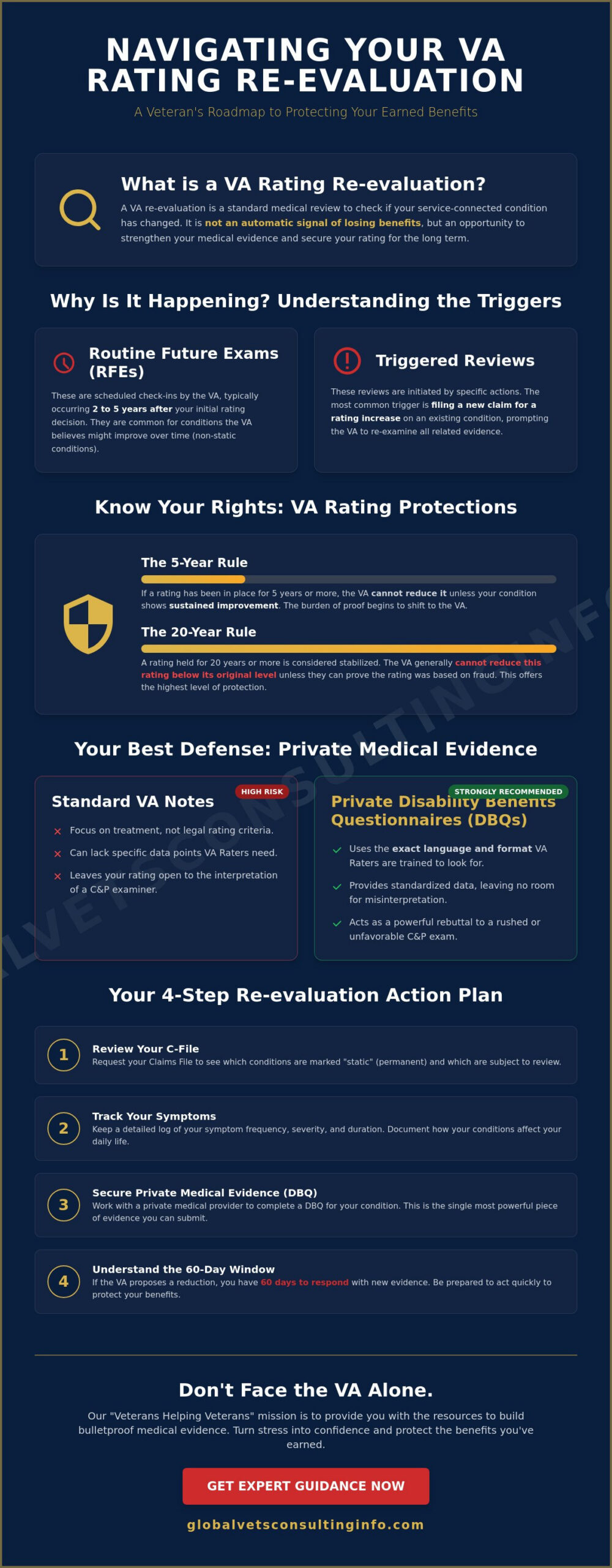
A VA rating re-evaluation is a scheduled medical review designed to determine if your service-connected condition has improved, worsened, or remained the same. The Veterans Benefits Administration (VBA) uses these exams to ensure that disability compensation accurately reflects your current level of impairment. While it’s stressful to receive a notice in the mail, preparing for a va rating re-evaluation starts with understanding that the system is built on periodic check-ins. With the VA processing over 1.9 million compensation claims in 2026, these reviews are a standard part of managing active files. Most veterans encounter Routine Future Exams (RFEs) within two to five years of their initial rating decision.
Static vs. Non-Static Conditions
The VA classifies certain conditions as static when they aren’t expected to improve over your lifetime. For example, a missing limb or a chronic degenerative condition is usually marked static. However, the VA often schedules re-evaluations for conditions they believe might improve, such as cancers in remission or post-surgical recovery. If you aren’t sure where you stand, you should request a copy of your Claims File (C-File). This document explicitly states which of your ratings are considered permanent and which are subject to future review. Knowing your status helps you stay ahead of the curve.
Beyond scheduled RFEs, certain actions can trigger a review. If you file for a VA rating increase, the VA will likely examine all evidence related to that specific condition. This process often initiates a re-evaluation of your existing percentage to confirm the current severity. Preparing for a va rating re-evaluation also requires knowing your rights during these reviews, especially if you have held your rating for several years.
The Five-Year and Twenty-Year Rules
The VA provides specific legal protections based on how long you’ve held your rating. Under the Five-Year Rule, the VA cannot reduce a rating that has been in place for five years or more unless the condition shows sustained improvement. For ratings held for twenty years or more, the VA generally cannot reduce the rating below that level unless they prove the original rating was based on fraud. These rules mean the burden of proof shifts to the VA, making it much harder for them to reduce a stabilized rating without significant evidence. Understanding these timelines allows you to approach your re-evaluation with a sense of security and professional confidence.
The Power of Private Medical Evidence: Why DBQs Matter
Relying exclusively on VA medical records during a review is a strategic risk you don’t have to take. While VA healthcare providers are excellent at treating conditions, their clinical notes often lack the specific legal language required by Raters. A Disability Benefits Questionnaire (DBQ) solves this problem by providing the exact data points the system needs to see. It ensures that your symptoms are measured against the VA’s specific rating criteria rather than buried in hundreds of pages of general treatment notes.
Independent medical evidence acts as a critical counterweight to a rushed C&P exam. If an examiner overlooks a flare-up or fails to record your full range of motion, a private DBQ serves as an authoritative rebuttal. It documents that your condition is “at least as likely as not” at the same level of severity as when you were first rated. This level of meticulousness is essential when you are preparing for a va rating re-evaluation and want to secure your VA disability compensation benefits. High-quality documentation removes the guesswork for the Rater.
Standardizing Your Evidence for the VA
A standard doctor’s note rarely suffices for a complex claim. DBQs are designed to mirror the VA Schedule for Rating Disabilities, using precise terminology that leaves no room for interpretation. By translating complex medical symptoms into standardized check-boxes and specific data fields, you provide the VA with a clear, predictable path to maintain your rating. This structured approach reduces the chance of administrative errors that could lead to a proposed reduction.
Global Vets Consulting: Professional Documentation Support
Our team operates on a “Veterans Helping Veterans” ethos. We understand the stress of the claims process and provide the educational resources you need to ensure your medical evidence is bulletproof. We focus on helping you understand how to obtain high-quality documentation that accurately reflects your service-connected struggles. If you want to feel more confident before your next exam, explore the educational resources at Global Vets Consulting to protect your hard-earned benefits.
Step-by-Step: Preparing for a VA Rating Re-evaluation
Approaching a review without a plan is the fastest way to lose the benefits you’ve earned. Success requires a structured, chronological preparation strategy that starts weeks before you step into a clinic. By following these four steps, you can turn a high-stress situation into a predictable administrative process. 🇺🇸
- Step 1: Review your award letter. Locate the diagnostic code assigned to your condition. This code links directly to how disability ratings are determined for your specific diagnosis, allowing you to see exactly what the VA Rater is looking for.
- Step 2: Start a Symptom Journal. Track the frequency, severity, and duration of your flare-ups over a 30-day period. This log provides concrete data that is much harder to dismiss than general statements about your health.
- Step 3: Secure a private DBQ. Work with a provider who understands the VA disability claims process. This ensures your medical evidence is translated into the specific language the VA requires.
- Step 4: Conduct a final review. Study your medical history and your private DBQ before your exam. When you are preparing for a va rating re-evaluation, being able to speak clearly about your medical timeline is vital.
Mastering the C&P Examination
The Compensation and Pension (C&P) exam is often the most stressful part of the process, but you can control the narrative. You must describe your symptoms as they appear on your “worst day.” If you tell the examiner you’re “doing fine” because you’re having a rare good day, they’ll record that as your baseline. Focus on “Functional Loss” by explaining how your condition prevents you from completing a full workday or participating in family life. Be specific about physical limitations, such as the need to lie down or the inability to lift standard household objects.
Documentation Checklist for 2026
Organization is your best defense against a rating reduction. When you attend your exam, bring physical copies of your evidence to ensure the examiner has everything they need. Relevant Evidence is any medical or lay data that proves your condition has not improved. 🇺🇸
- A copy of your professionally completed DBQ.
- Your 30-day symptom journal or flare-up log.
- Witness “buddy statements” from family or coworkers.
- Recent private treatment records not yet in your VA file.
If you need professional guidance to ensure your documentation is ready for your review, reach out to Global Vets Consulting today.
Navigating the Re-evaluation Results: What Comes Next?
Receiving your decision letter is the final step in the re-evaluation process. If your efforts in preparing for a va rating re-evaluation were successful, your rating will be maintained or even increased. In this scenario, you should review the letter to see if the VA has finally designated the condition as static. A static designation means you’re no longer subject to Routine Future Exams, providing long-term financial peace of mind. 🇺🇸
However, if the VA proposes a reduction, you must act immediately. You typically have a 60-day window to submit new medical evidence to fight the proposal. If the notice claims a lack of evidence, you can file a Supplemental Claim to introduce new, relevant data. Often, a VA claim was denied for lack of evidence because the C&P examiner didn’t see the full picture of your daily struggles. Submitting a private DBQ at this stage can effectively halt the reduction process by providing the clinical data the rater missed.
Responding to a Proposed Reduction
Your first priority is requesting a personal hearing. You must do this within 30 days of the notice date to ensure your current benefits continue while the VA reviews your case. During this time, you should secure a fresh private DBQ that highlights any “VA Math” errors. These errors occur when a rater ignores evidence of worsening symptoms or fails to apply the rating schedule correctly. A hearing allows you to present your symptom journal and buddy statements directly to a rater, which helps humanize the data on the page. 🇺🇸
Your 24/7 Support System with Global Vets Consulting
Navigating bureaucratic complexity shouldn’t be a solo mission. We provide a steady guide for veterans who feel overwhelmed by the system’s demands. Our mission-driven approach ensures you have access to the educational resources needed to protect your earned outcomes. 🌐
- 24/7 AI Veteran Intake Specialist: Get immediate guidance on your re-evaluation notice at any hour of the day.
- Expert Education: Understand the intricacies of DBQs and medical evidence through our specialized resource library.
- Worldwide Support: We assist veterans globally in securing the documentation they deserve.
If you’ve received a re-evaluation notice or a proposed reduction, don’t wait for the deadline to pass. Visit GlobalVetsConsultingInfo.com to start your journey toward a secure rating today. 📞
Take Control of Your Disability Rating
The re-evaluation process shouldn’t be a source of constant anxiety. By focusing on high-quality medical evidence and standardized documentation, you take control of the narrative before the VA even schedules your exam. You’ve learned that preparing for a va rating re-evaluation is about accuracy and thoroughness. Whether you’re tracking flare-ups in a symptom journal or securing a private DBQ, every step you take builds a stronger case for the rating you’ve earned.
Global Vets Consulting is veteran-owned and operated since 2021. We specialize in the standardized DBQ documentation that rater’s need to see. If you’re feeling overwhelmed, our 24/7 National Client Services Hotline is ready to provide the steady guidance you deserve. We’re committed to a “Veterans Helping Veterans” ethos because we’ve been in your boots and understand the complexity of the system.
Secure your medical evidence with a professional DBQ today! You served your country with honor, and we’re here to help you protect your future with confidence and peace of mind.
Frequently Asked Questions
Can the VA reduce my rating without a re-evaluation exam?
No, the VA generally cannot reduce your rating without first providing you with a notice of a proposed reduction and an opportunity for a re-evaluation exam. If they believe your condition has improved based on other medical records, they must still follow procedural due process. This includes giving you 60 days to submit evidence and 30 days to request a hearing to contest the change.
What happens if I miss my scheduled VA re-evaluation appointment?
Missing a scheduled appointment is one of the most common reasons for an automatic rating reduction or termination of benefits. If you have a valid reason for missing the exam, you should contact the VA or the third-party contractor immediately to reschedule. When you are preparing for a va rating re-evaluation, showing up for all scheduled appointments is the most basic step to protecting your financial stability.
Is my VA disability rating permanent after 5 years?
A rating held for five years is considered “stabilized,” meaning the VA faces a higher burden of proof to reduce it. While it isn’t automatically permanent, the VA cannot lower your percentage unless they show sustained improvement through a thorough medical exam. When you’re preparing for a va rating re-evaluation after the five-year mark, your focus should be on proving that your symptoms have remained constant or worsened over that period.
How do I prove my condition has worsened during a re-evaluation?
You prove a condition has worsened by submitting “new and relevant” medical evidence that documents increased frequency or severity of symptoms. This is best achieved by providing a private Disability Benefits Questionnaire (DBQ) that uses the VA’s specific rating criteria. You should also include lay evidence, such as a symptom journal or buddy statements from family members, to describe how the condition now limits your daily activities more than it did previously.
Can I submit a private DBQ instead of attending a C&P exam?
You can submit a private DBQ to support your case, but you are still legally required to attend a scheduled C&P exam if the VA orders one. While a high-quality private DBQ can serve as powerful evidence, refusing to attend the VA’s exam often leads to an immediate denial or reduction. Use your private documentation as a baseline for the examiner to review during the appointment to ensure they capture your symptoms accurately.

Article by
Willie Daniel
Willie Daniel is the Founder and Chief Executive Officer (CEO) of Global Vets Consulting (GVC) – National Veterans Disability Services, a veteran-led educational and medical evidence support organization dedicated to helping veterans better understand VA disability rating increases, DBQ medical evidence, secondary claims education, and C&P examination preparation.
He is a retired U.S. Army Medical Service Corps Officer with more than 27 years of honorable military service, a decorated Iraq combat veteran, and a retired federal official with the U.S. Department of Veterans Affairs. Throughout his military and federal career, Willie Daniel served in leadership, healthcare administration, operational, and veteran-support roles focused on improving services and support systems for servicemembers, veterans, and their families.
Drawing from decades of military leadership, healthcare administration, veteran advocacy, and federal government experience, Willie Daniel brings a practical, veteran-centered perspective to Global Vets Consulting’s educational articles, AI-powered veteran resources, video education initiatives, and outreach programs. His experience navigating military systems, medical documentation processes, and veteran-related administrative operations provides valuable insight into many of the challenges veterans face when seeking to better understand VA disability rating criteria, medical evidence, documentation strategies, and secondary condition education.
Through GVC’s “Veterans Helping Veterans” mission, his focus is on delivering clear, educational, and easy-to-understand information designed to empower veterans with knowledge, resources, and educational tools that may help them make more informed decisions regarding their individual VA disability journeys.
The information provided through GVC is intended for educational and informational purposes only and should not be considered legal or medical advice.
Disclaimer
Disclaimer: Global Vets Consulting, LLC (“GVC”) is a veteran-led educational and medical evidence support organization. GVC is not a law firm, is not a Veterans Service Organization (VSO), and is not affiliated with the U.S. Department of Veterans Affairs (VA) or any government agency.
Global Vets Consulting does not provide legal advice, medical advice, medical treatment, or healthcare services. GVC does not prepare, file, or submit VA disability claims on behalf of veterans. All information provided through this website, blog articles, videos, educational materials, AI tools, dashboards, templates, and communications is intended solely for general educational and informational purposes.
Veterans are encouraged to consult with accredited representatives, licensed attorneys, qualified medical providers, or Veterans Service Organizations regarding their specific legal, medical, or VA-related matters. VA disability decisions, ratings, and outcomes are determined solely by the U.S. Department of Veterans Affairs based on applicable laws, regulations, medical evidence, and individual circumstances. Past results do not guarantee future outcomes.

