

Your 20% back rating isn’t just a low number; it’s an incomplete picture of the nerve damage shooting down your legs every single day. 🇺🇸 Most veterans feel frustrated when the VA rates their spine but ignores the radiculopathy secondary to degenerative disc disease that actually limits their mobility. You know that your service-connected back condition doesn’t stop at your vertebrae, and your monthly compensation shouldn’t either.
We’re here to help you bridge that gap and secure the 2026 disability rates you’ve earned, such as the new $3,938.58 monthly payment for a 100% rating. 🌐 This guide provides a clear path to establishing a secondary service connection that accurately reflects your functional loss, numbness, and chronic pain. By focusing on precise medical evidence rather than just pain levels, you can finally move toward a combined rating that matches your true level of disability.
We’ll walk you through the specific requirements for a successful nexus letter and explain how the updated Back Conditions DBQ helps you prove nerve involvement to the VA. 📞
Key Takeaways
- Understand how nerve root compression from spinal changes establishes a clear medical link between back pain and neurological symptoms.
- Learn how the VA uses the 8500 series diagnostic codes to evaluate radiculopathy secondary to degenerative disc disease based on functional loss rather than pain alone.
- Discover why a high-quality Disability Benefits Questionnaire (DBQ) is the most critical piece of medical evidence for documenting the severity of your nerve condition.
- Identify the specific steps needed to review your current service-connected spine conditions and prepare for a specialist evaluation to secure a successful rating increase.
The Medical Link: How DDD Causes Secondary Radiculopathy
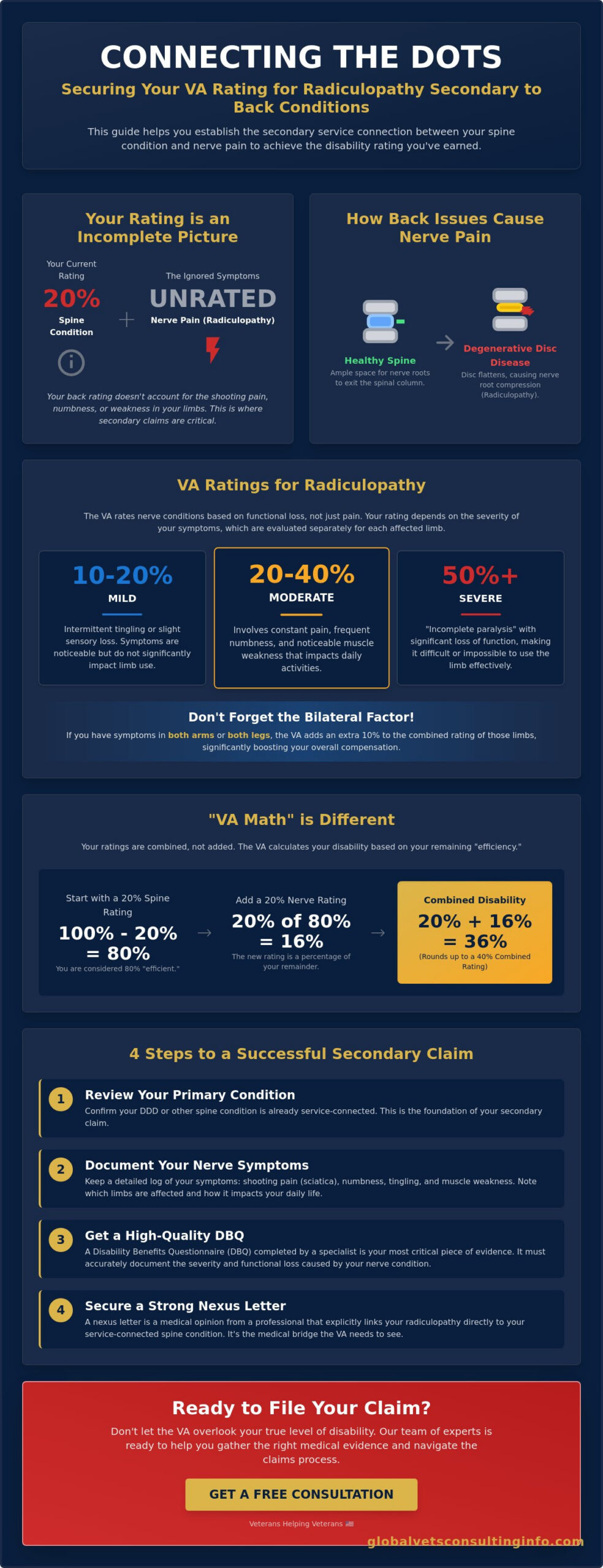
Degenerative Disc Disease (DDD) is often the starting point for a cascade of neurological issues. When the intervertebral discs lose hydration and elasticity, they begin to flatten. This loss of disc height creates a domino effect within your spinal column. As the space between your vertebrae shrinks, it often leads to foraminal narrowing, where the small openings that allow nerves to exit the spine become constricted. Radiculopathy occurs when these nerve roots are physically compressed or inflamed by the surrounding bone and tissue.
While DDD might start as localized stiffness or aching in your back, it doesn’t always stay there. The irritation of the nerve root causes pain to travel along the nerve’s path into your extremities. This progression is most common in three specific areas:
- Cervical: Affecting the neck, shoulders, and arms.
- Thoracic: Impacting the mid-back and rib cage area.
- Lumbar: Causing symptoms in the lower back, hips, and legs.
Common Symptoms of Secondary Nerve Compression
Nerve compression manifests in ways that go far beyond a simple backache. Veterans frequently report specific sensations that indicate radiculopathy secondary to degenerative disc disease is present. These symptoms often include:
- Sharp, electric, or shooting pain, such as sciatica, that radiates down the leg.
- Paresthesia, which feels like “pins and needles,” tingling, or total numbness in certain patches of skin.
- Muscle weakness or a sudden loss of motor control, making it difficult to grip objects or maintain balance while walking.
Why the VA Considers this a Secondary Condition
The VA recognizes that one service-connected disability can directly cause another. If you already have a rating for DDD, you don’t need to prove that your military service caused your nerve pain; you only need to show that your rated back condition caused the nerve damage. Secondary service connection serves as a medical and legal bridge between a rated spinal condition and new neurological deficits. This recognition is vital because it allows for multiple ratings for different nerve groups, which can lead to a higher combined disability percentage. 🇺🇸
VA Ratings for Radiculopathy Secondary to Degenerative Disc Disease
The VA evaluates nerve conditions using the 8500 series of diagnostic codes. These codes are organized by the specific nerve group affected, such as the sciatic nerve or the femoral nerve. It is a common misconception that a back rating covers all related pain. In reality, your rating for radiculopathy secondary to degenerative disc disease is separate from and additive to your primary spinal rating. This means you can receive a rating for your limited range of motion in the spine and additional ratings for the nerve damage it causes. 🇺🇸
When the VA reviews your claim, they focus on functional loss rather than just a medical diagnosis. Medical experts at the Mayo Clinic note that symptoms and causes of nerve compression often include significant sensory and motor deficits. The VA classifies these deficits into three main categories of severity:
- Mild: Often rated at 10% or 20%. This typically involves intermittent tingling or slight sensory loss without major impact on limb use.
- Moderate: Usually rated between 20% and 40%. This level involves constant pain, frequent numbness, and noticeable muscle weakness.
- Severe: Can be rated at 50% or higher. This applies to “incomplete paralysis” where you experience significant functional loss or inability to use the limb effectively.
If you experience symptoms in both legs or both arms, the VA applies the “Bilateral Factor.” This rule adds an extra 10% to the combined rating of those specific disabilities before they are added to your total percentage. This calculation can significantly boost your overall compensation. 🌐
The Impact of VA Math on Your Combined Rating
Understanding “VA Math” is essential for managing your expectations. If you have a 20% rating for DDD and receive a new 20% rating for secondary radiculopathy, your total isn’t 40%. Instead, the VA takes 20% of your “100% efficient” self, leaving you 80% efficient. They then take 20% of that remaining 80%, which is 16%. Adding 20 and 16 gives you 36%, which rounds to a 40% combined rating. Learning about VA disability claims process step by step can help you visualize how these numbers stack up. 📞
Securing the correct rating depends on having the right documentation. You might find that secondary VA claims education provides the clarity you need to move your claim forward effectively.
Medical Evidence: DBQs and the Nexus for Secondary Claims
Securing a rating for radiculopathy secondary to degenerative disc disease requires evidence that bridges the gap between your spine and your nervous system. The Disability Benefits Questionnaire (DBQ) serves as the roadmap for the VA rater. While a standard C&P exam is common, a private DBQ often offers a more detailed look at your functional limitations. This thoroughness is vital because the VA’s Schedule for Rating Disabilities relies on specific clinical findings to determine your percentage. 🇺🇸
A critical component of your claim is the medical nexus. This statement must provide a clear rationale explaining how your service-connected back condition led to nerve compression. To be effective, your medical provider should document several key factors:
- Frequency: How often do you experience shooting pain or numbness?
- Severity: Does the weakness in your legs cause you to stumble or lose balance?
- Duration: How long do these symptoms last during a typical flare-up?
Which DBQ Should You Use?
Veterans often struggle with which form to prioritize. The VA typically uses the Back (Spine) DBQ for the primary condition, but a Neurological DBQ is often necessary to fully capture radiculopathy secondary to degenerative disc disease. Using both forms ensures that no symptom is overlooked during the rating process. You can find more detail on this in our guide on what is a DBQ. 🌐
Documenting Functional Loss
When describing your condition, focus on how it limits your daily activities. Mention sensory changes such as hypesthesia (reduced sensation) or paresthesia (tingling), and explain how muscle weakness impacts your ability to work. If you are ready to improve your documentation, our Independent Medical Evidence Education can help you prepare for a more successful claim. 📞
Strategic Steps to Increase Your VA Rating in 2026
Increasing your disability percentage requires a methodical approach. You’ve already done the hard work of serving; now you must ensure your records reflect the physical toll of that service. If you are struggling with radiculopathy secondary to degenerative disc disease, following a structured plan is the best way to secure your 2026 benefits. 🇺🇸
- Step 1: Review your current service-connected disabilities. Verify that your Degenerative Disc Disease (DDD) is already rated, as this forms the essential foundation for any secondary claim.
- Step 2: Schedule an evaluation with a specialist. You need a formal diagnosis from a medical professional to confirm that your radiating nerve pain is medically linked to your spinal issues.
- Step 3: Secure a professionally prepared DBQ. Obtaining a Disability Benefits Questionnaire that accurately reflects your functional limitations for radiculopathy secondary to degenerative disc disease is vital for a successful rater review.
- Step 4: Submit your secondary claim. You can file this as a new secondary condition or a “Claim for Increase” if your existing nerve symptoms have worsened.
How Global Vets Consulting Supports Your Mission
Global Vets Consulting provides the educational resources you need to navigate this process with confidence. We offer professional DBQ preparation education designed to meet strict VA evidence requirements. You can learn more about how to use a DBQ for a VA disability rating increase through our specialized resources. 🌐 Our team is available through our 24/7 National Client Services Hotline and our 24/7 AI Veteran Intake Specialist to guide you through your medical evidence needs.
Taking Action Today
Don’t wait for your symptoms to become debilitating before you act. Documenting the current severity of your condition now prevents the VA from downplaying your functional loss later. Accurate documentation is the veteran’s strongest tool against claim denials. 📞 Connect with Global Vets Consulting today for a professional review of your medical evidence needs and start your journey toward the compensation you’ve earned.
Secure Your Earned Disability Benefits in 2026
You now have a clear roadmap to bridge the gap between your spinal condition and the neurological symptoms that impact your daily life. It’s vital to remember that your rating for radiculopathy secondary to degenerative disc disease is a distinct recognition of functional loss, not just an expected symptom of back pain. By focusing on precise medical evidence and the specific criteria in the 8500 series diagnostic codes, you can ensure the VA sees the full extent of your disability. 🇺🇸
Global Vets Consulting is veteran-owned and operated, standing ready to help you navigate these complex musculoskeletal and neurological claims. We provide the expert education and documentation support necessary to strengthen your case and reduce the anxiety of the claims process. Our 24/7 National Client Services Hotline is always available to guide you toward the rating you’ve earned. 📞
Get the Professional DBQ Documentation You Need to Win Your Claim
You don’t have to face the bureaucracy alone. Take the next step toward a higher combined rating and the peace of mind that comes with accurate compensation today. 🌐
Frequently Asked Questions
Can I get a separate rating for radiculopathy if I already have a rating for DDD?
Yes, you can receive separate ratings for both conditions because the VA views them as distinct disabilities. While Degenerative Disc Disease is rated under musculoskeletal codes for limited range of motion, radiculopathy is rated under neurological codes for nerve damage. This allows you to stack ratings for your back and your extremities without violating the VA’s rules against pyramiding. 🇺🇸
What is the highest VA disability rating for radiculopathy secondary to DDD?
The highest rating depends on the specific nerve group and the severity of functional loss. For example, severe radiculopathy of the sciatic nerve can reach 80% if it involves complete paralysis. However, most veterans with radiculopathy secondary to degenerative disc disease see ratings between 20% and 40% for moderate symptoms like constant pain and muscle weakness. These percentages are based on the degree of incomplete paralysis. 🌐
Does the VA recognize sciatica as radiculopathy?
Yes, the VA recognizes sciatica as a specific type of radiculopathy affecting the sciatic nerve. When you file a claim, the VA will often use diagnostic code 8520 to evaluate the paralysis, neuritis, or neuralgia associated with this nerve. If you have shooting pain down both legs, you may even qualify for the Bilateral Factor, which increases your combined rating. 📞
How do I prove my radiculopathy is secondary to my back condition?
You prove the connection by establishing a medical nexus between your service-connected back condition and your nerve symptoms. A doctor must provide a statement confirming it’s at least as likely as not that your DDD caused the nerve compression. Providing objective evidence like MRI results or EMG studies for radiculopathy secondary to degenerative disc disease will significantly strengthen your secondary service connection. 🇺🇸
Will a private DBQ help me win my radiculopathy claim?
A private Disability Benefits Questionnaire (DBQ) is a powerful tool because it ensures your symptoms are documented with clinical precision. Unlike a brief C&P exam, a private evaluation allows your doctor to spend more time recording flare-ups, sensory loss, and muscle weakness. This thorough medical evidence helps the VA rater accurately assign a percentage that reflects your true level of disability. It’s about getting the documentation right the first time. 🌐

Article by
Willie Daniel
Willie Daniel is the Founder and Chief Executive Officer (CEO) of Global Vets Consulting (GVC) – National Veterans Disability Services, a veteran-led educational and medical evidence support organization dedicated to helping veterans better understand VA disability rating increases, DBQ medical evidence, secondary claims education, and C&P examination preparation.
He is a retired U.S. Army Medical Service Corps Officer with more than 27 years of honorable military service, a decorated Iraq combat veteran, and a retired federal official with the U.S. Department of Veterans Affairs. Throughout his military and federal career, Willie Daniel served in leadership, healthcare administration, operational, and veteran-support roles focused on improving services and support systems for servicemembers, veterans, and their families.
Drawing from decades of military leadership, healthcare administration, veteran advocacy, and federal government experience, Willie Daniel brings a practical, veteran-centered perspective to Global Vets Consulting’s educational articles, AI-powered veteran resources, video education initiatives, and outreach programs. His experience navigating military systems, medical documentation processes, and veteran-related administrative operations provides valuable insight into many of the challenges veterans face when seeking to better understand VA disability rating criteria, medical evidence, documentation strategies, and secondary condition education.
Through GVC’s “Veterans Helping Veterans” mission, his focus is on delivering clear, educational, and easy-to-understand information designed to empower veterans with knowledge, resources, and educational tools that may help them make more informed decisions regarding their individual VA disability journeys.
The information provided through GVC is intended for educational and informational purposes only and should not be considered legal or medical advice.
Disclaimer
Disclaimer: Global Vets Consulting, LLC (“GVC”) is a veteran-led educational and medical evidence support organization. GVC is not a law firm, is not a Veterans Service Organization (VSO), and is not affiliated with the U.S. Department of Veterans Affairs (VA) or any government agency.
Global Vets Consulting does not provide legal advice, medical advice, medical treatment, or healthcare services. GVC does not prepare, file, or submit VA disability claims on behalf of veterans. All information provided through this website, blog articles, videos, educational materials, AI tools, dashboards, templates, and communications is intended solely for general educational and informational purposes.
Veterans are encouraged to consult with accredited representatives, licensed attorneys, qualified medical providers, or Veterans Service Organizations regarding their specific legal, medical, or VA-related matters. VA disability decisions, ratings, and outcomes are determined solely by the U.S. Department of Veterans Affairs based on applicable laws, regulations, medical evidence, and individual circumstances. Past results do not guarantee future outcomes.