
What if the most dangerous phrase in your military vocabulary is “I’m fine”? For many of us, “sucking it up” was a requirement of the job, but during a VA evaluation, that reflex can lead to a rating that completely misses the mark. It’s natural to feel anxious that a brief appointment won’t capture the full scope of your service-connected conditions. By utilizing professional C&P Exam Tips, you can overcome the confusion of what evidence to bring and ensure your daily reality is documented. You’ve earned your benefits through sacrifice, and it’s frustrating when the system feels like it’s designed to overlook your struggles.
You deserve a disability rating that reflects the true impact of your service on your life. We promise to help you master your evaluation with tactical preparation and evidence-based strategies that build your confidence before you ever step into the exam room. This guide previews seven essential ways to prepare, including how to use Disability Benefits Questionnaires as a strategic blueprint and the best methods for describing your symptoms accurately. We’ll show you how to turn your medical evidence into a powerful tool to ensure the VA recognizes the full extent of your conditions.
Key Takeaways
- Recognize that the C&P exam is a critical evaluation of symptom severity and service connection for your VA claim.
- Prepare effectively with tactical C&P Exam Tips, such as reviewing your medical records to ensure every detail is fresh in your mind.
- Apply the “Bad Day Rule” to describe your symptoms accurately, focusing on your worst days instead of the “I’m fine” reflex.
- Discover how a private DBQ provides a clear medical narrative that the VA examiner must consider during your evaluation.
- Learn to communicate your physical and mental limitations clearly without getting bogged down in administrative jargon or “VA Math.”
What is a C&P Exam and Why Does It Matter? 🇺🇸
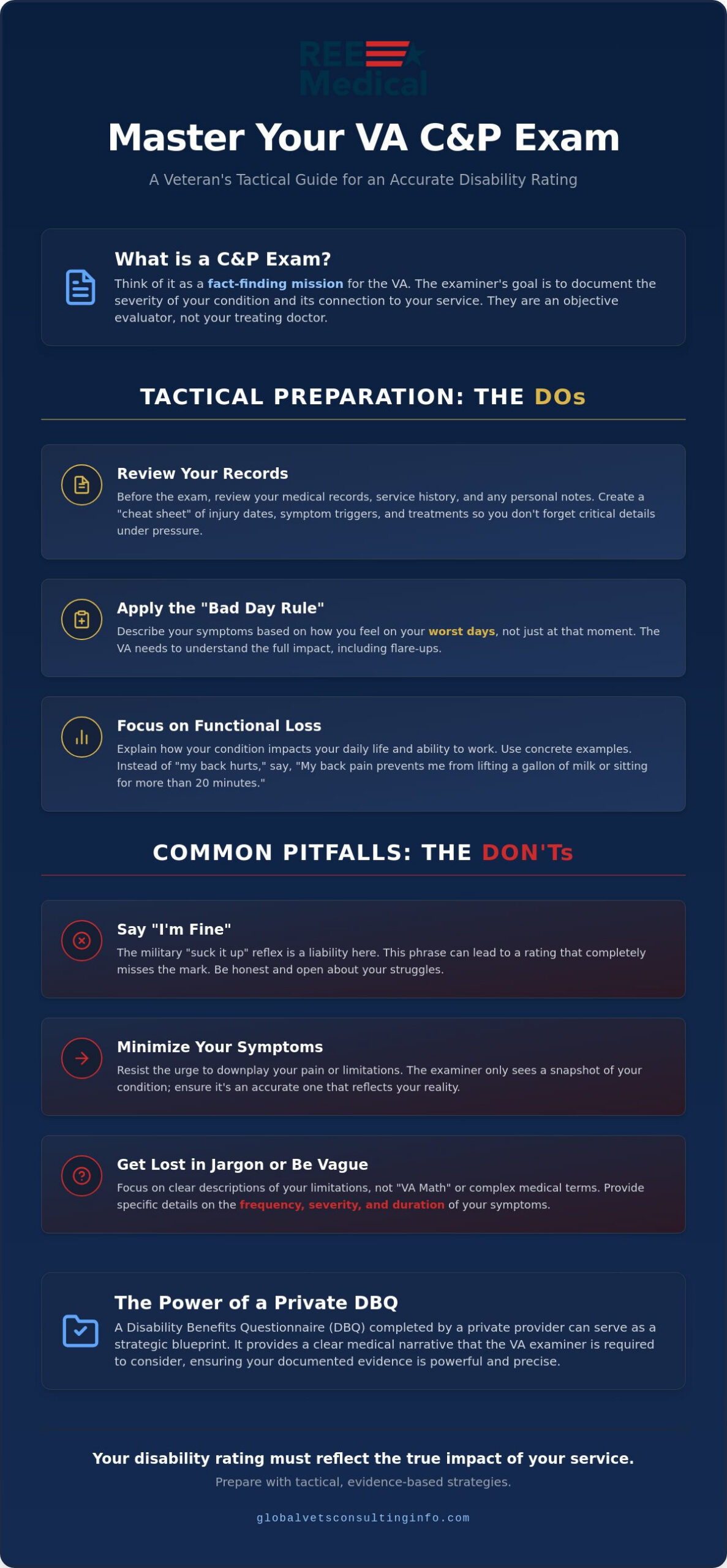
A Compensation and Pension (C&P) exam is a specialized medical evaluation requested by the VA to verify the specific details of your disability claim. Think of this appointment as a fact-finding mission for the VA rater who will ultimately decide your case. While it feels like a standard doctor visit, the purpose is fundamentally different. The examiner’s job is to determine service connection and the severity of your symptoms to see if they match the legal requirements for compensation. They aren’t there to treat you; they are there to document your condition for the record.
Understanding the examiner’s perspective is one of the most vital C&P Exam Tips we can offer. They are not your “treating” doctor, which means they won’t provide healthcare, prescribe medication, or offer long-term medical advice. They are objective evaluators. These exams are often facilitated through the Veterans Health Administration or third-party contractors. Because their time is limited, you must be prepared to provide clear, concise information that leaves no room for misinterpretation regarding your daily limitations.
The Role of the Examiner in 2026
In 2026, the VA continues to rely heavily on third-party contractors like QTC, VES, and LHI to handle the high volume of claims. Whether you meet with a VA employee or a contractor, they will use a Disability Benefits Questionnaire (DBQ) to record their findings in a structured format. This document acts as the primary evidence source for the rater. Your goal is to provide the specific data points they need to fill out that form accurately. To learn more about this document, you can review our guide on what is a dbq to see how it serves as a roadmap for your evaluation.
By treating the exam as a professional briefing rather than a casual medical check-up, you position yourself for a more accurate outcome. Utilizing these C&P Exam Tips ensures that you stay focused on the mission: providing the medical evidence necessary to verify the severity of your condition. You’ve done the hard work of serving; now it’s time to ensure the documentation reflects that sacrifice correctly.
Top C&P Exam Tips for Tactical Preparation 📞
Preparation is the key to ensuring your disability rating reflects the reality of your health. Before your appointment, review your medical records and our VA disability claims process step by step guide to see how this exam fits into your overall strategy. It’s useful to create a “cheat sheet” that includes your injury dates, symptom triggers, and a history of your treatments. Having these details written down prevents you from blanking out under the stress of the evaluation and ensures you don’t leave out critical information.
One of the most vital C&P Exam Tips is the “Bad Day Rule.” As veterans, we’re trained to say we’re fine even when we’re struggling. During a VA claim exam, you must resist the urge to minimize your pain. Describe your condition based on your worst days, not how you feel at that exact moment. Remember that functional loss is more important than just having a diagnosis on paper. The VA rater needs to know how your body fails to perform its duties during a flare-up, not just the name of your condition.
Documenting Your Functional Limitations
Examiners need to see how your condition impacts your ability to earn a living and maintain a home. Use concrete, physical examples to illustrate your point. Saying “I can’t lift a gallon of milk” provides a much clearer picture for the DBQ than simply saying “my back hurts.” Describe the frequency, severity, and duration of your flare-ups in detail. If your symptoms prevent you from completing daily chores or cause you to miss work, make sure the examiner records those specific limitations. If you need help organizing your documentation, our C&P exam preparation education can help you focus on the most impactful details.
By focusing on these tactical C&P Exam Tips, you transform a stressful medical appointment into a structured briefing. You aren’t there to complain; you’re there to provide the examiner with the evidence they need to verify your claim. Stay objective, be specific about your limitations, and ensure the record reflects the full scope of your service-connected conditions.
What Not to Say at a C&P Exam: Avoiding Common Pitfalls 🌐
Many veterans walk into the exam room with a “tough it out” mentality. While this serves you well in the field, it’s a liability during a medical evaluation. One of the most critical C&P Exam Tips is to stop saying “I’m fine” when the examiner asks how you’re doing. This reflex is often why veterans find their va claim denied for lack of evidence. The examiner is looking for clinical documentation of your struggles. If you tell them you’re okay, they’ll record exactly that, regardless of your actual medical history.
Another common mistake is trying to talk about “VA Math” or specific percentages. You aren’t the rater, so don’t try to calculate your own rating during the appointment. Stick to describing your medical symptoms and how they limit your life. You should also ensure you mention any secondary conditions that have developed over time. For example, if a service-connected knee injury has caused you to walk differently and lead to back pain, that’s a vital connection to make. You can find more official guidance on the process in the C&P Exam Fact Sheet provided by the VA.
The Danger of the ‘Good Day’ Reflex
If you happen to be having a “good day” during your appointment, you must tell the examiner that your current state is an exception. Describe what a typical week looks like for you, including the days when your pain is so severe that you can’t get out of bed. Be honest and thorough without exaggerating. While exaggeration can hurt your credibility, leaving out the details of your worst days will definitely hurt your rating. This is the time to be vulnerable and honest about the reality of your health.
You don’t have to navigate this complex system alone. If you’re worried about how to describe your symptoms accurately, our team can help you with C&P examination preparation education to ensure your voice is heard. Consistency and honesty are your best tools for a fair evaluation that reflects your service.
How a Private DBQ Can Secure Your Success 🇺🇸
A private DBQ provides a pre-existing medical narrative that the C&P examiner must consider. If you’re wondering what is a dbq and how it serves as a roadmap, think of it as your official voice in a system that often feels rushed. Under the Johnny Isakson and David P. Roe, M.D. Veterans Health Care and Benefits Improvement Act of 2020, the VA is mandated to accept and consider these documents from private providers. This proactive approach is one of the most effective C&P Exam Tips for veterans who want to avoid the “I’m fine” reflex we discussed earlier.
Submitting a DBQ from a provider who truly knows your history can effectively counter a rushed, 15-minute C&P exam. Examiners are often overwhelmed with high caseloads, which can lead to incomplete reports. When you arrive with a completed DBQ, you provide the examiner with a clear path to follow, making it much harder for them to overlook critical data points. Global Vets Consulting specializes in educating veterans on how to use a dbq for a va disability rating increase to ensure your documentation matches the severity of your condition.
Taking Control of the Evidence
Securing a private DBQ ensures that all your symptoms are documented by a professional who actually listens to your concerns. This level of thoroughness creates a stronger file that is significantly harder for the VA to ignore or low-ball during the rating process. The DBQ is the most powerful piece of medical evidence a veteran can possess because it translates your physical pain into the specific language the VA rater needs to see. By taking control of your evidence, you move from a passive participant to an empowered advocate for your own health.
Our mission at Global Vets Consulting is to provide the educational resources you need to succeed. We focus on ensuring you have the documentation required to verify your condition’s severity before you ever step into a room. This methodical preparation reduces anxiety and builds the steady confidence needed to navigate the VA system effectively. You’ve earned these benefits through your service, and we’re here to help you document that reality with precision.
Take Control of Your VA Disability Journey 🇺🇸
You’ve spent years serving your country, and now it’s time for the system to serve you. Navigating a VA evaluation is about more than just showing up; it’s about providing a clear medical narrative that cannot be ignored. By applying these C&P Exam Tips, you ensure that your functional limitations and worst days are documented with precision. Remember that the “I’m fine” reflex is your biggest obstacle, and a well-prepared DBQ is your strongest ally during this process.
Global Vets Consulting is a veteran-owned and operated team dedicated to providing specialized DBQ education and independent medical evidence resources. We understand the intricacies of the claims process because we’ve been in your boots. Whether you need help understanding secondary conditions or want to ensure your medical evidence is bulletproof, we’re here to help 24/7.
Ready to secure the evidence you need? Contact Global Vets Consulting today!
📞 24/7 National Client Services Hotline: 800-484-1859
🌐 GlobalVetsConsultingInfo.com
You earned these benefits through your sacrifice. Don’t leave your disability rating to chance. Stay focused, stay honest, and move forward with the confidence you deserve.
Frequently Asked Questions
Can I bring someone with me to my C&P exam?
You are generally allowed to bring a spouse, family member, or friend to your appointment for emotional support or to help you remember specific symptom details. While the examiner has the final discretion regarding who remains in the room during the actual physical evaluation, having a witness can be beneficial. They can provide a second perspective on how your condition limits your daily life, especially if you tend to downplay your pain or forget to mention specific flare-ups.
What should I do if the C&P examiner was rude or didn’t listen?
You should report any unprofessional behavior or a perceived lack of thoroughness immediately after your appointment concludes. Contact the VA directly or the third-party contractor, such as VES, QTC, or LHI, to file a formal complaint regarding the examiner’s conduct. It is also a good idea to submit a Statement in Support of Claim (VA Form 21-4138) to your file. This ensures the VA rater knows that the exam report may not accurately reflect your medical reality.
Is a C&P exam required for every VA disability claim?
A C&P exam is not mandatory for every single claim, although the VA requests them for the vast majority of cases to verify service connection. The VA may decide your claim without an in-person visit if your submitted medical evidence is already sufficient for a rating. This often occurs when you provide a fully developed claim that includes a high-quality private DBQ that covers all necessary clinical data points for the rater.
How long does it take to get results after a C&P exam in 2026?
You can typically expect the examiner to submit their findings to the VA within two weeks of your appointment. However, the final decision on your rating usually takes between four to eight weeks, depending on the complexity of your file and the current regional backlog. Utilizing effective C&P Exam Tips ensures that you provide the clear, concise data points the rater needs, which can help prevent unnecessary delays in the decision-making process.
Can a private DBQ replace a C&P exam?
A private DBQ provides powerful medical evidence, but the VA may still require you to attend their own scheduled evaluation. You should never skip a VA-ordered appointment, as missing it can lead to an automatic denial of your claim. Instead, use these C&P Exam Tips to treat your private documentation as a blueprint. This ensures the VA examiner records your symptoms accurately and doesn’t overlook the functional limitations already documented by your private provider.

Article by
Willie Daniel
Willie Daniel is the Founder and Chief Executive Officer (CEO) of Global Vets Consulting (GVC) – National Veterans Disability Services, a veteran-led educational and medical evidence support organization dedicated to helping veterans better understand VA disability rating increases, DBQ medical evidence, secondary claims education, and C&P examination preparation.
He is a retired U.S. Army Medical Service Corps Officer with more than 27 years of honorable military service, a decorated Iraq combat veteran, and a retired federal official with the U.S. Department of Veterans Affairs. Throughout his military and federal career, Willie Daniel served in leadership, healthcare administration, operational, and veteran-support roles focused on improving services and support systems for servicemembers, veterans, and their families.
Drawing from decades of military leadership, healthcare administration, veteran advocacy, and federal government experience, Willie Daniel brings a practical, veteran-centered perspective to Global Vets Consulting’s educational articles, AI-powered veteran resources, video education initiatives, and outreach programs. His experience navigating military systems, medical documentation processes, and veteran-related administrative operations provides valuable insight into many of the challenges veterans face when seeking to better understand VA disability rating criteria, medical evidence, documentation strategies, and secondary condition education.
Through GVC’s “Veterans Helping Veterans” mission, his focus is on delivering clear, educational, and easy-to-understand information designed to empower veterans with knowledge, resources, and educational tools that may help them make more informed decisions regarding their individual VA disability journeys.
The information provided through GVC is intended for educational and informational purposes only and should not be considered legal or medical advice.
Disclaimer
Disclaimer: Global Vets Consulting, LLC (“GVC”) is a veteran-led educational and medical evidence support organization. GVC is not a law firm, is not a Veterans Service Organization (VSO), and is not affiliated with the U.S. Department of Veterans Affairs (VA) or any government agency.
Global Vets Consulting does not provide legal advice, medical advice, medical treatment, or healthcare services. GVC does not prepare, file, or submit VA disability claims on behalf of veterans. All information provided through this website, blog articles, videos, educational materials, AI tools, dashboards, templates, and communications is intended solely for general educational and informational purposes.
Veterans are encouraged to consult with accredited representatives, licensed attorneys, qualified medical providers, or Veterans Service Organizations regarding their specific legal, medical, or VA-related matters. VA disability decisions, ratings, and outcomes are determined solely by the U.S. Department of Veterans Affairs based on applicable laws, regulations, medical evidence, and individual circumstances. Past results do not guarantee future outcomes.