
Your weight gain isn’t a “lifestyle choice” when it’s the direct result of the medications you take for your service-connected conditions. It’s incredibly frustrating to face a VA denial that blames your health on personal habits, especially when you’re just following a doctor’s orders for an existing service-connected injury. You know those pills for your chronic pain or mental health are the reason the scale has moved, and now your sleep is suffering because of it.
We understand the anxiety that comes with a new diagnosis and the confusion of linking it to an old claim. This guide will show you how to successfully link sleep apnea secondary to weight gain from medication to your benefits using the “weight gain as an intermediate step” medical theory. By using this proven path, you can move past the “lifestyle” label and focus on the medical facts that connect your conditions.
We’ll explain the specific medical evidence required, including Disability Benefits Questionnaires (DBQs) and Nexus Letters, to help you prepare for your C&P exam. With the 2026 COLA increase now in effect, a 100% disability rating pays $3,938.58 per month for a veteran with no dependents. Our goal is to provide the education you need to secure the 50% rating typically assigned for CPAP use and increase your overall disability compensation. 🇺🇸
Key Takeaways
- Understand the “intermediate step” medical theory to bridge the gap between your primary service-connected conditions and a new sleep apnea diagnosis.
- Identify which VA-prescribed medications for conditions like PTSD or chronic pain list weight gain as a primary side effect to establish a chain of causation.
- Learn why a private Disability Benefits Questionnaire (DBQ) and a specific Nexus Letter are vital for proving sleep apnea secondary to weight gain from medication.
- Follow a step-by-step checklist to gather medication logs and weight history from your VA medical records to build a comprehensive evidence package.
- Gain the education needed to navigate the C&P examination process and work toward a VA rating increase for your respiratory conditions.
The Link: How Service-Connected Medications Lead to Sleep Apnea
Many veterans struggle to connect their sleep issues to their service history because the VA often labels weight gain as a personal lifestyle choice. However, the “Intermediate Step” theory provides a clear medical path to bridge this gap. This theory allows you to link a primary service-connected condition to a secondary diagnosis by showing how a side effect, like weight gain, acted as the catalyst. Sleep apnea secondary to weight gain from medication is a compensable secondary service connection when you can prove your VA-prescribed meds directly caused the increase in body mass.
Common Medications Triggering Weight Gain
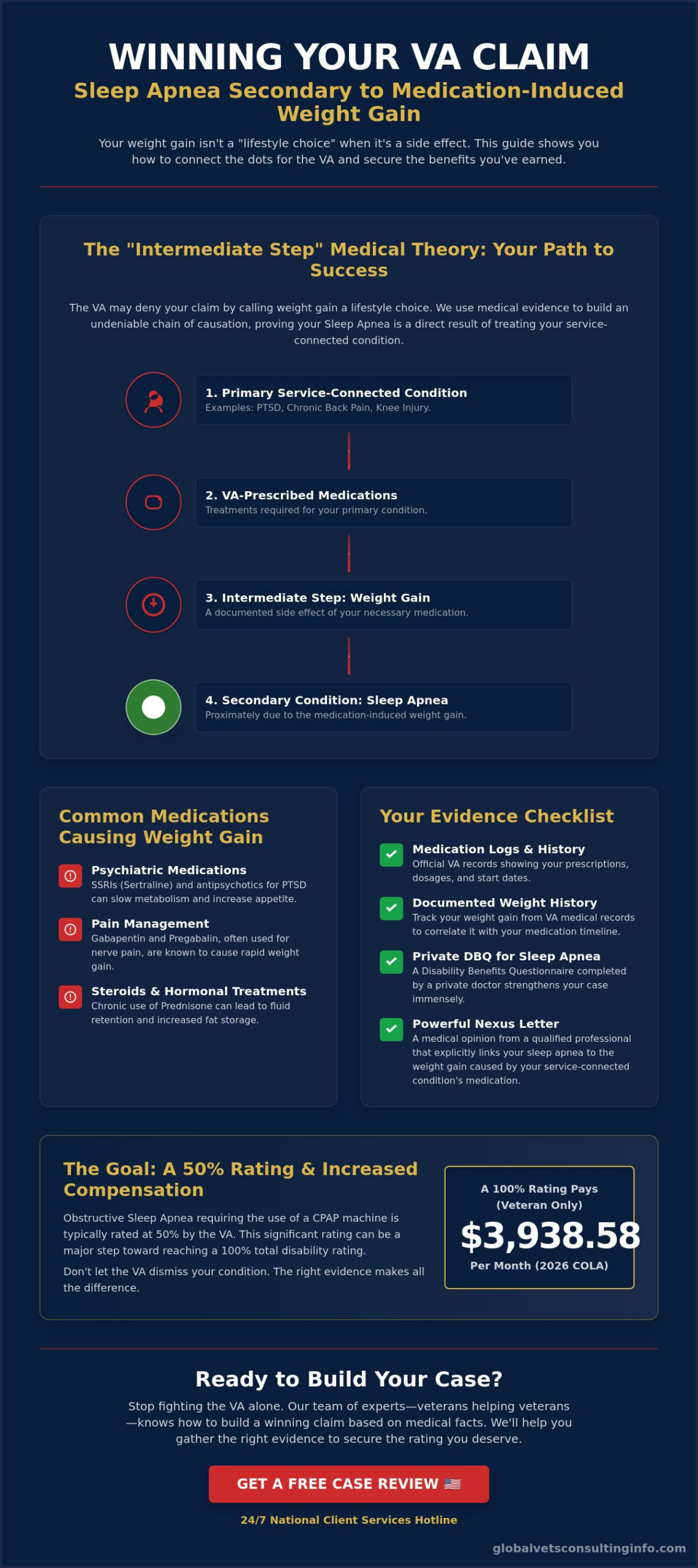
The medications you take to manage your service-connected disabilities often come with metabolic consequences. Identifying these drugs is the first step in building your claim. Common triggers include:
- Psychiatric medications: SSRIs like Sertraline or antipsychotics used for PTSD can significantly slow your metabolism and increase appetite.
- Pain management: Medications such as Gabapentin and Pregabalin, often prescribed for nerve pain or back injuries, are known to cause rapid weight gain in many patients.
- Steroids and Hormonal treatments: Chronic use of Prednisone for service-connected respiratory issues or skin conditions can lead to fluid retention and increased fat storage.
From Weight Gain to Airway Obstruction
Physiologically, weight gain changes how you breathe at night. Increased fat deposits in the neck, known as pharyngeal fat, put physical pressure on your throat. This pressure causes the airway to narrow or collapse during sleep. To understand the mechanics of this condition, it helps to review What is Sleep Apnea? and how these obstructions occur. As your body mass index (BMI) increases due to medication, the risk of developing obstructive sleep apnea rises proportionally.
The VA may try to argue that your weight is a “lifestyle” issue. You can counter this by providing medical evidence that your weight gain was an involuntary side effect of the drugs you need to manage your service-connected disabilities. This shifts the focus from your habits to the medical necessity of your treatment plan. By documenting this chain of causation, you transform a “lifestyle” excuse into a legitimate medical link for your disability claim.
VA Claim Strategy: Weight Gain as an Intermediate Medical Link
The VA’s official position is that obesity itself isn’t a ratable disability. However, it’s a powerful tool when used as an intermediate medical link. To win a claim for sleep apnea secondary to weight gain from medication, you must build a bridge that connects your primary service-connected condition to your new diagnosis. This isn’t about blaming “lifestyle” choices. It’s about showing that your service-connected injuries or their required treatments left you with no other physical outcome.
The roadmap for this claim follows a logical sequence. First, identify your primary condition, such as PTSD, chronic back pain, or a knee injury. Next, document the specific medications or physical limitations caused by that condition. Finally, show how those factors led to weight gain, which then caused your obstructive sleep apnea (OSA). This chain of causation turns a “lifestyle” issue into a legitimate medical consequence of service. Building this chain requires meticulous documentation of your medical history and treatment plan.
The Legal Framework for Secondary Claims
The foundation for your claim is 38 CFR § 3.310. This regulation states that a disability which is proximately due to or the result of a service-connected disease or injury shall be service-connected. Recent Board of Veterans’ Appeals (BVA) precedents in early 2026 have consistently upheld the “intermediate step” theory. These cases demonstrate that when weight gain is a side effect of treatment for a service-connected condition, the resulting OSA is eligible for compensation. This legal standing is critical for veterans who feel their claims have been unfairly dismissed in the past.
Overcoming the “Lifestyle Choice” Rejection
VAs often default to the “lack of exercise” argument to deny claims. You can defeat this by proving your weight gain was aggravated by your service-connected limitations. If a veteran has a 30% rating for a back injury that prevents aerobic exercise, the weight gain isn’t a choice; it’s a medical reality. When you combine physical limitations with medication side effects, the argument for service connection becomes undeniable. If you’re unsure how to structure this evidence, exploring secondary VA claims education can help you organize your records effectively to withstand VA scrutiny.
Essential Evidence: DBQs and Nexus Letters for Sleep Apnea
Winning a claim for sleep apnea secondary to weight gain from medication requires more than just a diagnosis. You need a structured presentation of medical evidence that the VA cannot ignore. The primary tool for this is the Disability Benefits Questionnaire (DBQ). You can learn what is a dbq and why it matters for your claim to ensure your symptoms are documented correctly. For sleep apnea, a DBQ is incomplete without a confirmed sleep study showing a diagnosis of obstructive sleep apnea. This document serves as the clinical proof of your condition’s severity and its impact on your daily life.
The Power of Independent Medical Evidence
Relying solely on a VA C&P examiner can be risky for complex secondary links. These examiners often have limited time to review your full history or understand the nuances of how your psychiatric or pain medications caused your weight gain. Professional medical documentation provides the technical accuracy the VA requires. Independent medical evidence ensures that the “intermediate step” of weight gain is clearly documented as a direct result of your service-connected treatment. It moves the conversation from a subjective “lifestyle” debate to an objective medical reality supported by your records.
Key Elements of a Strong Nexus
A Nexus Letter is the medical opinion that bridges your conditions. To be effective, the physician must review your entire medical file and service treatment records. They need to state that your sleep apnea is “at least as likely as not” caused by the weight gain from your service-connected medications. This specific phrasing is the legal threshold required for a successful VA disability claim. If the doctor uses weaker language, the VA might find the link insufficient to grant service connection.
A strong Nexus Letter should include these critical components:
- Comprehensive File Review: A statement confirming the doctor reviewed all relevant VA and private medical records.
- Detailed Medical Reasoning: An explanation of the physiological link between your specific medications, the resulting weight gain, and airway obstruction.
- The Legal Standard: The explicit use of the phrase “at least as likely as not” to satisfy VA requirements.
If you’re ready to strengthen your evidence, we offer specialized sleep apnea claims education to help you understand the documentation needed for a successful rating increase.
Steps to File Your Secondary Sleep Apnea Claim in 2026
Filing a successful claim requires a strategic approach that connects your current health status to your service history. You’ve already established the “intermediate step” theory; now it’s time to assemble the evidence. In early 2026, the average processing time for VA disability claims is between 80 and 125 days. By following a methodical checklist, you can provide the VA with a clear, undeniable path to approval for sleep apnea secondary to weight gain from medication.
Gathering Your Documentation
Your medical records are the backbone of your claim. You must collect evidence showing the exact timing of your weight gain relative to when you started your service-connected medications. It’s vital to request your full weight history and medication logs from the VA to show a clear upward trend in Body Mass Index (BMI) following your prescription dates. If your primary service-connected condition is psychological, utilizing a dbq for mental health conditions can help document the severity of your symptoms and the medical necessity of your weight-altering medications. This documentation establishes the first two links in your chain of causation.
Submitting a Fully Developed Claim (FDC)
The fastest way to receive a decision is by submitting a Fully Developed Claim. This means you provide all your medical evidence, Nexus Letters, and DBQs at the moment you file. You can use our va disability claims process step by step guide to ensure you don’t miss any critical milestones. Remember that as of May 2026, a veteran who requires a breathing assistance device like a CPAP machine is assigned a 50% disability rating. Ensure your current diagnosis and CPAP prescription are clearly visible in your package to secure this rating and work toward a VA rating increase.
We’re dedicated to helping you navigate this complex system with confidence. If you need assistance with independent medical evidence education or preparing for your C&P examination, our team is ready to support you. 🇺🇸
Get the Support You Earned:
- 🌐 GlobalVetsConsultingInfo.com
- 📞 24/7 National Client Services Hotline
- 🤖 24/7 AI Veteran Intake Specialist
- 🇺🇸 Worldwide Veteran Benefits Education & Resource Awareness
Secure Your Earned Benefits Today
You now have the roadmap to challenge a VA denial and prove that your respiratory issues are a direct result of your service-connected treatment. By using the “intermediate step” theory, you can shift the focus from personal habits to the clinical side effects of your medications. Meticulous documentation of your weight history and the use of private DBQs are the most effective ways to ensure your claim is viewed with the technical accuracy it deserves.
Linking sleep apnea secondary to weight gain from medication is a strategic process that requires precise documentation and a clear medical nexus. Our veteran-owned and operated team specializes in Secondary VA Claims Education to help you navigate these complex links. We offer the expertise needed to strengthen your medical evidence and prepare you for the C&P examination process. Our 24/7 AI Veteran Intake Specialist is always available to help you organize your next steps.
📞 Contact our 24/7 National Client Services Hotline for help with your DBQ and start your journey toward a VA rating increase. You’ve served your country with honor; now it’s time to ensure you receive the compensation you’ve rightfully earned. 🇺🇸
Frequently Asked Questions
Can the VA deny sleep apnea if I am overweight?
The VA often denies these claims by labeling obesity as a non-compensable lifestyle factor rather than a medical condition. You can overcome this hurdle by demonstrating that your weight gain is an “intermediate step” caused by service-connected medications or physical limitations. This medical bridge shifts the focus from personal habits to the involuntary side effects of your service-connected treatment plan.
Which medications are most likely to cause weight gain for a secondary VA claim?
Veterans commonly take medications like SSRIs for PTSD or Gabapentin for chronic pain; both are linked to metabolic changes and increased body mass. Other high-risk drugs include antipsychotics, Pregabalin, and long-term steroids like Prednisone. Documenting these specific prescriptions is a critical part of establishing sleep apnea secondary to weight gain from medication.
Do I need a sleep study to prove sleep apnea secondary to weight gain?
A formal sleep study is a mandatory requirement for any sleep apnea service connection. The VA requires clinical evidence of the condition’s existence and severity before they’ll consider a rating. Without a current diagnosis from a sleep study, your claim for sleep apnea secondary to weight gain from medication will likely be denied regardless of your weight history.
Is a 50% rating for sleep apnea guaranteed if I use a CPAP?
As of May 2026, the VA rating schedule assigns a 50% disability rating to veterans who require the use of a breathing assistance device like a CPAP machine. While the VA has proposed changing these rules to eliminate the automatic 50% rating, those changes haven’t been finalized or put into effect. Veterans with current ratings are also expected to be “grandfathered” in under the existing rules.
How do I prove my weight gain was caused by my service-connected meds?
You prove this link by submitting a comprehensive evidence package that includes medication logs and weight history from your VA medical records. A Nexus Letter from a medical professional is also essential to state that your weight gain is “at least as likely as not” a result of your service-connected medications. This documentation creates the legal and medical chain of causation the VA requires for approval.

Article by
Willie Daniel
Willie Daniel is the Founder and Chief Executive Officer (CEO) of Global Vets Consulting (GVC) – National Veterans Disability Services, a veteran-led educational and medical evidence support organization dedicated to helping veterans better understand VA disability rating increases, DBQ medical evidence, secondary claims education, and C&P examination preparation.
He is a retired U.S. Army Medical Service Corps Officer with more than 27 years of honorable military service, a decorated Iraq combat veteran, and a retired federal official with the U.S. Department of Veterans Affairs. Throughout his military and federal career, Willie Daniel served in leadership, healthcare administration, operational, and veteran-support roles focused on improving services and support systems for servicemembers, veterans, and their families.
Drawing from decades of military leadership, healthcare administration, veteran advocacy, and federal government experience, Willie Daniel brings a practical, veteran-centered perspective to Global Vets Consulting’s educational articles, AI-powered veteran resources, video education initiatives, and outreach programs. His experience navigating military systems, medical documentation processes, and veteran-related administrative operations provides valuable insight into many of the challenges veterans face when seeking to better understand VA disability rating criteria, medical evidence, documentation strategies, and secondary condition education.
Through GVC’s “Veterans Helping Veterans” mission, his focus is on delivering clear, educational, and easy-to-understand information designed to empower veterans with knowledge, resources, and educational tools that may help them make more informed decisions regarding their individual VA disability journeys.
The information provided through GVC is intended for educational and informational purposes only and should not be considered legal or medical advice.
Disclaimer
Disclaimer: Global Vets Consulting, LLC (“GVC”) is a veteran-led educational and medical evidence support organization. GVC is not a law firm, is not a Veterans Service Organization (VSO), and is not affiliated with the U.S. Department of Veterans Affairs (VA) or any government agency.
Global Vets Consulting does not provide legal advice, medical advice, medical treatment, or healthcare services. GVC does not prepare, file, or submit VA disability claims on behalf of veterans. All information provided through this website, blog articles, videos, educational materials, AI tools, dashboards, templates, and communications is intended solely for general educational and informational purposes.
Veterans are encouraged to consult with accredited representatives, licensed attorneys, qualified medical providers, or Veterans Service Organizations regarding their specific legal, medical, or VA-related matters. VA disability decisions, ratings, and outcomes are determined solely by the U.S. Department of Veterans Affairs based on applicable laws, regulations, medical evidence, and individual circumstances. Past results do not guarantee future outcomes.