
In 2026, your sleep apnea rating is no longer just about the machine you use; it’s about the medical evidence documenting your symptoms’ severity. You likely feel the weight of shifting regulations and the frustration of C&P examiners who don’t seem to listen to your history of service. It’s exhausting to worry that a system meant to support you might suddenly reduce your benefits due to new rules. This guide will show you how to secure the Sleep Apnea VA Benefits you earned by navigating the complex 2026 rating landscape with precision.
We’ll explore how to maintain a 50% rating, link your condition to PTSD or toxic exposure, and build a roadmap of medical documentation that acts as a shield for your claim. By understanding how to present your case, you can move forward with the steady confidence that your health and financial stability are protected. Our methodical approach ensures you have the tools to turn confusion into a clear path toward the outcomes you deserve.
Key Takeaways
- Understand how the 2026 rating changes shift the focus from CPAP equipment to the clinical severity of your symptoms.
- Learn the specific medical evidence required to secure a 50% or 100% rating for Sleep Apnea VA Benefits by documenting ineffective treatment or social impairment.
- Discover why a private Disability Benefits Questionnaire (DBQ) serves as a vital safeguard against the limitations of a standard 15-minute C&P exam.
- Identify the essential steps to link sleep apnea to other service-connected conditions like PTSD or toxic exposure for a stronger claim.
Navigating Sleep Apnea VA Benefits in 2026: What Has Changed?
Sleep apnea is a serious disorder where breathing repeatedly stops and starts during sleep. For veterans, this often leads to chronic fatigue, cardiovascular strain, and severe cognitive impairment. Securing Sleep Apnea VA Benefits used to be a straightforward process centered on the prescription of a CPAP machine. However, 2026 marks a significant transition in how the VA scrutinizes these claims.
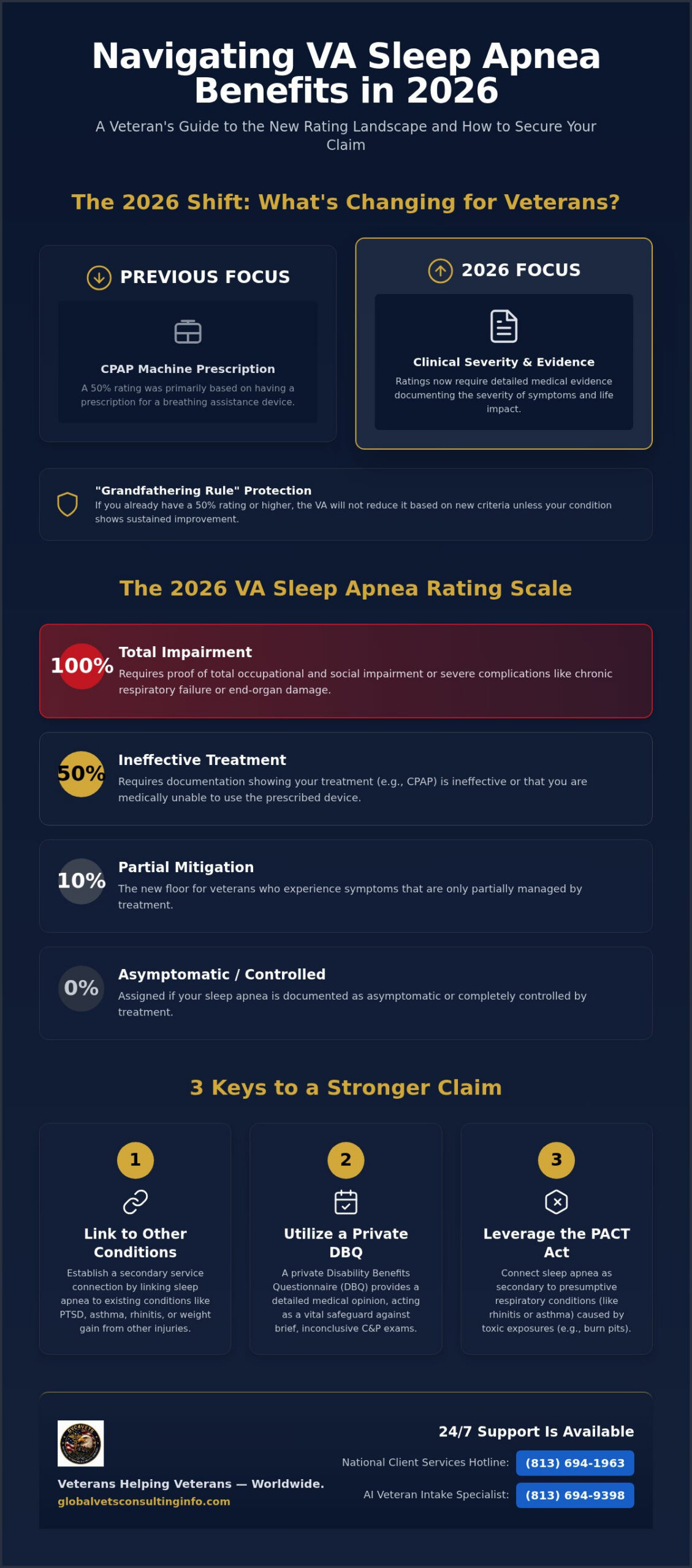
The VA is currently moving toward a more rigorous evaluation process. While a CPAP prescription still generally qualifies you for a 50% rating under current rules, there’s increased pressure to document the clinical severity of your symptoms. Securing Sleep Apnea VA Benefits now requires more than just a machine; it requires showing how the condition impacts your daily life. This is especially true as the VA considers shifting from equipment-based ratings to symptom-based evaluations that prioritize treatment effectiveness.
If you already hold a rating of 50% or higher, the “Grandfathering Rule” protects you. The VA won’t reduce your existing benefits based on new criteria unless your condition shows sustained medical improvement. For new claimants, however, professional documentation is more critical than ever to lock in these higher ratings before rules potentially tighten.
The Proposed vs. Final Rule: Where We Stand in 2026
As of August 2026, the VA continues to rate sleep apnea under existing criteria, meaning the proposed changes haven’t been finalized. One major part of the proposal is the elimination of the 30% rating tier, which would force claims into either a 0% or 50% category based on symptom management. It’s vital to file under the current, more favorable schedule while it remains in effect.
Direct vs. Secondary Service Connection
You can establish service connection in two primary ways. Direct connection applies if you were diagnosed during active duty. Secondary connection is often more common, linking sleep apnea to existing service-connected disabilities like PTSD, asthma, or rhinitis. This approach requires a strong medical nexus to show how your primary condition aggravates your sleep disorder.
Understanding the 2026 VA Sleep Apnea Rating Schedule
The VA Schedule for Rating Disabilities provides the legal framework for evaluating your condition. In 2026, the rating schedule has evolved to focus on the functional impact of your symptoms rather than just the use of medical devices. To secure your Sleep Apnea VA Benefits, you must understand where your symptoms fall on the current scale:
- 100% Rating: This requires proof of total occupational and social impairment or severe complications like chronic respiratory failure or end-organ damage.
- 50% Rating: You’ll need to document that your treatment is ineffective or that you’re medically unable to use a CPAP machine.
- 10% Rating: This acts as the new floor for veterans who experience symptoms that are partially mitigated by treatment.
- 0% Rating: This is assigned if your sleep apnea is asymptomatic or completely controlled.
Securing the correct rating depends entirely on the precision of your medical documentation. Securing Sleep Apnea VA Benefits requires a clear understanding of these evidentiary requirements. If you’re feeling overwhelmed by the paperwork, exploring Sleep Apnea Claims Education can help you organize your evidence effectively.
Linking Sleep Apnea to Other Service-Connected Disabilities
Many veterans successfully establish a secondary service connection. Conditions like PTSD or other mental health disorders can significantly aggravate sleep apnea symptoms. Additionally, service-connected physical injuries often lead to weight gain due to limited mobility, which then serves as a medical intermediary for OSA. Using a DBQ for mental health conditions is a vital step in proving this complex relationship to the VA.
The Impact of Toxic Exposure and the PACT Act
The PACT Act has changed the landscape for veterans exposed to burn pits or other toxins. You can now more easily link sleep apnea as secondary to service-connected respiratory conditions like rhinitis or asthma. Chronic sinus conditions have a presumptive relationship with the development of obstructive sleep apnea, making clinical history essential for your claim.
The Critical Role of Private DBQs and Medical Evidence
Relying on the VA’s internal examination process can be a gamble. A typical C&P exam often lasts less than 20 minutes, which is rarely enough time for an examiner to capture the full scope of your condition. A private Disability Benefits Questionnaire (DBQ) acts as your shield, allowing a physician who knows your history to provide a comprehensive view of the symptoms and causes of sleep apnea. This thoroughness is essential for securing Sleep Apnea VA Benefits under the stricter 2026 standards.
To build a winning claim, you’ll need three pillars of evidence: a current sleep study, buddy statements from those who witness your breathing pauses, and a strong Nexus letter. You must ensure your doctor documents specific functional limitations, such as persistent daytime sleepiness or a medical inability to tolerate CPAP therapy. If you’re ready to take control of your documentation, our Disability Benefits Questionnaire (DBQ) education services provide the clarity you need to move forward.
Overcoming a ‘Lack of Evidence’ Denial
The VA frequently denies Sleep Apnea VA Benefits claims due to a perceived lack of evidence. This typically happens when your records don’t clearly show a service connection or a current, confirmed diagnosis. You can fight back by recovering from a denied claim using fresh medical evidence that specifically addresses the gaps identified in your denial letter. Precise documentation is the only way to reverse these decisions.
The Importance of a Nexus Letter
A Nexus letter is the essential bridge between your military service and your current health. It must state that your condition is “at least as likely as not” caused or aggravated by your time in uniform. Without this professional medical opinion, the VA often fails to recognize the link, regardless of how severe your symptoms have become. This letter provides the steady confidence needed to prove your case.
How Global Vets Consulting Supports Your Claim Journey
Global Vets Consulting operates with a clear mission: “Veterans Helping Veterans.” Since 2021, we’ve focused on providing the expert education you need to secure your Sleep Apnea VA Benefits with accuracy. Our process centers on Disability Benefits Questionnaire (DBQ) preparation, which streamlines evidence gathering and helps you present a meticulous medical picture to the VA. By prioritizing professional VA disability claims process education, we empower you to take charge of your medical documentation.
Accessing immediate guidance is straightforward through our 24/7 National Client Services Hotline. We understand that the bureaucratic system feels overwhelming, so we act as a steady guide to reduce your anxiety. Whether you’re filing for the first time or seeking a higher rating, our education services ensure you aren’t handling these complex 2026 changes alone. This partnership approach prioritizes your peace of mind throughout the entire administrative process.
Preparing for Your Increase or Secondary Claim
If your symptoms have worsened since your last evaluation, you shouldn’t settle for an outdated rating. Securing an increase requires new, clinical evidence that reflects your current level of impairment. Using a DBQ for a rating increase allows you to document these changes precisely, ensuring the VA sees the full scope of your condition. This proactive step is vital for protecting the Sleep Apnea VA Benefits you’ve earned through your service.
Get Started with Global Vets Consulting Today
You can begin your journey immediately by engaging with our AI Veteran Intake Specialist. This tool is designed for a fast, efficient start, gathering the essential details needed to frame your case. Don’t navigate the complex 2026 VA system alone. We are here as your reliable ally, dedicated to simplifying the process and helping you achieve the earned outcomes you deserve.
Protect Your Benefits with Professional Evidence
Securing the Sleep Apnea VA Benefits you’ve earned requires a shift in strategy for 2026. Success no longer depends solely on a CPAP prescription. It now requires the meticulous documentation of your clinical symptoms and their impact on your daily life. By utilizing private DBQs and establishing strong secondary connections to service-connected conditions, you build a shield against the limitations of standard examinations. This proactive approach ensures your rating accurately reflects your health status rather than a bureaucratic checklist.
Global Vets Consulting stands as your steady guide in this process. As a veteran-owned and operated organization, we specialize in DBQ preparation and education to help you navigate these complex changes with confidence. You can access immediate support through our 24/7 National Client Services Hotline whenever questions arise. Don’t leave your financial stability to chance. Start your claim education with Global Vets Consulting today! You’ve served your country with honor; we are dedicated to helping you secure the outcomes you truly deserve.
Frequently Asked Questions
Will my 50% sleep apnea rating be reduced in 2026 if I use a CPAP?
No, your existing 50% rating won’t be reduced due to the use of a CPAP machine as long as your condition hasn’t shown sustained medical improvement. The VA’s grandfathering rule protects veterans who were already rated before any final changes to the schedule were implemented. You should maintain regular treatment and documentation to ensure your health records reflect the ongoing necessity of your breathing assistance device.
Can I claim sleep apnea as secondary to PTSD or Tinnitus?
Yes, you can claim sleep apnea as secondary to PTSD, though linking it to tinnitus is more complex and requires strong medical evidence. PTSD often aggravates sleep disorders through weight gain from medication or disrupted sleep patterns. Securing Sleep Apnea VA Benefits through secondary connection requires a nexus letter that clearly explains how your primary service-connected disability causes or worsens your breathing issues during sleep.
What is a DBQ and do I really need one for a sleep apnea claim?
A Disability Benefits Questionnaire (DBQ) is a standardized form used to document the severity of your medical condition. While the VA doesn’t strictly require a private DBQ, having one completed by a professional provides a more accurate picture of your symptoms than a brief C&P exam. It acts as a shield for your claim, ensuring that every specific symptom and functional limitation is clearly presented to the rater.
What happens if the VA denies my sleep apnea claim for lack of service connection?
If your claim is denied, you have the right to file a supplemental claim with new and relevant evidence or request a higher-level review. Denials often happen because the medical nexus between your service and diagnosis is weak. You can address this by providing a more detailed nexus letter or additional sleep study results that clarify the link to your military service or a secondary condition.
Is sleep apnea a presumptive condition under the PACT Act in 2026?
Sleep apnea is not a presumptive condition under the PACT Act as of August 2026. However, you can frequently link it as a secondary condition to presumptive respiratory issues like chronic rhinitis, sinusitis, or asthma. This strategy allows you to utilize the PACT Act’s favorable service connection rules for your primary respiratory condition to support your broader Sleep Apnea VA Benefits claim.

Article by
Willie Daniel
Willie Daniel is the Founder and Chief Executive Officer (CEO) of Global Vets Consulting (GVC4Vets) – National Veterans Disability Services, a veteran-led educational and medical evidence support organization dedicated to helping veterans better understand VA disability rating increases, DBQ medical evidence, secondary claims education, and C&P examination preparation.
He is a retired U.S. Army Medical Service Corps Officer with more than 27 years of honorable military service, a decorated Iraq combat veteran, and a retired federal official with the U.S. Department of Veterans Affairs. Throughout his military and federal career, Willie Daniel served in leadership, healthcare administration, operational, and veteran-support roles focused on improving services and support systems for servicemembers, veterans, and their families.
Drawing from decades of military leadership, healthcare administration, veteran advocacy, and federal government experience, Willie Daniel brings a practical, veteran-centered perspective to Global Vets Consulting’s educational articles, AI-powered veteran resources, video education initiatives, and outreach programs. His experience navigating military systems, medical documentation processes, and veteran-related administrative operations provides valuable insight into many of the challenges veterans face when seeking to better understand VA disability rating criteria, medical evidence, documentation strategies, and secondary condition education.
Through GVC’s “Veterans Helping Veterans” mission, his focus is on delivering clear, educational, and easy-to-understand information designed to empower veterans with knowledge, resources, and educational tools that may help them make more informed decisions regarding their individual VA disability journeys.
The information provided through GVC is intended for educational and informational purposes only and should not be considered legal or medical advice.
Disclaimer
Disclaimer: Global Vets Consulting, LLC (“GVC”) is a veteran-led educational and medical evidence support organization. GVC is not a law firm, is not a Veterans Service Organization (VSO), and is not affiliated with the U.S. Department of Veterans Affairs (VA) or any government agency.
Global Vets Consulting does not provide legal advice, medical advice, medical treatment, or healthcare services. GVC does not prepare, file, or submit VA disability claims on behalf of veterans. All information provided through this website, blog articles, videos, educational materials, AI tools, dashboards, templates, and communications is intended solely for general educational and informational purposes.
Veterans are encouraged to consult with accredited representatives, licensed attorneys, qualified medical providers, or Veterans Service Organizations regarding their specific legal, medical, or VA-related matters. VA disability decisions, ratings, and outcomes are determined solely by the U.S. Department of Veterans Affairs based on applicable laws, regulations, medical evidence, and individual circumstances. Past results do not guarantee future outcomes.