
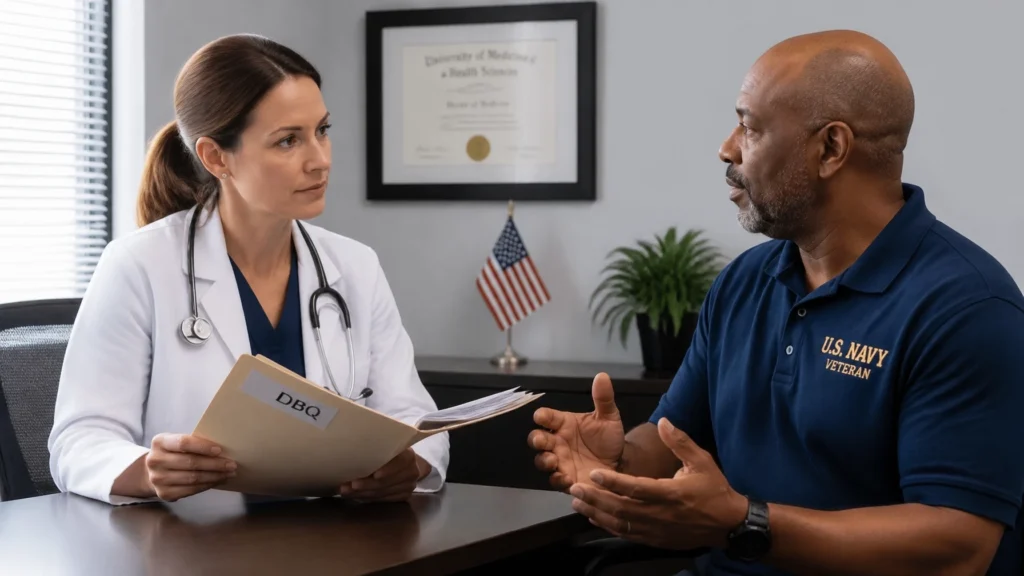
What if the reason your claim keeps getting denied isn't that you aren't "hurt enough," but that you're speaking the wrong language to the VA?
Listen, I get it. You spent years in the service, pushing through the pain, and now that you’re out, the VA wants you to jump through a thousand bureaucratic hoops just to acknowledge the toll the job took on your body and mind. It’s frustrating, it’s slow, and it feels like the system is designed to make you give up. But here is the hard truth: the VA rater doesn't care about your "pain" in the way you think they do. They care about objective evidence and functional impairment.
In this guide, we are moving past the "I hurt" phase and into the strategic blueprint phase. We’re going to break down the "Big Three" high-value ratings, Mental Health, Sleep Apnea, and Tinnitus, and show you exactly how to secure the rating you deserve in 2026. This isn't just about filling out forms; it’s about a tactical approach to your medical evidence.
Key Takeaways
- Precision is Power: Use the "Language of the Rater" by focusing on 38 CFR § 4.130 (Mental Health) and 38 CFR § 4.97 (Sleep Apnea).
- The CPAP Standard: As of June 2026, the 50% rating for sleep apnea requiring a CPAP is still the active regulation, but the window is closing.
- Occupational and Social Impairment: This is the "North Star" for all mental health ratings, focus your evidence here.
- Nexus is King: You need a clear bridge between your service and your current diagnosis, especially for secondary conditions.
Table of Contents
- The Mental Health "Ladder": Navigating 38 CFR § 4.130
- Sleep Apnea: The 50% Threshold and the 2026 Landscape
- Tinnitus: The Gateway to Secondary Claims
- The C&P Exam Mission: Tactical Preparation
- Overcoming Denials: The VA Claim Appeal Strategy
- Checklist for Your Next Submission
- Frequently Asked Questions (FAQ)
1. The Mental Health "Ladder": Navigating 38 CFR § 4.130
Mental health claims (PTSD, Depression, Anxiety) are among the most misunderstood areas of VA disability ratings. Many veterans think the diagnosis is the finish line. It’s not. The VA uses the General Rating Formula for Mental Disorders under 38 CFR § 4.130 to rate nearly all mental health conditions.
The rater isn't looking at what you have; they are looking at how it breaks your life.

Understanding the Ratings
- 100%: Total occupational and social impairment. Think: inability to function in almost any environment, persistent danger to self or others, or gross thought disorders.
- 70%: This is a common "high-value" target for veterans with severe symptoms. Key indicators include suicidal ideation, obsessive rituals, near-continuous panic or depression, and an inability to maintain effective relationships.
- 50%: Characterized by "reduced reliability and productivity." If you are missing work frequently or have "flattened affect," you are likely in this bracket.
- 30%: Occasional decrease in work efficiency. You’re getting by, but the depression or anxiety is definitely throwing a wrench in the gears.
Veteran Tip: Do not minimize your "bad days." If the examiner asks how you are doing, do not say "fine." Describe your worst day. If you struggle with occupational and social impairment, you must provide specific examples: "I had to leave my last job because I couldn't handle the crowds," or "I haven't spoken to my siblings in two years because of my irritability."
For more on how these conditions overlap, see our guide on VA claims for depression secondary to tinnitus.
2. Sleep Apnea: The 50% Threshold and the 2026 Landscape
Sleep apnea is currently one of the most high-value claims because of the 50% "floor" for anyone required to use a breathing assistance device (CPAP, BiPAP, or MAD).
Under 38 CFR § 4.97, Diagnostic Code 6847, the current breakdown is:
- 0%: Asymptomatic (diagnosed but no symptoms).
- 30%: Persistent daytime hypersomnolence (you’re tired all the time).
- 50%: Requires use of a CPAP or similar device.
- 100%: Chronic respiratory failure or cor pulmonale.

The 2026 Urgency
There has been talk for years about changing these criteria to focus on "treatment success" rather than "device usage." If the VA finalizes these changes, getting a 50% rating will become significantly harder. However, as of June 2026, the old rules still apply to new claims, and existing ratings are typically grandfathered.
The Strategy: If you have obstructive sleep apnea (OSA) and use a CPAP, ensure your medical records show compliance and medical necessity. If you are claiming it secondary to a service-connected condition (like PTSD or weight gain caused by a knee injury), you need a rock-solid Nexus Letter from a licensed physician to bridge the gap.
3. Tinnitus: The Gateway to Secondary Claims
Tinnitus is often called the "easiest" claim because it is subjective, there is no objective test to "prove" you don't hear ringing. Under Diagnostic Code 6260, it is a flat 10% rating.
While 10% doesn't seem like much, it is a powerful tactical asset. Tinnitus is a common "gateway" for secondary conditions. Many veterans suffer from insomnia, anxiety, or depression as a direct result of the constant ringing. By securing that 10% for tinnitus, you open the door to much higher-value secondary claims.
4. The C&P Exam Mission: Tactical Preparation
The Compensation & Pension (C&P) exam is the most critical hour of your claim process. Treat it like a mission. You wouldn't go into a debrief without your notes; don't go into a C&P exam without a plan.

C&P Exam Tips
- Verify the DBQ: Ensure you have reviewed the Disability Benefits Questionnaire (DBQ) for your specific condition. You should know exactly what the doctor is looking for. (Check out our DBQ guide for TBI for an example of high-level documentation).
- Focus on Functional Impact: Do not just list symptoms. Explain how the symptoms prevent you from living a normal life. If you have "calcaneal eversion" (flat feet), don't just say your feet hurt, say you can't stand for more than 15 minutes, which prevents you from working a retail job.
- Bring a "Battle Buddy" (Notes): It is easy to freeze up. Bring a written list of your symptoms, frequency, and severity. If the examiner tries to rush you, politely say, "I have a few more specific symptoms I need to ensure are on the record."
- Consistency is Key: Your statements at the exam must match your medical records. If there is a discrepancy, the rater will use it as a reason to deny.
5. Overcoming Denials: The VA Claim Appeal Strategy
If you receive a denial, do not panic. It is not the end of the road; it’s just a change in terrain. A VA claim appeal is a standard part of the process for many high-value ratings.
The Three Appeal Lanes
- Higher-Level Review (HLR): A senior rater looks at the same evidence. Use this if you believe the previous rater made an error based on the existing record.
- Supplemental Claim: This is for when you have new and relevant evidence. This is often the best path if you were denied for a lack of a "nexus" or a "diagnosis." This is where a fresh DBQ from an independent physician can change the outcome.
- Board Appeal: Taking it to a Veterans Law Judge. This is a longer process but necessary for complex legal arguments.
For those dealing with physical limitations that impact their ability to work, understanding the documentation for things like knee pain can often provide the additional evidence needed for a successful appeal.
6. Checklist for Your Next Submission
Before you hit "submit" on your claim or appeal, verify these data points:
- Diagnosis: Do you have a formal medical diagnosis for the condition?
- In-Service Event: Is there a clear event, injury, or onset in your service records?
- Nexus: Do you have a medical opinion (Nexus Letter) linking the two?
- Current Symptoms: Does your DBQ accurately reflect your current severity?
- Functional Impact: Have you clearly stated how this affects your work and social life?
- Secondary Conditions: Have you identified all conditions that are "caused by" or "aggravated by" your primary service-connected issues?
Frequently Asked Questions (FAQ)
Q: Can I get 100% for PTSD alone?
A: Yes, under 38 CFR § 4.130, a 100% rating is possible for "total occupational and social impairment." However, it is a high bar and usually requires evidence of severe symptoms like persistent hallucinations or a constant danger of hurting yourself.
Q: Does using a CPAP automatically guarantee 50% for Sleep Apnea?
A: Under current 2026 regulations, if a CPAP is medically required for your service-connected sleep apnea, it should result in a 50% rating. However, the diagnosis itself must be service-connected first (either primary or secondary).
Q: What if my C&P examiner was rude or rushed?
A: You can challenge a bad exam. Write a "Memorandum for Record" immediately after the exam detailing what happened and submit it to the VA. You can also request a new exam through a VA claim appeal or by calling the VA directly.
Q: Is Tinnitus going away as a rating?
A: There have been proposals to eliminate tinnitus as a stand-alone 10% rating. As of mid-2026, these changes have not been finalized. It is highly recommended to file your claim now to potentially be grandfathered in.
Q: Why was my secondary claim denied even though I have the condition?
A: Most secondary claims are denied because of a weak "nexus." You must prove that Condition B is at least as likely as not caused by Condition A. This usually requires a high-level medical rationale provided by an experienced physician.

At GVC4Vets, we specialize in helping you bridge the gap between your physical reality and the VA’s technical requirements. With a network of over 800 independent physicians, we ensure your medical documentation is accurate, compliant, and reflective of the sacrifices you made. Don't leave your rating to chance.
Ready to secure the rating you’ve earned? Contact us today to start your strategy session.

