
What if the reason your claim keeps getting denied isn’t that you aren't "injured enough," but simply that your doctor and the VA rater are speaking two different languages?
For many veterans, the transition from active duty to civilian life is met with a new kind of combat: the administrative battle for VA benefits. You know your body is broken. You feel the back pain every time you stand up, and you remember the exact moment in jump school when your knees gave out. But when you receive that decision letter from the VA, it says "10%" or, worse, "Service Connection Denied."
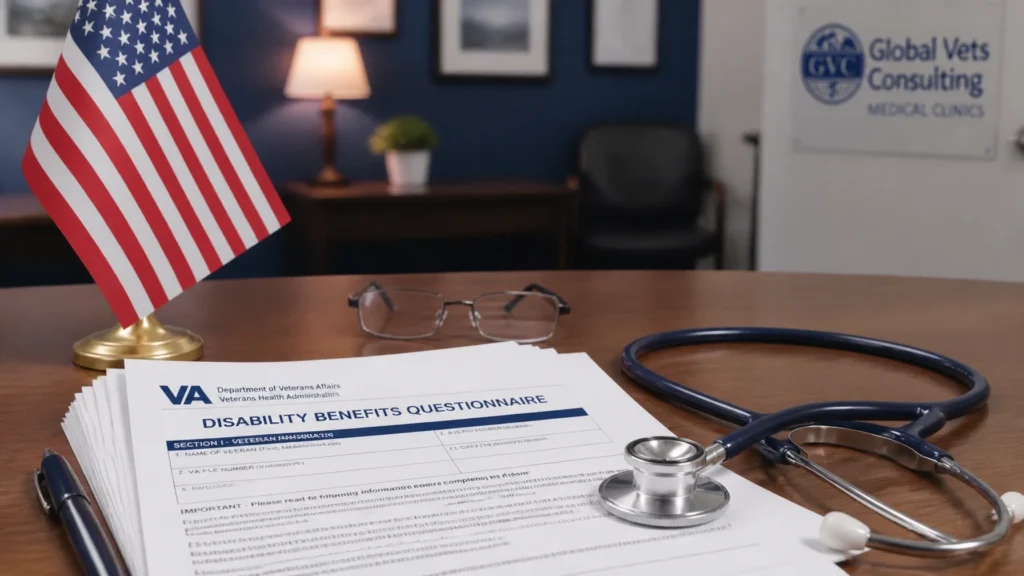
The difference between a low rating and the compensation you actually deserve often boils down to a single document: the Disability Benefits Questionnaire (DBQ). Think of the DBQ not just as a form, but as the tactical blueprint for your entire claim. At Global Vets Consulting, we’ve seen over 100,000 veterans struggle with this process. This guide is your roadmap to mastering the VA medical evidence required to win.
Table of Contents
- The Anatomy of a DBQ: The Language of the Rater
- Subjective Pain vs. Objective Evidence: Bridging the Gap
- Common Red Flags in Medical Documentation
- The Strategy: Private Doctors vs. C&P Examiners
- Condition Focus: DBQ for Flat Feet and Back Pain
- Mission Readiness Checklist
- Frequently Asked Questions
Key Takeaways
- The DBQ is the Primary Evidence Tool: It is specifically designed to mirror the VA disability ratings criteria found in 38 CFR Part 4.
- Objectivity is King: The VA prioritizes measurable data (Range of Motion, X-rays, PFTs) over subjective reports of pain.
- Consistency is Non-Negotiable: Any discrepancy between your DBQ, your C&P exam, and your service records is a red flag that can lead to denial.
- Independent Evaluations Matter: Utilizing independent medical evaluations from physicians who understand VA law provides a significant tactical advantage.
1. The Anatomy of a DBQ: The Language of the Rater
A Disability Benefits Questionnaire is a standardized form used by the VA to streamline the collection of medical evidence. However, its true purpose is more technical: it translates your physical or mental condition into the specific legal language required by 38 CFR Part 4 (the VA Schedule for Rating Disabilities).
When a rater looks at your file, they aren't looking for a story; they are looking for diagnostic codes. For example, if you are filing a claim for a respiratory condition, the rater is looking for diagnostic code 6522. The DBQ for this condition will ask for specific metrics like Pulmonary Function Tests (PFTs) or METs.
Verify that your doctor is filling out the correct version of the form. Confirm that every box is checked. A single missing signature or an "N/A" where a "Yes/No" was required can stall a claim for months.

2. Subjective Pain vs. Objective Evidence: Bridging the Gap
One of the most common points of "confusion" for veterans is why their "extreme pain" doesn't result in a higher rating. The hard truth is that the VA views pain as subjective. To secure a high VA disability rating, you must provide objective VA medical evidence.
Consider the difference:
- Subjective: "My back hurts so much I can't walk some days."
- Objective: "The veteran exhibits a range of motion (ROM) limited to 30 degrees of forward flexion, with evidence of functional loss due to pain during repeated use, as documented via goniometer."
To "bridge the gap," you must provide your doctor with specific data points. If you have back pain, don't just say it hurts; describe the flare-ups and how they limit your ability to perform daily tasks. Ensure your physician documents these limitations using the technical language of the Disability Benefits Questionnaire.
3. Common Red Flags in Medical Documentation
The VA is trained to look for reasons to doubt the validity of a claim. Avoiding these "red flags" is essential for mission success.
- Inconsistent Statements: If you tell your private doctor your pain is a "10" but tell the C&P examiner it's a "4," the rater will flag this as a credibility issue.
- Lazy Nexus Letters: A nexus letter must do more than state a condition is "service-connected." It must provide a detailed medical rationale, citing peer-reviewed literature or specific service treatment records.
- Missing ICD Codes: Ensure every diagnosis on your DBQ includes a formal ICD code. Without a clear diagnosis, the VA cannot assign a rating.
- The "Social Media Trap": Be aware that "rushed C&P exams" sometimes involve the examiner looking for contradictions between your claimed limitations and your lifestyle.

4. The Strategy: Private Doctors vs. C&P Exams
You have the right to submit a DBQ completed by a private, licensed physician. This is often the most strategic move a veteran can make.
Why? Because a typical C&P (Compensation and Pension) exam is often rushed. The examiner may only spend 15 minutes with you, leading to an incomplete picture of your disability. In contrast, an independent medical evaluation allows for a thorough review of your entire medical history.
Identify a physician who is willing to spend the time necessary to document your functional loss and range of motion accurately. This partnership is what helps veterans secure the ratings they have earned.
5. Condition Focus: DBQ for Flat Feet and Back Pain
Let's look at two of the most common claims: dbq for flat feet and back pain.
Pes Planus (Flat Feet) vs. Plantar Fasciitis
Many veterans confuse these two, but the rating criteria are different. For a dbq for flat feet (Pes Planus), the rater looks for evidence of calcaneal eversion and whether the condition is "pronounced," "severe," or "moderate." If you are claiming flat feet, ensure your doctor notes whether you require orthotics or if there is visible deformity.
Lumbar Spine (Back Pain)
For back pain, the rating is almost entirely dependent on range of motion. If your doctor does not use a goniometer to measure exactly where your motion stops due to pain, the DBQ is essentially useless. Identify if you have "radiculopathy" (nerve pain) shooting down your legs, as this can often be rated as a secondary condition, increasing your overall percentage.

Mission Readiness Checklist
Before you hit "submit" on your claim, go through this checklist to ensure your Disability Benefits Questionnaire is bulletproof:
- Diagnosis Confirmed: Does the DBQ list a clear diagnosis with an ICD code?
- Records Reviewed: Did the doctor check the box stating they reviewed your Service Treatment Records (STRs)?
- Objective Testing: Are X-rays, MRIs, or PFT results attached or cited?
- Functional Impact: Does the form describe how the injury affects your ability to work?
- No Blanks: Is every required section of the DBQ completed?
- Consistent Story: Does the DBQ align with your personal statement and past medical records?
Frequently Asked Questions
Q: Can the VA ignore a DBQ from my private doctor?
A: No. By law, the VA must consider all "competent medical evidence." However, they can weigh a C&P exam more heavily if your private DBQ is incomplete or lacks a strong medical rationale.
Q: What is "38 CFR Part 4"?
A: This is the federal regulation that governs how the VA rates disabilities. Every question on a Disability Benefits Questionnaire is designed to provide the information required by this regulation.
Q: Do I need a new DBQ for an increase?
A: Yes. If your condition has worsened, a new DBQ is the best way to document the current severity and justify a higher VA disability rating.
Q: What if the C&P examiner contradicts my private DBQ?
A: This is common. In these cases, the strength of your medical evidence: specifically the "remarks" and objective data in your DBQ: will be the deciding factor during an appeal or a Higher-Level Review.
At Global Vets Consulting, we believe that no veteran should be left behind due to paperwork. Your service was a mission; getting your benefits should be treated with the same level of tactical precision. If you're ready to secure the evidence you need, contact our network of experts today.