
What if the reason your claim keeps getting denied isn't that you lack the diagnosis, but that you’ve failed to build the bridge between your service-connected injury and the "new" pain you feel every morning?
As veterans, we are trained to "drive on" and ignore the small aches. But in the world of the VA, those small aches are often the "domino effect" of your primary service-connected disabilities. If you have a rated knee injury and now your lower back is screaming, that isn’t just "getting older", it’s a potential VA secondary claim.
In this guide, we’re going to stop treating the claims process like a guessing game and start treating it like a strategic mission. We will break down the regulatory framework of 38 CFR § 3.310, the clinical necessity of a VA nexus letter, and how you can secure a VA disability increase by proving that your new conditions are "proximately due to" your existing ones.
Table of Contents
- The Strategy: Understanding the Domino Effect
- The Legal Framework: 38 CFR § 3.310
- Causation vs. Aggravation: Two Paths to Victory
- The Bridge: The Role of the VA Nexus Letter
- Common Secondary Conditions and Pairings
- Checklist: Evidence Required for Your Secondary Claim
- FAQ: Navigating the Complexities
Key Takeaways
- Secondary Service Connection allows you to link a new condition to one that is already service-connected.
- 38 CFR § 3.310 is the governing regulation that mandates service connection for disabilities resulting from service-connected conditions.
- A VA nexus letter is the tactical "smoking gun" that provides the medical rationale necessary to override a skeptical C&P examiner.
- Precision in medical terminology, using phrases like "at least as likely as not", is mandatory for success.
1. The Strategy: Understanding the Domino Effect
The VA disability system often feels like a fragmented puzzle. You have a rating for Tinnitus here, a rating for a Lumbar Strain there. But the human body doesn’t work in silos. Chronic pain in your right ankle causes an altered gait, which leads to calcaneal eversion and eventual hip misalignment. This is the "Domino Effect."
To win a VA secondary claim, you must stop viewing your health as a list of independent symptoms. You need a blueprint that maps out how "Condition A" (Primary) physically or psychologically triggered "Condition B" (Secondary). Without this roadmap, the VA rater will likely dismiss your secondary condition as a "natural progression of age" or an "unrelated lifestyle issue."
2. The Legal Framework: 38 CFR § 3.310
Success in the VA world requires speaking the "language of the rater." That language is written in the Code of Federal Regulations.
38 CFR § 3.310(a) states: "Disability which is proximately due to or the result of a service-connected disease or injury shall be service connected."
This is your legal authority. When you file for a VA disability increase via a secondary route, you aren't asking for a favor; you are citing a federal mandate. If your service-connected PTSD has led to a diagnosis of GERD (Gastroesophageal Reflux Disease) due to medication side effects or chronic stress, the law requires the VA to recognize that link, provided you can prove the etiological link.

3. Causation vs. Aggravation: Two Paths to Victory
Many veterans miss out on benefits because they don't understand that there are two distinct ways to link conditions under 38 CFR § 3.310.
Path A: Direct Causation
This is when Condition A caused Condition B.
- Example: Your service-connected Diabetes Mellitus Type 2 causes Diabetic Retinopathy or Peripheral Neuropathy.
- Tactical Requirement: You must show that the secondary condition would not exist "but for" the primary condition.
Path B: Secondary Aggravation
This is for conditions you may have had before, or that developed independently, but are being made worse by your service-connected disability.
- Example: you have a non-service-connected back issue, but your service-connected knee stability issues cause frequent falls that permanently worsen your back.
- Tactical Requirement: You must establish a baseline level of severity for the pre-existing condition and prove that the service-connected condition caused an "increase in disability" beyond the natural progress of the disease.
| Feature | Direct Causation | Secondary Aggravation |
|---|---|---|
| Origin | Caused entirely by Primary | Existed or developed independently |
| VA Requirement | Proof of "Proximate Cause" | Proof of "Permanent Worsening" |
| Evidence Key | Clinical link | Baseline vs. Current severity |
4. The Bridge: The Role of the VA Nexus Letter
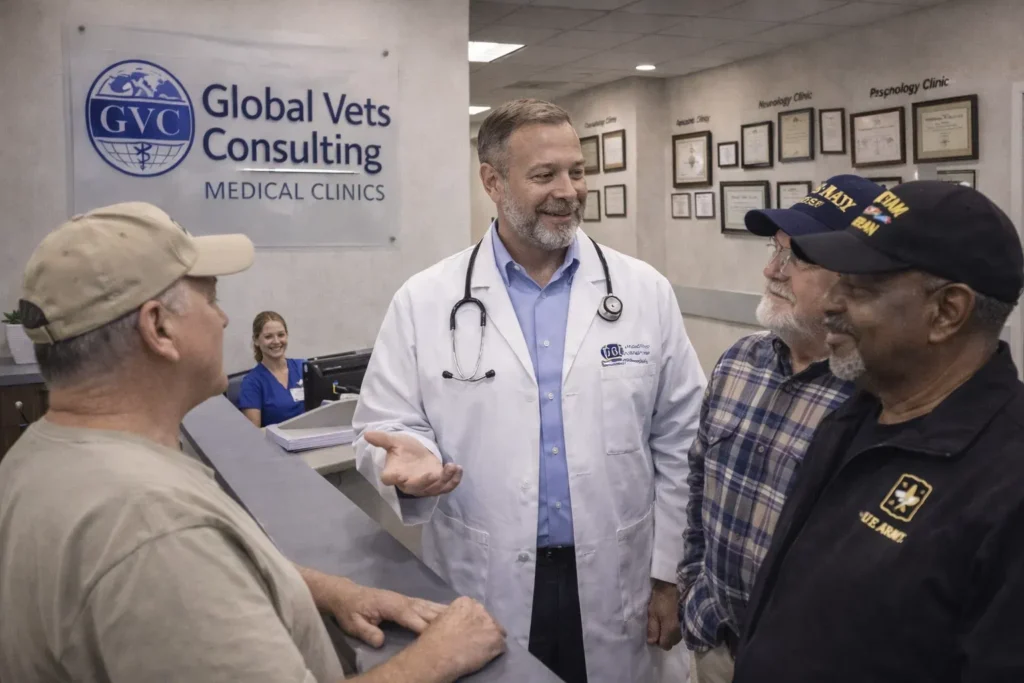
If the diagnosis is the "what," the VA nexus letter is the "why." A nexus letter is a formal medical opinion from a licensed physician, like those in the Global Vets Consulting network, that bridges the gap between your conditions.
The VA rater is not a doctor. They rely on the DBQ (Disability Benefits Questionnaire) and the medical nexus statement. To be effective, your nexus letter must include:
- A Review of Evidence: The doctor must state they have reviewed your entire C-File and medical history.
- Professional Rationale: "The veteran's radiculopathy is secondary to their degenerative disc disease because…" followed by peer-reviewed medical literature.
- The Magic Words: The clinician must use the legal standard of proof: "It is at least as likely as not (50% probability or greater)" that the conditions are linked.
Verify that your doctor uses specific Diagnostic Codes (e.g., Code 6522 for Allergic Rhinitis) to ensure the rater knows exactly where to look in the schedule of ratings.
5. Common Secondary Conditions and Pairings
Identifying a secondary link requires a strategic look at common physiological and psychological "chains." Here are some of the most successful pairings we see at GVC4Vets:
- Tinnitus → Anxiety/Depression: Constant ringing in the ears often leads to sleep deprivation and significant mental health strain. Read our guide on Depression secondary to Tinnitus.
- Knee/Ankle Issues → Lumbar Spine: Altered gait mechanics are a leading cause of secondary back ratings.
- PTSD/Mental Health → Sleep Apnea: While controversial, many veterans find success linking Sleep Apnea to PTSD via weight gain (obesity as an intermediate step) or medication side effects.
- Degenerative Disc Disease → Sciatica: If your back pain radiates down your legs, you likely have a secondary nerve condition. Check out our comprehensive guide on Sciatica DBQs.

6. Checklist: Evidence Required for Your Secondary Claim
Before you hit "submit" on your VA secondary claims, ensure you have completed this tactical checklist:
- Confirm Diagnosis: Do you have a current, formal diagnosis for the secondary condition (e.g., a formal diagnosis of Pes Planus)?
- Identify Primary Link: Is the "parent" condition already service-connected at 0% or higher?
- Secure a Nexus Letter: Does your medical opinion use the phrase "at least as likely as not"?
- Complete the Correct DBQ: Have you provided a VA-compliant DBQ that captures the objective limitations of the secondary condition?
- Draft a Personal Statement: Have you written a "Statement in Support of Claim" detailing the daily struggle and the timeline of how the secondary condition started?
7. FAQ: Navigating the Complexities
Q: Can I file a secondary claim if my primary condition is rated at 0%?
A: Yes. Even a 0% non-compensable rating establishes service connection. As long as the "parent" condition is service-connected, it can serve as the foundation for a secondary claim.
Q: What is the difference between a VA disability increase and a secondary claim?
A: An increase is for a condition that is already service-connected but has gotten worse. A secondary claim is for a new diagnosis that was caused by an existing service-connected one.
Q: The C&P examiner said my condition is just "age-related." What do I do?
A: This is where a private VA nexus letter is vital. You must rebut the "subjective" opinion of a rushed examiner with "objective" medical evidence and peer-reviewed studies that prove a causal link exists.
Q: How much does a secondary claim add to my rating?
A: The VA uses "VA Math" (combined rating table). Each secondary condition is rated based on its own Diagnostic Code. You can use our VA Disability Calculator to see how a new 10%, 30%, or 50% rating would affect your total monthly compensation.
Bridge the Gap with GVC4Vets
The VA disability system is built on evidence, not just empathy. If you are struggling with new conditions that you know are linked to your time in service, don't leave your future to chance. At Global Vets Consulting, we specialize in connecting you with independent physicians who understand the "language of the rater" and can provide the rigorous documentation needed to win.
Stop guessing and start strategizing.
Contact us today for a free consultation and let’s build the bridge to the rating you deserve.


