
Your VA disability rating isn’t a gift from the government; it’s a benefit you earned through service that must be defended with precise medical evidence. You probably feel like the system is designed to keep you in the dark with confusing jargon and inconsistent C&P exams. It’s frustrating to know you’re struggling while the VA tells you your condition is only worth 10% or, worse, denies it entirely. Understanding va disability benefits shouldn’t feel like a second full-time job, but in 2026, the stakes for your medical documentation are higher than ever. 🇺🇸
We’ve created this peer-to-peer guide to cut through the noise and give you a clear path forward. We agree that you deserve transparency and respect throughout this administrative process. You’ll learn exactly how the 2.8% COLA increase affects your monthly check and how to use Disability Benefits Questionnaires (DBQs) to build a bulletproof claim. We will explore the updated 2026 rating schedule, explain how to handle the increased scrutiny on private medical evidence, and provide a step-by-step strategy to help you secure the tax-free compensation you’ve rightfully earned.
Key Takeaways
- Recognize that VA disability compensation is an earned, tax-free benefit covering a wide range of service-connected physical and mental health conditions.
- Gain clarity on the 0% to 100% rating scale and how “VA Math” determines your final monthly compensation level.
- Learn how understanding va disability benefits allows you to use Disability Benefits Questionnaires (DBQs) to provide the exact medical evidence the VA requires.
- Establish a step-by-step plan to organize your medical documentation and identify the specific conditions that support your pursuit of a higher rating.
Defining VA Disability Benefits: What You Have Earned 🇺🇸
VA disability compensation is a monthly, tax-free benefit paid to veterans who have injuries or diseases that happened while on active duty, or were made worse by active military service. It’s not a handout or a social program; it’s a recognition of the physical and mental toll your service took on your body and mind. You earned this. A comprehensive VA disability benefits overview confirms that these payments are designed to compensate for the average loss in earning capacity caused by your service-connected conditions.
Covering a wide range of health issues, these benefits address everything from musculoskeletal injuries like chronic back pain to complex mental health conditions such as PTSD, depression, or anxiety. Service-connection is the essential link between your military duty and your current health status. The link is vital. Without this bridge, the VA cannot grant compensation, even if your condition is severe. You must demonstrate that your time in uniform is the reason you’re struggling today.
The VA doesn’t grant a rating simply because you have a medical label for your pain. Eligibility is based on the severity of your condition and how it impacts your daily life, not just the diagnosis itself. Functional loss is key. Understanding va disability benefits means recognizing that the system prioritizes how you function in the real world. If your symptoms prevent you from working or performing daily tasks, your rating should reflect that reality. Don’t assume a diagnosis is enough to win your claim.
The Three Pillars of a Successful VA Claim
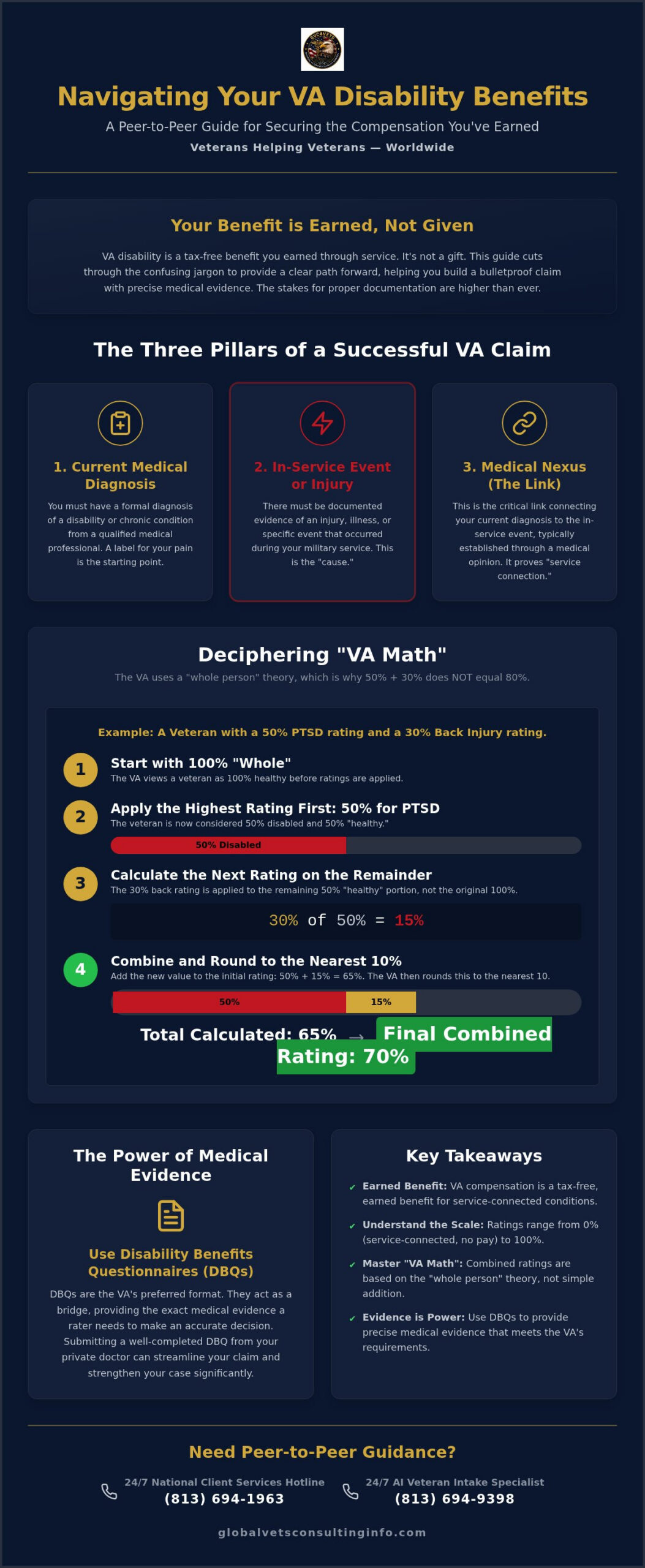
Establishing a solid foundation for your claim requires three specific elements to be documented clearly in your file. Understanding va disability benefits involves mastering these pillars to ensure your evidence is impossible for the VA to ignore:
- A current medical diagnosis: You must have a formal diagnosis of a disability or chronic condition from a qualified medical professional.
- An in-service event: You need evidence of an injury, illness, or specific event that occurred during your military service.
- A medical nexus: This is the critical link, usually provided through medical evidence, that connects your current diagnosis to the in-service event.
Deciphering the VA Rating System and “VA Math”
The VA assigns disability ratings in 10% increments, ranging from 10% to 100%. Each level corresponds to a specific dollar amount in tax-free monthly compensation. While a 0% rating doesn’t result in a monthly payment, it’s still a critical victory for your records. This “non-compensable” service connection acknowledges that your condition is related to your service, granting you access to VA healthcare and travel pay for that specific issue. It also makes it much easier to file for a VA rating increase if your symptoms worsen over time. 🇺🇸
Mastering the VA disability claims process step by step is the first real step to understanding your rating. The VA doesn’t use simple addition when you have multiple conditions. Instead, they use a “whole person” concept. If you have a 50% disability rating, the VA views you as 50% “whole.” Any additional disability is then calculated as a percentage of that remaining 50% of your health. This is why 50% plus 50% does not equal 100% in the eyes of the VA.
How the VA Assigns Your Disability Percentage
To determine your specific percentage, the VA follows the Schedule for Rating Disabilities found in 38 CFR Part 4. This guide outlines the symptoms, frequency, and severity required for each rating level. The focus is on how your condition impacts your “social and industrial” life. Consulting the Official VA Eligibility Criteria helps you understand which medical evidence is necessary for your specific diagnosis. 🌐
Let’s look at a 2026 example of “VA Math” in action. Suppose you have a 50% rating for PTSD and a new 30% rating for a back injury. The VA doesn’t add these to make 80%. They take 30% of your remaining 50% “healthy” self, which equals 15%. Adding 50% and 15% gives you 65%, which the VA then rounds to the nearest 10%. In this case, you’d receive a 70% combined rating. Understanding va disability benefits requires this level of precision to manage your expectations and plan your claim strategy effectively.
The Power of Medical Evidence: Using DBQs for Accuracy
Medical evidence acts as the bridge between your military service and your monthly compensation check. While many veterans believe a simple diagnosis is enough, the VA requires specific, standardized documentation to assign a rating. This is where Disability Benefits Questionnaires (DBQs) become essential. These forms are designed to capture the precise clinical data necessary to meet VA disability eligibility requirements. Without them, you’re essentially asking a Rater to guess the severity of your symptoms. 🇺🇸
A private DBQ for VA claims offers a significant advantage over relying solely on a standard C&P exam. C&P examiners often have limited time to review your full history; however, your own doctor understands the daily reality of your condition. This depth is particularly vital when dealing with DBQs for mental health conditions. Since symptoms like anxiety or social withdrawal are subjective, having a detailed clinical narrative ensures your impairment is fully documented. Understanding va disability benefits means knowing that the quality of your evidence dictates the speed and success of your outcome.
Why DBQs Are the “Gold Standard” of Evidence
DBQs use the exact terminology found in the VA’s rating schedule. This alignment reduces the risk of a Rater misinterpreting your doctor’s notes. When your medical provider uses these forms, they’re speaking the VA’s language, which simplifies the decision-making process for the VBA. A meticulously prepared form can help you avoid a common VA claim denial for lack of evidence. It’s about providing a clear, undeniable link between your symptoms and the rating criteria. 🌐
If you need help documenting your conditions properly to secure your earned rating, get started with professional DBQ education today.
Taking Action: Your Roadmap to a Successful VA Claim 🌐
You’ve put in the effort to learn the system; now you must translate that knowledge into a winning strategy. The first step in understanding va disability benefits is recognizing that your claim is only as strong as your documentation. Start by organizing your medical records and identifying every condition you believe is service-connected. Don’t guess. Look for specific dates, diagnoses, and treatment records that build a clear timeline of your health history. Once your list is complete, obtain professional DBQs to document the current severity of each condition. This ensures you’re presenting a complete picture to the Rater from the very beginning.
When your evidence is ready, submit your VA disability claim through the VA.gov portal. We recommend using the “Fully Developed Claim” (FDC) process for faster processing. By certifying that you’ve submitted all available evidence with your initial application, you tell the VA you’re ready for a decision. After your submission, stay vigilant. Monitor your claim status regularly and prepare for potential Compensation and Pension (C&P) exams. These exams are your opportunity to explain your “worst days” to the examiner, so keep your medical evidence fresh in your mind.
Maximizing Your Rating in 2026
Many veterans miss out on higher ratings because they overlook secondary conditions. A secondary claim allows you to link a new condition to one that’s already service-connected. For instance, a veteran might develop sleep apnea secondary to weight gain caused by a service-connected back injury. Identifying these connections is a powerful way to secure a VA rating increase. Always ensure your medical evidence clearly shows how your disability affects your ability to work and function in social settings. This functional loss is the primary factor the VA considers when assigning your final percentage. 🇺🇸
📞 Contact Global Vets Consulting at GlobalVetsConsultingInfo.com for expert DBQ preparation and education to support your claim. We’re here to help you navigate the complexities of the system and secure the benefits you’ve earned through your service. 🌎
Secure Your Earned Compensation in 2026
You’ve served your country with honor; now it’s time to ensure the system recognizes the toll that service took on your health. Success in the VA claims process depends on moving beyond confusion and taking total control of your medical narrative. By mastering the complexities of “VA Math” and utilizing standardized DBQs, you transform your claim from a simple request into a bulletproof case supported by high-quality evidence. Understanding va disability benefits is the essential foundation for securing the monthly, tax-free compensation you rightfully deserve for your physical and mental well-being.
Global Vets Consulting has been veteran-owned and operated since 2021, specializing in standardized DBQ preparation to ensure your medical evidence meets the VA’s rigorous 2026 standards for accurate evaluations. Our 24/7 AI Veteran Intake Specialist is available right now to help you begin your journey toward a higher rating with steady confidence. We prioritize your peace of mind by offering a clear, predictable path through complex administrative hurdles.
Get the DBQ documentation you need to support your VA claim today at Global Vets Consulting
You don’t have to face the administrative bureaucracy alone. Take the next step with the peace of mind that comes from having a knowledgeable advocate by your side. Secure the future you’ve earned today.
Frequently Asked Questions
How much does VA disability pay in 2026?
VA disability compensation rates increased by 2.8% for 2026 following the annual cost-of-living adjustment. For a veteran alone, a 10% rating pays $180.42 monthly, while a 100% rating provides $3,831.30. These tax-free payments were effective as of December 1, 2025. You don’t need to take any action to receive this increase, as the VA applies it automatically to your monthly benefits. 🇺🇸
What is the difference between a DBQ and a Nexus Letter?
A Disability Benefits Questionnaire (DBQ) focuses on the current severity of your symptoms to determine your rating percentage. In contrast, a Nexus Letter is a medical opinion that establishes the clinical link between your current condition and your military service. While a DBQ tells the VA how much you should be paid, the Nexus Letter proves why the VA is responsible for the condition in the first place.
Can I get VA disability for a pre-existing condition?
Yes, you can receive benefits if your military service aggravated a condition that existed before you enlisted. You must provide medical evidence showing your service made the condition worse than it would have been through natural progression. Understanding va disability benefits for aggravation requires clear documentation of your health status both before entry and after the service-connected event occurred to prove the increased severity.
How long does the VA disability claims process take in 2026?
The average time to complete a VA disability claim is approximately 80 days as of May 2026. The VA has reached record processing speeds this year, handling over two million claims by June 1, 2026. While the backlog has fallen below 75,000 pending cases, your specific timeline will depend on how quickly you provide thorough medical evidence and attend your scheduled C&P exams. 🌐
What happens if my VA disability claim is denied?
You have the right to appeal a denial through a Higher-Level Review, a Supplemental Claim, or a Board Appeal. If you have new medical evidence to provide, a Supplemental Claim is often the most effective path to address the VA’s specific concerns. Understanding va disability benefits means knowing that a denial isn’t the end of the road; it’s a signal to strengthen your evidence and resubmit for a more accurate evaluation.

Article by
Willie Daniel
Willie Daniel is the Founder and Chief Executive Officer (CEO) of Global Vets Consulting (GVC4Vets) – National Veterans Disability Services, a veteran-led educational and medical evidence support organization dedicated to helping veterans better understand VA disability rating increases, DBQ medical evidence, secondary claims education, and C&P examination preparation.
He is a retired U.S. Army Medical Service Corps Officer with more than 27 years of honorable military service, a decorated Iraq combat veteran, and a retired federal official with the U.S. Department of Veterans Affairs. Throughout his military and federal career, Willie Daniel served in leadership, healthcare administration, operational, and veteran-support roles focused on improving services and support systems for servicemembers, veterans, and their families.
Drawing from decades of military leadership, healthcare administration, veteran advocacy, and federal government experience, Willie Daniel brings a practical, veteran-centered perspective to Global Vets Consulting’s educational articles, AI-powered veteran resources, video education initiatives, and outreach programs. His experience navigating military systems, medical documentation processes, and veteran-related administrative operations provides valuable insight into many of the challenges veterans face when seeking to better understand VA disability rating criteria, medical evidence, documentation strategies, and secondary condition education.
Through GVC’s “Veterans Helping Veterans” mission, his focus is on delivering clear, educational, and easy-to-understand information designed to empower veterans with knowledge, resources, and educational tools that may help them make more informed decisions regarding their individual VA disability journeys.
The information provided through GVC is intended for educational and informational purposes only and should not be considered legal or medical advice.
Disclaimer
Disclaimer: Global Vets Consulting, LLC (“GVC”) is a veteran-led educational and medical evidence support organization. GVC is not a law firm, is not a Veterans Service Organization (VSO), and is not affiliated with the U.S. Department of Veterans Affairs (VA) or any government agency.
Global Vets Consulting does not provide legal advice, medical advice, medical treatment, or healthcare services. GVC does not prepare, file, or submit VA disability claims on behalf of veterans. All information provided through this website, blog articles, videos, educational materials, AI tools, dashboards, templates, and communications is intended solely for general educational and informational purposes.
Veterans are encouraged to consult with accredited representatives, licensed attorneys, qualified medical providers, or Veterans Service Organizations regarding their specific legal, medical, or VA-related matters. VA disability decisions, ratings, and outcomes are determined solely by the U.S. Department of Veterans Affairs based on applicable laws, regulations, medical evidence, and individual circumstances. Past results do not guarantee future outcomes.