
The long-standing “CPAP equals 50 percent” rule is officially a thing of the past. For years, veterans relied on the fact that a breathing device guaranteed a specific Sleep Apnea VA Rating, but the 2026 standards have shifted toward a battle of medical documentation. If you’re feeling anxious about how these updated symptom-based criteria affect your existing benefits or a new claim, you’re not alone. It’s frustrating to see the goalposts move when you’re just trying to access the support you earned through your service.
This guide will help you master the 2026 VA rating criteria for sleep apnea so you can secure the disability compensation you deserve. We’ll break down the current rating scale, explain how to successfully link sleep apnea to conditions like PTSD, and show you how a precise Disability Benefits Questionnaire (DBQ) makes all the difference in your claim. By focusing on meticulous medical evidence, you can move through these changes with confidence and protect your hard-earned benefits. You’ve served your country with honor, and now it’s time to ensure the system works for you.
Key Takeaways
- Understand the shift from “prescribed treatment” to “treatment efficacy” under the 2026 respiratory system rating updates.
- Learn the specific requirements for each level of the Sleep Apnea VA Rating scale, from asymptomatic 0% to the new 10% baseline.
- Discover how to successfully link sleep apnea to PTSD or other primary conditions through secondary service connection.
- Identify why a professional DBQ is essential for providing the precise medical evidence needed to substantiate your symptoms.
The 2026 Sleep Apnea VA Rating: What Has Changed? 🇺🇸
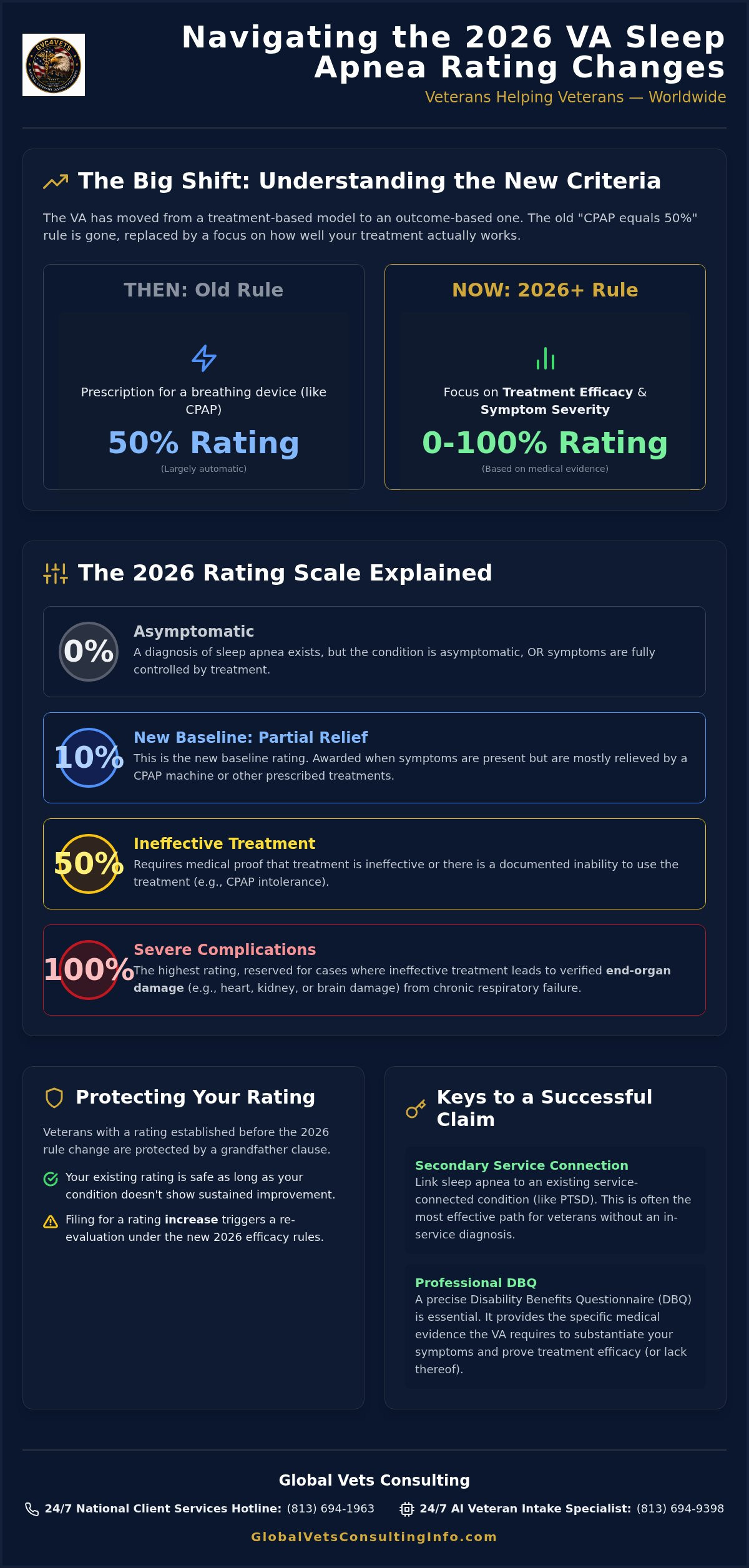
The 2026 update to 38 CFR Part 4 marks a significant shift in how the VA evaluates respiratory conditions. This change moves away from simply checking for a CPAP machine and looks at your actual medical outcomes. The VA updated these criteria to reflect modern medical results rather than just device usage. They now prioritize treatment efficacy to determine your level of disability.
- Shift in Focus: The VA no longer grants an automatic 50 percent rating for device use.
- Treatment Efficacy: Ratings are now based on how well your symptoms are managed by treatment.
- Functional Impairment: Evaluation focuses on your actual ability to function despite using a machine.
Understanding What is Sleep Apnea? is the first step in navigating these new rules. The VA recognizes three primary types of this condition that can impact your Sleep Apnea VA Rating:
- Obstructive: Physical blockages in the airway during sleep.
- Central: The brain fails to send proper signals to breathing muscles.
- Complex: A combination of both obstructive and central symptoms.
Are You Grandfathered In? Protecting Your Existing Rating
Veterans with a rating established before the 2026 rule change are protected by a grandfather clause. This protection ensures your current benefits remain intact despite the new, more restrictive criteria. However, you should be aware of how the VA handles these protections:
- Your existing rating is safe as long as your condition doesn’t improve.
- Filing for a VA rating increase triggers a re-evaluation under the 2026 efficacy rules.
- New claims filed after the effective date are subject to the updated symptom-based scale.
Grandfathering is a legal protection that allows veterans to maintain their original disability ratings even when the VA adopts a more restrictive rating schedule for new applicants.
The 2026 Rating Scale: From 0% to 100% Explained
The 2026 update establishes a clear hierarchy based on how your body responds to treatment. According to the Official VA Rating Criteria for Sleep Apnea, the 30 percent tier no longer exists. Your Sleep Apnea VA Rating is now determined by these specific thresholds:
- 0% Rating: Your condition is diagnosed but you are asymptomatic or symptoms are fully controlled.
- 10% Rating: This is the new baseline where symptoms are mostly relieved by CPAP or other prescribed treatments.
- 50% Rating: You must prove treatment is ineffective or you have a documented inability to use it.
- 100% Rating: This requires ineffective treatment that results in verified end-organ damage.
This new structure makes thorough medical evidence critical for your VA disability claim. The VA now looks for specific clinical data rather than just the presence of a machine. If you’re unsure where your symptoms fall, expert education on medical evidence can clarify your next steps. Every piece of documentation must align with these new efficacy standards.
Understanding ‘End-Organ Damage’ for a 100% Rating
The 100 percent tier is the most difficult to achieve and requires proof of severe systemic complications. The VA specifically looks for evidence that sleep apnea has caused permanent damage to vital organs through chronic respiratory failure.
- Cardiac Complications: This includes chronic heart failure or ischemic heart disease linked directly to your sleep disorder.
- Renal or Neurological Damage: Clinical evidence of damage to the kidneys or brain caused by long-term oxygen deprivation.
- Inability to Use Treatment: You must provide medical documentation of CPAP intolerance, such as severe skin reactions or anatomical obstructions.
To secure a higher Sleep Apnea VA Rating, your medical records must show that your symptoms persist despite treatment. Proving CPAP intolerance or treatment failure requires detailed DBQs that speak the VA’s language. Meticulous documentation is the only way to prove your condition meets these high-tier requirements.
Secondary Service Connection: The Key to a Successful Claim 🇺🇸
Direct service connection is a high hurdle for many veterans. Unless you had a sleep study during active duty, the VA often claims your condition isn’t related to your time in service. Secondary service connection solves this by linking your condition to an existing disability. This strategy is frequently the most effective way to secure your Sleep Apnea VA Rating.
Common secondary pathways include these conditions:
- Respiratory Issues: Sinusitis and Rhinitis under PACT Act presumptions often physically obstruct airways.
- Mental Health: PTSD symptoms or the medications used to treat them can trigger or worsen breathing disorders.
- Musculoskeletal Injuries: Chronic pain can limit mobility, leading to lifestyle changes that impact respiratory health.
Understanding What is Sleep Apnea? is vital for identifying these medical links. You can use a DBQ for mental health conditions to document how your psychiatric symptoms or treatments aggravate your sleep. If you’re ready to build your evidence, get started with our secondary claims education today to strengthen your medical documentation.
Obesity as an Intermediate Step
Obesity is not a standalone service-connected condition, but it serves as a critical medical bridge. The VA recognizes “Step-Down” logic where a primary injury leads to weight gain, which then causes a respiratory disorder. This creates a clear path for your Sleep Apnea VA Rating through secondary connection.
The Step-Down logic follows this progression:
- Primary Condition: An injury like a service-connected back condition limits your ability to exercise.
- Intermediate Step: This lack of mobility leads to obesity as a direct result of the primary injury.
- Secondary Condition: The obesity then causes or aggravates your obstructive sleep apnea.
A strong Medical Nexus Letter is essential for these complex cases. This document must state that your weight gain was “at least as likely as not” caused by your service-connected disability. Success depends on presenting a logical, evidence-based argument that connects each step of your health journey.
How a Professional DBQ Secures Your Sleep Apnea Rating
Many veterans walk away from a Compensation and Pension (C&P) exam feeling like the doctor barely listened. These exams are often rushed, sometimes lasting only 15 minutes, which isn’t enough time to capture the daily reality of your condition. Choosing a private DBQ for VA claims offers a powerful alternative. This document allows a medical professional to conduct a thorough review of your symptoms, ensuring that every detail is captured according to the 2026 standards. Global Vets Consulting streamlines this medical evidence gathering process, helping you present a clear, undeniable picture of your health to the VA.
Your Sleep Apnea VA Rating depends on the accuracy of your documentation. Under the 2026 rules, maintaining a 50 percent rating requires proving that your treatment is ineffective. A well-prepared DBQ focuses on these specific medical outcomes, documenting persistent daytime sleepiness or CPAP intolerance with precision. Using professional education is the best way to avoid a VA claim denial for lack of evidence. It’s about being proactive rather than waiting for an appeal.
Preparing for Your C&P Exam with Global Vets
Our educational resources empower you to speak the “VA language” during your evaluation. When you understand how the VA defines functional impairment, you can describe your symptoms in a way that aligns with their rating schedule. We focus on the value of standardized medical forms to substantiate the severity of your condition, leaving no room for guesswork by the rater. This meticulous approach ensures your Sleep Apnea VA Rating reflects your true level of disability. Get started with Global Vets Consulting today and take control of your medical evidence.
Take Control of Your Sleep Apnea Claim 🇺🇸
The transition to efficacy-based ratings means your medical evidence must be more precise than ever. Whether you’re navigating the 2026 criteria for the first time or defending a grandfathered rating, the quality of your documentation determines your financial future. Successfully securing your Sleep Apnea VA Rating depends on moving beyond rushed C&P exams and focusing on a thorough, professional DBQ that reflects the true severity of your symptoms. Linking your condition to secondary issues like PTSD or respiratory illness requires a clear medical nexus that the VA cannot ignore.
Ready to secure the compensation you’ve earned? Contact Global Vets Consulting for DBQ Support. As a Veteran-Owned and Operated team, we provide national service coverage and immediate assistance through our 24/7 AI Veteran Intake Specialist. You don’t have to navigate this complex bureaucratic system alone. We’re here to serve as your steady guide and knowledgeable advocate every step of the way. Your service deserves to be recognized with the maximum benefits available.
Frequently Asked Questions
Is sleep apnea still a 50% rating if I use a CPAP machine in 2026?
No, using a CPAP machine no longer guarantees an automatic 50 percent Sleep Apnea VA Rating. Under the 2026 criteria, the VA evaluates treatment efficacy rather than device usage. If your CPAP successfully manages your symptoms, you’ll likely receive a 10 percent rating. To secure a higher rating, you must provide medical evidence showing the treatment is ineffective or that your symptoms persist despite consistent use of the device.
Can the VA reduce my sleep apnea rating if my symptoms improve?
Yes, the VA can propose a rating reduction if they find sustained medical improvement in your condition. However, if you were rated before the 2026 rule change, you’re protected by grandfathering provisions as long as your condition doesn’t improve or you don’t reopen that specific claim. It’s vital to maintain consistent medical records that accurately reflect the ongoing severity of your symptoms to prevent unwarranted reductions during re-evaluations.
How do I prove sleep apnea is secondary to my PTSD?
You prove this link by providing a medical nexus letter that connects your sleep apnea to your service-connected PTSD. Common strategies include documenting how PTSD medications cause weight gain or how psychiatric symptoms aggravate sleep disturbances. Using a thorough DBQ helps establish that your sleep apnea is “at least as likely as not” caused or worsened by your mental health condition, creating a clear path for a secondary Sleep Apnea VA Rating.
What is the 2026 VA rating for obstructive sleep apnea without a CPAP?
Without a CPAP, your rating depends entirely on your documented symptoms and treatment outcomes. A 0 percent rating applies if you’re asymptomatic, while a 10 percent rating is the baseline for those experiencing relief through other treatments. If you require treatment but it’s found to be ineffective, or if you have a documented medical inability to use prescribed devices, you may still qualify for a 50 percent Sleep Apnea VA Rating.
What happens if I cannot tolerate my CPAP machine?
If you have a documented medical inability to use a CPAP, you may qualify for a 50 percent rating. You must provide clinical evidence of CPAP intolerance, such as severe claustrophobia, skin infections, or anatomical obstructions. The VA requires a medical professional to certify that you cannot use the device despite attempts to do so. This documentation is essential to prove your condition remains unmanaged by standard treatment protocols.

Article by
Willie Daniel
Willie Daniel is the Founder and Chief Executive Officer (CEO) of Global Vets Consulting (GVC4Vets) – National Veterans Disability Services, a veteran-led educational and medical evidence support organization dedicated to helping veterans better understand VA disability rating increases, DBQ medical evidence, secondary claims education, and C&P examination preparation.
He is a retired U.S. Army Medical Service Corps Officer with more than 27 years of honorable military service, a decorated Iraq combat veteran, and a retired federal official with the U.S. Department of Veterans Affairs. Throughout his military and federal career, Willie Daniel served in leadership, healthcare administration, operational, and veteran-support roles focused on improving services and support systems for servicemembers, veterans, and their families.
Drawing from decades of military leadership, healthcare administration, veteran advocacy, and federal government experience, Willie Daniel brings a practical, veteran-centered perspective to Global Vets Consulting’s educational articles, AI-powered veteran resources, video education initiatives, and outreach programs. His experience navigating military systems, medical documentation processes, and veteran-related administrative operations provides valuable insight into many of the challenges veterans face when seeking to better understand VA disability rating criteria, medical evidence, documentation strategies, and secondary condition education.
Through GVC’s “Veterans Helping Veterans” mission, his focus is on delivering clear, educational, and easy-to-understand information designed to empower veterans with knowledge, resources, and educational tools that may help them make more informed decisions regarding their individual VA disability journeys.
The information provided through GVC is intended for educational and informational purposes only and should not be considered legal or medical advice.
Disclaimer
Disclaimer: Global Vets Consulting, LLC (“GVC”) is a veteran-led educational and medical evidence support organization. GVC is not a law firm, is not a Veterans Service Organization (VSO), and is not affiliated with the U.S. Department of Veterans Affairs (VA) or any government agency.
Global Vets Consulting does not provide legal advice, medical advice, medical treatment, or healthcare services. GVC does not prepare, file, or submit VA disability claims on behalf of veterans. All information provided through this website, blog articles, videos, educational materials, AI tools, dashboards, templates, and communications is intended solely for general educational and informational purposes.
Veterans are encouraged to consult with accredited representatives, licensed attorneys, qualified medical providers, or Veterans Service Organizations regarding their specific legal, medical, or VA-related matters. VA disability decisions, ratings, and outcomes are determined solely by the U.S. Department of Veterans Affairs based on applicable laws, regulations, medical evidence, and individual circumstances. Past results do not guarantee future outcomes.