

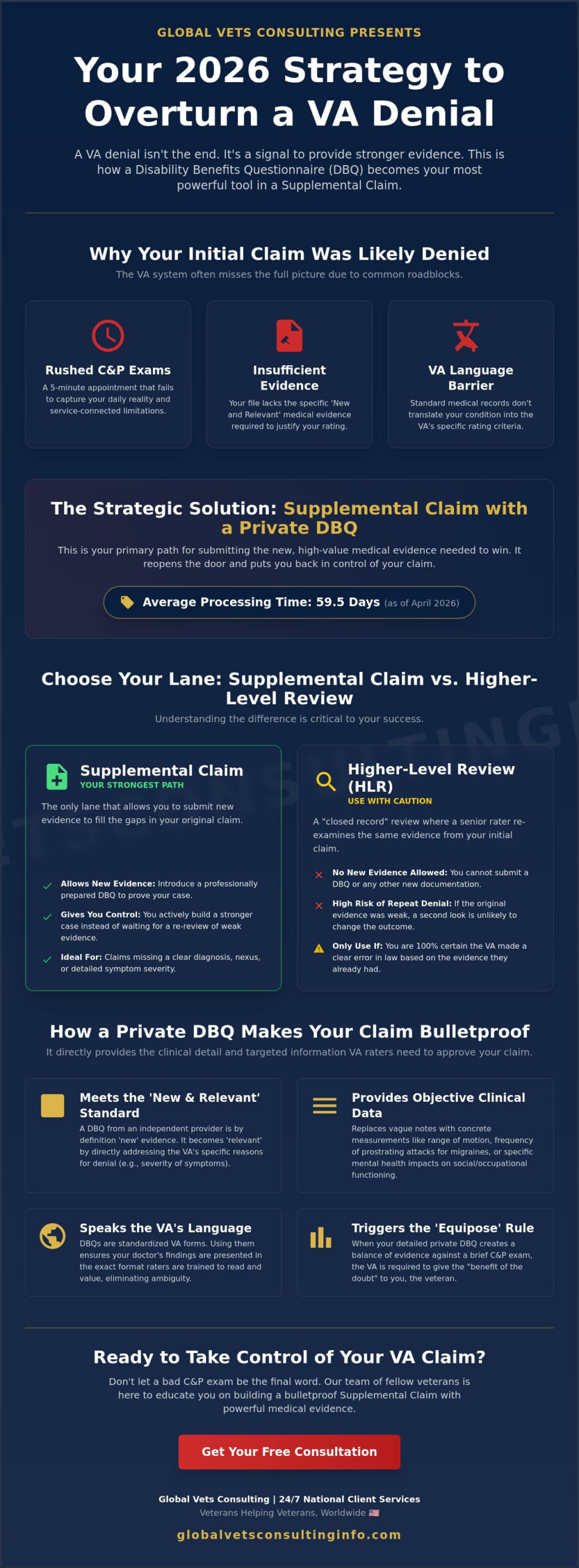
A VA denial isn’t a final verdict; it’s often just the result of a rushed C&P exam that failed to capture your daily reality. You’ve likely felt the frustration of a five-minute appointment or the confusion of being told you lack the ‘new and relevant’ evidence required to reopen your file. It’s exhausting to wait months only to receive a letter that doesn’t reflect your actual service-connected limitations. Using a dbq for va supplemental claim is the most effective way to challenge these surface-level findings and provide the clinical depth the VA requires for an accurate rating.
We understand that navigating the Appeals Modernization Act feels like a second job. You deserve a rating that reflects the true severity of your condition without waiting years for a Board Appeal. This article outlines your 2026 strategy for success, focusing on how a professionally prepared Disability Benefits Questionnaire serves as the strategic counter-evidence needed to overturn a denial. We will explore current processing times, which averaged 59.5 days as of April 2026, and show you how to leverage the latest legal standards to secure the benefits you earned.
Key Takeaways
- Understand why the Supplemental Claim lane is your primary path for submitting evidence that was missing from your initial filing. 🇺🇸
- Learn how to meet the ‘New and Relevant’ evidence standard by providing documentation that directly addresses the VA’s previous reasons for denial.
- Discover how using a dbq for va supplemental claim can trigger the ‘Equipose’ rule, ensuring the benefit of the doubt goes to the veteran when medical evidence is balanced.
- Identify the specific ‘missing links’ in your denial letter to build a stronger case for a VA rating increase that reflects your true condition.
- See how a professionally prepared DBQ from an independent medical provider provides the clinical detail necessary to challenge an unfavorable C&P exam. 🌎
Winning Your VA Appeal: Why a DBQ is Critical for Supplemental Claims
The VA system often feels like a maze designed to keep you from the benefits you’ve earned. We’ve been in your boots, and we know that receiving a denial letter can feel like a punch in the gut. However, the Veterans Benefits Administration (VBA) provides specific pathways to fix these errors. The Supplemental Claim lane is your primary tool for success because it allows you to submit new evidence that the VA hasn’t seen before. In 2026, using a dbq for va supplemental claim is the most tactical move you can make. It forces the rater to look at clinical data that contradicts a poor C&P exam.
The Role of Disability Benefits Questionnaires (DBQs) in Appeals
DBQs are standardized forms that ensure medical evidence is presented in the exact format VA raters are trained to read. While the VA used to rely almost exclusively on their own contract examiners, the system now recognizes the high value of private medical evidence. A well-prepared DBQ translates your symptoms into the specific language of the VA Schedule for Rating Disabilities. If you need a deeper dive into the basics, check out our guide on What is a DBQ? to see how these forms function.
Supplemental Claim vs. Higher-Level Review: Choosing Your Lane
Veterans often ask if they should choose a Higher-Level Review (HLR) instead. The answer depends entirely on your evidence. An HLR is a “closed record” review; you can’t submit anything new. If your initial claim lacked a clear diagnosis or a nexus, an HLR will likely result in another denial. A Supplemental Claim is superior because it reopens the door. It’s the only lane where you can introduce a private DBQ to bridge the gap between your current medical records and the VA’s requirements. This path gives you the control to present the full truth of your condition.
Meeting the ‘New and Relevant’ Evidence Standard with a Private DBQ
To win a supplemental claim, you must clear the “new and relevant” hurdle. This isn’t just a suggestion; it’s a legal requirement established by the Appeals Modernization Act. “New” evidence means information the VA didn’t have when they made their last decision. “Relevant” evidence is anything that tends to prove or disprove a point in your claim. Using a dbq for va supplemental claim allows you to bypass the vague notes of a contract examiner and present specific clinical data points raters need. In 2026, a DBQ is considered relevant if it addresses the specific reason for denial, such as severity of symptoms or service connection.
The official Disability Benefits Questionnaires (DBQs) are designed to mirror the VA’s rating schedule. By using these forms, your private doctor speaks the VA’s language and provides clarity where a contract examiner might have been rushed. Using a dbq for va supplemental claim is the most direct way to prove that your condition has worsened since your last evaluation. If your symptoms have been getting worse and you believe your current rating no longer reflects your limitations, using a dbq for va rating increase alongside your supplemental filing can be a powerful combined strategy to document that progression.
How a DBQ Addresses VA Denial Reasons
If the VA denied you because they claimed your condition isn’t severe enough, a private DBQ can provide objective measurements like range of motion or frequency of episodes. If the issue was a lack of service connection, the DBQ helps establish a “nexus” for secondary conditions, such as migraines caused by tinnitus. This targeted approach fills the gaps that a standard medical record might miss. It ensures your case is based on clinical facts rather than a rater’s assumptions. If your va claim denied for lack of evidence is the core issue you’re facing, understanding how to identify and close those documentation gaps is the critical first step before submitting your supplemental filing.
The Importance of 2026 Documentation Standards
The VA increased its scrutiny of private evidence in March 2026 to identify low-quality submissions. It’s not enough to just have a doctor sign a paper; the documentation must be meticulous and current. This is where Independent Medical Evidence Education becomes vital. Ensuring your doctor uses the most current versions of these forms prevents administrative rejections. We help you understand these requirements so your supplemental filing is bulletproof from the start.
Strategizing Your Supplemental Claim: Private DBQ vs. C&P Exam Results
One of the biggest concerns we hear from the community is that the VA will automatically side with their own examiner over a private doctor. This isn’t how the law works. When you are using a dbq for va supplemental claim, you are providing evidence that must be weighed fairly against the C&P results. The VA rater is legally required to consider the “probative value” of each document. If your private evidence is more thorough and better supported by your medical history, it can carry more weight than a rushed contract exam.
The “Equipoise” rule is your strongest ally in this process. This rule states that when medical evidence is essentially equal in persuasiveness, the VA must decide in favor of the veteran. By submitting a high-quality private DBQ, you create a situation where the rater must reconcile conflicting opinions. If your evidence meets the VA’s ‘new and relevant’ evidence standard, you effectively force the system to give you the benefit of the doubt.
Countering a Negative C&P Exam Opinion
Too many C&P exams are inadequate. We’ve seen examiners skip using a goniometer for joint range-of-motion tests or fail to review a veteran’s records entirely. A detailed private DBQ serves as a formal rebuttal to these 10-minute appointments. It points out exactly what the contract examiner missed, providing the clinical depth needed to overturn a denial. Understanding the VA Disability Claims Process Step by Step helps you time these submissions to ensure they are part of your supplemental file before a final decision is reached.
The Power of Independent Medical Evidence
Private doctors often provide a more comprehensive evaluation because they aren’t restricted by the high-volume quotas of VA contractors. For your evidence to be effective, it must be based on a physical exam and a complete review of your records. This level of meticulousness makes it difficult for a rater to ignore your claim. When you take control of your medical narrative through private documentation, you stop being a number and start being a veteran with a documented service-connected condition. If you’re ready to secure the evidence you need, you can learn more about professional DBQ education here.
Steps to Filing Your Supplemental Claim with Global Vets Consulting
Filing a supplemental claim is a methodical process that requires attention to detail. You shouldn’t just resubmit the same information and hope for a different result. Instead, you must follow a structured path to ensure your evidence meets the VA’s strict standards. Using a dbq for va supplemental claim is the most effective way to address previous errors in your file. 🌎
- Step 1: Analyze your denial letter. Identify the “missing link” in your evidence. Look for the “Reasons for Decision” section to see if the VA disputed your diagnosis, your nexus, or the severity of your symptoms. If your situation involves a VA claim denied for lack of evidence, this step is especially critical for pinpointing the exact documentation gap you need to close.
- Step 2: Secure a professional DBQ. Obtain a Disability Benefits Questionnaire that specifically addresses the gaps identified in Step 1. This provides the clinical data needed to satisfy the “new and relevant” requirement. Veterans whose conditions have worsened should also review our guide on using a dbq for va rating increase to understand how the same documentation can simultaneously support a higher disability percentage.
- Step 3: Complete VA Form 20-0995. This is the official Decision Review Request: Supplemental Claim form. Ensure all boxes are checked correctly to avoid administrative delays.
- Step 4: Submit your evidence. Send your completed DBQ and any supporting medical evidence education documents to the VA.
Maximizing Your Claim with Professional DBQ Preparation
Global Vets Consulting has assisted over 95,000 veterans in navigating this complex system. Our veteran-owned team understands “VA math” and how to present evidence that raters can easily process. We provide 24/7 support through our AI Veteran Intake Specialist and our National Client Services Hotline to ensure you’re never left in the dark. By using a dbq for va supplemental claim prepared with professional education, you are positioning your case for a favorable outcome based on clinical facts.
What to Expect After Submitting Your Supplemental Claim
As of April 2026, the average processing time for a supplemental claim is 59.5 days. This is a significant improvement from previous years, but you should still monitor your status regularly on VA.gov. Sometimes the VA may still schedule a new C&P exam even after you submit private evidence. If this happens, don’t panic. Your private DBQ serves as the benchmark that the VA examiner must reconcile. If you are ready to take the next step in your journey, contact Global Vets Consulting to start your DBQ today. 🇺🇸
Secure Your Benefits with a Strategic 2026 Appeal
You now have the roadmap to turn a denial into an approval. By focusing on the “new and relevant” evidence standard, you can bypass the limitations of a standard C&P exam. Using a dbq for va supplemental claim ensures that your medical narrative is told through the lens of clinical accuracy rather than a rushed contract evaluation. This strategy positions you to leverage the Equipoise rule, where the benefit of the doubt must legally go to you when evidence is balanced. 🇺🇸
Our veteran-owned and operated team is dedicated to helping you meet the latest 2026 VA documentation standards. We provide the expertise you need to ensure your medical evidence is probative and powerful. If you’re tired of being ignored by the system, our 24/7 National Client Services Hotline is ready to assist you. 📞 Get the medical evidence you earned. Connect with Global Vets Consulting now. 🌎
You served your country with honor; now it’s time to get the compensation you deserve. We are proud to stand with you as you navigate this process. 🇺🇸
Frequently Asked Questions
Can I use a private DBQ for a VA supplemental claim in 2026?
Yes, private DBQs are accepted as valid medical evidence in 2026. While the VA increased its scrutiny of private submissions in March 2026, these forms remain a primary way for veterans to submit independent opinions. A professionally prepared DBQ ensures your symptoms are documented using the exact clinical language the VA raters use to determine your disability percentage. This helps fill the gaps left by rushed contract exams.
What is considered ‘new and relevant’ evidence for a VA appeal?
Evidence meets this legal standard if it was not previously in your file and it addresses a point of contention in your denial. For instance, if the VA denied you because they claimed your condition wasn’t service-connected, a new nexus letter is relevant. Using a dbq for va supplemental claim is a proven method to provide this data because it focuses on the specific criteria found in the rating schedule.
Is a supplemental claim better than a Higher-Level Review if I have a new DBQ?
The Supplemental Claim lane is the superior choice if you want to introduce new medical documentation. A Higher-Level Review (HLR) is restricted to the evidence that was present at the time of the original decision. You cannot add a new DBQ or medical opinion to an HLR. If your denial was based on a lack of evidence, the Supplemental Claim lane is the only way to fix it.
How long does the VA have to decide a supplemental claim?
The VA currently aims to finalize supplemental claims within 125 days. Data from April 2026 shows a much faster average completion time of 59.5 days. This speed is a result of improved processing systems implemented under the Appeals Modernization Act. You can monitor your status on the VA’s website or mobile app, which provides real-time updates on where your appeal stands in the queue.
Will the VA still require a C&P exam if I submit a private DBQ with my appeal?
The VA often schedules a C&P exam even when you submit your own private DBQ. They do this to ensure their own examiners have a chance to evaluate the claim. However, your private evidence is not ignored. It creates a record that the VA examiner must reconcile. If the opinions differ, the rater must consider the “probative value” of both, often triggering the Equipoise rule in your favor.

Article by
Willie Daniel
Willie Daniel is the Founder and Chief Executive Officer (CEO) of Global Vets Consulting (GVC) – National Veterans Disability Services, a veteran-led educational and medical evidence support organization dedicated to helping veterans better understand VA disability rating increases, DBQ medical evidence, secondary claims education, and C&P examination preparation.
He is a retired U.S. Army Medical Service Corps Officer with more than 27 years of honorable military service, a decorated Iraq combat veteran, and a retired federal official with the U.S. Department of Veterans Affairs. Throughout his military and federal career, Willie Daniel served in leadership, healthcare administration, operational, and veteran-support roles focused on improving services and support systems for servicemembers, veterans, and their families.
Drawing from decades of military leadership, healthcare administration, veteran advocacy, and federal government experience, Willie Daniel brings a practical, veteran-centered perspective to Global Vets Consulting’s educational articles, AI-powered veteran resources, video education initiatives, and outreach programs. His experience navigating military systems, medical documentation processes, and veteran-related administrative operations provides valuable insight into many of the challenges veterans face when seeking to better understand VA disability rating criteria, medical evidence, documentation strategies, and secondary condition education.
Through GVC’s “Veterans Helping Veterans” mission, his focus is on delivering clear, educational, and easy-to-understand information designed to empower veterans with knowledge, resources, and educational tools that may help them make more informed decisions regarding their individual VA disability journeys.
The information provided through GVC is intended for educational and informational purposes only and should not be considered legal or medical advice.
Disclaimer
Disclaimer: Global Vets Consulting, LLC (“GVC”) is a veteran-led educational and medical evidence support organization. GVC is not a law firm, is not a Veterans Service Organization (VSO), and is not affiliated with the U.S. Department of Veterans Affairs (VA) or any government agency.
Global Vets Consulting does not provide legal advice, medical advice, medical treatment, or healthcare services. GVC does not prepare, file, or submit VA disability claims on behalf of veterans. All information provided through this website, blog articles, videos, educational materials, AI tools, dashboards, templates, and communications is intended solely for general educational and informational purposes.
Veterans are encouraged to consult with accredited representatives, licensed attorneys, qualified medical providers, or Veterans Service Organizations regarding their specific legal, medical, or VA-related matters. VA disability decisions, ratings, and outcomes are determined solely by the U.S. Department of Veterans Affairs based on applicable laws, regulations, medical evidence, and individual circumstances. Past results do not guarantee future outcomes.

