
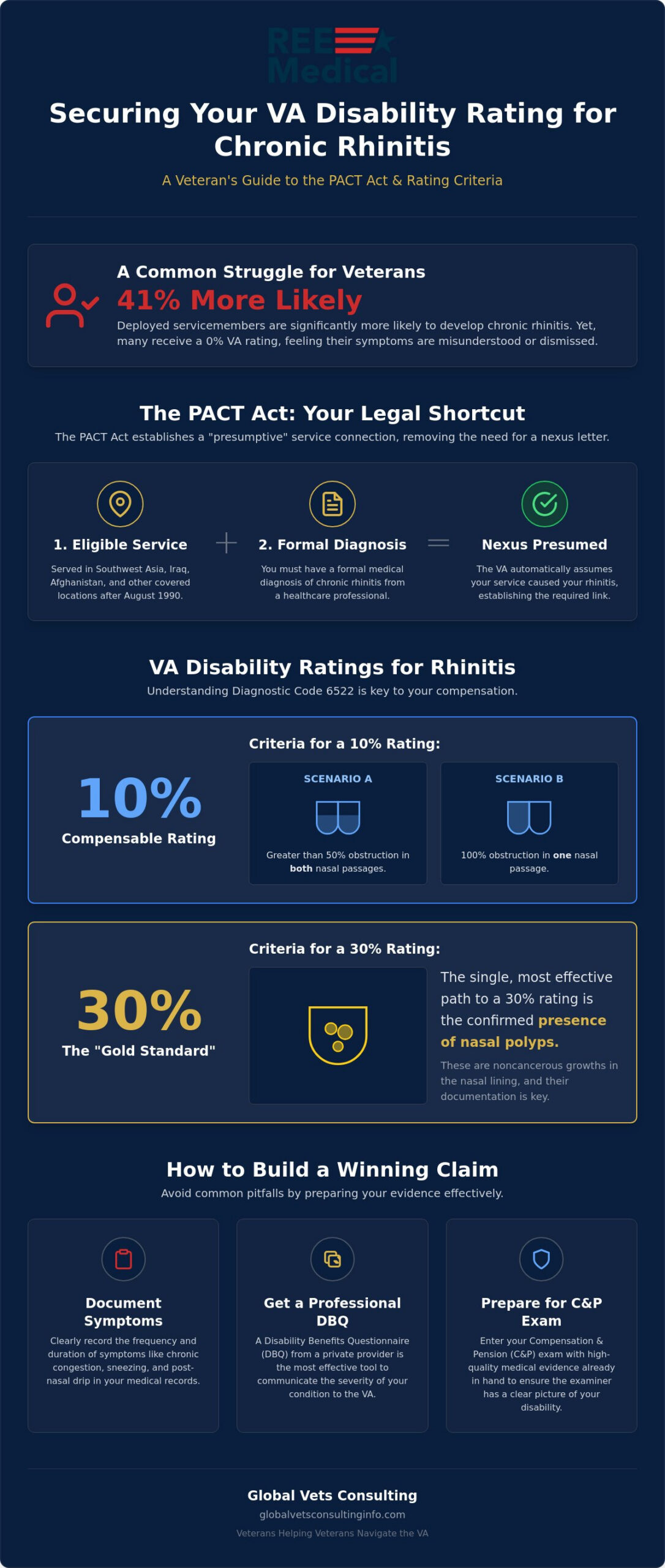
Deployed servicemembers are 41% more likely to develop chronic rhinitis than the general population, yet many veterans still walk away from the VA with a 0% rating despite a daily struggle to breathe. It’s frustrating to wait months for a decision only to feel like the examiner didn’t understand the severity of your symptoms or the impact on your quality of life. You’ve served your country with honor, and you shouldn’t have to fight a second battle just to prove your nasal passages are blocked or that those recurring polyps are service-connected.
Filing a va claim for chronic rhinitis pact act should be a straightforward process because the law now presumes your condition is linked to your service in locations like Southwest Asia or Afghanistan. I’m going to show you exactly how to document your medical evidence to secure a 10% or 30% disability rating without getting stuck in the claims backlog. We’ll examine the specific 2026 rating criteria, the importance of proving nasal obstruction, and how a private Disability Benefits Questionnaire (DBQ) can provide the clarity needed for a successful service connection.
Key Takeaways
- Understand how presumptive status removes the need for a nexus letter if you served in covered locations like Iraq or Afghanistan.
- Learn the specific medical criteria the VA uses to distinguish between a 10% and 30% rating, including the presence of nasal polyps.
- Discover the step-by-step process to file your va claim for chronic rhinitis pact act using your service records and a formal medical diagnosis.
- Find out why a professional Disability Benefits Questionnaire (DBQ) is the most effective tool to communicate the severity of your symptoms to the VA.
- Identify how to avoid common C&P exam pitfalls by documenting your symptoms with high-quality medical evidence before your appointment.
Understanding Chronic Rhinitis and PACT Act Presumptive Status
Chronic rhinitis is more than just a seasonal annoyance. It is defined as a persistent inflammation of the nasal lining that lasts for more than 12 weeks. For veterans who spent time in the Southwest Asia theater of operations or other designated toxic exposure zones, this condition is often a direct result of environmental hazards like burn pits and fine particulate matter. Before the 2022 PACT Act, proving that your service caused your breathing issues was a massive uphill battle. Now, the law has shifted the burden of proof off your shoulders.
Your service records are the key here. If you served on or after August 2, 1990, in locations like Iraq, Kuwait, or Saudi Arabia, or on or after September 11, 2001, in Afghanistan or Syria, the VA acknowledges your exposure. When you file a va claim for chronic rhinitis pact act, you are leveraging a legal shortcut that bypasses the traditional requirement for a medical nexus. However, presumptive status is not a shortcut around a medical diagnosis. You must still have a formal diagnosis in your records to move forward. Without a doctor confirming the condition exists, the VA cannot grant service connection, regardless of where you served.
What Does ‘Presumptive’ Actually Mean for Your Claim?
In the VA world, presumptive means the agency assumes your military service caused your condition. This legally establishes the “Nexus,” which is the link between your health and your time in uniform. By removing this hurdle, the PACT Act allows you to focus your energy on proving the severity of your symptoms rather than fighting to prove they started in the desert. It is a powerful tool that has already led to over 1.7 million approved claims since the law was passed. You no longer need to find a specific event in your service treatment records to explain why you can’t breathe through your nose today.
Common Symptoms of Service-Connected Rhinitis
Symptoms usually include chronic nasal congestion, frequent sneezing, and post-nasal drip that won’t go away. Some veterans experience “allergic” rhinitis triggered by pollen, while others suffer from Understanding Non-Allergic Rhinitis, which is often tied to irritants like smoke, dust, or chemicals. The VA evaluates both under the same diagnostic code, but documenting the specific frequency and duration of these symptoms is vital for your rating. If your breathing is restricted or you have developed secondary issues, those details must be clear in your medical evidence to avoid being lowballed during your evaluation.
VA Disability Ratings for Rhinitis: 10% vs. 30%
Establishing a service connection is only half the battle. Once the VA acknowledges your condition under the PACT Act Presumptive Conditions for Rhinitis, the focus shifts to Diagnostic Code 6522. This is the rulebook that determines whether you receive a 0%, 10%, or 30% rating. Many veterans feel the frustration of a 0% rating because they lack the specific clinical findings required for compensation. To move beyond a non-compensable rating, your medical evidence must show clear, measurable physical symptoms rather than just a general feeling of congestion.
A 10% rating is typically granted when you have greater than 50% obstruction in both nasal passages or 100% obstruction in one. If your symptoms don’t meet this threshold, your va claim for chronic rhinitis pact act will likely result in a 0% rating. It’s vital to understand that the VA rater isn’t looking for how much it hurts; they’re looking for how much air is actually getting through. Clinical observation by a medical professional is required to validate these obstruction levels, as subjective complaints of “stuffiness” aren’t enough to satisfy the rating criteria.
The Role of Nasal Polyps in Your Rating
Nasal polyps are the “Gold Standard” for securing a 30% disability rating. These are soft, painless, noncancerous growths that hang like teardrops or grapes in the lining of your nasal passages or sinuses. If a doctor identifies polyps during an examination, the VA criteria for a 30% rating are met. Documenting these polyps is the most efficient path to a higher rating, yet they are often missed during rushed C&P exams. Ensuring your medical records explicitly mention their presence is a key step in substantiating your claim with high-quality medical evidence.
Understanding Nasal Obstruction Percentages
Calculating “greater than 50%” obstruction is a technical process. It requires a medical provider to physically inspect the nasal cavity to see how much of the airway is blocked by inflamed tissue or structural issues. Because this is a physical measurement, having a detailed Disability Benefits Questionnaire (DBQ) that specifies these percentages can prevent the VA from lowballing your rating based on a five-minute contractor exam. Precision in your documentation ensures the rater has the facts needed to award the rating you’ve earned.
How to File a Rhinitis Claim Under the PACT Act: Step-by-Step
Filing your va claim for chronic rhinitis pact act in 2026 requires a tactical approach to ensure you aren’t stuck in the administrative backlog. The VA has streamlined the process for presumptive conditions, but the quality of your submission still dictates the speed of your decision. By following a structured path, you move from a place of uncertainty to a position of strength. 🇺🇸
- Step 1: Secure a Formal Diagnosis. You cannot win a claim based on a hunch. Visit a specialist to confirm you meet the criteria outlined in this Clinical Guide to Chronic Rhinitis.
- Step 2: Prove Your Boots Were on the Ground. Gather your DD-214 or deployment orders showing service in Southwest Asia, Afghanistan, or other covered toxic exposure zones.
- Step 3: Complete a DBQ. Use a Disability Benefits Questionnaire to translate your daily breathing struggles into the specific medical language the VA rater uses to assign a percentage.
- Step 4: File as a Fully Developed Claim (FDC). Submit all your evidence at once. This tells the VA you have nothing left to add, which can significantly shorten the 2026 processing timeline.
Gathering Your Medical Evidence
Success starts with treatment records that prove your condition is chronic. If you only see a doctor once, the VA might view your rhinitis as a temporary seasonal allergy. You need a paper trail showing persistent inflammation over time. We’ve seen that using private DBQs for VA claims allows you to present a complete medical picture before you ever step foot in a VA facility. This proactive step ensures your polyps or obstruction levels are documented by a provider who isn’t rushing through a 10-minute exam.
Preparing for the C&P Examination
The Compensation and Pension (C&P) exam is often where claims fall apart. When the examiner asks how you’re doing, don’t just describe how you feel that morning. You must describe your “worst days”—the days when you can’t breathe through your nose at all or when your post-nasal drip makes sleep impossible. Many veterans find their VA Claim Denied for Lack of Evidence: How to Recover in 2026 because they didn’t clearly articulate the frequency of their symptoms. Don’t leave your rating to chance; be prepared to speak specifically about your diagnosis and service history.
Ready to ensure your medical evidence is bulletproof? Explore our educational resources on respiratory claims today. 🌎
Maximizing Your Claim with a Professional DBQ
The VA rater relies on the Disability Benefits Questionnaire (DBQ) to translate your medical history into a compensable percentage. If your DBQ is incomplete or vague, your va claim for chronic rhinitis pact act may result in a rating that doesn’t reflect your daily struggle. While VA contractors are often limited by high quotas and short appointment windows, a private medical provider can dedicate the necessary time to meticulously document every polyp and every percentage of obstruction. Accuracy here is the difference between getting the benefits you’ve earned and being forced into a multi-year appeal.
At Global Vets Consulting, we act as your dedicated partner, guiding you through the VA disability claims process step by step. Our “Veterans Helping Veterans” ethos means we speak your language and understand the specific challenges of toxic exposure claims. We focus on ensuring your medical evidence is thorough and meets the VA’s 2026 standards for respiratory conditions. 🇺🇸
Why Accuracy in Documentation Matters
Precision is everything in a bureaucratic system. A single missing checkmark or an overlooked clinical observation on a form can be the difference between a 30% rating and a 0% non-compensable decision. High-quality medical evidence acts as a shield against the frustration of lowball ratings. Ensuring your va claim for chronic rhinitis pact act is supported by precise clinical findings is the best way to avoid being overlooked. This level of thoroughness provides the rater with a clear path to approval and prevents the need for the lengthy appeals that often clog the system.
Secondary Conditions to Consider
Think of your chronic rhinitis as a gateway condition. Persistent nasal inflammation often leads to other serious issues, creating a clear path for secondary service connection for conditions like sleep apnea, migraines, or chronic sinusitis. It’s vital to take a holistic view of your respiratory health. When you document the full impact of your rhinitis today, you’re building a stronger foundation for your entire VA disability profile. Don’t let a single diagnosis limit your access to the support you deserve.
🇺🇸 Global Vets Consulting
📞 24/7 National Client Services Hotline: 1-800-VET-HELP
🌐 GlobalVetsConsultingInfo.com
🤖 24/7 AI Veteran Intake Specialist Available Online
Secure the Rating You’ve Earned Under the PACT Act
Your military service has already established the link between your toxic exposure and your breathing issues. Now, the success of your va claim for chronic rhinitis pact act depends on the precision of your medical evidence. Remember that documenting nasal polyps is the most direct path to a 30% rating, while clear clinical findings of obstruction are essential for a 10% award. Don’t leave your future to the chance of a brief C&P exam when you can submit a Fully Developed Claim backed by high-quality documentation.
We are a veteran-owned and operated consulting service specialized in respiratory system claims education. We understand the intricacies of the VA system and are dedicated to helping you substantiate your claim with thorough evidence. Get the medical evidence you need for your rhinitis claim—Contact Global Vets Consulting today!
Our 24/7 National Client Services Hotline is ready to assist you at any time. You’ve completed your mission with honor; let’s work together to ensure you receive the compensation you deserve. 🇺🇸
Frequently Asked Questions
Is chronic rhinitis automatically service-connected under the PACT Act?
Service connection is presumptive for eligible veterans, but it isn’t automatic because you must still provide a formal medical diagnosis. The PACT Act removes the need for a nexus letter, but the VA won’t grant a rating without clinical evidence that the condition exists. You must show that your symptoms have persisted for at least 12 weeks to meet the definition of chronic. Without this proof, the VA will deny the claim even if you served in a toxic exposure zone.
What is the difference between sinusitis and rhinitis for VA ratings?
Rhinitis involves inflammation of the nasal passages, while sinusitis affects the four pairs of hollow cavities in your skull. The VA rates them under different diagnostic codes, 6522 and 6510 through 6514, respectively. While they share symptoms like congestion, sinusitis often requires evidence of headaches or tenderness over the sinus areas to reach higher compensable levels. It’s common for veterans to suffer from both conditions simultaneously due to toxic exposure.
Can I get a 30% rating for rhinitis without polyps?
You cannot receive a 30% rating for chronic rhinitis without the presence of nasal polyps. Under Diagnostic Code 6522, the maximum rating for nasal obstruction alone is 10%. This is why it’s critical to have a thorough examination to identify any growths that might be present but weren’t caught during a standard screening. If polyps aren’t documented in your records, the VA is legally required to cap your rating at 10%.
How do I prove I was exposed to burn pits for my rhinitis claim?
You don’t need to provide specific photos or logs of burn pits to support your va claim for chronic rhinitis pact act. If your service records show you were deployed to a covered location like Iraq or Afghanistan during the designated periods, the VA concedes your exposure. Your primary focus should be on documenting the current severity of your respiratory symptoms through a detailed DBQ. Proving where you were is much simpler than proving how much you’re suffering.
What should I do if my PACT Act rhinitis claim was denied?
Start by reviewing your Decision Narrative to see if the denial was due to a lack of a formal diagnosis or missing service records. If you have new medical evidence or if the VA failed to apply presumptive status correctly, you can file a Supplemental Claim. Providing an independent Disability Benefits Questionnaire can often resolve issues where an examiner didn’t properly document your nasal obstruction or polyps during the initial C&P exam.
Can rhinitis be secondary to other service-connected conditions?
Rhinitis can be service-connected as a secondary condition to issues like a deviated septum or even certain autoimmune disorders. Conversely, it often serves as the primary condition for secondary claims like sleep apnea or chronic sinusitis. Taking a holistic view of your health helps ensure you aren’t missing related conditions that contribute to your overall disability rating. This approach ensures you’re compensated for the full scope of your service-connected respiratory issues.

Article by
Willie Daniel
Willie Daniel is the Founder and Chief Executive Officer (CEO) of Global Vets Consulting (GVC) – National Veterans Disability Services, a veteran-led educational and medical evidence support organization dedicated to helping veterans better understand VA disability rating increases, DBQ medical evidence, secondary claims education, and C&P examination preparation.
He is a retired U.S. Army Medical Service Corps Officer with more than 27 years of honorable military service, a decorated Iraq combat veteran, and a retired federal official with the U.S. Department of Veterans Affairs. Throughout his military and federal career, Willie Daniel served in leadership, healthcare administration, operational, and veteran-support roles focused on improving services and support systems for servicemembers, veterans, and their families.
Drawing from decades of military leadership, healthcare administration, veteran advocacy, and federal government experience, Willie Daniel brings a practical, veteran-centered perspective to Global Vets Consulting’s educational articles, AI-powered veteran resources, video education initiatives, and outreach programs. His experience navigating military systems, medical documentation processes, and veteran-related administrative operations provides valuable insight into many of the challenges veterans face when seeking to better understand VA disability rating criteria, medical evidence, documentation strategies, and secondary condition education.
Through GVC’s “Veterans Helping Veterans” mission, his focus is on delivering clear, educational, and easy-to-understand information designed to empower veterans with knowledge, resources, and educational tools that may help them make more informed decisions regarding their individual VA disability journeys.
The information provided through GVC is intended for educational and informational purposes only and should not be considered legal or medical advice.
Disclaimer
Disclaimer: Global Vets Consulting, LLC (“GVC”) is a veteran-led educational and medical evidence support organization. GVC is not a law firm, is not a Veterans Service Organization (VSO), and is not affiliated with the U.S. Department of Veterans Affairs (VA) or any government agency.
Global Vets Consulting does not provide legal advice, medical advice, medical treatment, or healthcare services. GVC does not prepare, file, or submit VA disability claims on behalf of veterans. All information provided through this website, blog articles, videos, educational materials, AI tools, dashboards, templates, and communications is intended solely for general educational and informational purposes.
Veterans are encouraged to consult with accredited representatives, licensed attorneys, qualified medical providers, or Veterans Service Organizations regarding their specific legal, medical, or VA-related matters. VA disability decisions, ratings, and outcomes are determined solely by the U.S. Department of Veterans Affairs based on applicable laws, regulations, medical evidence, and individual circumstances. Past results do not guarantee future outcomes.