

What if the reason you struggle to follow a conversation isn’t just the noise of the flight line, but the fuel that powered the aircraft? For many veterans, the VA’s reliance on standard noise exposure charts leads to frustrating denials, leaving you to feel ignored by the system. If you’ve been told your hearing is “fine” according to a mechanical formula but you know something is wrong, you’re likely dealing with the toxic effects of JP-8. Filing a successful va claim for hearing loss secondary to jet fuel exposure requires moving beyond simple noise data and proving the chemical damage caused by ototoxicity.
We understand the frustration of having your lived experience dismissed by a bureaucratic chart. This guide helps you bridge that gap by explaining the medical link between toxic chemicals and auditory processing dysfunction. You’ll learn how to use a Disability Benefits Questionnaire (DBQ) to provide technical evidence and what documentation is required to establish a strong medical nexus. We’ll walk through the 2026 regulations and the strategic steps needed to prove your condition is “at least as likely as not” connected to your service.
Key Takeaways
- Learn why jet fuel exposure is considered an ototoxic event that causes neurological hearing damage beyond standard noise exposure limits.
- Discover the specific requirements to file a va claim for hearing loss secondary to jet fuel exposure, including the importance of a strong medical nexus.
- Understand how a private Disability Benefits Questionnaire (DBQ) can provide the detailed medical evidence necessary to overcome common VA denials.
- Follow a step-by-step guide to gathering service treatment records and personnel files that document your history of toxic chemical exposure.
The Link Between Jet Fuel Exposure and Hearing Loss 🛩️
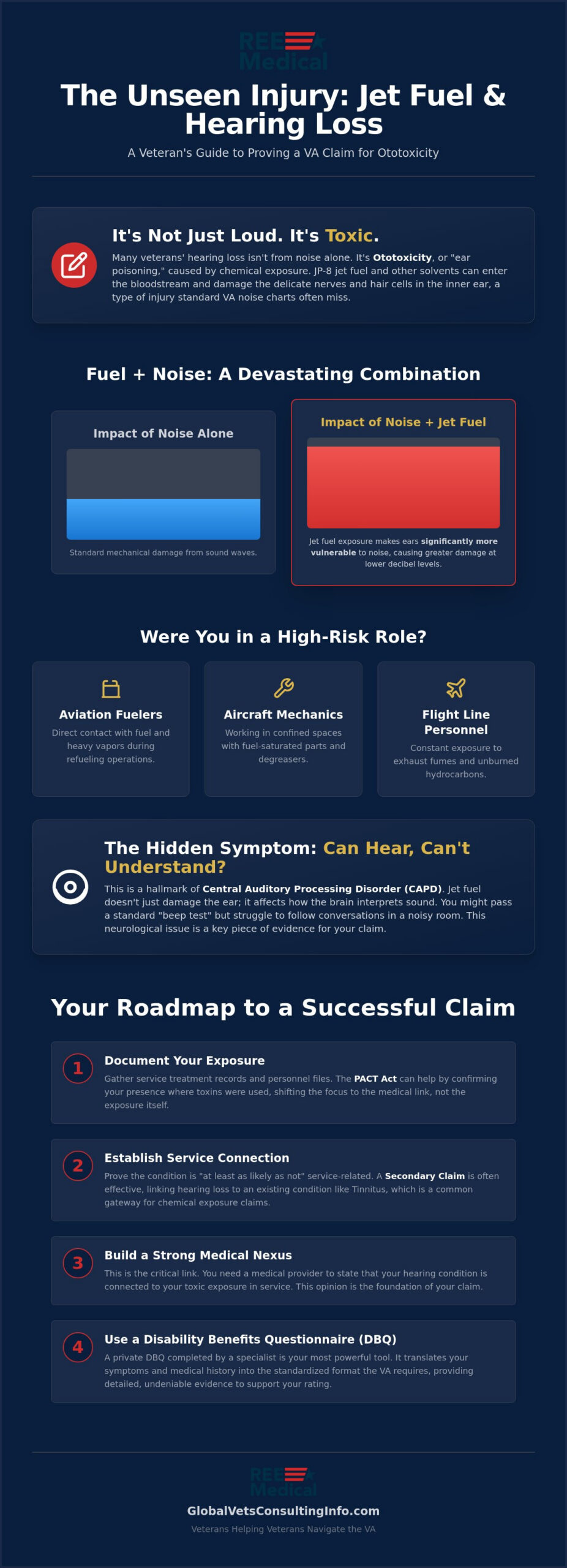
Many veterans assume their hearing loss is strictly the result of loud engines and explosions. While noise is a major factor, researchers have identified a more insidious cause known as Ototoxicity. This term describes the “ear poisoning” that occurs when certain chemicals, like JP-8 jet fuel, enter the bloodstream and damage the delicate hair cells of the inner ear or the auditory nerves. If you worked around fuel, your hearing loss might not be a mechanical injury from sound; it’s often a chemical injury from toxic exposure.
The standard VA noise exposure charts often fail veterans who worked with fuel. These charts categorize MOS roles based on decibel levels, but they don’t account for the fact that jet fuel makes your ears significantly more vulnerable to sound. This synergistic effect means that a noise level that might be safe for most people becomes devastating for someone regularly exposed to fuel vapors. When you are filing a va claim for hearing loss secondary to jet fuel exposure, it’s vital to highlight this combined impact. High-risk roles include:
- Aviation Fuelers: Direct contact with liquid fuel and heavy vapors during refueling operations.
- Aircraft Mechanics: Working in confined spaces with fuel-saturated components and degreasers.
- Flight Line Personnel: Constant exposure to exhaust fumes and unburned hydrocarbons in the air.
Understanding Central Auditory Processing Disorder (CAPD)
Have you ever passed a standard VA “beep test” only to find you still can’t understand what people are saying in a crowded room? This is a hallmark of Central Auditory Processing Disorder. Jet fuel exposure doesn’t just damage the ear’s physical structure; it affects how the brain interprets sound signals. You might technically “hear” the sound, but your brain can’t decode the speech correctly. When pursuing a va claim for hearing loss secondary to jet fuel exposure, discussing these hidden symptoms with a medical provider is essential for a complete diagnosis.
Proving Service Connection for Ototoxicity in 2026
Establishing a service connection is the most critical hurdle in any VA disability claim. When you file a va claim for hearing loss secondary to jet fuel exposure, you must decide between a direct or secondary path. A direct connection requires proof that your hearing loss began while you were on active duty. However, many veterans find more success with a secondary connection, which occurs when an existing service-connected condition causes or worsens a new medical issue.
The PACT Act has significantly simplified the process of proving you were exposed to toxins like JP-8. While hearing loss isn’t currently a “presumptive” condition under the act, the law confirms your presence in locations where these chemicals were used. This removes the burden of proving exposure, allowing you to focus on the “Nexus”—the medical evidence linking that exposure to your current diagnosis. VA Research on Jet Fuel and Hearing confirms that these toxins specifically target the brain’s ability to process sound, providing a scientific foundation for your claim.
Secondary Claims: Linking Hearing Loss to Other Conditions
If you already have a rating for a neurological condition or persistent tinnitus, your path to a successful va claim for hearing loss secondary to jet fuel exposure might be through a secondary claim. Tinnitus is often considered a “gateway” claim because it’s the most common disability among veterans and frequently co-occurs with hearing damage from chemical exposure. A secondary service connection occurs when a primary service-connected disability causes or aggravates a separate condition.
When you’re ready to strengthen your evidence, learning how to use a DBQ for a VA disability rating increase in 2026 can help you document the full scope of your symptoms. Our team at Global Vets Consulting specializes in helping veterans understand the complex medical evidence needed to win these challenging claims through education and resource awareness.
The Role of the Hearing Loss DBQ in Your Claim 📋
A Disability Benefits Questionnaire (DBQ) is a standardized form used by the VA to evaluate the severity of your symptoms and determine your disability rating. For a va claim for hearing loss secondary to jet fuel exposure, a DBQ is your primary tool for translating personal struggles into medical evidence. To understand the basics of these forms, you can read What is a DBQ? A Veteran’s Guide to Disability Benefits Questionnaires in 2026. While the VA often schedules a C&P exam, submitting a private DBQ ensures that your specific exposure history isn’t overlooked during a brief appointment.
Private DBQs provide a level of detail that standard exams often miss. A thorough evaluation captures the functional impact of your hearing loss, such as your inability to communicate in work environments or the social isolation caused by auditory processing issues. This is especially important because the VA Research on Hearing Loss Factsheet confirms that exposure to JP-8 is linked with auditory processing dysfunctions. Without a detailed DBQ, a rater might only see “normal” beep test results and ignore the underlying neurological damage.
Key Information Your DBQ Should Include
To win your claim, your documentation must be precise. Your medical provider needs to document the specific type of fuel you handled, such as JP-4, JP-5, or JP-8, as these are known ototoxins. The DBQ should also include:
- Audiometric Testing: Puretone threshold results and Maryland CNC speech recognition scores administered without hearing aids.
- Toxic Link: A specific mention of your MOS and the duration of your chemical exposure.
- Medical Nexus: A clear statement that your condition is “at least as likely as not” caused by your military service.
Providing standardized medical documentation is the most effective way to reduce anxiety and create a predictable path toward a successful outcome. If you need assistance gathering the right evidence, get started with Global Vets Consulting today.
Filing Your Claim: Step-by-Step for Success 🇺🇸
Winning a va claim for hearing loss secondary to jet fuel exposure is about building a bridge between your service records and current medical science. By following a structured process, you can present a claim that is difficult to deny. This methodical approach reduces the risk of administrative errors that often lead to unnecessary delays.
First, collect your service treatment records (STRs) and any personnel files that document your daily exposure. This includes performance reports mentioning flight line duties, MOS descriptions for fuel handlers, or orders to specific environments where JP-8 was prevalent. Second, secure a private DBQ. This document ensures that the specific symptoms of chemical ototoxicity and auditory processing issues are captured in a format the VA recognizes. Finally, submit your paperwork as a Fully Developed Claim (FDC). This signals to the VA that you’ve already gathered all necessary medical evidence, which frequently results in a faster decision. To navigate this journey with confidence, review our VA Disability Claims Process Step by Step: A 2026 Veteran’s Guide.
What to Do if Your Claim is Denied
A denial isn’t the end of the road; it’s often just a signal to refine your evidence. Carefully read your Rating Decision to identify the specific trigger for the denial, such as a missing nexus or insufficient testing results. If you believe the rater overlooked your evidence of toxic exposure or the synergistic effects of fuel and noise, a Higher-Level Review (HLR) is a powerful tool. This allows a senior reviewer to take a second look at your existing file without the need for a new exam.
If your denial was based on a perceived lack of documentation, our resource on VA Claim Denied for Lack of Evidence: How to Recover in 2026 provides a clear path forward. Our mission at Global Vets Consulting is to empower you with the education and resource awareness needed to secure the rating you’ve earned through your service. We’re here to help you move from confusion to a concrete result.
Secure Your Earned Benefits with Medical Evidence 🇺🇸
You now have a clear path to proving that your hearing loss is a chemical injury, not just a noise-induced one. By understanding the science of ototoxicity and the strategic importance of the PACT Act, you’ve taken the first step toward a successful outcome. A successful va claim for hearing loss secondary to jet fuel exposure depends on precise documentation that links your time on the flight line to your current auditory struggles. Using a private DBQ ensures your symptoms are evaluated with the thoroughness they deserve, rather than relying on a brief government exam.
Global Vets Consulting is veteran-owned and operated, standing as a reliable ally for those seeking accurate medical evidence for VA rating increases. We are dedicated to providing the educational resources and standardized documentation you need to navigate this complex system with confidence. If you’re ready to strengthen your claim and provide the VA with the evidence it requires, our team is ready to support you.
📞 24/7 National Client Services Hotline: (833) 222-VETS
Get the Expert DBQ Documentation You Need at Global Vets Consulting. You’ve done the hard work of serving our nation; let’s work together to ensure your sacrifices are properly recognized and your future is secure.
Frequently Asked Questions
Is hearing loss a presumptive condition under the PACT Act?
Hearing loss is not currently listed as a presumptive condition under the PACT Act. While the law simplifies the process of proving you were exposed to toxins based on your service location, you must still provide a medical nexus. This means you need a medical professional to confirm that your hearing loss is at least as likely as not caused by your documented exposure to jet fuel.
How do I prove I was exposed to jet fuel during my military service?
Proving exposure involves gathering personnel records that highlight your specific duties on the flight line or in maintenance bays. You should use MOS descriptions, performance evaluations, and service treatment records to show regular contact with JP-8 or other fuels. These documents provide the objective evidence the VA needs to verify that your work environment was chemically hazardous.
Can I claim hearing loss secondary to tinnitus if I worked around jet fuel?
Yes, you can file a va claim for hearing loss secondary to jet fuel exposure by linking it to your service-connected tinnitus. Because both conditions are frequently caused by the same ototoxic chemicals, establishing tinnitus as your primary condition can provide a logical path for your hearing loss claim. This approach is often successful when standard noise exposure charts don’t fully capture your lived experience.
What is the VA rating for hearing loss caused by toxic exposure?
The VA evaluates hearing loss using a mechanical formula regardless of whether the cause was noise or chemical exposure. Your rating depends on the results of puretone audiometry and Maryland CNC speech discrimination tests. For 2026, a 10% disability rating pays $180.42 per month, while a 100% rating for a veteran alone is $3,938.58 per month.
What happens if the VA denies my hearing loss claim but I have fuel exposure?
A denial usually indicates a missing link in your medical evidence or the absence of a clear nexus statement. You have the right to file a Higher-Level Review if you believe the rater ignored your exposure records. Alternatively, submitting a Supplemental Claim with a private DBQ can provide the specific medical details needed to overcome the initial denial and secure your earned benefits.

Article by
Willie Daniel
Willie Daniel is the Founder and Chief Executive Officer (CEO) of Global Vets Consulting (GVC) – National Veterans Disability Services, a veteran-led educational and medical evidence support organization dedicated to helping veterans better understand VA disability rating increases, DBQ medical evidence, secondary claims education, and C&P examination preparation.
He is a retired U.S. Army Medical Service Corps Officer with more than 27 years of honorable military service, a decorated Iraq combat veteran, and a retired federal official with the U.S. Department of Veterans Affairs. Throughout his military and federal career, Willie Daniel served in leadership, healthcare administration, operational, and veteran-support roles focused on improving services and support systems for servicemembers, veterans, and their families.
Drawing from decades of military leadership, healthcare administration, veteran advocacy, and federal government experience, Willie Daniel brings a practical, veteran-centered perspective to Global Vets Consulting’s educational articles, AI-powered veteran resources, video education initiatives, and outreach programs. His experience navigating military systems, medical documentation processes, and veteran-related administrative operations provides valuable insight into many of the challenges veterans face when seeking to better understand VA disability rating criteria, medical evidence, documentation strategies, and secondary condition education.
Through GVC’s “Veterans Helping Veterans” mission, his focus is on delivering clear, educational, and easy-to-understand information designed to empower veterans with knowledge, resources, and educational tools that may help them make more informed decisions regarding their individual VA disability journeys.
The information provided through GVC is intended for educational and informational purposes only and should not be considered legal or medical advice.
Disclaimer
Disclaimer: Global Vets Consulting, LLC (“GVC”) is a veteran-led educational and medical evidence support organization. GVC is not a law firm, is not a Veterans Service Organization (VSO), and is not affiliated with the U.S. Department of Veterans Affairs (VA) or any government agency.
Global Vets Consulting does not provide legal advice, medical advice, medical treatment, or healthcare services. GVC does not prepare, file, or submit VA disability claims on behalf of veterans. All information provided through this website, blog articles, videos, educational materials, AI tools, dashboards, templates, and communications is intended solely for general educational and informational purposes.
Veterans are encouraged to consult with accredited representatives, licensed attorneys, qualified medical providers, or Veterans Service Organizations regarding their specific legal, medical, or VA-related matters. VA disability decisions, ratings, and outcomes are determined solely by the U.S. Department of Veterans Affairs based on applicable laws, regulations, medical evidence, and individual circumstances. Past results do not guarantee future outcomes.

