
What if the most disabling part of your chronic physical injury isn’t the injury itself, but the way your brain processes the constant pain? Many veterans feel like the VA completely ignores the mental toll of long-term physical suffering. It’s frustrating when a C&P examiner focuses only on your range of motion while overlooking the anxiety and social isolation that come with a body that won’t stop hurting. You might even feel confused by the shift from Chronic Pain Syndrome to this newer diagnosis, but the impact on your life remains just as heavy.
We understand that your pain is real and deserves a rating that reflects its actual impact on your lifestyle. This guide will show you how to successfully file a va claim for somatic symptom disorder by translating your daily struggles into the specific medical evidence the VA requires. You’ll learn how to use a Mental Health DBQ to document social and occupational impairment and understand the 2026 rating criteria under 38 CFR § 4.130. We will also provide a clear path to securing a secondary service connection through a strong medical nexus, ensuring your claim is backed by the thorough documentation needed for a fair outcome.
Key Takeaways
- Understand the terminology shift from “Chronic Pain Syndrome” to SSD and what it means for your current medical documentation.
- Learn the specific criteria used to evaluate a va claim for somatic symptom disorder, ranging from a 0% non-compensable rating to 100% total disability.
- Discover how to bridge the gap between physical pain and mental health by establishing a secondary service connection based on lifestyle impact.
- Identify why a private Disability Benefits Questionnaire (DBQ) is often more effective than a standard C&P exam for capturing your true level of impairment.
- Get a clear overview of the 38 CFR § 4.130 rating schedule to help you understand how the VA measures social and occupational distress.
What is Somatic Symptom Disorder (SSD) in a VA Claim?
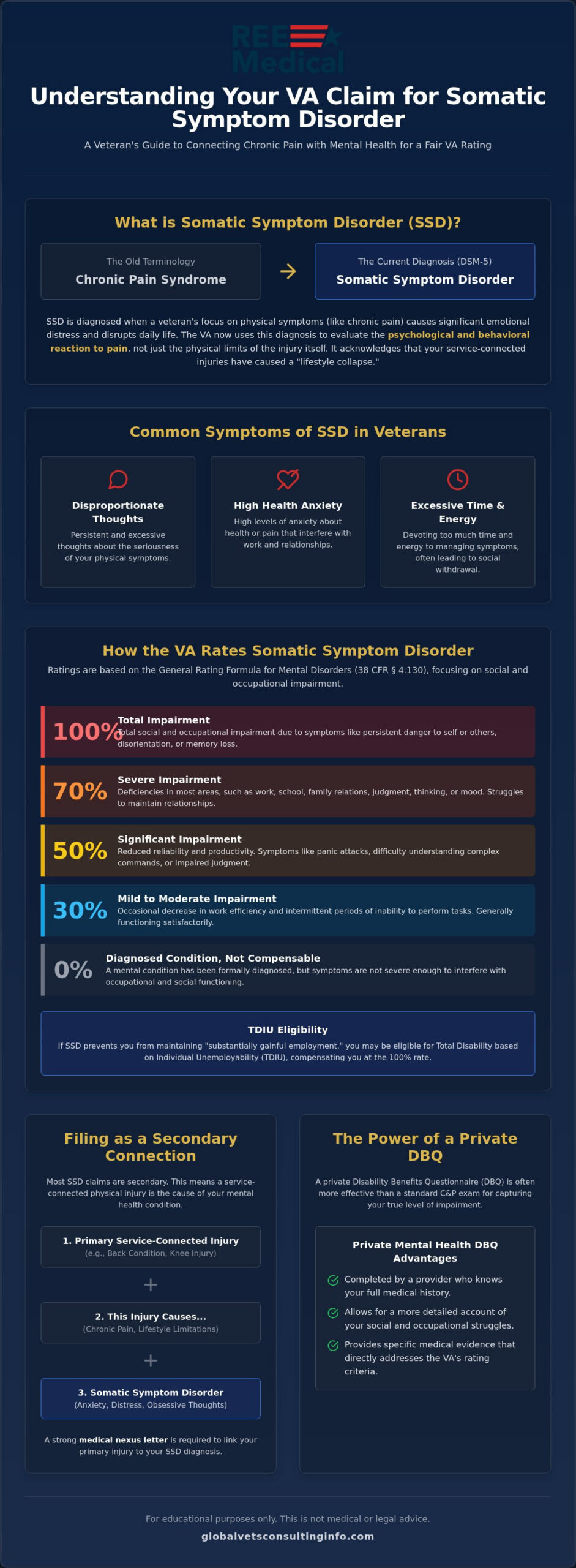
A Somatic Symptom Disorder (SSD) diagnosis occurs when a veteran experiences an extreme focus on physical symptoms, such as chronic pain or fatigue, that results in significant emotional distress and functional impairment. For years, the VA often labeled these struggles as “Chronic Pain Syndrome.” However, the system has shifted toward the DSM-5 criteria for SSD to better capture how physical ailments affect a veteran’s mental health. When you file a va claim for somatic symptom disorder, you’re asking the VA to recognize that your service-connected injuries have caused a “lifestyle collapse” that goes beyond just physical limitations.
It’s vital to understand the veteran perspective here. The VA isn’t suggesting your pain is “all in your head” or that you’re faking your injuries. Instead, they are evaluating your psychological and behavioral reaction to that pain. If your back injury causes you to obsess over your health, avoid social gatherings, or feel constant anxiety about your future, that is a compensable mental health condition. SSD is frequently the most accurate diagnosis for veterans whose physical disabilities have spiraled into depression or severe health-related anxiety.
Common Symptoms of SSD in Veterans
- Persistent, disproportionate thoughts about the seriousness of physical symptoms.
- High levels of anxiety regarding health or pain that interfere with your ability to work or maintain relationships.
- Devoting excessive time and energy to managing these symptoms, often leading to social withdrawal.
SSD vs. PTSD: Understanding the Difference
While PTSD is often rooted in a specific traumatic event, SSD is rooted in your ongoing physical symptom response. Both are rated under the same General Rating Formula for Mental Disorders found in 38 CFR § 4.130. Because of the VA’s “pyramiding” rule, you can only receive one mental health rating. This makes choosing the most accurate diagnosis essential for your va claim for somatic symptom disorder. 🇺🇸
VA Rating for Somatic Symptom Disorder: 0% to 100%
The VA evaluates your va claim for somatic symptom disorder using the same criteria applied to other mental health conditions like depression or anxiety. This standard, known as the General Rating Formula for Mental Disorders in 38 CFR § 4.130, focuses on how your symptoms disrupt your ability to function. As MedlinePlus explains Somatic Symptom Disorder, the intense focus on physical pain can create a cycle of distress that makes regular employment or social interaction nearly impossible. The VA assigns a percentage based on the severity of this disruption rather than the specific physical injury itself.
- 0% Rating: You have a formal diagnosis; however, your symptoms aren’t severe enough to interfere with your work or social life.
- 30% to 50% Ratings: These represent the “middle ground” where occupational impairment begins. You might experience an occasional decrease in work efficiency or periods where you can’t perform routine tasks due to pain-related anxiety.
- 70% to 100% Ratings: These ratings are reserved for severe impairment. At 70%, you likely struggle in most areas of life, including family relationships and workplace attendance. A 100% rating reflects total social and occupational impairment.
The Importance of Social and Occupational Impairment
The VA doesn’t just rate the intensity of your pain. They rate the wreckage that pain leaves in its wake. Occupational impairment is the inability to perform work tasks due to mental distress over physical symptoms. If you find yourself calling out of work because you’re overwhelmed by health anxiety, that’s a key indicator of your rating level. If you are unsure where your symptoms fall, exploring professional education on VA rating increases can provide the clarity you need.
TDIU for Somatic Symptom Disorder
If your SSD makes it impossible to maintain “substantially gainful employment,” you may be eligible for Total Disability based on Individual Unemployability (TDIU). This benefit allows you to be compensated at the 100% rate, which is $3,938.57 per month as of 2026 for a veteran alone. Documenting these limitations early in your va claim for somatic symptom disorder is the best way to ensure your rating reflects your actual lifestyle impact. 🇺🇸
Filing SSD as a Secondary Service Connection
Most veterans don’t experience Somatic Symptom Disorder as a direct result of a single combat event. Instead, a successful va claim for somatic symptom disorder is typically filed as a secondary service connection. This means your mental health condition is caused or aggravated by an existing physical disability, such as degenerative disc disease or chronic knee strain. The American Psychiatric Association on SSD highlights that the distress is often tied to the persistent nature of physical symptoms, making the “lifestyle impact” of your primary injury the central focus of your claim.
To win this claim, you must provide three specific pieces of evidence. First, you need a current diagnosis of SSD from a qualified mental health professional. Second, you must have a primary service-connected disability already on your record. Finally, you need a medical nexus that bridges the two. Understanding the VA disability claims process step by step will help you organize these documents before you submit your application.
Establishing the Medical Nexus
A nexus is a formal medical opinion stating that your SSD is “at least as likely as not” caused by your service-connected physical condition. The VA frequently denies these claims because the veteran fails to provide a clear link between their physical pain and their mental health. Without a strong nexus, the C&P examiner might conclude your anxiety is unrelated to your service-connected back or neck injury. It’s the bridge that turns your subjective experience into objective medical evidence.
Common Primary Conditions for SSD
- Musculoskeletal Injuries: Back and neck issues like spinal stenosis or radiculopathy often lead to chronic pain that triggers SSD.
- Gastrointestinal Disorders: Conditions like IBS or GERD can cause persistent health-related anxiety and functional impairment.
- Tinnitus: The constant ringing in the ears can lead to sleep deprivation and a severe decline in mental well-being.
If you’re ready to document how your physical injuries have impacted your mental health, you can learn more about secondary VA claims education to strengthen your evidence package. 🇺🇸
The Role of the Mental Health DBQ in Your Claim
A Disability Benefits Questionnaire (DBQ) is the standardized form the VA uses to evaluate the severity of your condition. For a va claim for somatic symptom disorder, the Mental Health DBQ serves as the primary tool for a rater to assign your percentage. It translates your internal distress into the technical language required by 38 CFR § 4.130. Without a properly completed form, the VA may lack the specific data points needed to grant a fair rating.
Many veterans find that a private DBQ is a game-changer for their claim. A standard C&P exam often lasts only 15 to 20 minutes, which is rarely enough time to explain how chronic pain has eroded your mental health. By working with a professional who understands your history, you ensure that your symptoms are documented thoroughly. You can learn more about how this form works in our guide to the DBQ for mental health conditions. This proactive step prevents the VA from relying solely on a brief, one-time evaluation.
Winning the Evidence Battle
A detailed DBQ prevents the VA from downplaying your symptoms or ignoring the lifestyle impact of your service-connected injuries. Our “Veterans Helping Veterans” approach emphasizes that getting the right documentation is the first step to a fair rating. When the “Symptoms” checklist and the “Social and Occupational Impairment” sections are filled out accurately, it forces the rater to acknowledge the full scope of your struggle. If you are ready to secure the evidence you need, you can explore our DBQ preparation services to get started. 🇺🇸
Preparing for the C&P Exam
Your completed DBQ also serves as an excellent study guide for your VA Compensation and Pension (C&P) exam. Reviewing it before your appointment helps you articulate how your SSD symptoms manifest daily. It’s critical to be honest about your “worst days” during the evaluation. Don’t try to “tough it out” or minimize your distress; the examiner needs to see the reality of your condition to document it correctly. Clear, consistent evidence is the most effective way to achieve a successful va claim for somatic symptom disorder. 🌎
Secure the Rating Your Service Deserves
Winning a va claim for somatic symptom disorder requires more than just describing your physical pain. It requires a methodical approach to documenting how that pain has fundamentally changed your ability to work and interact with your family. By establishing a clear secondary service connection and utilizing a detailed Mental Health DBQ, you move from a place of uncertainty to a position of evidence-based strength. This documentation ensures your actual lifestyle impact is the focus of your rating decision rather than a brief, impersonal examination.
Veteran-owned and operated since 2021, our team specializes in detailed DBQ preparation and medical evidence education to help you navigate this complex system. We maintain a 24/7 National Client Services Hotline to ensure you always have a partner in this process. You don’t have to face the VA alone when you have the right resources and a steady guide by your side.
🇺🇸 Get the Medical Documentation You Need for Your VA Claim
You’ve already done the hard work of serving our nation. Now, take the final step to secure the benefits you earned and the peace of mind you deserve. We are ready to help you move forward with confidence.
Frequently Asked Questions
Can I get a VA rating for somatic symptom disorder and PTSD at the same time?
You cannot receive separate ratings for both conditions due to the VA’s anti-pyramiding rule. The VA assigns a single mental health rating based on the total occupational and social impairment caused by all your mental health symptoms combined. If you have both, the examiner will list all symptoms on one Mental Health DBQ. This ensures you get the highest possible rating for your situation.
Is somatic symptom disorder the same as chronic pain syndrome for VA purposes?
For the purposes of a va claim for somatic symptom disorder, the VA uses this newer DSM-5 terminology to replace what was formerly called Chronic Pain Syndrome. While the name has changed, the evaluation process remains focused on the psychological distress and functional limitations caused by your physical pain. Both use the same rating formula. The evidence requirements remain centered on your daily struggle.
What is the maximum VA rating for somatic symptom disorder?
The maximum rating for SSD is 100%. This level of compensation is reserved for veterans who experience total occupational and social impairment. As of 2026, a 100% disability rating for a veteran alone provides $3,938.57 per month. Most veterans fall into the 30% to 70% range depending on how much their symptoms interfere with daily work, family life, and their ability to maintain stable relationships.
Do I need a nexus letter for a secondary SSD claim?
You need a strong medical nexus to link your SSD to a primary service-connected condition. Without a professional medical opinion stating that your mental health struggles are “at least as likely as not” caused by your physical injuries, the VA is likely to deny the connection. This evidence is the bridge that proves your pain has caused a secondary psychological impact. It’s vital for a successful outcome.
How do I prove my somatic symptom disorder is service-connected?
Proving your va claim for somatic symptom disorder requires three specific elements: a current medical diagnosis, evidence of a primary service-connected physical disability, and a medical nexus linking the two. You should provide treatment records that document your persistent focus on physical symptoms because the VA won’t grant a rating without objective proof. Using a Disability Benefits Questionnaire clearly outlines your social and occupational impairment to the rater. 🇺🇸

Article by
Willie Daniel
Willie Daniel is the Founder and Chief Executive Officer (CEO) of Global Vets Consulting (GVC) – National Veterans Disability Services, a veteran-led educational and medical evidence support organization dedicated to helping veterans better understand VA disability rating increases, DBQ medical evidence, secondary claims education, and C&P examination preparation.
He is a retired U.S. Army Medical Service Corps Officer with more than 27 years of honorable military service, a decorated Iraq combat veteran, and a retired federal official with the U.S. Department of Veterans Affairs. Throughout his military and federal career, Willie Daniel served in leadership, healthcare administration, operational, and veteran-support roles focused on improving services and support systems for servicemembers, veterans, and their families.
Drawing from decades of military leadership, healthcare administration, veteran advocacy, and federal government experience, Willie Daniel brings a practical, veteran-centered perspective to Global Vets Consulting’s educational articles, AI-powered veteran resources, video education initiatives, and outreach programs. His experience navigating military systems, medical documentation processes, and veteran-related administrative operations provides valuable insight into many of the challenges veterans face when seeking to better understand VA disability rating criteria, medical evidence, documentation strategies, and secondary condition education.
Through GVC’s “Veterans Helping Veterans” mission, his focus is on delivering clear, educational, and easy-to-understand information designed to empower veterans with knowledge, resources, and educational tools that may help them make more informed decisions regarding their individual VA disability journeys.
The information provided through GVC is intended for educational and informational purposes only and should not be considered legal or medical advice.
Disclaimer
Disclaimer: Global Vets Consulting, LLC (“GVC”) is a veteran-led educational and medical evidence support organization. GVC is not a law firm, is not a Veterans Service Organization (VSO), and is not affiliated with the U.S. Department of Veterans Affairs (VA) or any government agency.
Global Vets Consulting does not provide legal advice, medical advice, medical treatment, or healthcare services. GVC does not prepare, file, or submit VA disability claims on behalf of veterans. All information provided through this website, blog articles, videos, educational materials, AI tools, dashboards, templates, and communications is intended solely for general educational and informational purposes.
Veterans are encouraged to consult with accredited representatives, licensed attorneys, qualified medical providers, or Veterans Service Organizations regarding their specific legal, medical, or VA-related matters. VA disability decisions, ratings, and outcomes are determined solely by the U.S. Department of Veterans Affairs based on applicable laws, regulations, medical evidence, and individual circumstances. Past results do not guarantee future outcomes.