
What if the most critical piece of evidence for your claim isn’t something the VA writes, but a document you and your doctor control? Most veterans feel overwhelmed by complex jargon and rushed exams that fail to capture the true impact of their service-connected conditions. It’s frustrating to feel like your medical history is being summarized in a few minutes by someone who doesn’t know your story. You deserve a process that respects your service and recognizes the reality of your symptoms. The VA Disability Questionnaire is designed to bridge this gap, acting as a standardized roadmap that ensures your medical evidence is clear, precise, and impossible to overlook.
We believe that every veteran should have the tools to advocate for themselves with confidence. In this guide, you’ll learn how to master the VA Disability Questionnaire process to ensure your documentation accurately reflects your health. With over 70 publicly available forms now optimized for electronic submission under the Elizabeth Dole Act, taking control of your evidence has never been more accessible. We will explore how to document your symptoms for a fair rating, navigate the 2026 rating schedules, and provide the high-quality evidence needed to secure the benefits you’ve earned through your service.
Key Takeaways
- Discover how standardized forms prevent critical details about your health from being missed during a high-volume claims review.
- Learn how to properly utilize a VA Disability Questionnaire to document the frequency and severity of flare-ups for your service-connected conditions.
- Master the steps for identifying the specific questionnaire required for your diagnosis, from sleep apnea to musculoskeletal issues.
- Understand why accurate medical evidence is the most vital component for achieving a successful VA rating increase and securing the benefits you earned.
What is a VA Disability Questionnaire (DBQ)?
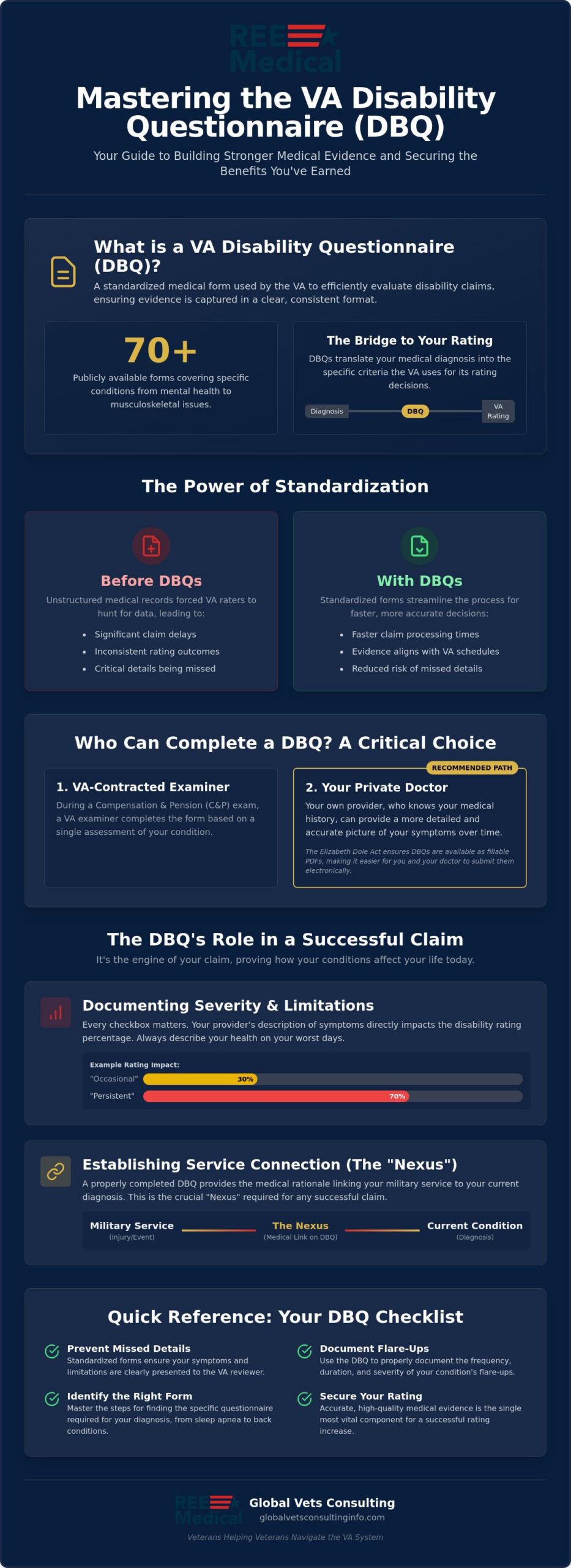
A VA Disability Questionnaire is a standardized medical form that the Department of Veterans Affairs uses to evaluate disability claims efficiently. These documents ensure that medical evidence is captured in a format the VA can process without confusion. There are currently over 70 different forms available, covering everything from mental health conditions to complex musculoskeletal issues. This standardized approach allows raters to find the specific information they need to assign an accurate disability percentage. Essentially, the Disability Benefits Questionnaire (DBQ) acts as a bridge between your clinical diagnosis and the VA rating criteria.
The Purpose of Standardized Documentation
The VA moved toward using a standardized VA Disability Questionnaire to streamline the rating process for faster decisions. Before these forms existed, medical records were often unstructured, which forced raters to hunt through hundreds of pages of notes to find relevant data. This frequently led to delays and inconsistent outcomes for veterans. By using these forms, the VA can process claims more quickly because the evidence is presented in a way that aligns directly with their internal rating schedules. These forms also significantly reduce the risk of missed medical details. When a provider follows the specific prompts on a questionnaire, they are less likely to overlook the functional limitations or flare-ups that are vital for your claim.
Who Can Complete a DBQ?
You will most commonly encounter these forms during a Compensation and Pension (C&P) exam. In these instances, a VA-contracted examiner completes the form based on a single assessment of your condition. However, it’s important to know that you have the legal right to have your private healthcare providers complete these forms too. This is often a better path for veterans who have long-standing relationships with their doctors. A private provider who has treated you for years can often provide a more detailed and accurate picture of your symptoms than a one-time examiner. Under the Elizabeth Dole Act of 2025, these forms must be provided in PDF format, making it easier for your private doctor to fill them out and for you to submit them electronically.
The Role of DBQs in the Evidence-Gathering Process
The VA Disability Questionnaire is the primary engine of a successful claim. While your service treatment records prove you were there, these forms prove how your conditions affect your life today. Raters rely on these documents to streamline the collection of necessary medical evidence, focusing specifically on the frequency and severity of your symptoms. When you submit a complete questionnaire with your application, you may qualify for a Fully Developed Claim (FDC). As of mid-2026, the VA has processed over 2 million claims this fiscal year, and providing precise, pre-organized evidence is the best way to ensure your file doesn’t get stuck in the backlog.
Documenting Severity and Limitations
VA ratings are determined by the specific criteria found in the Schedule for Rating Disabilities. Every checkbox on your questionnaire carries weight. If a provider marks that you have “occasional” symptoms instead of “persistent” ones, it can be the difference between a 30% and a 70% rating. It’s vital to describe your health as it is on your worst days. Accurate documentation ensures that the “VA Math” used to calculate your combined rating reflects your actual level of impairment rather than a sanitized version of your symptoms.
Establishing Service Connection
Winning a claim requires a “Nexus,” which is a formal medical link between your military service and your current diagnosis. A properly completed VA Disability Questionnaire provides the medical rationale needed to establish this connection. This is true for direct injuries, presumptive conditions, or secondary claims like sleep apnea caused by a service-connected respiratory condition. Understanding how to link your medical documentation to your service records is a critical step in the VA disability claims process. If you feel overwhelmed by the paperwork, our team at Global Vets Consulting can help you understand the evidence requirements for your specific conditions.
- 🇺🇸 Functional Impact: Clearly detail how your condition limits your ability to work.
- 🌎 Frequency: Highlight how often flare-ups occur and how long they last.
- 📞 Clarity: Ensure every checkbox aligns with your current medical diagnosis.
How to Effectively Use a DBQ for Your VA Claim
Identifying the correct form is your first strategic step. Whether you’re dealing with PTSD, migraines, or sleep apnea, there’s a specific VA Disability Questionnaire tailored to that condition. You shouldn’t walk into an exam or a doctor’s office empty-handed. Gather your treatment records first to provide a solid foundation for the questionnaire. This ensures that the provider isn’t guessing about your history but is instead documenting a verified medical timeline that aligns with your service records.
- 🇺🇸 Select the Right Form: Match the questionnaire exactly to your diagnosed condition to avoid processing delays.
- 🌎 Prepare Your Records: Provide your doctor with a summary of your treatment history before they fill out the form.
- 📞 Review for Accuracy: Never submit a form without double-checking that the checkboxes accurately reflect your worst days.
Private DBQs vs. C&P Exams
Relying on a standard Compensation and Pension (C&P) exam can be risky for your claim’s success. These appointments often last only 15 to 20 minutes, which is rarely enough time to explain the complexities of a chronic condition. In contrast, private medical documentation often provides a more comprehensive view of your health. While the VA will subject private evidence to careful review, a detail-oriented form from a doctor who knows your history can provide the clarity a rater needs to grant a fair rating.
Submitting Your Evidence
Once the VA Disability Questionnaire is complete, review it for accuracy before you hit submit. Check that every section reflects your actual symptoms and that no functional limitations were left out. In 2026, the best practice is to upload these documents as PDFs directly to the VA.gov portal to comply with the electronic submission standards of the Elizabeth Dole Act. Always keep a “paper trail” by saving a digital copy of every form and medical opinion you provide. If you’re ready to ensure your evidence is as strong as possible, contact Global Vets Consulting to learn more about our professional educational resources.
Professional DBQ Education and Your Rating Increase
Navigating the VA system shouldn’t feel like a solo mission. Professional education empowers you to understand exactly what evidence a rater needs to see on your VA Disability Questionnaire. When your documentation is accurate and thorough, you significantly improve your chances of a favorable outcome. This level of detail is especially critical when you are pursuing a VA disability rating increase, as the VA requires clear proof that your condition has worsened since your last evaluation. Global Vets Consulting specializes in streamlining the gathering of this vital evidence by helping you organize your medical history to meet current standards. We act as a mission-driven partner for veterans worldwide, ensuring that no one is left behind because of bureaucratic hurdles.
The Global Vets Consulting Advantage 🇺🇸
We operate with a “Veterans Helping Veterans” ethos. This peer-to-peer approach ensures that the person helping you understand your documentation requirements actually understands the life you’ve lived. We prioritize your peace of mind by offering support through our 24/7 National Client Services Hotline and our 24/7 AI Veteran Intake Specialist. You can get the information you need whenever you need it. Our focus remains on standardized medical documentation that reflects your true medical status and functional limitations.
Taking the Next Step
Don’t let a past failure stop your progress. It’s entirely possible to move from a denied claim to a successful evaluation by addressing gaps in your medical evidence. If your previous submission lacked the necessary detail, a well-prepared VA Disability Questionnaire can change the trajectory of your claim. Contact Global Vets Consulting today for educational resources on DBQ preparation and take control of your future. 📞
- 🇺🇸 National Hotline: Reach out anytime for immediate guidance.
- 🌎 Worldwide Support: Our resources are accessible to veterans wherever they are.
- 💻 GlobalVetsConsultingInfo.com: Visit our site for comprehensive educational tools.
Take Control of Your Medical Evidence
Mastering your medical documentation is a critical step toward securing the benefits you earned through your service. By understanding how to properly utilize a VA Disability Questionnaire, you transform your claim from a disorganized collection of records into a clear, undeniable case for support. This process ensures that your symptoms, from musculoskeletal limitations to complex mental health challenges, are documented with the precision required by current rating schedules. Precise evidence reduces the risk of being misunderstood during a brief examination and provides the clarity needed for a fair evaluation.
You don’t have to navigate these administrative requirements alone. As a veteran-owned and operated team, we provide specialized expertise in mental health and musculoskeletal DBQ education to help you bridge the gap between your service and your rating. Ready to secure the evidence you deserve? Visit Global Vets Consulting for DBQ Education to start your journey with a partner who understands your mission. We are here to support you 24/7 through our National Client Services Hotline at 📞 800-484-0551. Your history of service is valuable, and your medical evidence should reflect that. Stay steady, stay informed, and take the next step with confidence.
Frequently Asked Questions
Can I fill out my own VA Disability Questionnaire (DBQ)?
You cannot fill out your own questionnaire because it must be completed and signed by a licensed medical professional. While you are the best source for describing your daily symptoms and limitations, the VA requires a clinical assessment to verify the severity of your condition. Your role is to provide your doctor with accurate treatment records so they can document your health history effectively on the form.
Does the VA have to accept a DBQ from a private doctor in 2026?
The VA is required to accept a private VA Disability Questionnaire as valid medical evidence. Under current 2026 regulations and the Elizabeth Dole Act, rater staff must consider private documentation when making a decision on your claim. While they may still order a C&P exam to supplement the file, they cannot simply ignore credible evidence provided by your own healthcare team.
How much does it cost to get a private DBQ filled out?
Costs for private medical documentation vary based on the complexity of your condition and the specific administrative fees set by your healthcare provider. The VA doesn’t reimburse veterans for the cost of private exams or the time a doctor spends filling out paperwork. It’s best to discuss these fees with your doctor’s office or insurance provider before your appointment to avoid unexpected expenses.
What happens if my C&P exam contradicts my private DBQ?
When evidence is contradictory, the VA rater must evaluate the probative value of each document to determine which is more persuasive. If your private doctor has a long-term treating relationship with you, their opinion often carries significant weight. If the evidence is equally balanced between a positive private form and a negative C&P exam, the benefit of the doubt rule typically favors the veteran.
Which DBQ should I use for mental health conditions like PTSD?
You must use the specific Review Post Traumatic Stress Disorder (PTSD) form for established service connections or the Initial PTSD form if you’re filing for the first time. For other conditions like depression or anxiety, a separate Mental Disorders questionnaire is required. Using the wrong form can lead to unnecessary delays in your VA Disability Questionnaire processing.

Article by
Willie Daniel
Willie Daniel is the Founder and Chief Executive Officer (CEO) of Global Vets Consulting (GVC) – National Veterans Disability Services, a veteran-led educational and medical evidence support organization dedicated to helping veterans better understand VA disability rating increases, DBQ medical evidence, secondary claims education, and C&P examination preparation.
He is a retired U.S. Army Medical Service Corps Officer with more than 27 years of honorable military service, a decorated Iraq combat veteran, and a retired federal official with the U.S. Department of Veterans Affairs. Throughout his military and federal career, Willie Daniel served in leadership, healthcare administration, operational, and veteran-support roles focused on improving services and support systems for servicemembers, veterans, and their families.
Drawing from decades of military leadership, healthcare administration, veteran advocacy, and federal government experience, Willie Daniel brings a practical, veteran-centered perspective to Global Vets Consulting’s educational articles, AI-powered veteran resources, video education initiatives, and outreach programs. His experience navigating military systems, medical documentation processes, and veteran-related administrative operations provides valuable insight into many of the challenges veterans face when seeking to better understand VA disability rating criteria, medical evidence, documentation strategies, and secondary condition education.
Through GVC’s “Veterans Helping Veterans” mission, his focus is on delivering clear, educational, and easy-to-understand information designed to empower veterans with knowledge, resources, and educational tools that may help them make more informed decisions regarding their individual VA disability journeys.
The information provided through GVC is intended for educational and informational purposes only and should not be considered legal or medical advice.
Disclaimer
Disclaimer: Global Vets Consulting, LLC (“GVC”) is a veteran-led educational and medical evidence support organization. GVC is not a law firm, is not a Veterans Service Organization (VSO), and is not affiliated with the U.S. Department of Veterans Affairs (VA) or any government agency.
Global Vets Consulting does not provide legal advice, medical advice, medical treatment, or healthcare services. GVC does not prepare, file, or submit VA disability claims on behalf of veterans. All information provided through this website, blog articles, videos, educational materials, AI tools, dashboards, templates, and communications is intended solely for general educational and informational purposes.
Veterans are encouraged to consult with accredited representatives, licensed attorneys, qualified medical providers, or Veterans Service Organizations regarding their specific legal, medical, or VA-related matters. VA disability decisions, ratings, and outcomes are determined solely by the U.S. Department of Veterans Affairs based on applicable laws, regulations, medical evidence, and individual circumstances. Past results do not guarantee future outcomes.