

Your back pain doesn’t matter as much to the VA as your ability to bend over and touch your toes. While chronic pain makes every day a struggle, your Lumbar Strain VA Rating is primarily determined by Range of Motion (ROM) measurements. It’s a frustrating reality for many veterans who find that their daily limitations aren’t accurately captured during a brief C&P exam.
We understand that navigating the VA “math” and complex medical documentation can feel like a second job. This guide will help you master the 10% to 100% rating scale and show you how to document your functional loss correctly to secure the benefits you’ve earned 🇺🇸. We’ll preview the 2026 COLA increases and explain the recent “painful motion” updates that could impact your claim. For immediate assistance, our 24/7 National Client Services Hotline and AI Veteran Intake Specialist are available at (727) 350-8387, or you can visit https://www.GlobalVetsConsultingInfo.com to learn more about our worldwide peer-to-peer support model.
Key Takeaways
- Understand how the VA uses the General Rating Formula for Diseases and Injuries of the Spine to determine your Lumbar Strain VA Rating based on functional loss rather than just pain levels.
- Learn why the goniometer is the most critical tool during your C&P exam and how the “flare-up” rule ensures your rating reflects your condition on your worst days.
- Discover how a detailed Disability Benefits Questionnaire (DBQ) provides the comprehensive medical evidence needed to bridge the gap between your daily struggles and VA documentation.
- Access 24/7 peer-to-peer support and claim education worldwide by visiting https://www.GlobalVetsConsultingInfo.com or calling our intake specialist at (727) 350-8387 🇺🇸.
What is Lumbar Strain and How Does the VA Rate It in 2026? 🇺🇸
Lumbar strain is a service-connected musculoskeletal condition that occurs when the muscles or tendons in your lower back are stretched or torn. While many refer to this simply as a back strain, the VA views it as a measurable physical limitation. The VA evaluates this condition under the General Rating Formula for Diseases and Injuries of the Spine, typically using Diagnostic Code 5237. It’s crucial to understand that your Lumbar Strain VA Rating is determined by your Range of Motion (ROM) rather than subjective pain levels. If you’re new to filing, reviewing the VA disability claims process step by step can help you avoid common administrative pitfalls.
The VA Rating Scale for Lumbar Strain
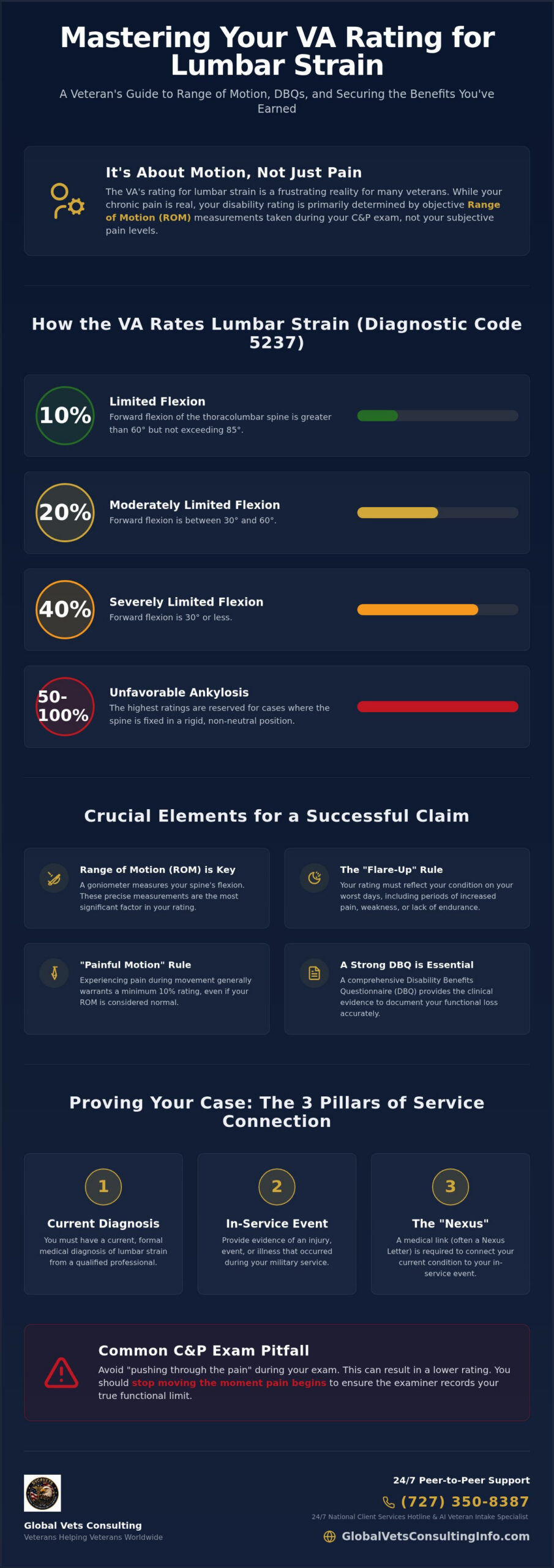
The VA assigns ratings of 10%, 20%, 40%, 50%, or 100% based on the severity of your spinal stiffness or movement loss. Most claims result in a 10% or 20% rating, as these reflect common limitations in forward flexion. A 40% rating is typically reserved for those who can only bend forward 30 degrees or less. The highest ratings, 50% and 100%, are only assigned in cases of unfavorable ankylosis. Unfavorable ankylosis is a total lack of movement in the spine where the joints have become fixed in a rigid, non-neutral position. In 2026, the VA continues to emphasize functional loss. Following the March 2026 updates to the “painful motion” rule, raters have clearer guidance to ensure veterans receive a compensable rating when pain limits their movement, even if the degree of motion isn’t otherwise compensable.
Service Connection Requirements for Back Pain
Securing benefits requires proving three specific elements. You must have a current medical diagnosis of lumbar strain and evidence of an injury or event that occurred during your service. The final piece is the “nexus,” which is the medical link between your current back issues and your military history. Establishing this connection is often the most difficult part of the process. Many veterans find that using a professional nexus letter and DBQ service provides the clinical evidence needed to satisfy VA raters. For worldwide support, you can reach our 24/7 intake specialist at (727) 350-8387 or visit https://www.GlobalVetsConsultingInfo.com.
The Role of Range of Motion (ROM) in Your VA Rating
The goniometer is the primary tool used by examiners to determine your Lumbar Strain VA Rating. This device measures the exact degrees you can bend forward, backward, and side-to-side. According to the VA Schedule of Ratings for the Musculoskeletal System, these measurements are the most significant factor in your claim’s success. It’s not just about how you move during the appointment; the VA must also consider the “Flare-up” rule, or DeLuca Criteria. This means your rating should reflect your functional loss during your worst days, including periods of increased pain, weakness, or lack of endurance.
If you experience “pain with motion,” the VA generally warrants a minimum 10% rating even if your range of motion falls within normal limits. When describing your symptoms, focus on how the pain limits your daily tasks like driving or lifting. If you need help understanding how these rules apply to your specific situation, you can access independent medical evidence education through our worldwide network.
Flexion and Extension Benchmarks
The following benchmarks are the standard used to assign a Lumbar Strain VA Rating based on physical movement:
- 10% Rating: Forward flexion of the thoracolumbar spine is greater than 60 degrees but does not exceed 85 degrees.
- 20% Rating: Forward flexion is between 30 and 60 degrees.
- 40% Rating: Forward flexion is 30 degrees or less, or there is evidence of favorable ankylosis.
Common Pitfalls During ROM Testing
A common mistake veterans make is “pushing through the pain” to show the examiner they’re trying. This often results in a lower rating because the examiner records the movement you forced rather than your actual functional limit. You should stop moving the moment pain begins during the measurement process. For 24/7 support with claim education, call our intake specialist at (727) 350-8387.
Strengthening Your Claim with a Lumbar Strain DBQ
A Disability Benefits Questionnaire (DBQ) is the essential tool the VA uses to capture clinical evidence for your claim. While the VA often schedules a C&P exam, these appointments can be brief and may not capture the full scope of your daily limitations. A private DBQ provides a comprehensive view of your condition, ensuring your Lumbar Strain VA Rating reflects the true severity of your back pain. Global Vets Consulting specializes in educating veterans on how to secure these vital documents through our worldwide support network. You can find more details in our guide on what is a dbq.
Secondary Conditions: Radiculopathy and Sciatica
Lumbar strain frequently causes secondary nerve issues known as radiculopathy or sciatica. These conditions manifest as tingling, numbness, or radiating pain in the legs. Under 38 C.F.R. § 4.71a, Schedule for Rating Musculoskeletal Disabilities, these neurological symptoms can be added (pyramided) on top of your primary Lumbar Strain VA Rating. This is an effective way to maximize your benefits, as the VA allows for multiple ratings when one injury causes separate functional impairments. Ensure your provider documents these neurological symptoms clearly during your evaluation.
Preventing a Claim Denial
Lack of medical evidence remains the top reason for back claim denials. If your va claim is denied for lack of evidence, it’s often because your records didn’t meet the VA’s strict documentation standards. To avoid this, call our 24/7 National Client Services Hotline at (727) 350-8387 or visit learn more to learn how to document your medical evidence correctly 🇺🇸.
Next Steps: Securing an Accurate VA Rating for Lumbar Strain 🇺🇸
Securing an accurate Lumbar Strain VA Rating requires more than just showing up to an appointment. It demands a proactive strategy that aligns your medical evidence with the VA’s specific criteria. Whether you’re filing for the first time or seeking a rating increase, your documentation must clearly reflect your functional loss. This isn’t about asking for a handout; it’s about securing the compensation you earned through your service to this country. A well-prepared veteran is always in the best position to succeed during a C&P examination.
Global Vets Consulting operates on a “Veterans Helping Veterans” model. We understand the physical toll of chronic back pain because we’ve been in your boots. Our mission is to serve as a steady guide through the complexities of the claims system. We prioritize transparency and clarity to reduce the anxiety often associated with the administrative process. By acting as a reliable partner, we help you move from confusion to a clear, predictable path forward.
How Global Vets Consulting Supports Your Mission
Our team provides expert education on Disability Benefits Questionnaires (DBQ) and independent medical evidence. This ensures your symptoms are documented with the meticulousness the VA requires. We offer a worldwide reach, supporting veterans regardless of their location. You don’t have to manage this process alone; we provide 24/7 access to support through multiple channels:
- 24/7 National Client Services Hotline: Call (727) 350-8387 for immediate assistance with your claim education needs.
- 24/7 AI Veteran Intake Specialist: Use our automated system at (727) 350-8387 for a streamlined start to your evidence gathering.
- Digital Resources: Visit learn more to explore our educational materials and peer-to-peer support options.
Taking the next step toward an accurate rating is a matter of preparation. By focusing on professional documentation and a clear plan, you can move forward with confidence. Reach out today to begin your journey toward the benefits you deserve.
Take Command of Your Future Benefits 🇺🇸
Understanding that your Lumbar Strain VA Rating depends on measurable Range of Motion is the first step toward a successful claim. You’ve learned that stopping at the first sign of pain during an exam and documenting secondary conditions like radiculopathy are vital strategies for accuracy. As a veteran-owned and operated organization, we’re dedicated to ensuring no veteran navigates this complex system alone. We specialize in DBQ and medical evidence education to help you bridge the gap between your physical reality and the VA’s documentation requirements.
Ready to secure the evidence your claim deserves? Contact Global Vets Consulting today or call our 24/7 National Client Services Hotline and 24/7 AI Veteran Intake Specialist at (727) 350-8387. Our worldwide support model provides the resources and confidence needed to achieve the results you’ve earned through your service. We’re standing by to help you finish this mission with the respect and integrity you deserve.
Frequently Asked Questions
Can I get a 100% VA rating for lumbar strain?
You can achieve a 100% rating, but it requires a very specific medical condition known as unfavorable ankylosis of the entire spine. This means your spine is fixed in a rigid, non-neutral position that prevents any movement. Most lumbar strain cases don’t reach this level of severity. Instead, ratings typically reflect the degree of movement loss you experience during daily life and your C&P examination.
What is the most common VA rating for lower back pain?
Most veterans receive a 10% or 20% Lumbar Strain VA Rating because these percentages align with common range of motion limitations. A 10% rating is often granted when you can bend forward more than 60 degrees but less than 85 degrees. If your forward flexion is between 30 and 60 degrees, you’ll likely receive 20%. These ratings reflect how your back pain restricts your ability to perform routine physical tasks.
How does radiculopathy affect my lumbar strain rating?
Radiculopathy is rated as a secondary condition, which means it’s added on top of your primary back rating rather than replacing it. This occurs when nerve damage in your lower spine causes numbness or tingling in your legs. By documenting these neurological symptoms, you can increase your total disability percentage. We provide 24/7 education on how to ensure your medical evidence captures these distinct functional impairments for an accurate evaluation.
What happens if my C&P examiner doesn’t use a goniometer?
If an examiner fails to use a goniometer, they’ve violated VA protocol, and you have grounds to challenge the results. VA regulations require the use of this tool to provide objective, precise measurements of your spinal movement. An estimate made by eye is often inaccurate and can lead to a lower rating. You should report this immediately to ensure your claim is based on the correct range of motion data.
How can a private DBQ help if my VA claim was previously denied?
A private Disability Benefits Questionnaire (DBQ) provides a more thorough medical record that can bridge the evidence gap responsible for your previous denial. Unlike a brief C&P exam, a private evaluation allows for a detailed review of your history and flare-ups. You can start this process 24/7 by calling our intake specialist at (727) 350-8387 or visiting https://www.GlobalVetsConsultingInfo.com to access our specialized medical evidence education services 🇺🇸.

Article by
Willie Daniel
Willie Daniel is the Founder and Chief Executive Officer (CEO) of Global Vets Consulting (GVC4Vets) – National Veterans Disability Services, a veteran-led educational and medical evidence support organization dedicated to helping veterans better understand VA disability rating increases, DBQ medical evidence, secondary claims education, and C&P examination preparation.
He is a retired U.S. Army Medical Service Corps Officer with more than 27 years of honorable military service, a decorated Iraq combat veteran, and a retired federal official with the U.S. Department of Veterans Affairs. Throughout his military and federal career, Willie Daniel served in leadership, healthcare administration, operational, and veteran-support roles focused on improving services and support systems for servicemembers, veterans, and their families.
Drawing from decades of military leadership, healthcare administration, veteran advocacy, and federal government experience, Willie Daniel brings a practical, veteran-centered perspective to Global Vets Consulting’s educational articles, AI-powered veteran resources, video education initiatives, and outreach programs. His experience navigating military systems, medical documentation processes, and veteran-related administrative operations provides valuable insight into many of the challenges veterans face when seeking to better understand VA disability rating criteria, medical evidence, documentation strategies, and secondary condition education.
Through GVC’s “Veterans Helping Veterans” mission, his focus is on delivering clear, educational, and easy-to-understand information designed to empower veterans with knowledge, resources, and educational tools that may help them make more informed decisions regarding their individual VA disability journeys.
The information provided through GVC is intended for educational and informational purposes only and should not be considered legal or medical advice.
Disclaimer
Disclaimer: Global Vets Consulting, LLC (“GVC”) is a veteran-led educational and medical evidence support organization. GVC is not a law firm, is not a Veterans Service Organization (VSO), and is not affiliated with the U.S. Department of Veterans Affairs (VA) or any government agency.
Global Vets Consulting does not provide legal advice, medical advice, medical treatment, or healthcare services. GVC does not prepare, file, or submit VA disability claims on behalf of veterans. All information provided through this website, blog articles, videos, educational materials, AI tools, dashboards, templates, and communications is intended solely for general educational and informational purposes.
Veterans are encouraged to consult with accredited representatives, licensed attorneys, qualified medical providers, or Veterans Service Organizations regarding their specific legal, medical, or VA-related matters. VA disability decisions, ratings, and outcomes are determined solely by the U.S. Department of Veterans Affairs based on applicable laws, regulations, medical evidence, and individual circumstances. Past results do not guarantee future outcomes.

