
What if the reason you’re currently underrated isn’t because your symptoms aren’t severe, but because the VA hasn’t seen them translated into their specific language? It’s a common struggle for many of us. You walk into a C&P exam feeling anxious, and you walk out feeling like you didn’t accurately describe your worst days. We understand that the process of securing a va rating for major depressive disorder feels like an uphill battle against a system that values paperwork over people. 🇺🇸
You’ve earned your benefits through service, and you deserve a rating that reflects the true impact of your mental health on your life. This guide will teach you exactly how the VA evaluates your claim under the current 38 C.F.R. § 4.130 criteria. We’ll show you how to use a Disability Benefits Questionnaire (DBQ) to provide the meticulous medical evidence required for a 70% or 100% rating. You’ll also learn about the 2026 COLA adjustments that increased compensation rates by 2.8% on December 1, 2025; this ensures you have the most up-to-date information to achieve the financial stability you deserve.
Key Takeaways
- Understand the General Rating Formula for Mental Disorders and how the VA evaluates your symptoms based on social and occupational impairment.
- Learn the specific symptom thresholds for each tier, from mild 10% ratings to the total occupational impairment required for a 100% rating.
- Discover why using a private Disability Benefits Questionnaire (DBQ) often provides more accurate medical evidence than a standard C&P examination.
- Identify strategies to secure a va rating for major depressive disorder by linking it as a secondary condition to existing physical disabilities like chronic pain.
- Gain clarity on the steps needed to file for a VA rating increase if your mental health symptoms have worsened since your last evaluation.
Understanding the VA Rating Schedule for Major Depressive Disorder
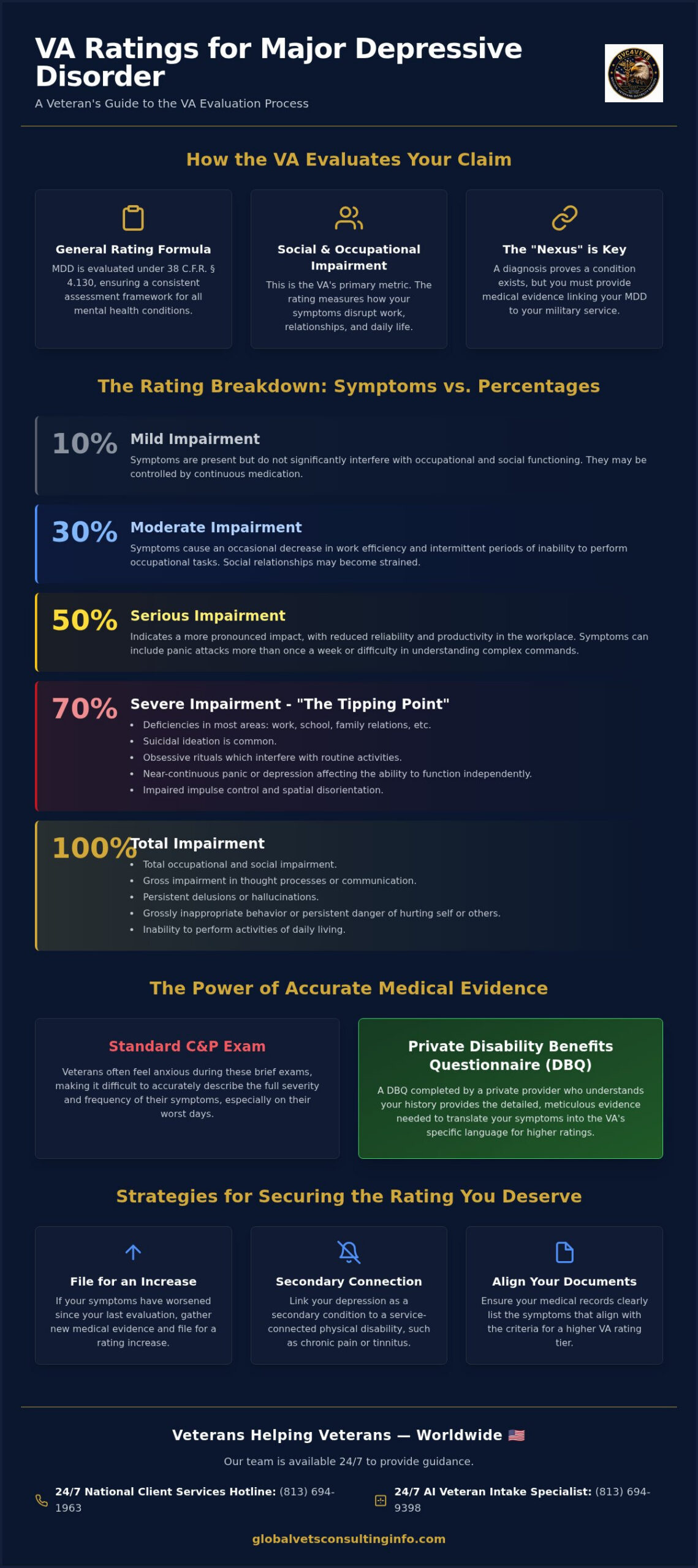
Major Depressive Disorder (MDD) is evaluated using the General Rating Formula for Mental Disorders. This framework ensures that every veteran receives a consistent assessment, regardless of their specific diagnosis. The VA assigns a va rating for major depressive disorder in specific increments:
- 0% and 10%: Mild symptoms or symptoms controlled by medication.
- 30% and 50%: Moderate impairment affecting work productivity and reliability.
- 70% and 100%: Severe impairment or total occupational and social disability.
Social and Occupational Impairment is the VA’s primary metric for mental health severity, focusing on how your condition disrupts your ability to perform work tasks and maintain healthy relationships with others. The rater isn’t looking at how you feel on your best days, but how the condition limits you on your worst ones. Accuracy in your medical documentation is vital to ensure your rating matches your reality.
The Role of 38 CFR § 4.130 in Your Claim
The VA uses a federal regulation known as 38 CFR § 4.130 to standardize evaluations. This rulebook ensures that a rater uses the same criteria for every claim. You’ll likely notice that the VA groups conditions like PTSD, anxiety, and depression into a single rating. They do this because mental health symptoms often overlap. Instead of “pyramiding” or giving multiple ratings for the same symptoms, they evaluate the total functional impact of all your mental health conditions combined to reach a final decision.
Why Your Diagnosis is Only the Beginning
A clinical diagnosis from a doctor is a critical first step, but it doesn’t automatically determine your disability percentage. A diagnosis proves the condition exists, while the rating measures the severity of that condition’s impact on your life. To secure a successful va rating for major depressive disorder, you must establish a “nexus.” This is the medical evidence linking your depression to your military service. Without a clear connection to your time in uniform, even a severe diagnosis won’t result in the benefits you’ve earned through your service.
The 0% to 100% Breakdown: Symptoms vs. Disability Ratings
Many veterans feel stuck at a 30% or 50% rating because their medical records don’t capture the full extent of their struggle. To fix this, you must align your documented symptoms with the VA’s specific percentage tiers. This ensures that the rater sees a clear picture of your daily reality rather than just a list of medications. 🇺🇸
- 0% to 10%: These ratings are for mild symptoms. You might have a diagnosis and take medication, but your condition doesn’t significantly interfere with your work or social life.
- 30% to 50%: This is where impairment becomes more evident. You likely experience an occasional decrease in work efficiency or periods of inability to perform tasks. Relationships might start to feel strained due to mood swings or lack of motivation.
- 70%: Often called the ‘tipping point,’ this rating reflects deficiencies in most areas of life. It includes near-continuous panic, suicidal ideation, or an inability to maintain healthy relationships.
- 100%: This is reserved for total occupational and social impairment. It often involves an inability to perform basic activities of daily living or a complete disconnect from reality.
If you feel your current symptoms don’t match your paperwork, reviewing educational resources on mental health ratings can help you identify the missing links in your evidence.
What Does a 70% Rating for MDD Look Like?
A 70% va rating for major depressive disorder is one of the most common targets for veterans seeking an increase. At this level, the VA recognizes that your depression causes significant issues in nearly every aspect of your life. Symptoms might include obsessive rituals that interfere with daily activities; for example, repetitive checking or cleaning. You might also struggle with speech impairment or spatial disorientation. These symptoms make it incredibly difficult to hold a steady job or interact with family without significant friction.
Criteria for a 100% Total Disability Rating
Securing a 100% rating requires proving total occupational and social impairment through meticulous documentation. The medical evidence must show that your symptoms are so severe that you cannot work and struggle to care for yourself. This might include persistent delusions or grossly inappropriate behavior. It’s different from Total Disability Individual Unemployability (TDIU). While 100% is a schedular rating based on symptom severity, TDIU allows you to be paid at the 100% rate even if your MDD is only rated at 70%, provided you can prove you’re unable to maintain substantially gainful employment because of your service-connected conditions.
How a Mental Health DBQ Proves Your MDD Severity
A Disability Benefits Questionnaire (DBQ) serves as the primary tool the VA uses to translate your mental health symptoms into a numerical percentage. Think of it as a standardized checklist. If a symptom isn’t checked on this form, the VA rater essentially assumes it doesn’t exist. This is why understanding what is a DBQ for VA claims is vital for anyone seeking a fair va rating for major depressive disorder. 🇺🇸
The Mental Health DBQ focuses on three main areas: your clinical diagnosis, the frequency of your symptoms, and the specific functional impact those symptoms have on your life. While a VA examiner might only spend 20 minutes with you during a C&P exam, a private physician can take the time to document the full scope of your condition. This thoroughness is often the difference between a 30% rating and the 70% rating you actually deserve based on your daily struggles.
The Advantage of Private Medical Evidence
Relying solely on a C&P examiner can be risky. These exams are often rushed and may not capture the nuances of your “worst days.” Submitting a private DBQ completed by a qualified mental health professional provides a powerful counterweight to a negative or incomplete C&P report. It ensures that your medical evidence is comprehensive and accurately reflects your social and occupational impairment. If you’re ready to take control of your documentation, you can explore our Disability Benefits Questionnaire (DBQ) education to learn how to prepare your evidence properly.
Avoiding Common DBQ Mistakes
One of the biggest mistakes veterans make is assuming the VA will find the evidence for them. Every symptom you experience must be explicitly checked on the form. If you suffer from suicidal ideation or near-continuous panic but the box isn’t checked, the rater won’t consider those factors. Use the “Remarks” section of the DBQ to provide specific examples of your most difficult days. This section allows your provider to detail the specific ways your depression prevents you from functioning in a work environment or maintaining family bonds. Precision here is the key to securing your earned benefits.
Strategies for Rating Increases and Secondary Service Connection
If your mental health has deteriorated since your last evaluation, don’t feel obligated to settle for an outdated percentage. You have the right to file for a VA rating increase when your condition worsens. Many veterans find that their initial va rating for major depressive disorder was based on a snapshot of time that no longer reflects their current social or occupational impairment. Learning how to use a DBQ for a VA disability rating increase is the most effective way to ensure the VA sees the full scope of your current symptoms.
Establishing a secondary service connection is another powerful strategy for securing the benefits you’ve earned. This involves linking your depression to an existing service-connected physical ailment. To do this successfully, you’ll need a Nexus Letter. This document provides a professional medical opinion stating that your mental health condition is “at least as likely as not” caused or aggravated by your primary physical disability. This bridge between conditions is often the key to a successful claim.
Depression Secondary to Tinnitus or Chronic Pain
The VA recognizes the heavy psychological toll that persistent physical conditions take on a person. For example, the constant, intrusive ringing of tinnitus can lead to sleep deprivation, chronic irritability, and eventually severe depression. Similarly, chronic back or joint pain often results in social isolation and a loss of physical identity. You must document this chain of causation in your medical records. By showing how the physical pain led directly to the mental health symptoms you’re experiencing today, you build a stronger case for a va rating for major depressive disorder as a secondary condition.
Next Steps: Gathering Your Evidence 🇺🇸
Start by reviewing your current award letter and identifying gaps in your symptoms list. If your documentation doesn’t match your reality, it’s time to take action. We’re here to provide the expert guidance and medical evidence education you need to move forward with confidence. 🇺🇸
- 🌐 Website: GlobalVetsConsultingInfo.com
- 📞 24/7 National Client Services Hotline: Contact us anytime for support.
- 🤖 24/7 AI Veteran Intake Specialist: Available on our website for immediate guidance.
- 🌍 Worldwide Support: Veterans Helping Veterans, no matter where you’re located.
Don’t let an inaccurate rating impact your financial stability. With the 2.8% COLA adjustment for 2026 now in effect, ensuring your rating is accurate is more important than ever for your long-term well-being. Reach out today to start the process of securing the rating you’ve earned through your service.
Secure the Benefits You’ve Earned
Understanding the VA’s rating schedule is only the first step toward the compensation you deserve. You now know that the VA evaluates your va rating for major depressive disorder based on how your symptoms disrupt your work and relationships. By focusing on meticulous medical evidence and utilizing a professional DBQ, you can present a clear picture of your social and occupational impairment to the rater. This documentation is the bridge between feeling underrated and securing a rating that matches your reality.
We’ve been veteran-owned and operated since 2021, and we’re dedicated to helping you navigate this complex system with steady confidence. Whether you need education on professional DBQ preparation or assistance identifying secondary service connections, we have the expertise to guide you. You can even access our 24/7 AI Veteran Intake Specialist right now to begin your journey. Get the medical evidence you need for your VA claim—Start with Global Vets Consulting today! You served your country with honor, and you don’t have to face the bureaucracy alone. It’s time to take the next step toward the stability you’ve earned.
Frequently Asked Questions
What is the average VA rating for major depressive disorder?
The most common va rating for major depressive disorder typically falls between 30% and 70% based on the severity of your symptoms. While the VA doesn’t publish a single official average, many veterans receive a 50% rating when their symptoms cause noticeable decreases in work productivity. Your specific rating depends entirely on the social and occupational impairment documented in your medical evidence rather than a general industry standard.
Can the VA reduce my disability rating for depression in 2026?
The VA has the authority to reduce your rating if your medical records show sustained improvement in your mental health over a period of time. However, the VA must follow strict rules before making a change, especially if you’ve held your rating for five years or more. You can protect your rating by ensuring your healthcare providers accurately document your “worst days” to show that any improvement isn’t just a temporary fluctuation.
What is the difference between MDD and PTSD for VA rating purposes?
There is no functional difference in the percentage assigned because the VA evaluates both conditions using the same General Rating Formula for Mental Disorders. The VA rater looks at your total level of impairment rather than the specific label of your diagnosis. Whether you are seeking a va rating for major depressive disorder or PTSD, the criteria for 30%, 50%, 70%, or 100% remain identical under federal law.
How do I prove my depression is service-connected without medical records from the military?
You can establish service connection by using buddy statements, lay evidence, and a professional Nexus letter to bridge the gap in your records. Buddy statements from fellow service members can verify that your symptoms began during your time in uniform even if you didn’t visit a clinic. A Nexus letter from a qualified doctor then provides the medical opinion necessary to link those early symptoms to your current clinical diagnosis.
Can I get 100% VA disability for depression alone?
You can receive a 100% schedular rating for depression if your evidence proves total occupational and social impairment. This requires showing that your symptoms are so severe that you cannot maintain employment and struggle with basic daily self-care or social boundaries. If your symptoms don’t quite meet the 100% criteria but still prevent you from working, you might consider applying for Total Disability Individual Unemployability (TDIU) instead.

Article by
Willie Daniel
Willie Daniel is the Founder and Chief Executive Officer (CEO) of Global Vets Consulting (GVC4Vets) – National Veterans Disability Services, a veteran-led educational and medical evidence support organization dedicated to helping veterans better understand VA disability rating increases, DBQ medical evidence, secondary claims education, and C&P examination preparation.
He is a retired U.S. Army Medical Service Corps Officer with more than 27 years of honorable military service, a decorated Iraq combat veteran, and a retired federal official with the U.S. Department of Veterans Affairs. Throughout his military and federal career, Willie Daniel served in leadership, healthcare administration, operational, and veteran-support roles focused on improving services and support systems for servicemembers, veterans, and their families.
Drawing from decades of military leadership, healthcare administration, veteran advocacy, and federal government experience, Willie Daniel brings a practical, veteran-centered perspective to Global Vets Consulting’s educational articles, AI-powered veteran resources, video education initiatives, and outreach programs. His experience navigating military systems, medical documentation processes, and veteran-related administrative operations provides valuable insight into many of the challenges veterans face when seeking to better understand VA disability rating criteria, medical evidence, documentation strategies, and secondary condition education.
Through GVC’s “Veterans Helping Veterans” mission, his focus is on delivering clear, educational, and easy-to-understand information designed to empower veterans with knowledge, resources, and educational tools that may help them make more informed decisions regarding their individual VA disability journeys.
The information provided through GVC is intended for educational and informational purposes only and should not be considered legal or medical advice.
Disclaimer
Disclaimer: Global Vets Consulting, LLC (“GVC”) is a veteran-led educational and medical evidence support organization. GVC is not a law firm, is not a Veterans Service Organization (VSO), and is not affiliated with the U.S. Department of Veterans Affairs (VA) or any government agency.
Global Vets Consulting does not provide legal advice, medical advice, medical treatment, or healthcare services. GVC does not prepare, file, or submit VA disability claims on behalf of veterans. All information provided through this website, blog articles, videos, educational materials, AI tools, dashboards, templates, and communications is intended solely for general educational and informational purposes.
Veterans are encouraged to consult with accredited representatives, licensed attorneys, qualified medical providers, or Veterans Service Organizations regarding their specific legal, medical, or VA-related matters. VA disability decisions, ratings, and outcomes are determined solely by the U.S. Department of Veterans Affairs based on applicable laws, regulations, medical evidence, and individual circumstances. Past results do not guarantee future outcomes.