

What if the outcome of your disability claim has less to do with your daily pain and more to do with the specific medical keywords buried in your file? It’s a frustrating reality for many veterans who feel like they’re shouting into a void while waiting an average of 72.3 days for a decision. When you ask what does a va rater look for, it’s easy to feel overwhelmed by the 551,895 pending claims currently sitting in the VA system. You deserve to know how decision-makers evaluate your evidence so you can stop fearing a denial due to a supposed lack of evidence.
We understand that navigating the VA bureaucracy feels like a high-stakes puzzle where the instructions are written in code. This guide will show you exactly how to document your symptoms to match the 2026 rating criteria and the recent 2.8% COLA adjustments. You’ll learn the importance of the Caluza Triangle, how to utilize Disability Benefits Questionnaires (DBQs), and the precise data points raters use to assign a rating. We’re going to provide a clear roadmap to help you turn your medical history into a decision-ready claim that secures the benefits you earned. 🇺🇸
Key Takeaways
- Master the “Caluza Triangle” to ensure your claim includes a current diagnosis, an in-service event, and a clear medical nexus.
- Discover what does a va rater look for within the 38 CFR Part 4 criteria to translate your symptoms into the highest possible disability percentage.
- Learn how to use a Disability Benefits Questionnaire (DBQ) as a standardized tool that provides raters with the exact data points they need to approve your claim.
- Identify the specific keywords and evidence required to document “functional loss” and demonstrate how your condition impacts your daily life.
- Find out how to organize your medical records chronologically to present a decision-ready claim that avoids common delays and denials.
The VA Rater’s Checklist: The Three Pillars of a Successful Claim
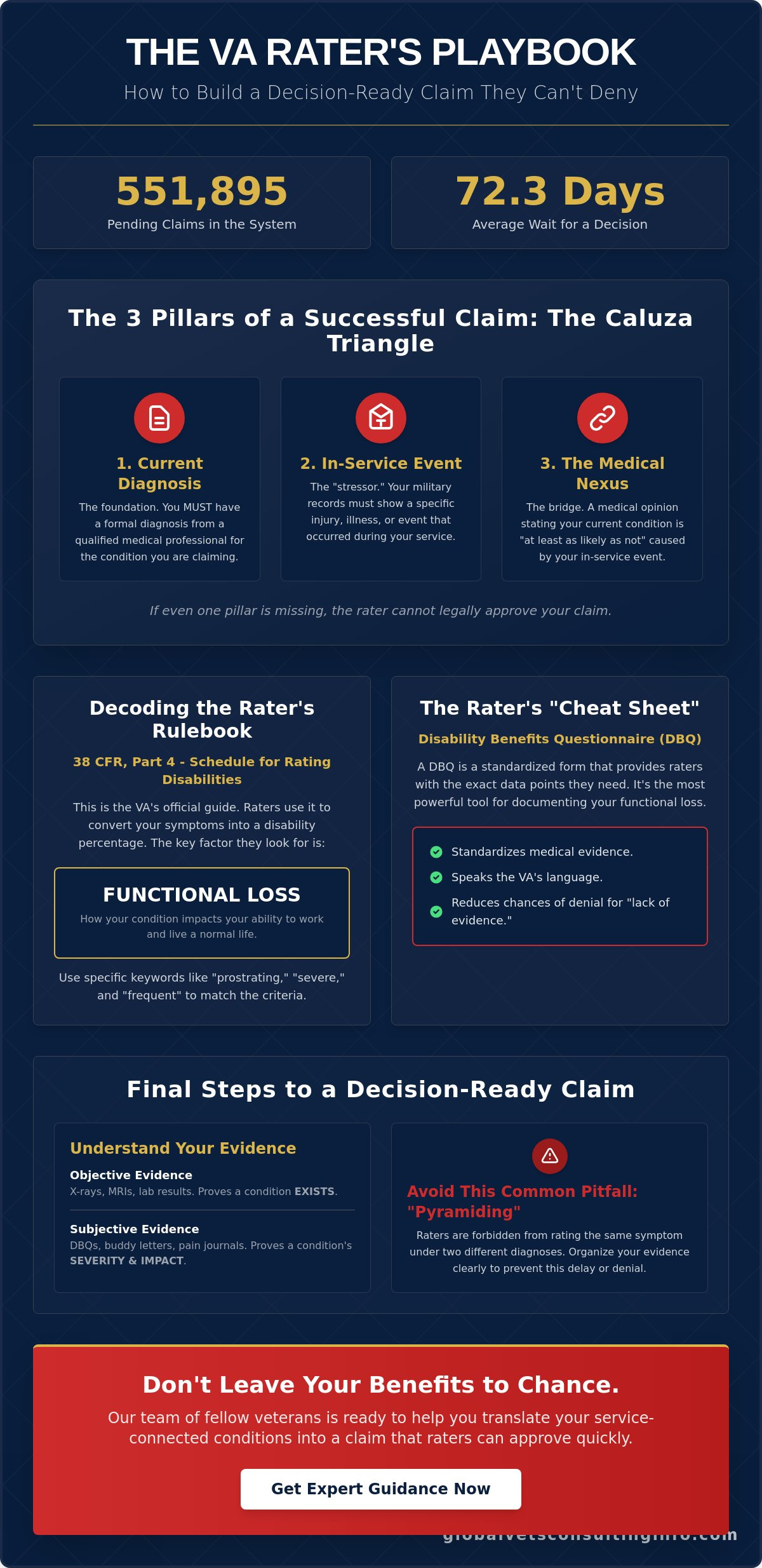
To understand what does a va rater look for, you must first understand the legal framework they follow. This framework is often called the “Caluza Triangle.” It consists of three non-negotiable pillars that must be present in your medical evidence. If even one pillar is missing, the rater cannot legally approve your VA disability claim. 🇺🇸
- A Current Medical Diagnosis: This is the foundation of your entire claim. You need a formal diagnosis from a qualified medical professional that exists at the time you file. Without a current diagnosis, the rater cannot proceed, regardless of how much pain you’re in.
- An In-Service Event or Injury: Your military records must show a specific “stressor,” injury, or illness that occurred during your service. This is the “event” that started the problem.
- The Medical Nexus: This is the medical bridge. It’s an opinion from a medical provider stating that your current condition is “at least as likely as not” caused by your military service.
The Role of the RVSR (Rating Veterans Service Representative)
The person reviewing your file is officially known as a Rating Veterans Service Representative (RVSR). These individuals work within the Veterans Benefits Administration (VBA) and often manage heavy workloads with strict production quotas. Because they process a high volume of files, they look for “decision-ready” evidence. Clarity is your best ally. When you provide organized documentation that allows them to check their required boxes quickly, you reduce the risk of a denial based on a simple oversight.
Direct vs. Secondary Service Connection
Raters also evaluate whether your condition has a direct or secondary connection to your service. A direct connection is straightforward; you hurt your back while on jump status, and it still hurts today. A secondary connection is more complex. This happens when a service-connected disability causes or worsens a separate medical issue. For example, if your service-connected tinnitus leads to secondary anxiety, the rater looks for evidence of that relationship. You can learn how to prove service connection to ensure your medical evidence clearly identifies these links for the rater.
Decoding the Rating Schedule: How Raters Translate Symptoms into Percentages
The VA rater’s “Bible” is Title 38 of the Code of Federal Regulations, specifically Part 4. This document contains the Schedule for Rating Disabilities, which dictates exactly how many percentage points each symptom is worth. When you wonder what does a va rater look for, the answer is “functional loss.” The rater isn’t just checking if you have a condition; they’re looking at how that condition interferes with your ability to work and live. 🇺🇸
Raters look for specific trigger words that match the criteria in the rating schedule. For example, keywords like “prostrating” in a migraine claim or “severe” and “frequent” in mental health documentation can move you into a higher percentage bracket. They evaluate the frequency, duration, and intensity of your episodes to determine where you fit on the scale. Understanding these technicalities is a key part of learning how to file a VA disability claim successfully. If you need help understanding these levels, our VA benefits education can help you identify the right evidence.
Subjective vs. Objective Evidence
Objective evidence like MRIs or X-rays proves the existence of a physical abnormality, but it doesn’t always tell the whole story. Raters use Disability Benefits Questionnaires (DBQs) to understand the severity of your symptoms. While a scan shows a herniated disc, the DBQ records your range of motion and pain levels. When asking what does a va rater look for, remember they prioritize medical opinions that are “competent and credible.” This means they’re looking for evidence backed by clinical findings rather than just personal statements from friends or family.
The ‘Pyramiding’ Rule
Raters are strictly trained to avoid “pyramiding.” This is the practice of rating the same symptom under two different diagnostic codes. For example, if you have two different respiratory conditions that both cause shortness of breath, the VA will usually only grant one rating based on that shared symptom. You can avoid common VA disability claim mistakes by ensuring your documentation clearly distinguishes between separate symptoms and how they individually impact your health.
The DBQ as a ‘Cheat Sheet’: Why Medical Documentation is the Rater’s Best Friend
VA raters love Disability Benefits Questionnaires (DBQs) because they eliminate guesswork. These forms are designed to follow the VA Schedule for Rating Disabilities perfectly, providing the rater with a standardized map of your condition. When you ask what does a va rater look for, the answer is often found in the checkboxes of a well-prepared DBQ. These documents ensure that your medical evidence is presented in the exact language the rater needs to justify a specific percentage. 🇺🇸
A private DBQ is a powerful tool because it allows you to capture symptom severity that a brief Compensation and Pension (C&P) exam might overlook. While a C&P examiner may only spend 15 minutes with you, a private medical provider can document the full scope of your daily struggles. This thoroughness is essential for creating a “decision-ready” claim. You can read more about what is a DBQ and why it matters to see how these forms streamline the process for both you and the rater.
Standardizing Your Medical Evidence
Raters look for specific evidence markers to justify 30%, 50%, or 70% ratings. By using a standardized DBQ, you reduce the rater’s “administrative burden.” This is a significant advantage in a system where the VA accuracy rate is currently 94.02% but the backlog remains over 100,000 claims. When a rater can quickly verify that your symptoms meet the legal criteria, they can issue a decision faster. If you are ready to strengthen your file, you can explore our Disability Benefits Questionnaire (DBQ) education to ensure your evidence is rater-ready.
Mental Health Ratings and Rater Observations
For mental health claims, raters focus heavily on “social and industrial impairment.” They aren’t just looking at a diagnosis; they are looking at how your PTSD, anxiety, or depression affects your ability to hold a job and maintain relationships. What does a va rater look for in these cases? They look for documented evidence of suicidal ideation, panic attacks, or inability to perform daily tasks. Following a guide to mental health DBQs can help you ensure these critical impairment levels are clearly communicated to the rater.
Avoiding the ‘Lack of Evidence’ Trap: Final Steps to a Decision-Ready Claim
A denial for “lack of evidence” is often a failure of organization rather than a lack of medical truth. When you consider what does a va rater look for during the final review, they want a file that is easy to navigate. If a rater has to hunt through hundreds of pages of unorganized records, the risk of a mistake increases. 🇺🇸
- Chronological Organization: Arrange your medical records by date. This helps the rater see the progression of your condition from service to the present.
- The Nexus Letter: If your diagnosis came years after you hung up the uniform, a clear Nexus letter is vital. It provides the “medical bridge” the rater needs to link your current pain to your past service.
- Fully Developed Claims (FDC): By submitting an FDC, you explicitly tell the VA you have no more evidence to provide. This can expedite the process, as it signals the rater can move straight to a decision.
- Credential Verification: Double-check that every Disability Benefits Questionnaire (DBQ) is signed by a qualified medical professional. A missing signature or an invalid license number can stall your claim for months.
The Power of a Decision-Ready Claim (DRC)
A Decision-Ready Claim is one where all the work is done before it hits the rater’s desk. This approach can significantly cut down on the “Evidence Gathering” phase, which is where many claims sit for the majority of the current 72.3-day average processing time. Raters are far more likely to grant an increase when the evidence is clearly mapped to the rating criteria from the moment of submission. It reduces their administrative burden and allows them to maintain their 94.02% accuracy rate while moving your file toward a favorable outcome.
Immediate Steps for Veterans
Your path forward starts with a clear assessment of your current health. Review your records and compare your symptoms to the VA rating increase criteria to see where you may be underrated. 🌐
📞 24/7 National Client Services Hotline: Call us anytime to speak with a dedicated veteran advocate about your medical evidence needs.
💻 24/7 AI Veteran Intake Specialist: Visit GlobalVetsConsultingInfo.com to start your education on the claims process today.
Take Control of Your Disability Claim Outcome 🇺🇸
Success in the VA claims process is not a matter of luck. It’s a matter of providing the right medical data points. By mastering the Caluza Triangle and aligning your symptoms with the 38 CFR Part 4 schedule, you remove the guesswork for the person reviewing your file. Understanding exactly what does a va rater look for allows you to move from a state of uncertainty to a position of strength.
Remember that a decision-ready claim relies on standardized documentation like the DBQ. This form ensures your functional loss is documented in the technical language the VA requires for a fair rating. Organizing your records chronologically and securing a valid nexus letter are the final steps to avoiding the common “lack of evidence” denial. These details make the difference between a fast approval and a long appeal.
Ready to submit a decision-ready claim? Get your professional DBQ from Global Vets Consulting today. We are a veteran-owned and operated team specialized in DBQ preparation for all major conditions. You can also engage with our 24/7 AI Veteran Intake Specialist to start your journey. You earned these benefits through your service. We are here to help you document them correctly.
Frequently Asked Questions
Can a VA rater deny a claim if I have a diagnosis?
Yes, a rater can deny your claim even with a current diagnosis if the other two pillars of service connection are missing. The rater must verify that an injury or event occurred during your military service and that a medical nexus links the two. Without these connections, a diagnosis alone does not meet the legal requirements for compensation. This is why organized evidence is critical for every veteran.
How much weight do raters give to private DBQs vs. C&P exams?
VA raters are legally required to give equal weight to private DBQs and C&P exams as long as the private evidence is competent and credible. However, there is a 2026 trend of increased scrutiny regarding private documentation to ensure quality and prevent fraud. When you ask what does a va rater look for in these forms, they prioritize detailed clinical findings and a clear rationale that mirrors the VA’s own rating schedule.
What is the ‘Duty to Assist’ and how does it affect the rater?
The Duty to Assist is the VA’s legal obligation to help you obtain the evidence needed to support your claim, such as service medical records or federal documents. It’s important to realize this duty has limits. If the records don’t exist or private providers don’t respond, the rater can move forward with a decision based on the available file. Providing a decision-ready claim ensures you aren’t relying solely on this administrative process.
Do VA raters look at my social media accounts?
VA raters don’t typically browse social media for every claim, but the VA’s Office of Inspector General may use public posts during fraud investigations. If your reported physical limitations or mental health symptoms are directly contradicted by public photos or videos, it can create credible evidence of an inconsistency. It is best to ensure your documented symptoms in your medical file accurately reflect your daily reality.
How long does a VA rater take to make a decision in 2026?
The average time for a VA rater to decide a claim was 72.3 days in April 2026, which is a significant decrease from previous years. This faster pace is part of a broader effort that saw the claims backlog drop to 100,115 pending cases by January 2026. While processing times have improved by 43% since the start of the current administration, submitting a complete file remains the best way to avoid delays.

Article by
Willie Daniel
Willie Daniel is the Founder and Chief Executive Officer (CEO) of Global Vets Consulting (GVC) – National Veterans Disability Services, a veteran-led educational and medical evidence support organization dedicated to helping veterans better understand VA disability rating increases, DBQ medical evidence, secondary claims education, and C&P examination preparation.
He is a retired U.S. Army Medical Service Corps Officer with more than 27 years of honorable military service, a decorated Iraq combat veteran, and a retired federal official with the U.S. Department of Veterans Affairs. Throughout his military and federal career, Willie Daniel served in leadership, healthcare administration, operational, and veteran-support roles focused on improving services and support systems for servicemembers, veterans, and their families.
Drawing from decades of military leadership, healthcare administration, veteran advocacy, and federal government experience, Willie Daniel brings a practical, veteran-centered perspective to Global Vets Consulting’s educational articles, AI-powered veteran resources, video education initiatives, and outreach programs. His experience navigating military systems, medical documentation processes, and veteran-related administrative operations provides valuable insight into many of the challenges veterans face when seeking to better understand VA disability rating criteria, medical evidence, documentation strategies, and secondary condition education.
Through GVC’s “Veterans Helping Veterans” mission, his focus is on delivering clear, educational, and easy-to-understand information designed to empower veterans with knowledge, resources, and educational tools that may help them make more informed decisions regarding their individual VA disability journeys.
The information provided through GVC is intended for educational and informational purposes only and should not be considered legal or medical advice.
Disclaimer
Disclaimer: Global Vets Consulting, LLC (“GVC”) is a veteran-led educational and medical evidence support organization. GVC is not a law firm, is not a Veterans Service Organization (VSO), and is not affiliated with the U.S. Department of Veterans Affairs (VA) or any government agency.
Global Vets Consulting does not provide legal advice, medical advice, medical treatment, or healthcare services. GVC does not prepare, file, or submit VA disability claims on behalf of veterans. All information provided through this website, blog articles, videos, educational materials, AI tools, dashboards, templates, and communications is intended solely for general educational and informational purposes.
Veterans are encouraged to consult with accredited representatives, licensed attorneys, qualified medical providers, or Veterans Service Organizations regarding their specific legal, medical, or VA-related matters. VA disability decisions, ratings, and outcomes are determined solely by the U.S. Department of Veterans Affairs based on applicable laws, regulations, medical evidence, and individual circumstances. Past results do not guarantee future outcomes.

