
What if the difference between a 30% and a 70% VA rating isn’t your actual medical condition, but how that condition is translated onto a single piece of paper? For many veterans, the process of filing a claim feels like a battle against a system that speaks a language you don’t understand. You might be wondering, what is a dbq for va claims, and why does everyone say it’s the key to your benefits? It’s completely normal to feel anxious about C&P exams with unknown doctors or to fear a denial because of “insufficient evidence.” You’ve earned these benefits through your service, and the paperwork shouldn’t stand in your way. 🇺🇸
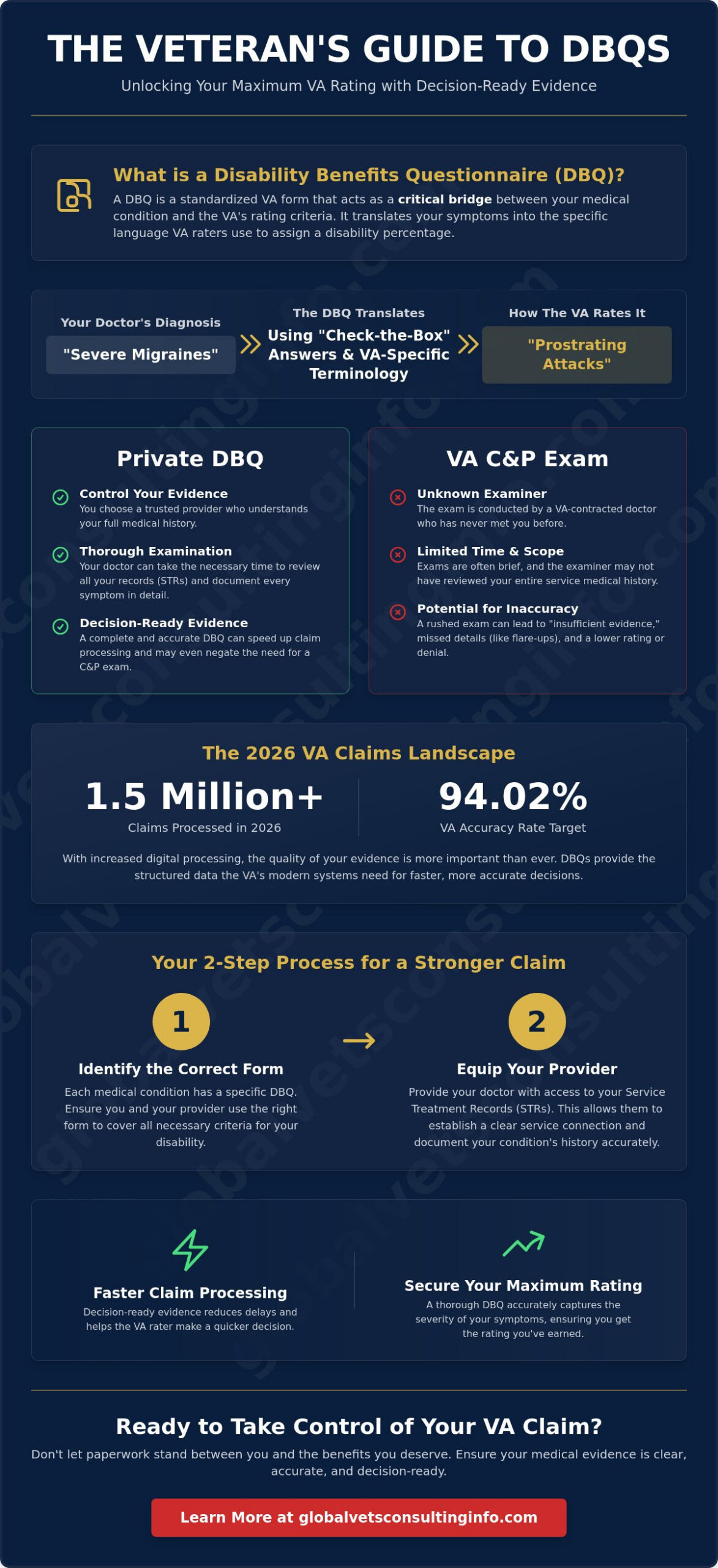
We understand that navigating the VA’s medical criteria can feel overwhelming. This guide will show you exactly how Disability Benefits Questionnaires (DBQs) function as the critical link between your medical diagnosis and a successful VA disability rating. With the VA processing over 1.5 million claims so far in 2026 and maintaining a 94.02% accuracy rate, the quality of your evidence is more important than ever. We’ll break down the “medical-speak” so you can document your symptoms with precision. You’ll gain a clear understanding of how to use these forms to speed up your claim and secure the maximum rating you deserve.
Key Takeaways
- Learn how DBQs act as a standardized bridge that translates your medical symptoms directly into the specific language of VA rating criteria.
- Understand what is a dbq for va claims and how these forms use “check-the-box” questions to accurately document flare-ups and range of motion.
- Discover the strategic advantage of private DBQs, which allow a doctor of your choice to conduct a thorough review of your entire medical history.
- Master the two-step process for identifying the correct form for your condition and ensuring your provider has access to your Service Treatment Records (STRs).
- Find out how high-quality, decision-ready evidence can lead to faster claim processing and help you secure the maximum VA rating increase you’ve earned.
Understanding the Disability Benefits Questionnaire (DBQ) and Its Role
A Disability Benefits Questionnaire (DBQ) is more than just another government document; it’s a strategic tool designed to streamline the evaluation of your disability claim. When you ask what is a dbq for va claims, you’re essentially looking for the bridge between your medical diagnosis and your final disability rating. These standardized forms cover nearly every service-connected condition, ranging from musculoskeletal injuries to complex mental health issues. They’re vital because they translate your physical or psychological symptoms into the specific language used by VA rating specialists to determine your benefits.
Why the VA Uses Standardized Forms
The VA uses these standardized documents to ensure every veteran is evaluated using the same medical benchmarks. This consistency is meant to create a fair playing field for everyone, regardless of which doctor performs the exam. By using a uniform format, the VA reduces the time rating specialists spend searching through disorganized medical records. Key roles of these forms include:
- Consistency: Ensures that identical symptoms are rated the same way across different VA regional offices.
- Efficiency: Provides a “check-the-box” style that matches the VA Schedule for Rating Disabilities (VASRD) criteria.
- Detail: Captures the specific severity of symptoms, such as range of motion or frequency of flare-ups, that determine your percentage.
The 2026 Shift in Evidence Requirements
In 2026, the VA has significantly increased its focus on digital processing and automated systems. This shift means that having high-quality medical evidence for VA disability claim is more critical now than it has ever been. DBQs fit perfectly into this automated landscape because they provide structured data that the VA’s modern systems can quickly analyze. If your evidence is disorganized or doesn’t follow this format, your claim might stall in the backlog. Using a DBQ ensures your symptoms are documented in a way that aligns with the VA’s digital-first approach, helping you reach a decision much faster.
How DBQs Standardize Medical Evidence for VA Ratings
A DBQ functions as a high-precision filter for your medical data. Instead of requiring a rater to interpret pages of handwritten doctor’s notes, these forms use a “check-the-box” style that corresponds directly to specific VA disability percentages. This structure is intentional. It allows your physician to document critical data points like range of motion, frequency of flare-ups, and specific symptoms with clinical accuracy. When you understand what is a dbq for va claims, you see that it provides a clear roadmap for the VA rater to determine if your condition meets the 30%, 50%, or 70% rating criteria.
This standardization is especially powerful when documenting secondary conditions. For instance, if you’re dealing with radiculopathy secondary to back condition, the DBQ ensures the nerve issues are properly linked to the primary spinal injury. Without this specific format, a rater might miss the connection, leading to a lower overall rating or a partial denial. If you need help understanding these connections, exploring educational resources for secondary claims can provide much-needed clarity.
Translating Symptoms into VA Language
Your doctor might describe your migraines as “severe,” but the VA looks for the word “prostrating.” A mental health note might mention “difficulty with friends,” but the rating schedule requires evidence of “social and industrial impairment.” DBQs bridge this gap by prompting doctors to use the exact terminology found in the VA’s legal requirements. This translation ensures your symptoms aren’t lost in a sea of general medical jargon.
The Connection to the Rating Schedule
The structure of every completed DBQ mirrors the exact requirements laid out in 38 CFR Part 4, which is the legal foundation for all VA ratings. Because of this alignment, a thoroughly completed form acts as a “cheat sheet” for the VA rating specialist, showing them exactly where your condition fits within the law.
Private DBQs vs. C&P Exams: Taking Control of Your Evidence
One of the biggest sources of stress in the disability process is the Compensation and Pension (C&P) exam. Often, a VA-contracted doctor who only sees you for a few minutes determines your future. This is where understanding what is a dbq for va claims becomes a game-changer. By choosing a private DBQ, you work with a doctor of your own choosing who can review your entire medical history. This approach allows you to submit a “Fully Developed Claim,” which can often help you avoid the C&P exam entirely. It puts the power back in your hands by ensuring your medical records are interpreted by someone who understands your long-term health journey.
Taking control of your evidence reduces the anxiety of explaining your worst days to a stranger in a clinical setting. Instead of hoping an examiner captures your symptoms correctly, you provide the VA with a completed form that already speaks their language. If you’re ready to take this step, you can access our DBQ educational resources to learn how to document your condition effectively.
When to Consider an Independent Medical Opinion
Sometimes a standard form isn’t enough. In complex or previously denied cases, the value of an independent medical opinion (IMO) for VA claims cannot be overstated. While a DBQ documents the severity of your symptoms, an IMO provides the “nexus” or medical link between your service and your current condition. This combination is often the deciding factor in winning a difficult claim, as it provides the scientific rationale the VA requires for service connection.
Pros and Cons of the Private Route
Choosing the private route involves several factors to consider. The “pros” include receiving detailed evidence from a provider you trust, which often leads to faster decisions. In early 2026, the average claim completion time dropped to 80.7 days, and decision-ready evidence is a major driver of that efficiency. On the “cons” side, private medical evidence involves out-of-pocket costs. You must also ensure your doctor is familiar with specific VA requirements to ensure the evidence is considered “actionable and sufficient” under 38 CFR § 3.326.
How to Use a DBQ for a VA Rating Increase or New Claim
Applying the knowledge of what is a dbq for va claims requires a methodical approach to ensure your evidence is actionable. The goal is to submit a Fully Developed Claim (FDC), which tells the VA you’ve provided all necessary evidence and no further records are needed. This strategy is the most effective way to avoid the typical back-and-forth that stalls many claims. To execute this correctly, follow these four essential steps:
- Step 1: Identify the correct DBQ. There are over 70 different forms. You must select the one that matches your specific service-connected condition or the new condition you’re claiming.
- Step 2: Grant access to your STRs. Ensure your medical provider has reviewed your Service Treatment Records. A DBQ carries much more weight when the doctor confirms your current symptoms are rooted in your military service.
- Step 3: Complete the form thoroughly. Have your provider fill out every section. Blank spaces can lead to “deferred” claims or requests for additional exams, which slows down the process.
- Step 4: Submit via VA.gov. Upload the completed form as part of your FDC. This proactive step signals to the rater that your claim is ready for an immediate decision.
Filing for a VA Rating Increase
Conditions often worsen as we age. If your current rating no longer reflects your daily reality, using a new DBQ for va disability rating increase is the most effective way to reopen your claim. It provides the VA with updated, clinical proof of your increased symptoms, such as reduced range of motion or greater social impairment. This updated documentation forces the VA to re-evaluate your case based on current medical benchmarks rather than old records.
Recovering from a Denied Claim
A denial isn’t the end of the road. If your VA claim was denied for lack of evidence, a professional DBQ can serve as the “new and relevant evidence” needed for a supplemental claim. It addresses the gaps the VA rater identified in your initial filing. By providing the specific clinical data the VA previously found missing, you create a clear path for the rater to grant the service connection you’ve earned. 🇺🇸
Secure the Benefits You’ve Earned
Understanding what is a dbq for va claims is the most effective way to bridge the gap between your medical reality and a successful VA rating. These forms serve as a standardized map, ensuring that your symptoms are translated into the specific language the VA uses to award benefits. By taking control of your medical evidence through a private DBQ, you reduce the uncertainty of C&P exams and provide the VA with a clear, decision-ready path for your claim. This methodical approach is designed to help you secure the maximum rating you deserve without unnecessary delays.
Global Vets Consulting has been veteran-owned and operated since 2021. We specialize in precise DBQ preparation for accurate disability evaluations, ensuring that every detail of your condition is meticulously documented. Our team understands the mission because we’ve been there ourselves. We’re here to act as your steady guide through the complexities of the VA system.
🇺🇸 Get the Medical Documentation You Earned at Global Vets Consulting
If you’re ready to move forward, our 24/7 National Client Services Hotline is available at 📞 800-484-0552. You don’t have to navigate this process alone; we’re ready to help you document the truth of your service. 🇺🇸
Frequently Asked Questions
Can I fill out a DBQ myself as a veteran?
No, you cannot fill out a DBQ yourself; it must be completed by a licensed healthcare professional. The form requires a medical provider to document specific clinical findings, such as range of motion measurements or neurological deficits, that a veteran isn’t qualified to certify. If you submit a form you’ve filled out yourself, the VA will reject it as insufficient evidence. Your doctor’s signature and medical license number are what give the document its legal weight.
Does the VA have to accept a private DBQ from my doctor?
Yes, the VA is legally required to accept private medical evidence, including a DBQ from your own doctor, under 38 CFR § 3.326. As long as the evidence is actionable and sufficient for rating purposes, the VA must consider it as part of your claim. This regulation is a key part of understanding what is a dbq for va claims because it gives you the right to use your own physician’s expertise during the evaluation process.
How long is a completed DBQ valid for a VA claim?
A completed DBQ is generally considered current if you submit it within one year of the medical examination date. However, for conditions that fluctuate or worsen rapidly, the VA might request more recent evidence if the form is several months old. It’s always best to submit your documentation as soon as possible after your doctor completes it. This ensures the evidence accurately reflects your current level of disability and prevents unnecessary processing delays.
What happens if my DBQ and C&P exam results contradict each other?
If your private DBQ and the VA’s C&P exam results contradict each other, the rating specialist must determine which report is more probative. The VA often places higher value on a report from a long term treating physician who has a deep understanding of your medical history. If the evidence is equally balanced between the two reports, the benefit of the doubt rule requires the VA to decide the issue in your favor.
Is there a specific DBQ for mental health conditions like PTSD?
Yes, there are specific DBQs for mental health conditions, including a dedicated form for Review Post Traumatic Stress Disorder. These forms focus on symptoms like occupational and social impairment rather than physical measurements. When veterans ask what is a dbq for va claims in the context of mental health, they’re often referring to these specialized documents. These forms capture the psychological impact of your service that standard medical notes might otherwise miss.

Article by
Willie Daniel
Willie Daniel is the Founder and Chief Executive Officer (CEO) of Global Vets Consulting (GVC) – National Veterans Disability Services, a veteran-led educational and medical evidence support organization dedicated to helping veterans better understand VA disability rating increases, DBQ medical evidence, secondary claims education, and C&P examination preparation.
He is a retired U.S. Army Medical Service Corps Officer with more than 27 years of honorable military service, a decorated Iraq combat veteran, and a retired federal official with the U.S. Department of Veterans Affairs. Throughout his military and federal career, Willie Daniel served in leadership, healthcare administration, operational, and veteran-support roles focused on improving services and support systems for servicemembers, veterans, and their families.
Drawing from decades of military leadership, healthcare administration, veteran advocacy, and federal government experience, Willie Daniel brings a practical, veteran-centered perspective to Global Vets Consulting’s educational articles, AI-powered veteran resources, video education initiatives, and outreach programs. His experience navigating military systems, medical documentation processes, and veteran-related administrative operations provides valuable insight into many of the challenges veterans face when seeking to better understand VA disability rating criteria, medical evidence, documentation strategies, and secondary condition education.
Through GVC’s “Veterans Helping Veterans” mission, his focus is on delivering clear, educational, and easy-to-understand information designed to empower veterans with knowledge, resources, and educational tools that may help them make more informed decisions regarding their individual VA disability journeys.
The information provided through GVC is intended for educational and informational purposes only and should not be considered legal or medical advice.
Disclaimer
Disclaimer: Global Vets Consulting, LLC (“GVC”) is a veteran-led educational and medical evidence support organization. GVC is not a law firm, is not a Veterans Service Organization (VSO), and is not affiliated with the U.S. Department of Veterans Affairs (VA) or any government agency.
Global Vets Consulting does not provide legal advice, medical advice, medical treatment, or healthcare services. GVC does not prepare, file, or submit VA disability claims on behalf of veterans. All information provided through this website, blog articles, videos, educational materials, AI tools, dashboards, templates, and communications is intended solely for general educational and informational purposes.
Veterans are encouraged to consult with accredited representatives, licensed attorneys, qualified medical providers, or Veterans Service Organizations regarding their specific legal, medical, or VA-related matters. VA disability decisions, ratings, and outcomes are determined solely by the U.S. Department of Veterans Affairs based on applicable laws, regulations, medical evidence, and individual circumstances. Past results do not guarantee future outcomes.