

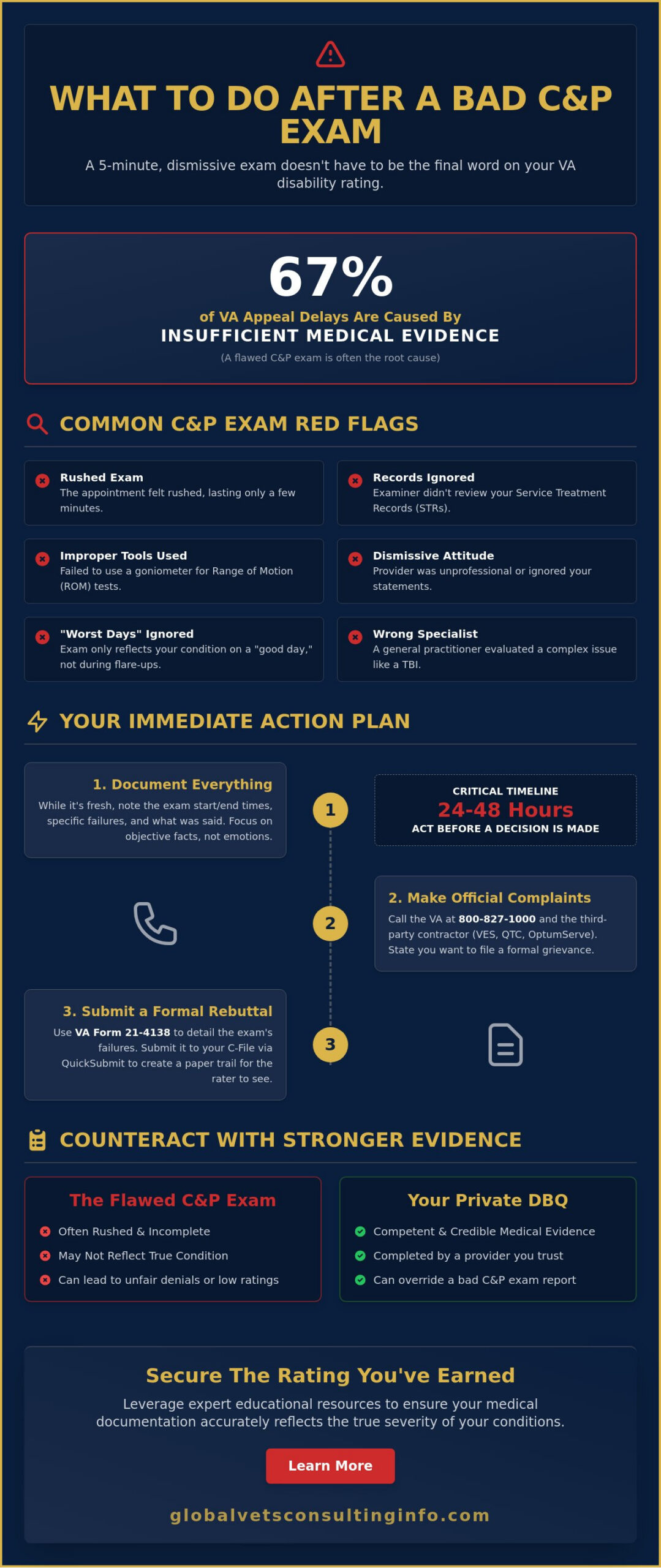
What if a five-minute conversation with a dismissive examiner doesn’t have to be the final word on your VA disability rating? 🇺🇸 It’s incredibly frustrating to walk out of a C&P exam feeling like the provider ignored your symptoms or rushed through the process. If you’re wondering what to do after a bad c&p exam, you aren’t alone. Insufficient medical evidence accounts for 67% of VA appeal delays as of 2026; a flawed exam is often the root cause. You deserve a fair evaluation that reflects the true impact of your service-connected conditions.
This guide provides the exact steps to challenge an inadequate exam and protect your claim. You’ll learn how to submit a formal rebuttal the VA must consider and how to request a new exam with a different provider. We’ll also explain how to use private medical evidence, such as Disability Benefits Questionnaires (DBQs), to override a bad report and secure the rating you’ve earned. By following the 365-day appeal deadline under the AMA framework, you can keep your claim moving forward with steady confidence and a clear path to the benefits you deserve.
Key Takeaways
- Take immediate action within 24–48 hours of a substandard exam to document your concerns with the VA before a rating decision is finalized. 📞
- Identify the signs of an inadequate evaluation, such as an examiner failing to review your service treatment records or ignoring objective measurement tools.
- Learn exactly what to do after a bad c&p exam to challenge the results and request a new evaluation with a different provider. 🇺🇸
- Discover how to use private Disability Benefits Questionnaires (DBQs) to provide the competent and credible medical evidence needed to win your claim.
- Leverage expert educational resources to ensure your medical documentation accurately reflects the true severity of your service-connected conditions. 🌎
Immediate Steps to Take After a Bad C&P Exam
Don’t wait for a denial letter to arrive in the mail. If you’ve just left a clinic feeling unheard, the most important thing you can do is act immediately. Most veterans wait for the VA to send a decision; however, by then, the bad exam is already part of your permanent record. Taking action within the first 24 to 48 hours is the best way to preserve your rights and ensure the Veterans Benefits Administration hears your side of the story before a rating is assigned. 🇺🇸
Start by calling the VA directly at 800-827-1000 or using the 24/7 National Client Services Hotline. 📞 You need to log your complaint officially. Tell the representative that you had an inadequate exam and want to file a formal grievance. If a third-party contractor like VES, QTC, or OptumServe handled your appointment, you should call them as well. They maintain their own internal quality control and need to know if an examiner isn’t following the standard procedures. Knowing exactly what to do after a bad c&p exam starts with creating this paper trail.
Document every detail while it’s still fresh in your mind. Did the doctor measure your range of motion? Did they actually look at your service treatment records? Note the exact time the exam started and ended. If the provider was dismissive or skipped required tests, these are objective failures that can help you overturn a negative report later. 🌎
Drafting a Memorandum for Record (MFR)
Use VA Form 21-4138, which is a Statement in Support of Claim, to detail the inadequacies of the appointment. This is your opportunity to be a credible witness of your own experience. Avoid using emotional language; instead, focus on the facts. Write specific statements like, “The examiner spent only five minutes in the room,” or “The provider did not use a goniometer to measure joint rotation.” Submit this document through AccessVA or QuickSubmit immediately to get it into your C-File. This ensures your rebuttal is available for the rating specialist to see alongside the examiner’s notes. It’s a proactive step that forces the VA to acknowledge the exam’s flaws before they issue a rating decision.
How to Identify an Inadequate VA Claim Exam
Recognizing a flawed exam requires understanding the medical standards the VA expects from its providers. While you might feel like the appointment went poorly, you need to identify specific, objective failures to successfully challenge the results. Understanding these errors is a critical part of knowing what to do after a bad c&p exam to prevent an unfair denial. 🇺🇸
A primary indicator of an inadequate exam is the examiner’s failure to review your service treatment records (STRs) or previous medical evidence. If the provider asks basic questions already answered in your file, it’s a sign they haven’t performed the required review. According to official VA Claim Exam Information, these appointments serve to gather specific evidence for your claim. If the examiner dismisses your service connection without a logical medical rationale, or if they were unprofessional and rushed the process, the exam does not meet the ‘competent and credible’ threshold.
For musculoskeletal claims, the use of a goniometer is mandatory. If the doctor estimated your Range of Motion (ROM) by sight, they’ve violated VA protocol. This lack of precision often leads to lower ratings that don’t reflect your actual physical limitations. If you’re concerned about how your exam was conducted, exploring C&P examination preparation education can provide the clarity you need to move forward. 🌎
Common C&P Exam Red Flags
Watch for examiners who only record your current state rather than your ‘worst days.’ VA ratings are supposed to account for flare-ups and functional loss. If the provider ignores how your condition affects you during a crisis, the report is incomplete. Be wary if a general practitioner evaluates a complex condition like a TBI; the VA often requires specialists for these neurological assessments. Failure to address secondary conditions you mentioned during the exam is another major red flag that warrants a formal rebuttal. If the provider provided a medical opinion outside their area of specialty, you have strong grounds to request a new evaluation.
Counteracting a Bad Exam with Private Medical Evidence
A bad exam doesn’t have to be the end of your claim. While the VA uses their own examiners to gather evidence, you have the right to submit your own documentation. Private medical evidence, specifically a Disability Benefits Questionnaire (DBQ), serves as ‘competent and credible’ evidence that the VA is legally required to consider. Knowing what to do after a bad c&p exam often means shifting your strategy from VA-led exams to veteran-controlled private documentation. 🇺🇸
The VA is required to consider private medical evidence that is ‘probative’ and thorough. When you combine a private DBQ with a strong Nexus Letter, you place your claim in a ‘Fully Developed Claim’ (FDC) posture. This tells the rater that you’ve already gathered the necessary medical nexus and diagnosis required for a successful decision. If you’ve already received a rating decision based on a poor exam, review our guide on VA Claim Denied for Lack of Evidence: How to Recover in 2026 🇺🇸. Navigating official VA decision review options like a Supplemental Claim allows you to introduce this new evidence to override a previous bad report. 🌎
If you’re ready to strengthen your file with high-quality evidence, exploring our disability benefits questionnaires education is a logical next step to ensure your documentation meets the VA’s strict standards.
Why a Private DBQ Often Outweighs a C&P Exam
Private providers typically spend significantly more time reviewing your service treatment records and full medical history than C&P contractors. This thoroughness ensures that every symptom and functional loss is documented, making the VA math work in your favor. Detailed documentation is the best defense against a rushed five-minute exam. To understand the specifics of these forms, read What is a DBQ? A Veteran’s Guide to Disability Benefits Questionnaires in 2026. By taking control of the medical evidence, you move from a passive participant to an empowered advocate for your own benefits.
Securing Your VA Rating with Global Vets Consulting 🌎
Global Vets Consulting understands the frustration of a rushed or dismissive exam. We specialize in providing the medical documentation and educational resources required to substantiate your VA disability claim. Our process focuses on ensuring your DBQs are completed with meticulous accuracy, reflecting the true severity of your condition. Don’t let one bad exam dictate your future. You have the power to take control of your evidence today. For those looking to maximize their current compensation, check out How to Use a DBQ for a VA Disability Rating Increase in 2026.
Understanding what to do after a bad c&p exam is much easier when you have a partner that speaks your language. We operate with a mission-driven focus, providing the tools you need to bypass bureaucratic hurdles and administrative confusion. By utilizing high-quality medical evidence education, you can present a claim that the VA must consider seriously. This shift from relying on VA-contracted examiners to submitting your own probative evidence is the most effective way to protect your effective date and your benefits. 🇺🇸
24/7 Support for Your Disability Claim
We integrate modern technology with veteran-centric expertise to provide round-the-clock assistance for those navigating the system. Access our 24/7 AI Veteran Intake Specialist for immediate guidance on your next steps. 📞 This digital resource helps you categorize your symptoms and determine which educational resources best fit your specific situation. We provide standardized forms and education that detail the severity of service-connected conditions, ensuring accurate evaluations by VA raters.
Join a worldwide community that understands the VA Disability Claims Process Step by Step. Our goal is to simplify the complex administrative path, giving you peace of mind throughout your journey. Visit GlobalVetsConsultingInfo.com to start your path toward an accurate rating today. 🌎
Take Control of Your Medical Evidence Today 🇺🇸
A flawed C&P exam is a hurdle, but it isn’t the end of your journey. By documenting the examiner’s failures immediately and submitting a Statement in Support of Claim, you protect your rights within the system. Moving from VA-led evaluations to veteran-controlled private medical evidence is the most effective way to secure your earned benefits. Understanding what to do after a bad c&p exam ensures you don’t settle for a rating that fails to reflect your true physical or mental health status.
Global Vets Consulting is veteran-owned and operated since 2021. We specialize in professional DBQ preparation and independent medical evidence education to help you build a Fully Developed Claim. With our 24/7 National Client Services Hotline and tech-forward intake specialists, support is always available when you need it most. You’ve served your country with honor; now let’s ensure the system provides the compensation you’ve earned. 🌎
Take Control of Your VA Claim Evidence Today
Frequently Asked Questions
Can I request a new C&P exam if I didn’t like my examiner?
Yes, you can request a new exam, but the request must be based on the examiner’s incompetence or an inadequate evaluation process. Simply “not liking” a provider isn’t enough; you must prove they failed to follow VA protocols, such as ignoring your medical history or skipping objective tests. Call the VA at 800-827-1000 immediately to report the issue and request a new evaluation with a different provider. 🇺🇸
What is a Memorandum for Record (MFR) and how do I file it?
An MFR is a formal written statement that documents the specific flaws of your appointment for your official record. You should file it using VA Form 21-4138, which is the Statement in Support of Claim. Submit this document through the VA’s QuickSubmit portal to ensure the rating specialist sees your detailed account of the exam’s failures alongside the examiner’s report. 📞
How long do I have to complain about a bad VA claim exam?
You should file a formal complaint as soon as possible, ideally within 48 hours of the appointment. While there is no hard regulatory deadline, notifying the VA before they issue a rating decision is vital for your claim’s success. Knowing what to do after a bad c&p exam immediately allows you to flag issues like a provider’s failure to perform required tests before the damage is done. 🌎
Will a private DBQ really help if the C&P examiner was negative?
Yes, a private Disability Benefits Questionnaire (DBQ) provides “competent and credible” evidence that carries legal weight. If a C&P examiner’s report is brief or inaccurate, a thorough private DBQ from a qualified provider can override it. The VA must consider all probative evidence in your file, and a detailed private report often provides the technical depth a rushed contractor exam lacks.
What happens if the VA denies my claim based on a bad exam?
If your claim is denied, you can use the Supplemental Claim lane to submit new and relevant medical evidence. This is the most effective path when a bad exam caused the denial. You have one year from the decision date to file an appeal and protect your effective date. Understanding what to do after a bad c&p exam denial means pivoting to private evidence that addresses the examiner’s errors directly. 🇺🇸
Article by
Willie Daniel
Willie Daniel is the Founder and Chief Executive Officer (CEO) of Global Vets Consulting (GVC) – National Veterans Disability Services, a veteran-led educational and medical evidence support organization dedicated to helping veterans better understand VA disability rating increases, DBQ medical evidence, secondary claims education, and C&P examination preparation.
He is a retired U.S. Army Medical Service Corps Officer with more than 27 years of honorable military service, a decorated Iraq combat veteran, and a retired federal official with the U.S. Department of Veterans Affairs. Throughout his military and federal career, Willie Daniel served in leadership, healthcare administration, operational, and veteran-support roles focused on improving services and support systems for servicemembers, veterans, and their families.
Drawing from decades of military leadership, healthcare administration, veteran advocacy, and federal government experience, Willie Daniel brings a practical, veteran-centered perspective to Global Vets Consulting’s educational articles, AI-powered veteran resources, video education initiatives, and outreach programs. His experience navigating military systems, medical documentation processes, and veteran-related administrative operations provides valuable insight into many of the challenges veterans face when seeking to better understand VA disability rating criteria, medical evidence, documentation strategies, and secondary condition education.
Through GVC’s “Veterans Helping Veterans” mission, his focus is on delivering clear, educational, and easy-to-understand information designed to empower veterans with knowledge, resources, and educational tools that may help them make more informed decisions regarding their individual VA disability journeys.
The information provided through GVC is intended for educational and informational purposes only and should not be considered legal or medical advice.
Disclaimer
Disclaimer: Global Vets Consulting, LLC (“GVC”) is a veteran-led educational and medical evidence support organization. GVC is not a law firm, is not a Veterans Service Organization (VSO), and is not affiliated with the U.S. Department of Veterans Affairs (VA) or any government agency.
Global Vets Consulting does not provide legal advice, medical advice, medical treatment, or healthcare services. GVC does not prepare, file, or submit VA disability claims on behalf of veterans. All information provided through this website, blog articles, videos, educational materials, AI tools, dashboards, templates, and communications is intended solely for general educational and informational purposes.
Veterans are encouraged to consult with accredited representatives, licensed attorneys, qualified medical providers, or Veterans Service Organizations regarding their specific legal, medical, or VA-related matters. VA disability decisions, ratings, and outcomes are determined solely by the U.S. Department of Veterans Affairs based on applicable laws, regulations, medical evidence, and individual circumstances. Past results do not guarantee future outcomes.

