
Getting a 50% rating for Obstructive Sleep Apnea VA claims should be straightforward if you use a CPAP, yet it remains one of the most frequently denied conditions in the entire benefits system. You’ve likely spent nights struggling to breathe and days fighting through exhaustion, only to have the VA tell you your condition isn’t service-connected. It’s frustrating to feel like you’re being penalized for a health issue that started because of your time in uniform. We understand that the path to a 50% or higher disability rating feels blocked by red tape and confusing requirements.
This article provides a clear roadmap to help you navigate the complexities of VA disability for sleep apnea, from understanding rating criteria to securing the medical evidence you need. We’ll break down the current 2026 rating schedule, explain how to establish a secondary service connection, and discuss why a private DBQ is often the missing piece of a successful claim. By the end, you’ll have the knowledge to move forward with confidence and secure the benefits you earned through your service.
Key Takeaways
- Understand the specific criteria used to determine ratings between 0% and 100%, including how treatment requirements impact your monthly compensation.
- Learn how to establish a service connection for Obstructive Sleep Apnea VA claims, whether your condition started on active duty or developed secondary to another disability.
- Identify the critical medical evidence and symptoms, such as chronic fatigue and hypersomnolence, required to support a successful rating increase.
- Discover the tactical advantage of using a private Disability Benefits Questionnaire (DBQ) to ensure your medical records accurately reflect the severity of your condition.
Understanding Obstructive Sleep Apnea (OSA) in the VA System
Understanding Obstructive Sleep Apnea involves recognizing it as a respiratory condition where the airway physically collapses during sleep. This interruption in breathing leads to symptoms like chronic fatigue, morning headaches, and gasping for air. For veterans, Obstructive Sleep Apnea VA claims are evaluated under the respiratory system rating schedule. While Central sleep apnea involves the brain failing to signal muscles to breathe and Mixed apnea is a combination of both, Obstructive is the most common form seen in the veteran community. Obstructive Sleep Apnea is a service-connectable respiratory disorder under 38 CFR.
The Importance of a Clinical Diagnosis
A formal diagnosis is non-negotiable for a successful claim. The VA considers a sleep study, or polysomnography, the gold standard for medical evidence. While home sleep tests are increasingly common, an in-lab study often provides more comprehensive data that raters find harder to dispute. This detailed evidence confirms the frequency of breathing pauses, known as the Apnea-Hypopnea Index (AHI), which is vital for your rating. You must have a current diagnosis to move forward with any Obstructive Sleep Apnea VA claim.
Why OSA Claims are Often Challenging
Many veterans face denials because their diagnosis occurs years after they leave active duty. Without a record of sleep issues in your service treatment records, the VA often issues a “lack of service connection” denial. Understanding the VA disability claims process step by step can help you identify where your evidence might be falling short. Proving your condition is related to your service requires a clear medical nexus, which is where many claims fail without the right documentation and peer support.
VA Rating Criteria for Sleep Apnea: 0% to 100%
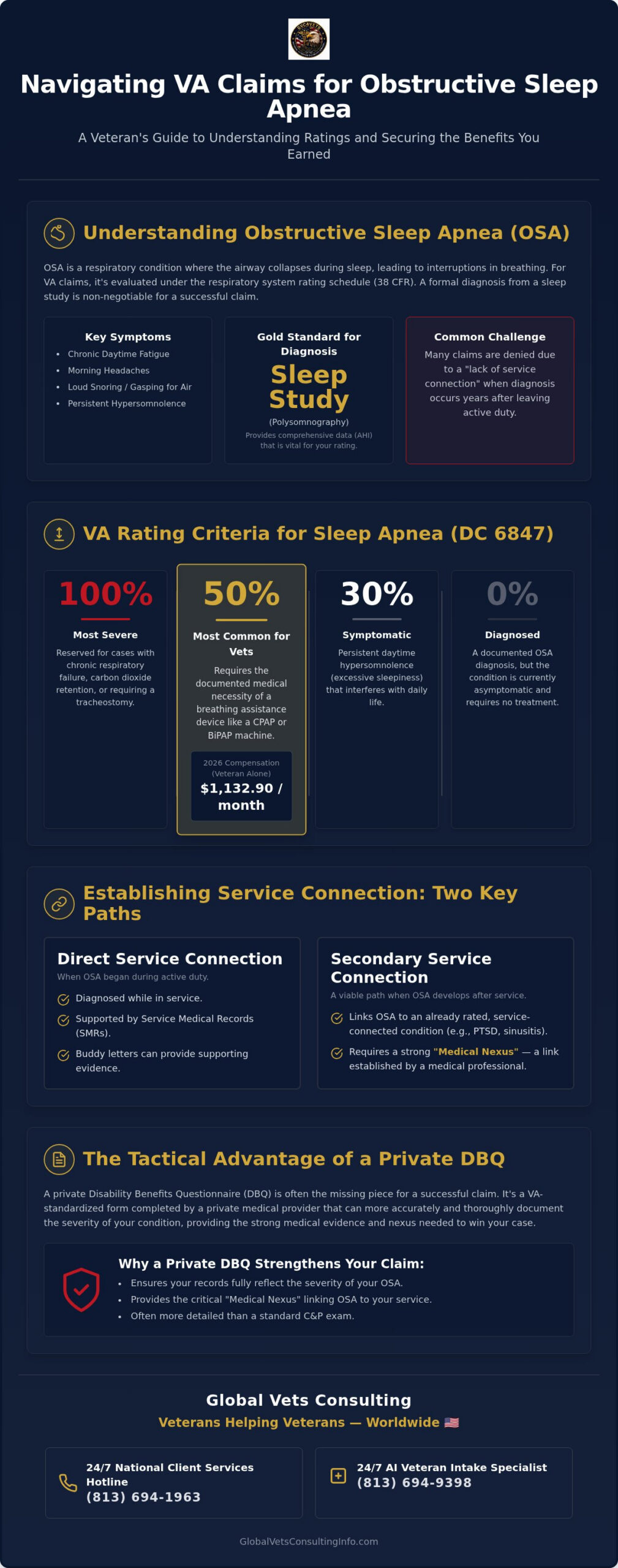
The VA evaluates sleep disorders under Diagnostic Code 6847. Your specific rating depends on the severity of your symptoms and the medical treatment required to manage your airway. The schedule is broken down into four distinct tiers:
- 0% Rating: You have a documented diagnosis, but the condition is asymptomatic or does not currently require treatment.
- 30% Rating: You experience persistent daytime hypersomnolence, which is excessive sleepiness that interferes with daily life, even with treatment.
- 50% Rating: This is the most common tier for veterans. It requires the use of a breathing assistance device.
- 100% Rating: This is reserved for the most severe cases involving chronic respiratory failure, carbon dioxide retention, or the medical necessity of a tracheostomy.
The 50% Rating and CPAP Requirements
Securing a 50% rating for Obstructive Sleep Apnea VA claims typically hinges on a medical requirement for a CPAP machine. If a physician prescribes a CPAP, BiPAP, or a custom-fitted oral appliance to prevent airway collapse, you meet the threshold for this tier. It’s not enough to simply own the device; your medical records must clearly document the clinical necessity of the equipment. If you’re unsure if your current evidence meets these strict standards, our team provides Sleep Apnea Claims Education to help you understand the requirements.
VA Math and Combined Ratings
Your sleep apnea rating fits into your overall disability percentage through a process often called “VA Math.” Instead of simple addition, the VA calculates ratings based on your “remaining efficiency.” For example, if you’re already 50% disabled and receive a new 50% rating for OSA, you aren’t 100% disabled. The VA takes 50% of your remaining “healthy” 50%, which equals 25%, bringing your total to 75%. This is then rounded to 80%. Every percentage point is vital, as a 50% rating for a veteran alone in 2026 provides $1,132.90 per month in compensation.
Establishing Service Connection: Direct vs. Secondary Claims
Establishing a service connection for Obstructive Sleep Apnea VA claims requires a clear medical link between your time in uniform and your current diagnosis. Direct service connection is common for those diagnosed while on active duty, supported by Service Medical Records (SMRs) or buddy letters. However, many veterans aren’t diagnosed until years after discharge, making secondary service connection a more viable path. This involves linking OSA to an already rated condition through the Official VA Schedule of Ratings for Respiratory System.
The “Medical Nexus” serves as the essential bridge in these claims. To be successful, a medical professional must provide a nexus letter stating the condition is “at least as likely as not” caused or aggravated by your service or a service-connected disability. This legal threshold means there is at least a 50% probability that the link exists.
Sleep Apnea Secondary to Mental Health
There is a documented physiological link between mental health struggles and sleep disorders. Conditions like PTSD and anxiety can lead to weight gain from medications or sleep architecture changes that worsen airway collapse. If you are already rated for a psychiatric condition, using a DBQ for Mental Health Conditions can help document the relationship between your mental health and your breathing issues.
Secondary Connection to Respiratory Conditions
Upper respiratory issues like service-connected Rhinitis or Sinusitis often aggravate Obstructive Sleep Apnea VA symptoms. Chronic inflammation in the nasal passages forces mouth breathing, which increases the likelihood of the tongue falling back and blocking the airway. We provide Secondary VA Claims Education to help you understand how to document these complex medical connections effectively. Using a professional DBQ ensures that the aggravation of your OSA by existing respiratory disabilities is clearly explained to the VA rater.
How a Professional DBQ Secures Your VA Claim 🇺🇸
A Disability Benefits Questionnaire (DBQ) is the primary tool a rater uses to decide your compensation level. It’s a standardized medical form designed to ensure that your symptoms align with the criteria found in the rating schedule. Understanding What is a DBQ? is vital because it serves as the bridge between your diagnosis and your rating. For an Obstructive Sleep Apnea VA claim, this document proves you meet the specific requirements for a 50% or 100% rating.
A private DBQ offers a significant advantage over a standard C&P exam. While C&P exams can be brief and sometimes overlook nuances, a private DBQ allows for a thorough review of your medical history. Global Vets Consulting streamlines this evidence-gathering process by focusing on technical accuracy and compliance. This ensures your claim isn’t just a list of complaints, but a professional package of medical evidence that speaks the rater’s language.
Preparing for Your OSA Evaluation
- Step 1: Obtain a current diagnosis through a formal sleep study. Without this medical foundation, your claim won’t move forward.
- Step 2: Gather all service treatment records and private medical files. This data creates a clear timeline for the rater to follow.
- Step 3: Partner with experts for professional DBQ preparation. This step ensures your documentation is complete and accurate before it reaches the VA’s desk.
Reducing Anxiety in the Claims Process
The stress of a potential denial often stems from a lack of clarity. Thorough documentation prevents the common “denied for lack of evidence” scenario that stalls so many Obstructive Sleep Apnea VA claims. We take a “Veterans Helping Veterans” approach in 2026 to provide the steady guidance you need during this process. By submitting a complete evidence package from the start, you reduce the risk of long appeals and gain the peace of mind you deserve.
Take Action on Your VA Disability Claim
Securing your earned benefits requires moving beyond a simple diagnosis to provide the VA with undeniable medical evidence. We’ve explored how rating tiers are determined, the importance of establishing a secondary service connection, and why a professional DBQ is the gold standard for claim accuracy. Managing an Obstructive Sleep Apnea VA claim doesn’t have to be a solo mission when you have the right educational resources and support at your side. Global Vets Consulting stands ready as your partner, offering veteran-owned integrity and expert Sleep Apnea Claims Education to help you achieve a successful rating increase.
Our team is available through our 24/7 National Client Services Hotline at 📞 1-800-484-0642 to provide immediate intake assistance. Take the next step toward the compensation you’ve earned by connecting with our knowledgeable advocates today. 🇺🇸 Contact Global Vets Consulting for Professional DBQ Support to start your journey toward a predictable path forward. You deserve peace of mind and a claim that reflects the true impact of your service.
Frequently Asked Questions
Can I get VA disability for sleep apnea if I was not diagnosed in service?
Yes, you can still receive benefits through a secondary service connection even if your diagnosis occurred after discharge. Many veterans successfully link their Obstructive Sleep Apnea VA claim to already rated conditions like PTSD, rhinitis, or sinusitis. This path requires a medical nexus letter explaining how your service-connected disability caused or aggravated your sleep disorder, bridging the gap between your time in uniform and your current diagnosis.
Is a 50% rating for sleep apnea automatic if I use a CPAP machine?
No, a 50% rating is not automatic simply because you have a CPAP prescription. You must first establish a legal service connection to your military service or another rated condition. Once the VA recognizes the condition as service-connected, the 2026 rating schedule dictates a 50% evaluation if a breathing assistance device is medically required. Without proving that initial service link, the equipment alone will not trigger a payout.
What medical evidence do I need to prove my sleep apnea is secondary to PTSD?
You need three specific pieces of evidence: a current diagnosis from a sleep study, a service-connected PTSD rating, and a medical nexus letter. The nexus letter is the most critical component. It must clearly state that your sleep apnea is “at least as likely as not” caused or aggravated by your PTSD. Providing a detailed DBQ further ensures that the physiological link between these conditions is properly documented for the rater.
How much does the VA pay for a 50% sleep apnea rating in 2026?
For a veteran alone with no dependents, the 2026 monthly compensation for a 50% rating is $1,132.90. This amount reflects the 2.8% Cost of Living Adjustment (COLA) that became effective on December 1, 2025. If you have a spouse, children, or dependent parents, your monthly payment will increase. Every Obstructive Sleep Apnea VA rating of 30% or higher qualifies you for additional monthly compensation for your eligible dependents.
What happens if the VA denies my sleep apnea claim for lack of service connection?
If your claim is denied, you have the right to file a supplemental claim or a Higher-Level Review. Denials for lack of service connection usually happen because the medical link between your service and the diagnosis is weak. To succeed on appeal, you should focus on gathering stronger independent medical evidence, such as a private DBQ or a more detailed nexus letter, to clearly demonstrate how your condition began or was aggravated.

Article by
Willie Daniel
Willie Daniel is the Founder and Chief Executive Officer (CEO) of Global Vets Consulting (GVC4Vets) – National Veterans Disability Services, a veteran-led educational and medical evidence support organization dedicated to helping veterans better understand VA disability rating increases, DBQ medical evidence, secondary claims education, and C&P examination preparation.
He is a retired U.S. Army Medical Service Corps Officer with more than 27 years of honorable military service, a decorated Iraq combat veteran, and a retired federal official with the U.S. Department of Veterans Affairs. Throughout his military and federal career, Willie Daniel served in leadership, healthcare administration, operational, and veteran-support roles focused on improving services and support systems for servicemembers, veterans, and their families.
Drawing from decades of military leadership, healthcare administration, veteran advocacy, and federal government experience, Willie Daniel brings a practical, veteran-centered perspective to Global Vets Consulting’s educational articles, AI-powered veteran resources, video education initiatives, and outreach programs. His experience navigating military systems, medical documentation processes, and veteran-related administrative operations provides valuable insight into many of the challenges veterans face when seeking to better understand VA disability rating criteria, medical evidence, documentation strategies, and secondary condition education.
Through GVC’s “Veterans Helping Veterans” mission, his focus is on delivering clear, educational, and easy-to-understand information designed to empower veterans with knowledge, resources, and educational tools that may help them make more informed decisions regarding their individual VA disability journeys.
The information provided through GVC is intended for educational and informational purposes only and should not be considered legal or medical advice.
Disclaimer
Disclaimer: Global Vets Consulting, LLC (“GVC”) is a veteran-led educational and medical evidence support organization. GVC is not a law firm, is not a Veterans Service Organization (VSO), and is not affiliated with the U.S. Department of Veterans Affairs (VA) or any government agency.
Global Vets Consulting does not provide legal advice, medical advice, medical treatment, or healthcare services. GVC does not prepare, file, or submit VA disability claims on behalf of veterans. All information provided through this website, blog articles, videos, educational materials, AI tools, dashboards, templates, and communications is intended solely for general educational and informational purposes.
Veterans are encouraged to consult with accredited representatives, licensed attorneys, qualified medical providers, or Veterans Service Organizations regarding their specific legal, medical, or VA-related matters. VA disability decisions, ratings, and outcomes are determined solely by the U.S. Department of Veterans Affairs based on applicable laws, regulations, medical evidence, and individual circumstances. Past results do not guarantee future outcomes.