
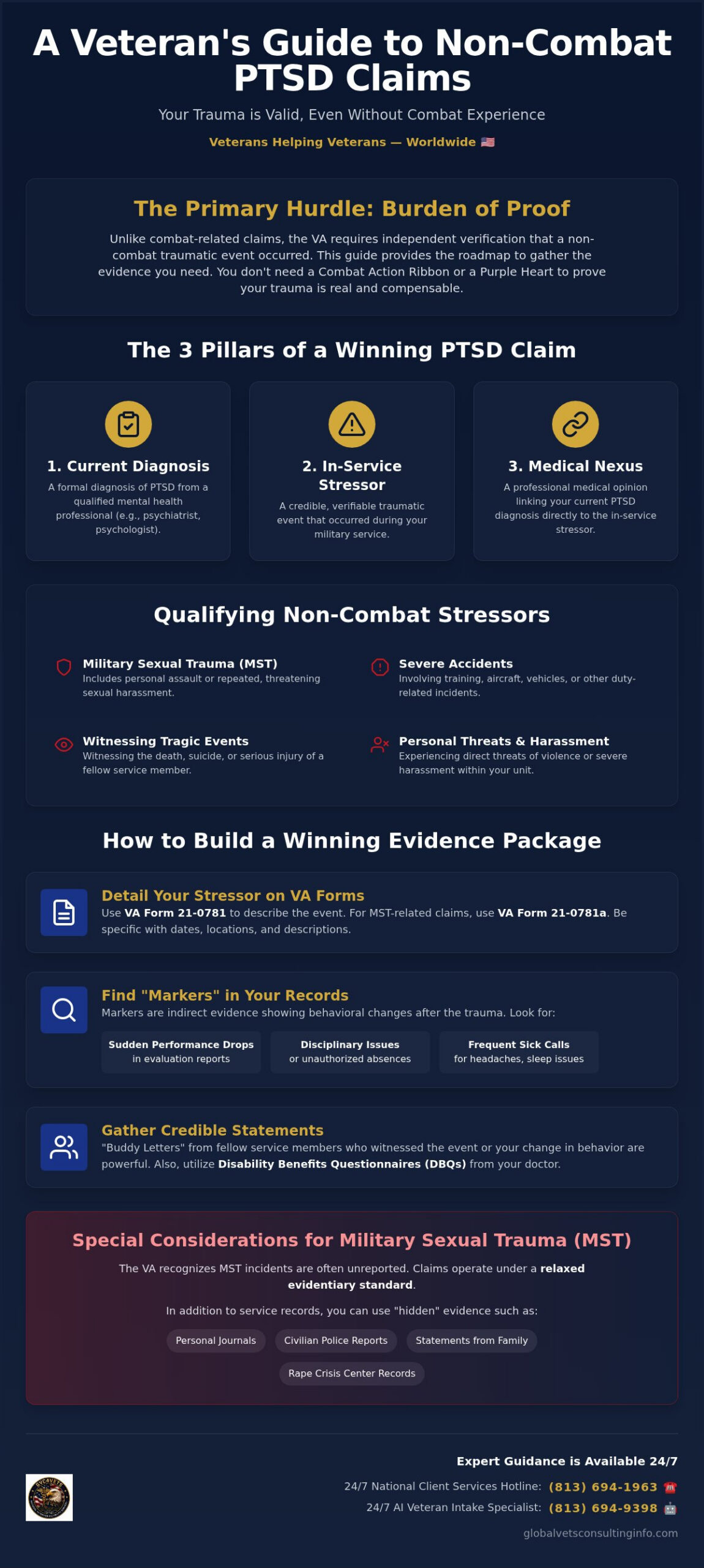
You don’t need a Combat Action Ribbon or a Purple Heart to prove that your trauma is real, valid, and compensable 🇺🇸. For many, the most daunting part of filing a va claim for non-combat ptsd is the fear that their experience won’t be taken seriously because it didn’t occur on a traditional battlefield. Whether you are dealing with the aftermath of a training accident, personal trauma, or a high-stress service event, the burden of proof can feel overwhelming without a combat badge to simplify the process. It’s common to feel like you’re shouting into a void when trying to verify a stressor through mountains of military paperwork.
We believe that every veteran deserves a clear, predictable path to the benefits they earned. This 2026 guide will teach you exactly how to document your stressors and gather the medical evidence required to win your claim. We will break down the mandatory forms, explain the impact of the 2.8% COLA increase on your potential rating, and provide a roadmap for the C&P exam. By the end of this article, you’ll have the tools to move from feeling neglected by the system to becoming a knowledgeable advocate for your own health and financial stability.
Key Takeaways
- Identify the specific non-combat stressors, such as MST or training accidents, that qualify you for service-connected disability benefits.
- Master the use of VA Form 21-0781 and learn to find “markers” in your military records that prove a traumatic event occurred.
- Understand how to secure a formal diagnosis and utilize DBQs to provide the standardized medical evidence the VA rater requires.
- Navigate the process of filing a va claim for non-combat ptsd through the Fully Developed Claim (FDC) program for a more efficient decision.
- Prepare for your C&P examination with confidence by knowing exactly how your symptoms align with the current 2026 rating criteria.
What is a VA Claim for Non-Combat PTSD?
A va claim for non-combat ptsd is a formal request for disability compensation based on a traumatic event that occurred during your military service but was not the result of direct enemy engagement. While many people associate PTSD exclusively with the front lines, the VA recognizes that trauma can happen anywhere, from a stateside training base to a support role overseas. For a comprehensive overview of PTSD, it’s helpful to understand that the condition is defined by the psychological impact of the event on your life, not just whether you were in a fire-fight.
Common non-combat stressors that frequently lead to valid claims include:
- Military Sexual Trauma (MST) or personal assault
- Severe training accidents, aircraft mishaps, or vehicle crashes
- Witnessing the death, suicide, or serious injury of a fellow service member
- Direct personal threats of violence or harassment within the unit
The primary hurdle in these cases is the “Burden of Proof.” In combat-related claims, the VA often concedes that a stressor occurred if you have certain medals or badges. In a non-combat scenario, the rater requires independent verification that the event actually happened. This makes following a VA disability claims process step by step essential for success. You must be prepared to gather records that “mark” the event in time, even if no official police or accident report exists.
The Three Pillars of a Successful PTSD Claim
To secure a service-connected rating, your evidence package must establish three specific elements. First, you need a current medical diagnosis of PTSD from a qualified mental health professional. Second, you must identify a credible in-service stressor that meets the VA’s criteria. Finally, you need a medical nexus, which is a formal link between your current diagnosis and the event that occurred during your service. If any of these pillars are weak, the claim is at high risk for denial. Meticulous documentation is the only way to bridge the gap between your experience and a successful rating.
Identifying and Documenting Your Non-Combat Stressors
Since you don’t have a combat badge to “concede” your stressor, the burden is on you to prove the event occurred. VA Form 21-0781 serves as your primary tool for detailing the incident to the VA. This form requires specific dates, locations, and descriptions. It’s the most critical piece of your va claim for non-combat ptsd because it tells your story in a way that aligns with administrative requirements.
Searching for “markers” is a strategy that often wins claims. These are indirect pieces of evidence found in your personnel or medical files that point to the trauma. Look for:
- Sudden performance drops in evaluation reports
- Disciplinary issues or unauthorized absences
- Frequent sick call visits for headaches or sleep issues
These markers provide a timeline of your psychological response. The National Center for PTSD offers excellent resources to help you identify how these symptoms typically appear in veteran populations.
Buddy letters are equally essential. Statements from fellow service members who witnessed the trauma or noticed your behavior change can provide the “credible evidence” the VA demands. When you pair these statements with a DBQ for mental health conditions, you create a robust package that bridges the gap between your personal history and the rater’s clinical criteria.
Special Considerations for Military Sexual Trauma (MST)
When filing a va claim for non-combat ptsd related to MST, the documentation process is slightly different but no less critical. MST-related claims operate under a relaxed evidentiary standard. The VA recognizes that these incidents are frequently under-reported through official channels. Instead of the standard form, you’ll use VA Form 21-0781a. This allows you to include “hidden” evidence like journals, civilian police reports, or statements from family members. If the paperwork feels overwhelming, our mental health ratings education resources can help you organize your documentation effectively.
How to Build a Winning Evidence Package for PTSD
Success hinges on how you translate your internal struggle into the VA’s clinical language. A winning evidence package for a va claim for non-combat ptsd moves beyond just telling your story; it provides a structured, undeniable proof of your condition’s severity. You don’t want to leave your rating up to the luck of the draw with a random examiner. Instead, you should approach your claim with a methodical strategy that covers every requirement the rater looks for.
A complete evidence package follows these four essential steps:
- Step 1: Secure a formal diagnosis. You must have a current diagnosis of PTSD from a qualified mental health professional. A diagnosis is the foundation of your claim.
- Step 2: Utilize a Disability Benefits Questionnaire (DBQ). Use a DBQ to standardize your symptoms. This ensures the VA rater sees your symptoms in the exact format they are trained to process.
- Step 3: Draft a personal statement. Your statement should be a clear, chronological narrative. Pair this with VA Form 21-0781 to ensure the VA has a primary record of the stressor and its long-term impact on your life.
- Step 4: Address Social and Industrial Impairment. This specific section of the medical record determines your rating percentage. You must clearly document how PTSD affects your ability to work and maintain relationships.
These are the critical components of your va claim for non-combat ptsd that bridge the gap between a “denied” letter and a service-connected rating.
Why Private DBQs are the Gold Standard
Private medical evidence often provides a more thorough and accurate picture than a rushed C&P exam. C&P examiners may only spend 15 to 20 minutes reviewing your entire history. In contrast, a private clinician can take the time to understand the nuances of your trauma. It’s vital to work with a professional who understands the what is a dbq framework to ensure no symptoms are overlooked. A DBQ is a standardized document that translates clinical symptoms into clear, VA-ready evidence for the rater.
Ready to strengthen your medical evidence? Explore our mental health ratings education resources today 🇺🇸.
Submitting Your Claim and Navigating the VA Rating
Submitting your va claim for non-combat ptsd is the final step in a long journey of documentation and self-advocacy. To give yourself the best chance at a favorable rating, you should review your package as a Fully Developed Claim (FDC). This means double-checking that every medical diagnosis, nexus letter, and stressor statement is present before the rater sees it. Missing even one piece of medical evidence can lead to months of delays or an outright denial.
After submission, your file enters the “Evidence Gathering, Review, and Decision” phase. Data from June 2026 shows that the average claim takes about 71.3 days to complete. While you wait, it’s normal to feel anxious about the outcome. Many non-combat cases are denied because the VA claims there isn’t enough “credible evidence” to verify the stressor. If you experience a VA claim denied for lack of evidence, the best path forward is to submit a Supplemental Claim with new, relevant documentation that directly fills the gaps identified by the rater.
Common reasons for denial in non-combat cases include:
- Failure to provide specific markers in service records.
- A medical nexus that is too vague or lacks clinical reasoning.
- Symptoms that don’t meet the “social and industrial impairment” threshold for a compensable rating.
The Global Vets Difference: Veterans Helping Veterans
We believe in a tech-forward approach to veteran advocacy. You can access our 24/7 AI Veteran Intake Specialist at any time to begin organizing your documentation journey. Our mission-driven focus means we treat your history with the respect it earned, ensuring your DBQ accurately captures the functional domains affected by your PTSD. We aren’t just consultants; we are a global community of peers dedicated to your success 🇺🇸.
Our goal is to reduce your anxiety by providing a clear, predictable path forward. Whether you are filing for a va claim for non-combat ptsd for the first time or seeking a rating increase, we offer the educational resources and medical evidence support you need to secure your earned outcomes.
Contact Global Vets Consulting Today for professional DBQ support and mental health ratings education.
Take Control of Your VA Rating Journey Today
The path to securing a va claim for non-combat ptsd doesn’t have to be a solo mission through a complex system. By identifying clear “markers” in your service records and utilizing standardized DBQs to document your social and industrial impairment, you bridge the gap between your lived experience and the VA’s clinical requirements. Your trauma is valid and compensable. With the right medical evidence, the benefits you earned are within reach.
Global Vets Consulting has been veteran-owned and operated since 2021, providing the mission-driven support you need to navigate these administrative hurdles. We specialize in standardized DBQ preparation to ensure your evaluation is accurate and thorough. Our 24/7 National Client Services Hotline at 📞 800-484-0551 is always available to assist you in finding the clarity and peace of mind you deserve. It’s time to move forward with steady confidence.
🇺🇸 Start Your Non-Combat PTSD Evidence Gathering with Global Vets Consulting
You’ve served your country with honor; now it’s time to ensure the system serves you. Stay focused, stay organized, and know that a reliable partner is ready to help you every step of the way.
Frequently Asked Questions
Can I get VA disability for PTSD if I never saw combat?
Yes, you can absolutely receive VA disability for PTSD even if you never saw combat. The Department of Veterans Affairs acknowledges that traumatic events like training accidents, personal assaults, or witnessing a severe injury qualify as valid stressors. Your eligibility depends on proving the event occurred and showing how it impacts your daily life through a formal diagnosis from a qualified professional.
What is the average VA rating for non-combat PTSD?
There is no single “average” rating because the VA assigns percentages based on the severity of your social and industrial impairment. Ratings for a va claim for non-combat ptsd typically fall into the 30%, 50%, or 70% brackets based on your symptoms. For 2026, a 70% rating for a single veteran results in a monthly payment of $1,808.45, while a 100% rating pays $3,938.57.
How do I prove a stressor for a non-combat PTSD claim?
You prove a non-combat stressor by providing independent evidence that corroborates the event described in your VA Form 21-0781. This includes searching for “markers” in your personnel file, such as sudden drops in performance reports or frequent sick call visits after the incident. Buddy statements from fellow service members who witnessed your behavior change are also vital for establishing the credibility of your claim.
Do I need a Nexus Letter for a non-combat PTSD claim?
While a formal Nexus Letter isn’t always mandatory, it’s highly recommended to bridge the gap between your current diagnosis and the in-service event. A medical professional must explicitly state that your PTSD is “at least as likely as not” caused by the specific stressor you identified. This medical link is often the deciding factor in whether the VA grants service connection for your condition.
What happens if the VA denies my non-combat PTSD claim?
If your va claim for non-combat ptsd is denied, you have several options to appeal the decision, such as filing a Supplemental Claim or a Higher-Level Review. A denial often happens due to a lack of evidence regarding the stressor or the medical nexus. You should review the denial letter carefully, gather new medical documentation or buddy statements, and resubmit your claim to address the specific gaps identified by the rater.

Article by
Willie Daniel
Willie Daniel is the Founder and Chief Executive Officer (CEO) of Global Vets Consulting (GVC4Vets) – National Veterans Disability Services, a veteran-led educational and medical evidence support organization dedicated to helping veterans better understand VA disability rating increases, DBQ medical evidence, secondary claims education, and C&P examination preparation.
He is a retired U.S. Army Medical Service Corps Officer with more than 27 years of honorable military service, a decorated Iraq combat veteran, and a retired federal official with the U.S. Department of Veterans Affairs. Throughout his military and federal career, Willie Daniel served in leadership, healthcare administration, operational, and veteran-support roles focused on improving services and support systems for servicemembers, veterans, and their families.
Drawing from decades of military leadership, healthcare administration, veteran advocacy, and federal government experience, Willie Daniel brings a practical, veteran-centered perspective to Global Vets Consulting’s educational articles, AI-powered veteran resources, video education initiatives, and outreach programs. His experience navigating military systems, medical documentation processes, and veteran-related administrative operations provides valuable insight into many of the challenges veterans face when seeking to better understand VA disability rating criteria, medical evidence, documentation strategies, and secondary condition education.
Through GVC’s “Veterans Helping Veterans” mission, his focus is on delivering clear, educational, and easy-to-understand information designed to empower veterans with knowledge, resources, and educational tools that may help them make more informed decisions regarding their individual VA disability journeys.
The information provided through GVC is intended for educational and informational purposes only and should not be considered legal or medical advice.
Disclaimer
Disclaimer: Global Vets Consulting, LLC (“GVC”) is a veteran-led educational and medical evidence support organization. GVC is not a law firm, is not a Veterans Service Organization (VSO), and is not affiliated with the U.S. Department of Veterans Affairs (VA) or any government agency.
Global Vets Consulting does not provide legal advice, medical advice, medical treatment, or healthcare services. GVC does not prepare, file, or submit VA disability claims on behalf of veterans. All information provided through this website, blog articles, videos, educational materials, AI tools, dashboards, templates, and communications is intended solely for general educational and informational purposes.
Veterans are encouraged to consult with accredited representatives, licensed attorneys, qualified medical providers, or Veterans Service Organizations regarding their specific legal, medical, or VA-related matters. VA disability decisions, ratings, and outcomes are determined solely by the U.S. Department of Veterans Affairs based on applicable laws, regulations, medical evidence, and individual circumstances. Past results do not guarantee future outcomes.