

Global Vets Consulting (Worldwide) operates on the belief that every veteran’s claim is a mission that requires a strategic blueprint for success. 🌎 Your Sleep Apnea C&P Exam isn’t a typical medical appointment; it’s a forensic evidence review where every statement is measured against a specific legal checklist. Many veterans walk into the room expecting a clinical discussion about their health, only to find the examiner strictly focused on the technical boxes within a Disability Benefits Questionnaire (DBQ). 🇺🇸
We understand the anxiety of feeling like you might be “tricked” or the fear that a clear diagnosis won’t lead to a fair rating. It’s difficult to explain how gasping for air at night or chronic daytime exhaustion impacts your safety and performance at work. This guide will help you master your Sleep Apnea C&P Exam by explaining exactly what examiners look for and how to document your symptoms effectively. We’ll walk through the 2026 rating criteria and the medical evidence required so you can walk into your appointment feeling prepared and confident. 📞
Key Takeaways
- Understand that your exam is a forensic medical review focused on confirming your diagnosis and assessing symptom severity for the VA.
- Learn how to navigate the Sleep Apnea C&P Exam by focusing on the specific criteria outlined in the Disability Benefits Questionnaire (DBQ).
- Identify the critical role a formal sleep study and CPAP usage play in determining your eligibility for a 50% disability rating under current rules.
- Master the “Worst Day” rule to effectively communicate the true impact of your symptoms during your appointment.
- Discover how private medical evidence can serve as a comprehensive blueprint to ensure your full medical history is considered by the VA.
What is a Sleep Apnea C&P Exam and Why Does it Matter?
A Compensation and Pension (C&P) exam is a forensic medical review that the VA uses to evaluate your claim for benefits. Unlike a visit to your primary care doctor, this appointment isn’t for medical treatment or health advice. The Sleep Apnea C&P Exam is a non-treatment event focused solely on gathering disability rating evidence to determine if your condition is service-connected.
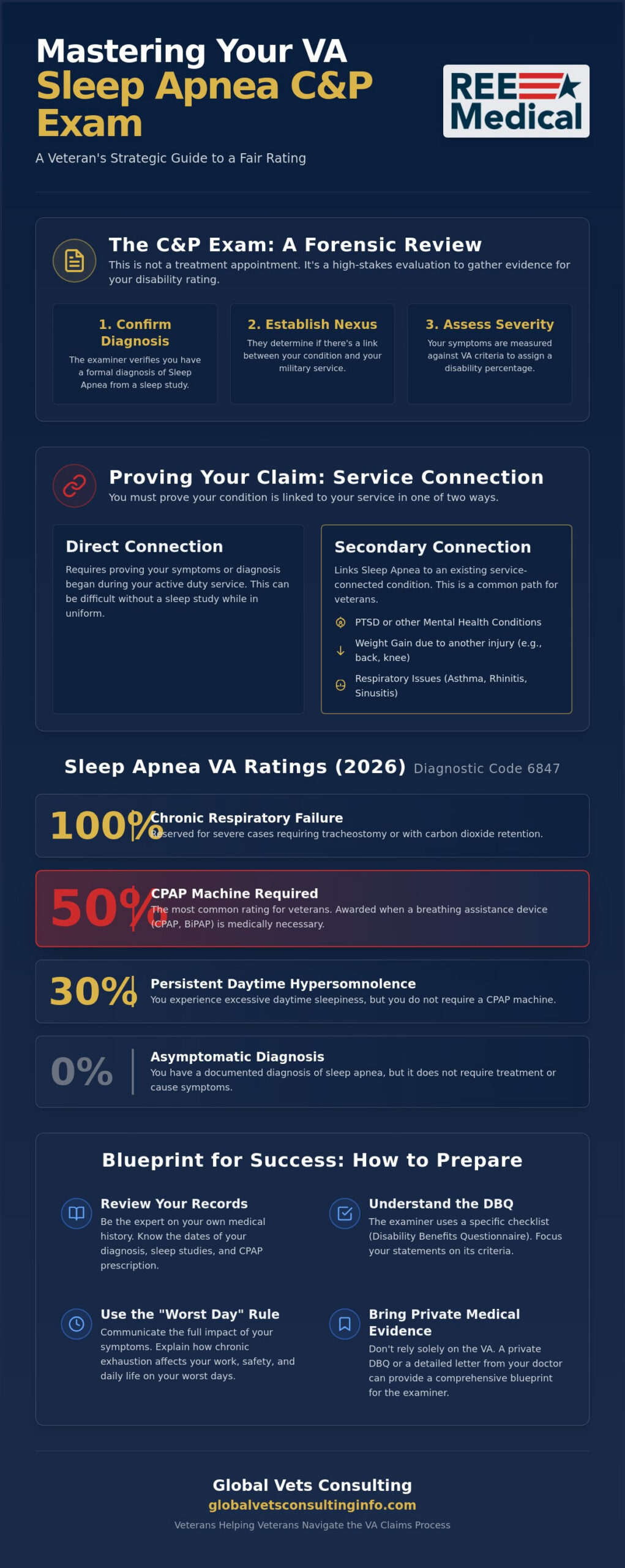
The examiner has three primary objectives during this brief encounter. They must confirm a formal diagnosis of Sleep Apnea, determine if there’s a “nexus” or link between your condition and your military service, and assess the severity of your symptoms. This single appointment is high-stakes because it often determines your disability percentage. Based on the examiner’s report, you could receive a rating of 0%, 30%, 50%, or 100%. For example, in 2026, a 50% rating alone provides $1,132.90 per month in tax-free compensation for a veteran without dependents.
Direct vs. Secondary Service Connection
Understanding how you’ll prove your claim is vital before you walk into the room. Direct service connection requires proving your symptoms or diagnosis began during active duty. This can be difficult if you didn’t have a sleep study while in uniform. Many veterans find more success through secondary service connection, which links sleep apnea to an existing rated condition. Common examples include:
- PTSD or Mental Health: Conditions that disrupt sleep or require medications that exacerbate breathing issues.
- Weight Gain: Obesity caused by a service-connected back or knee injury that prevents physical activity.
- Respiratory Issues: Linking sleep apnea to service-connected asthma, rhinitis, or sinusitis.
Positioning your claim correctly is the first step toward a fair rating. For a broader look at how this fits into your overall journey, review our VA Disability Claims Process Step by Step: A 2026 Veteran’s Guide. 🇺🇸
What the Examiner Looks for: The Sleep Apnea DBQ Criteria
The examiner at your Sleep Apnea C&P Exam is essentially “filling in the blanks” of a standardized form. This form, known as the Sleep Apnea Disability Benefits Questionnaire (DBQ), dictates exactly which symptoms qualify for specific compensation levels. You cannot win this claim without a formal sleep study, or polysomnogram, which serves as the foundational medical evidence for your diagnosis. If you don’t have a sleep study on record, the VA will likely deny the claim or schedule a new study before proceeding.
Beyond the diagnosis, the examiner looks for the medical necessity of an assistive breathing device. Under current 2026 regulations, the requirement for a CPAP or BIPAP machine is the primary factor for a 50% rating. They’ll also document your “daytime hypersomnolence,” which is the medical term for excessive sleepiness. Be prepared to explain how this fatigue impacts your safety and performance at work, as this documentation is critical for your evaluation. If you need help understanding how to present this evidence, exploring Sleep Apnea Claims Education can provide the clarity you need. 🇺🇸
Understanding the 2026 Rating Percentages
Ratings are assigned under Diagnostic Code 6847 based on the severity of your respiratory disturbance and the treatment required. As of July 2026, the criteria are as follows:
- 0% Rating: You have a documented diagnosis of sleep apnea, but you’re currently asymptomatic and don’t require treatment.
- 30% Rating: You experience persistent daytime exhaustion but don’t require a breathing assistance device.
- 50% Rating: This is the most common rating for veterans who require a CPAP, BIPAP, or similar device to maintain an open airway during sleep.
- 100% Rating: This rare rating is reserved for chronic respiratory failure, carbon dioxide retention, or cases requiring a tracheostomy.
While the VA has proposed changes that might eliminate the automatic 50% rating for CPAP use, those changes haven’t been implemented as of mid-2026. Your exam will still follow these established standards.
How to Prepare for Your Sleep Apnea C&P Appointment
Success at your Sleep Apnea C&P Exam begins long before you arrive at the clinic. You need to be the expert on your own medical history. Start by reviewing your records to confirm the exact date of your sleep study and the name of the physician who diagnosed you. Understanding the clinical Diagnosis and treatment of sleep apnea helps you speak the same language as the examiner during the review.
One of the most vital strategies is the “Worst Day” rule. When an examiner asks how you’re doing, don’t just describe how you feel at that specific moment. Instead, describe your symptoms as they appear on your most difficult days. If you’re frequently exhausted, irritable, or struggling to stay awake during work hours, make that clear. Most veterans tend to downplay their struggles, but this is the time to be brutally honest about your limitations.
You should also prepare an “Impact Statement” and gather “Buddy Letters.” Since you’re asleep when the worst symptoms occur, a statement from a spouse or roommate describing your gasping or stopped breathing is powerful evidence. This documentation bridges the gap between clinical data and your daily reality. For personalized guidance on gathering this evidence, explore our C&P Examination Preparation Education. 🇺🇸
Common Examiner Questions to Anticipate
Examiners often use specific questions to gauge the severity of your condition and verify the information in your file. Be ready to answer these directly:
- How often do you use your CPAP machine? Be honest about your compliance. If the mask is uncomfortable or you struggle to keep it on throughout the night, explain those challenges.
- Do you fall asleep during the day or while driving? This question directly addresses safety risks and the level of daytime hypersomnolence you experience.
- When did you first notice these symptoms? Your answer helps the examiner establish a clear timeline for service connection, whether direct or secondary.
The Power of a Private DBQ in Your Sleep Apnea Claim 🇺🇸
Entering your Sleep Apnea C&P Exam with only your verbal testimony is a significant risk. A private Disability Benefits Questionnaire (DBQ) provides a comprehensive medical opinion that the VA must consider alongside the results of the contracted examiner. This documentation ensures your symptoms aren’t reduced to a 15-minute snapshot taken by a provider who doesn’t know you. It allows a medical professional who understands your full history to record the specific functional limitations and severity of your condition with technical precision.
Organization is the best defense against claim denial. Having your evidence prepared before the appointment puts the power back in your hands and reduces the stress of the process. We focus on educating veterans on what is a dbq and how it supports your claim as a foundational blueprint. When a completed DBQ is already in your file, it creates a clear record that the examiner must address, making it much harder for your symptoms to be overlooked during the Sleep Apnea C&P Exam.
How Global Vets Consulting Supports Your Mission
Our veteran-owned team provides the educational resources you need to ensure your medical evidence meets VA compliance standards. We offer specialized guidance on a dbq for mental health conditions, as these issues often serve as the secondary link for sleep apnea claims. We act as a steady guide through the complexities of the system, speaking your language and respecting your service. Our mission is to empower you with the knowledge required to document your health accurately and pursue the rating you’ve earned. 🇺🇸
Take Control of Your Disability Rating 🇺🇸
Navigating the VA system shouldn’t feel like a battle you’re fighting alone. Success comes down to your ability to translate clinical symptoms into the specific language the VA requires. By mastering the “Worst Day” rule and ensuring your sleep study data is current, you can walk into your Sleep Apnea C&P Exam with steady confidence. Remember that private medical evidence acts as a powerful blueprint that gives the examiner a full view of your health history rather than just a brief snapshot.
Global Vets Consulting has been veteran-owned and operated since 2021. We provide specialized Sleep Apnea Claims Education and round-the-clock assistance through our 24/7 National Client Services Hotline. Our team understands the intricacies of the system and is dedicated to helping you document your evidence with meticulous accuracy. We speak your language and respect the history you bring to the table.
Contact Global Vets Consulting Today for DBQ Support
You’ve done the hard work of serving our nation. Now, it’s time to secure the benefits you’ve earned through your service. Stay focused, stay prepared, and know that you have a reliable ally in your corner.
Frequently Asked Questions
Can I bring my own sleep study results to the C&P exam?
Yes, you should absolutely bring a physical copy of your sleep study results to the appointment. While the examiner is supposed to have access to your electronic records, technology issues can occur. Having your polysomnogram results in hand ensures the examiner sees the clinical evidence of your diagnosis. This prevents any claims that your file lacks the necessary medical evidence to support your rating. 🇺🇸
What happens if the C&P examiner is rude or doesn’t listen?
You should report any unprofessional behavior or a “rushed” exam immediately after leaving the clinic. Contact the VA directly or the exam vendor, such as VES or QTC, to file a formal complaint. You can also submit a Statement in Support of Claim (VA Form 21-4138) to document that the provider failed to accurately record your symptoms during the Sleep Apnea C&P Exam. This creates a critical paper trail for any future appeals.
Does a CPAP machine automatically guarantee a 50% VA rating in 2026?
As of July 2026, the medical necessity of a CPAP or BIPAP machine still qualifies a veteran for a 50% disability rating under Diagnostic Code 6847. While the VA has proposed changing these criteria to focus on treatment effectiveness, those rules haven’t been implemented yet. If your physician has documented that you require a breathing assistance device, you’re eligible for the 50% level under current standards. 🇺🇸
Can I get sleep apnea secondary to PTSD or Tinnitus?
Yes, sleep apnea is frequently granted as a secondary service connection to mental health conditions or respiratory issues. To succeed, you must provide a medical nexus showing how your primary condition causes or aggravates your sleep apnea. For example, PTSD medications can cause weight gain or muscle relaxation that worsens airway obstruction. Establishing this link is often the most effective way to secure a VA rating increase for sleep apnea.
What should I do if my sleep apnea claim is denied after the exam?
You should immediately review the Rating Decision letter to identify exactly where the medical evidence was lacking. If the denial was based on a flawed Sleep Apnea C&P Exam, you can file a Supplemental Claim with new evidence, such as a private DBQ. You also have the option of a Higher-Level Review if you believe the evidence already in your file was sufficient but overlooked by the rater. 🇺🇸

Article by
Willie Daniel
Willie Daniel is the Founder and Chief Executive Officer (CEO) of Global Vets Consulting (GVC) – National Veterans Disability Services, a veteran-led educational and medical evidence support organization dedicated to helping veterans better understand VA disability rating increases, DBQ medical evidence, secondary claims education, and C&P examination preparation.
He is a retired U.S. Army Medical Service Corps Officer with more than 27 years of honorable military service, a decorated Iraq combat veteran, and a retired federal official with the U.S. Department of Veterans Affairs. Throughout his military and federal career, Willie Daniel served in leadership, healthcare administration, operational, and veteran-support roles focused on improving services and support systems for servicemembers, veterans, and their families.
Drawing from decades of military leadership, healthcare administration, veteran advocacy, and federal government experience, Willie Daniel brings a practical, veteran-centered perspective to Global Vets Consulting’s educational articles, AI-powered veteran resources, video education initiatives, and outreach programs. His experience navigating military systems, medical documentation processes, and veteran-related administrative operations provides valuable insight into many of the challenges veterans face when seeking to better understand VA disability rating criteria, medical evidence, documentation strategies, and secondary condition education.
Through GVC’s “Veterans Helping Veterans” mission, his focus is on delivering clear, educational, and easy-to-understand information designed to empower veterans with knowledge, resources, and educational tools that may help them make more informed decisions regarding their individual VA disability journeys.
The information provided through GVC is intended for educational and informational purposes only and should not be considered legal or medical advice.
Disclaimer
Disclaimer: Global Vets Consulting, LLC (“GVC”) is a veteran-led educational and medical evidence support organization. GVC is not a law firm, is not a Veterans Service Organization (VSO), and is not affiliated with the U.S. Department of Veterans Affairs (VA) or any government agency.
Global Vets Consulting does not provide legal advice, medical advice, medical treatment, or healthcare services. GVC does not prepare, file, or submit VA disability claims on behalf of veterans. All information provided through this website, blog articles, videos, educational materials, AI tools, dashboards, templates, and communications is intended solely for general educational and informational purposes.
Veterans are encouraged to consult with accredited representatives, licensed attorneys, qualified medical providers, or Veterans Service Organizations regarding their specific legal, medical, or VA-related matters. VA disability decisions, ratings, and outcomes are determined solely by the U.S. Department of Veterans Affairs based on applicable laws, regulations, medical evidence, and individual circumstances. Past results do not guarantee future outcomes.

