

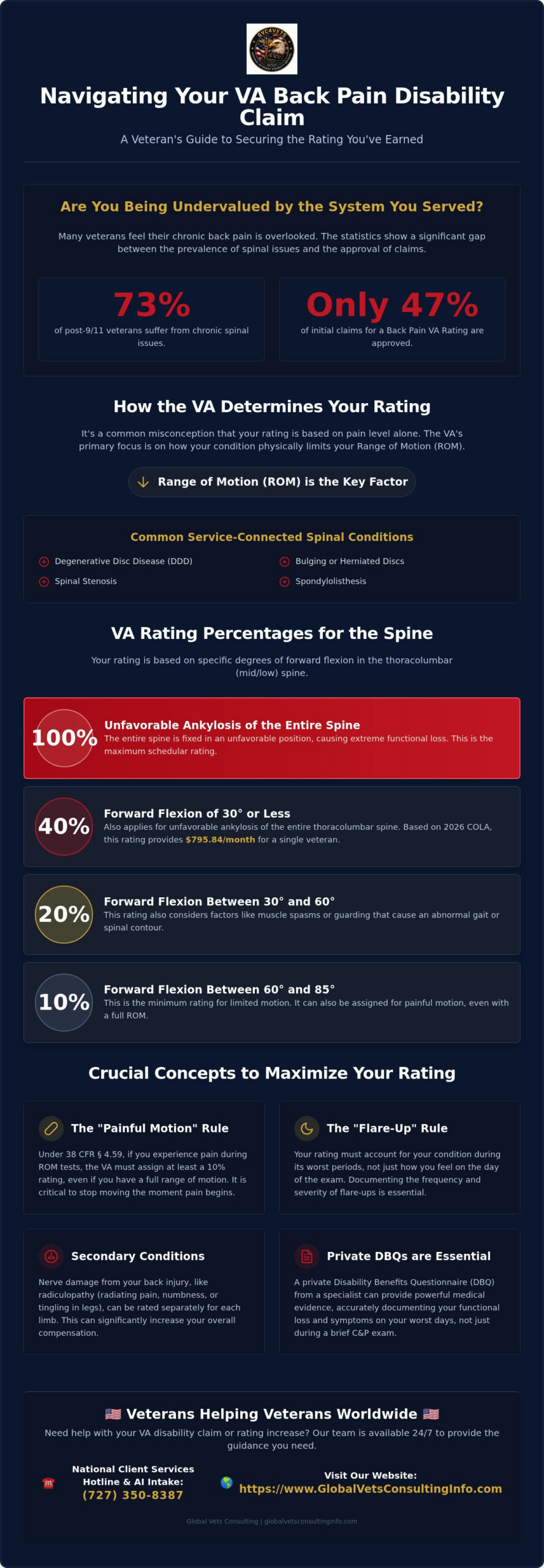
Did you know that 73% of post-9/11 veterans suffer from chronic spinal issues, yet only 47% of initial claims for a Back Pain VA Rating are approved? It’s a common frustration to feel like your daily struggle is ignored during a rushed C&P exam. You shouldn’t feel “lowballed” by a system you served so faithfully. Do you need help securing a rating that actually matches your pain level? We understand the confusion surrounding Range of Motion requirements and the physical toll of living with chronic pain. 🇺🇸
We’re here to help you secure the compensation you’ve earned. This guide simplifies the VA process by explaining how to use DBQs and medical evidence to reflect your true condition. You’ll learn about the 2026 COLA adjustments, the “Painful Motion” rule, and how secondary conditions like radiculopathy can increase your monthly benefits. For assistance, our AI Veteran Intake Specialist and National Client Services Hotline are available 24/7 at ☎️ (727) 350-8387. Visit us at 🌎 https://www.GlobalVetsConsultingInfo.com to start your journey toward a fair rating.
Key Takeaways
- 🇺🇸 Learn how the VA uses specific Range of Motion measurements as the primary factor to determine your Back Pain VA Rating.
- Identify the degrees of forward flexion you’ll need to qualify for a VA rating increase under the General Rating Formula for the spine.
- Understand how to use medical evidence to service-connect secondary conditions like radiculopathy for higher compensation.
- Discover why private DBQs are essential for documenting your functional loss on your worst day. ☎️ Call us 24/7 at (727) 350-8387 or 🌎 visit https://www.GlobalVetsConsultingInfo.com for help with your VA disability claim.
Understanding the Back Pain VA Rating Criteria
The Veterans Benefits Administration (VBA) evaluates most spinal conditions using the General Rating Formula for Diseases and Injuries of the Spine. This standardized formula applies to several common service-connected issues, including:
- Degenerative disc disease (DDD)
- Bulging or herniated discs
- Spinal stenosis
- Spondylolisthesis
It’s a common misconception that your Back Pain VA Rating is based solely on the intensity of your pain. In reality, the VA focuses on physical limitations. While pain is a factor, the system prioritizes how much your condition restricts your movement and daily activity.
The Role of Range of Motion (ROM)
During a C&P exam, the examiner uses a goniometer to measure your flexion and extension. These measurements are the primary evidence used to determine if you qualify for a VA rating increase. It is critical to stop moving the moment pain begins during these tests. Under 38 CFR § 4.59, also known as the “Painful Motion” rule, the VA must assign at least a 10% rating if movement causes pain, even if you have a full range of motion. Additionally, the “Flare-up” rule requires that your rating reflects your condition during its worst periods. Using private DBQs can help ensure your functional loss, including weakness or lack of coordination, is documented accurately.
Service Connection for Back Conditions
Establishing service connection is the first step in any VA disability claim. Direct service connection requires proving that a specific event or injury during your time in uniform caused your current back issues. To build a strong case, you must link your current diagnosis to your service records using credible medical evidence. If you’re struggling with the complexity of these requirements, our team is available 24/7 at ☎️ (727) 350-8387 or through 🌎 https://www.GlobalVetsConsultingInfo.com. We provide the education and resources you need to substantiate your claim with confidence.
Breaking Down the VA Rating Percentages for Spine Conditions
The VA uses a specific set of criteria to assign a percentage for your Back Pain VA Rating. These benchmarks are based primarily on how far you can bend forward. A 10% rating is assigned when forward flexion of the thoracolumbar spine is between 60 and 85 degrees. If your movement is restricted further, between 30 and 60 degrees, or if muscle spasms cause a noticeable side-to-side lean, you qualify for a 20% rating. Understanding these VA disability eligibility criteria is vital for anyone seeking a fair evaluation.
Severe limitations lead to higher percentages. A 40% rating applies when forward flexion is 30 degrees or less. This rating also triggers if there is “unfavorable ankylosis” of the entire thoracolumbar spine. Under the confirmed 2026 COLA adjustments, a 40% rating provides $795.84 per month for a single veteran. The 100% rating is rare, reserved for total unfavorable ankylosis of the entire spine. This means the spine is essentially fixed in an unfavorable position, causing extreme functional loss.
Thoracolumbar vs. Cervical Spine Ratings
The VA treats the neck (cervical spine) and the mid/lower back (thoracolumbar spine) as two distinct segments. Each has its own ROM standards. If you have issues in both areas, the VA doesn’t just add the percentages together. They use a complex calculation to determine your overall disability level. We recommend understanding VA math to see how these combined ratings impact your monthly compensation and total benefits.
The Impact of Incapacitating Episodes
For veterans with Intervertebral Disc Syndrome (IVDS), the VA may use a different rating method based on incapacitating episodes. This requires a physician to prescribe bed rest for specific durations throughout the year. While less common, this path can be beneficial for those with severe degenerative disc disease whose ROM doesn’t fully capture their level of disability. If you’re unsure which criteria apply to your situation, our team offers specialized musculoskeletal claims education to guide you. Reach our AI Veteran Intake Specialist 24/7 at ☎️ (727) 350-8387. 🇺🇸
Secondary Conditions and the Importance of Radiculopathy
A Back Pain VA Rating often serves as the foundation for a much larger disability claim. Many veterans don’t realize that the nerve damage radiating into their legs, known as radiculopathy, can be rated separately for each affected limb. This secondary service connection allows you to receive compensation for conditions caused or aggravated by your primary back injury. You should document symptoms like numbness, tingling, and sharp, shooting pains in your extremities to ensure your VA disability claim reflects the full scope of your physical limitations.
Linking Radiculopathy to Your Back Pain VA Rating
Securing a rating for nerve issues requires a clear medical link. A professional medical opinion or Nexus letter is essential to prove that your radiculopathy secondary to back condition is service-connected. Documenting specific functional losses, such as “foot drop” or muscle weakness, provides the medical evidence needed to substantiate these claims. We specialize in radiculopathy secondary to back condition education to help you navigate this complex documentation process using professional DBQs for neurological conditions.
Other Common Secondary Conditions
Chronic physical pain rarely exists in isolation. It often leads to secondary mental health challenges like depression and anxiety. Additionally, an altered gait caused by back pain frequently results in compensatory injuries to the hips, knees, and ankles. In some cases, sleep apnea is linked to back-related weight gain or the side effects of pain medication. If you believe your service-connected back injury has caused additional health problems, you may be eligible for a VA rating increase. Our team is ready to assist you 24/7. Call our National Client Services Hotline at ☎️ (727) 350-8387 or visit 🌎 learn more to learn more about our secondary VA claims education.
How a Professional DBQ Secures Your Back Pain VA Rating Increase
Do you need help ensuring your medical evidence is bulletproof? A Disability Benefits Questionnaire (DBQ) is the primary tool the VA uses to evaluate the severity of your condition. While the VA provides these forms, the specific details documented within them determine your Back Pain VA Rating. Global Vets Consulting specializes in delivering comprehensive medical documentation that speaks the VA’s language. By submitting a Fully Developed Claim (FDC), you provide all necessary evidence at the start, which significantly reduces wait times and simplifies the administrative process. 🇺🇸
Private DBQ vs. the C&P Exam
Why leave your compensation to chance during a rushed evaluation? It’s a frequent complaint among veterans that a C&P examiner might spend only 10 minutes on a complex back evaluation. This brief interaction often fails to capture the reality of your “worst day” or the full extent of your functional loss. A private evaluation offers the advantage of a thorough, professional review of your entire medical history. You can learn how to use a private DBQ for a VA disability rating increase to ensure your Range of Motion is measured with precision and empathy.
Next Steps for Your Claim Increase
Taking control of your VA disability claim starts with preparation. You should gather all current treatment records and recent imaging, such as MRIs or X-rays, to substantiate your condition. These documents provide the objective proof needed for a successful VA rating increase. Once your records are ready, contact Global Vets Consulting for expert DBQ preparation support. Our National Client Services Hotline and AI Veteran Intake Specialist are available 24/7 at ☎️ (727) 350-8387. Visit us at 🌎 learn more to begin the process of securing the benefits your service deserves.
Take Control of Your Back Pain Claim Today
You’ve served your country with honor; now it’s time to ensure the system serves you. Securing a fair Back Pain VA Rating requires more than just describing your symptoms. It demands precise medical evidence that highlights your functional loss and range of motion limitations. By documenting secondary conditions like radiculopathy and utilizing professional DBQs, you can present a claim that accurately reflects the daily impact of your service-connected injuries. These steps turn a confusing process into a clear path toward the compensation you deserve.
Are you ready to pursue the VA rating increase you’ve earned? Global Vets Consulting is a veteran-owned and operated partner dedicated to your success. We provide expert DBQ documentation to simplify the administrative process and build stronger claims. Our National Client Services Hotline and AI Veteran Intake Specialist are available 24/7 at ☎️ (727) 350-8387. Secure Your Back Pain VA Rating Increase with Global Vets Consulting 🇺🇸. Visit us at 🌎 https://www.GlobalVetsConsultingInfo.com to get started. Don’t settle for less than the benefits your service warrants. We’re here to help you move forward with confidence. 🇺🇸
Frequently Asked Questions
Can I get a 100% VA rating for back pain?
Yes, you can receive a 100% Back Pain VA Rating, but it’s reserved for the most severe cases involving unfavorable ankylosis of the entire spine. This means the spine is fixed in a position that causes extreme functional loss. Most veterans find that reaching a 100% total disability evaluation requires combining their primary spinal condition with secondary ratings, such as radiculopathy, using the VA’s combined rating table.
What is the average VA disability rating for back pain?
The average Back Pain VA Rating is currently 10%. This rating is typically assigned to veterans who experience painful motion or have forward flexion of the thoracolumbar spine between 60 and 85 degrees. Because many initial claims are lowballed at this level, it’s essential to provide detailed medical evidence and DBQs that accurately capture your functional limitations during flare-ups to potentially secure a higher, more appropriate percentage for your condition.
Do I need a Nexus letter for a back pain claim?
You generally need a Nexus letter or a strong medical opinion to establish a direct link between your current back condition and your military service. This document serves as the bridge connecting your diagnosis to a specific in-service event or injury. Providing a clear Nexus, alongside professional DBQs, helps substantiate your VA disability claim and reduces the likelihood of a denial based on a lack of service connection or missing evidence.
Can I submit a DBQ from a private doctor instead of going to a C&P exam?
You can submit a DBQ from a private doctor, and doing so often provides a more thorough evaluation than a standard C&P exam. While the VA may still request that you attend their own examination, your private medical evidence must be considered during the rating process. Using a private DBQ ensures your Range of Motion is measured accurately on your worst day, providing the specific documentation required for a potential VA rating increase.
How do I prove my back pain is service-connected if it started years after discharge?
Proving service connection years later requires medical evidence that demonstrates a clear link to your time in uniform. You can achieve this by showing a continuous history of treatment or by proving that your back pain is secondary to another service-connected condition. Professional education on evidence gathering is vital here. Our team is available 24/7 at ☎️ (727) 350-8387 to help you understand how to substantiate these complex claims effectively.

Article by
Willie Daniel
Willie Daniel is the Founder and Chief Executive Officer (CEO) of Global Vets Consulting (GVC4Vets) – National Veterans Disability Services, a veteran-led educational and medical evidence support organization dedicated to helping veterans better understand VA disability rating increases, DBQ medical evidence, secondary claims education, and C&P examination preparation.
He is a retired U.S. Army Medical Service Corps Officer with more than 27 years of honorable military service, a decorated Iraq combat veteran, and a retired federal official with the U.S. Department of Veterans Affairs. Throughout his military and federal career, Willie Daniel served in leadership, healthcare administration, operational, and veteran-support roles focused on improving services and support systems for servicemembers, veterans, and their families.
Drawing from decades of military leadership, healthcare administration, veteran advocacy, and federal government experience, Willie Daniel brings a practical, veteran-centered perspective to Global Vets Consulting’s educational articles, AI-powered veteran resources, video education initiatives, and outreach programs. His experience navigating military systems, medical documentation processes, and veteran-related administrative operations provides valuable insight into many of the challenges veterans face when seeking to better understand VA disability rating criteria, medical evidence, documentation strategies, and secondary condition education.
Through GVC’s “Veterans Helping Veterans” mission, his focus is on delivering clear, educational, and easy-to-understand information designed to empower veterans with knowledge, resources, and educational tools that may help them make more informed decisions regarding their individual VA disability journeys.
The information provided through GVC is intended for educational and informational purposes only and should not be considered legal or medical advice.
Disclaimer
Disclaimer: Global Vets Consulting, LLC (“GVC”) is a veteran-led educational and medical evidence support organization. GVC is not a law firm, is not a Veterans Service Organization (VSO), and is not affiliated with the U.S. Department of Veterans Affairs (VA) or any government agency.
Global Vets Consulting does not provide legal advice, medical advice, medical treatment, or healthcare services. GVC does not prepare, file, or submit VA disability claims on behalf of veterans. All information provided through this website, blog articles, videos, educational materials, AI tools, dashboards, templates, and communications is intended solely for general educational and informational purposes.
Veterans are encouraged to consult with accredited representatives, licensed attorneys, qualified medical providers, or Veterans Service Organizations regarding their specific legal, medical, or VA-related matters. VA disability decisions, ratings, and outcomes are determined solely by the U.S. Department of Veterans Affairs based on applicable laws, regulations, medical evidence, and individual circumstances. Past results do not guarantee future outcomes.