
What if the key to keeping your disability compensation isn’t just about how you feel today, but how well you’ve documented your symptoms over the last several years? Many veterans live in constant fear that a single surprise C&P exam could strip away their financial security, often wondering what the actual chances of va reducing rating are in 2026. It is completely normal to feel anxious when the VA re-evaluates a condition you’ve struggled with for a long time, especially when you thought your rating was permanent.
We understand the weight of this stress and believe that knowledge is your best defense against a reduction notice. You will learn how to identify specific triggers that catch the VA’s attention and how to use medical evidence to prove your condition hasn’t improved. We’ll also walk through the 5, 10, and 20-year rules that provide a legal shield for your benefits. This guide provides a clear, step-by-step look at how to document your health effectively and maintain the compensation you earned through your service.
Key Takeaways
- Identify the specific triggers for Routine Future Exams (RFE) and learn why the VA must prove “material improvement” before lowering your compensation.
- Understand the 5, 10, and 20-year benchmarks that provide legal protection for your disability rating and service-connected status.
- Discover how consistent medical documentation and attending every C&P exam can minimize the chances of va reducing rating for non-static conditions.
- Learn the critical deadlines for responding to a Notice of Proposed Reduction, including the 30-day window to request a pre-determination hearing.
Understanding the Chances of VA Reducing Your Rating in 2026
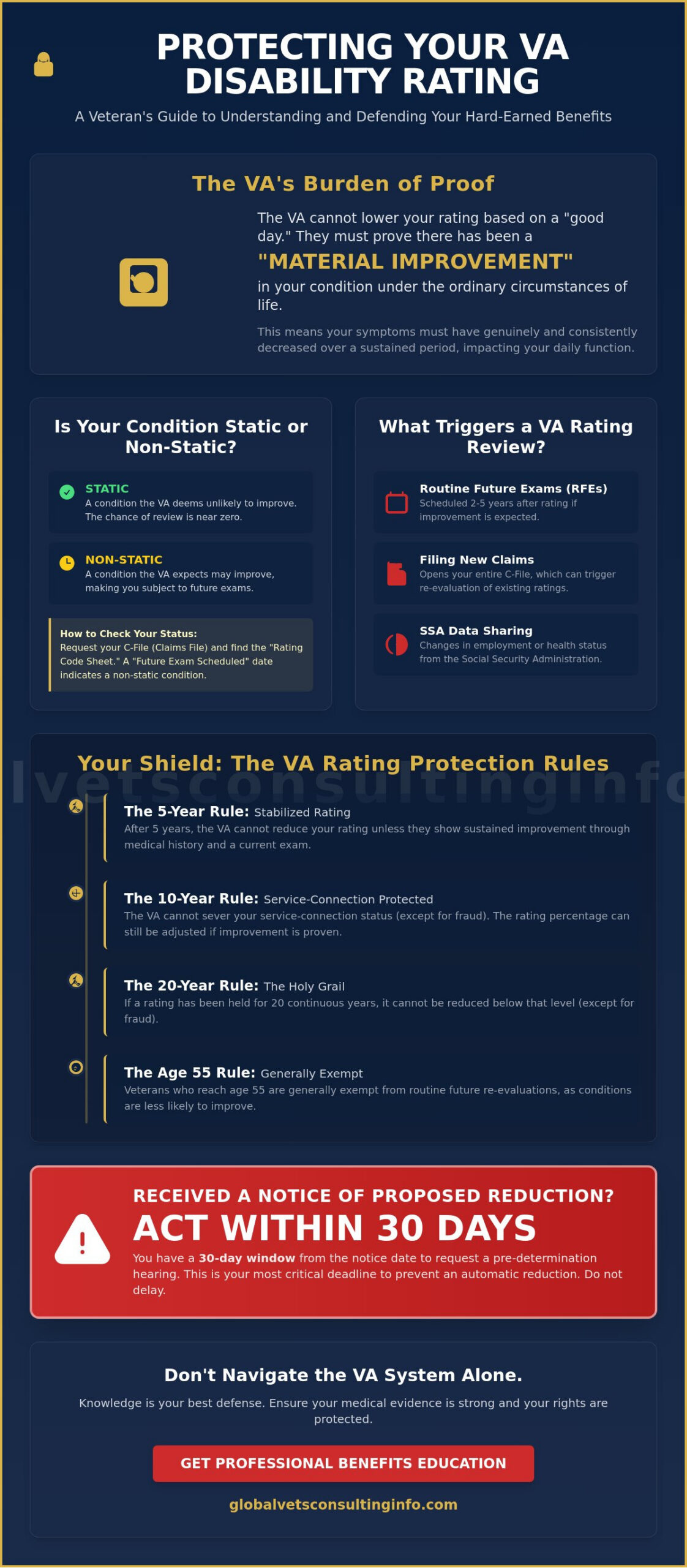
The Veterans Benefits Administration (VBA) follows strict protocols when considering a reduction. They aren’t allowed to lower your disability percentage based on a single “good day” or a brief period of relief. Instead, they must prove there has been a “material improvement” in your condition under the ordinary conditions of life. This means your symptoms have genuinely decreased in a way that impacts your daily function over a sustained period of time. 🇺🇸
Your actual chances of va reducing rating depend heavily on how your conditions are categorized. If your disabilities are labeled “static” or you’ve achieved a “Permanent and Total” (P&T) status, the likelihood of a routine review is near zero. A static disability is a condition the VA deems unlikely to improve over the veteran’s lifetime. However, if your condition is “non-static,” you are much more likely to face a Routine Future Exam (RFE). Understanding this distinction is the first step in protecting your hard-earned compensation.
What Triggers a VA Rating Review?
The VA doesn’t usually look for reasons to cut benefits without a specific prompt. Understanding the triggers can help you manage your medical evidence effectively. Common reasons for a review include:
- Routine Future Exams (RFEs): These are typically scheduled 2 to 5 years after your initial rating if the VA expects your condition to improve.
- Filing New Claims: When you file for an increase or a secondary condition, the VA “opens” your entire claims folder. This can trigger a re-evaluation of existing ratings.
- SSA Data Sharing: Information from the Social Security Administration regarding changes in your employment or health status can sometimes prompt the VA to take another look.
Static vs. Non-Static: How to Check Your Status
You don’t have to guess whether you’re at risk. The most reliable way to confirm your status is by requesting your C-File (Claims File) and looking at the Rating Code Sheet. This internal document lists every service-connected condition and indicates if it is static. If you see a “Future Exam Scheduled” date next to a disability, that condition is non-static. Knowing this date allows you to prioritize consistent medical treatment and documentation well before the exam date arrives. 🌐
VA Rating Protection Rules: The 5, 10, and 20-Year Benchmarks
The law provides specific benchmarks that significantly lower the chances of va reducing rating as time passes. These rules act as a legal shield for your compensation, requiring the VA to meet a much higher burden of proof before making changes. Understanding where you fall on this timeline is essential for long-term financial planning and peace of mind. 🇺🇸
- The 5-Year Rule: Under the VA’s 5-Year Rule, a rating is considered “stabilized” once it has been in place for five years. The VA cannot reduce a stabilized rating unless they show your condition has shown sustained improvement through a thorough medical history and a current exam.
- The 10-Year Rule: After a disability has been service-connected for ten years, the VA cannot sever that connection unless they find the original claim was fraudulent. While the specific percentage can still be adjusted if improvement is proven, your status as a service-connected veteran is legally protected.
- The 20-Year Rule: This is the “Holy Grail” of protection. If you’ve held a specific rating level for 20 continuous years, the VA cannot reduce it below that level unless the rating was based on fraud.
- The Age 55 Rule: Veterans who reach age 55 are generally exempt from routine future re-evaluations. The VA recognizes that conditions at this stage of life are less likely to improve significantly.
The ‘Continuous’ Rating Requirement
The 20-year clock requires a “continuous” rating at a specific level. If you receive a rating increase or decrease during that period, the clock resets for that specific percentage. The VA calculates these protections based on the “effective date” of the rating. If you’re unsure how close you are to these benchmarks, obtaining professional benefits education can help you verify your protection status. 🌐
Exceptions to Protection Rules
Protection rules are strong, but they aren’t absolute. The VA can bypass these benchmarks if they prove the initial claim was based on fraudulent evidence. They may also look for a “Clear and Unmistakable Error” (CUE). A CUE occurs when the VA proves the original decision was legally or factually flawed based on the evidence available at that time. These instances are rare, but they highlight why accurate medical evidence is vital throughout your journey.
How to Protect Your VA Disability Rating from Decreases
Protecting your benefits is an active process that requires more than just waiting for the 20-year mark. The best way to lower the chances of va reducing rating is to build a wall of medical evidence around your file long before a re-evaluation occurs. You should treat your medical documentation as a continuous log of your service-connected challenges rather than something you only address when a notice arrives in the mail. 🇺🇸
- Maintain Consistent Treatment: If you stop seeking medical care, the VA may assume your condition has improved or resolved. Regular visits ensure your records reflect the ongoing severity of your symptoms.
- Never Miss a C&P Exam: Failure to report for a scheduled Compensation and Pension exam is the top reason for an automatic rating reduction. If you have a scheduling conflict, contact the VA immediately to reschedule.
- Use Disability Benefits Questionnaires (DBQs): These standardized forms ensure that your medical evidence directly addresses the specific criteria the VA uses for rating your condition.
- Speak the VA Language: Ensure your medical records describe your functional loss using terms found in the Schedule for Rating Disabilities. This helps the rater see that your condition still meets the requirements for your current percentage.
The Role of Private Medical Evidence
A private DBQ often provides a much more comprehensive view of your health than a standard 15-minute C&P exam. Private providers often have a better understanding of your long-term medical history. Learning how to use a DBQ for a VA disability rating increase can also serve as a defensive strategy. It creates a fresh, accurate baseline in your file that makes it harder for the VA to claim your condition has improved. 🌐
Handling the ‘Routine Future Exam’ Notification
If you receive a notice for a Routine Future Exam (RFE), you must act quickly. Review your recent medical records to ensure they are up to date. You should also consider preparing a “Statement in Support of Claim.” This personal statement allows you to explain the chronicity of your symptoms and how they impact your ability to work or maintain a social life. If you feel overwhelmed by the process, seeking professional claims education can help you organize your evidence effectively.
Fighting a Proposed Reduction with Strong Medical Evidence
Receiving a “Notice of Proposed Reduction” is a serious challenge, but it isn’t a final decision. While the chances of va reducing rating might seem overwhelming once you receive a notice, the law provides a clear path to fight back. You have specific due process rights that allow you to freeze the reduction while you gather the necessary medical evidence to protect your income. 🇺🇸
- Step 1 (30 Days): You have 30 days from the date on the notice to request a pre-determination hearing. This is a vital tactical move; requesting this hearing stops the VA from reducing your pay until the hearing is complete and a new decision is issued.
- Step 2 (60 Days): You have a 60-day window to submit new medical evidence. This is when you provide documentation that proves your symptoms remain at their current compensable level.
- Step 3: Attend your hearing to present your case directly. You can explain how your condition impacts your daily life and why the VA’s assessment of “improvement” is inaccurate.
- Step 4: If the VA moves forward with a reduction, you can still utilize a Higher-Level Review or file a Supplemental Claim to keep the fight alive.
Proving ‘No Material Improvement’
The VA must meet a high burden of proof to lower a stabilized rating. They have to demonstrate that you’ve shown “material improvement” under the ordinary conditions of life, not just during a single exam. For instance, a DBQ for mental health conditions can show that occasional periods of stability don’t mean your condition has resolved. It provides the clinical depth needed to show your symptoms are still chronic and severe. 🌐
Global Vets Consulting: Your Partner in Evidence
Our mission is global and veteran-centric, providing the technical expertise needed to counter VA claims of improvement. We’ve stood in your boots and understand that navigating the VA disability claims process shouldn’t be a solo mission. We focus on meticulous medical documentation and DBQ education to ensure your rating reflects the true impact of your service-connected conditions. 🇺🇸
📞 24/7 National Client Services Hotline: 1-800-484-0542
🌐 Website: GlobalVetsConsultingInfo.com
🤖 24/7 AI Veteran Intake Specialist available on our site
Take Action to Safeguard Your Earned Compensation
You now have the knowledge to move from a place of anxiety to a place of strategic preparedness. We’ve covered how the VA must prove sustained material improvement before lowering your benefits, and you understand how the 5, 10, and 20-year benchmarks create a legal shield for your rating. By maintaining consistent medical treatment and documenting your symptoms accurately, you significantly lower the chances of va reducing rating in the future. 🇺🇸
Global Vets Consulting has been veteran-owned and operated since 2021, and we’re dedicated to helping our fellow veterans navigate these complex requirements. We specialize in DBQ medical documentation to ensure your evaluations are accurate and reflect the true severity of your conditions. If you’re ready to solidify your evidence, our 24/7 AI Veteran Intake Specialist is available on our website to help you begin the process immediately. 🛡️ Secure Your Rating with a Professional DBQ from Global Vets Consulting. You worked hard for your benefits, and we’re here to help you protect them for the long haul.
Frequently Asked Questions
Can the VA reduce a 100% P&T rating?
A 100% P&T rating is generally protected from routine re-evaluations because the VA has determined the condition is permanent. Total disability means you are rated at the 100% level, and “permanent” means the VA doesn’t expect improvement. The only ways this rating is typically reduced are if the VA discovers fraud or a Clear and Unmistakable Error (CUE) in the original claim. 🇺🇸
What happens if I miss a VA re-examination appointment?
Failing to report for a scheduled C&P exam is the most common reason for an automatic benefit reduction. If you miss an appointment for a re-evaluation, the VA assumes your condition has improved or that you no longer require compensation. If a conflict arises, call the VA immediately to reschedule and keep a record of that conversation. This proactive step prevents an administrative decrease in your monthly pay. 📞
Does the VA re-evaluate you after age 55?
The VA generally exempts veterans over the age of 55 from routine future re-evaluations. This policy recognizes that most service-connected disabilities are unlikely to improve significantly as a veteran ages. While this rule lowers the chances of va reducing rating for older veterans, the VA can still order an exam under unusual circumstances or if you file for a new increase. 🇺🇸
How do I know if my VA disability is static?
You can find out if your condition is static by requesting your C-File and looking at the Rating Code Sheet. This specific document lists every service-connected disability and notes whether it is “static” or has a “Future Exam Scheduled” date. If the condition is static, the VA does not plan to re-evaluate it unless you file a new claim that opens your folder for review. 🌐
Can the VA reduce my rating without an exam?
The VA cannot legally reduce a stabilized rating without following a specific due process. This includes sending a “Notice of Proposed Reduction” and giving you 60 days to submit new medical evidence. While they can propose a change based on hospital reports, they must prove your condition has improved in a way that impacts your daily life. You should always request a hearing to ensure your voice is heard before any final decision is made. 🌐

Article by
Willie Daniel
Willie Daniel is the Founder and Chief Executive Officer (CEO) of Global Vets Consulting (GVC) – National Veterans Disability Services, a veteran-led educational and medical evidence support organization dedicated to helping veterans better understand VA disability rating increases, DBQ medical evidence, secondary claims education, and C&P examination preparation.
He is a retired U.S. Army Medical Service Corps Officer with more than 27 years of honorable military service, a decorated Iraq combat veteran, and a retired federal official with the U.S. Department of Veterans Affairs. Throughout his military and federal career, Willie Daniel served in leadership, healthcare administration, operational, and veteran-support roles focused on improving services and support systems for servicemembers, veterans, and their families.
Drawing from decades of military leadership, healthcare administration, veteran advocacy, and federal government experience, Willie Daniel brings a practical, veteran-centered perspective to Global Vets Consulting’s educational articles, AI-powered veteran resources, video education initiatives, and outreach programs. His experience navigating military systems, medical documentation processes, and veteran-related administrative operations provides valuable insight into many of the challenges veterans face when seeking to better understand VA disability rating criteria, medical evidence, documentation strategies, and secondary condition education.
Through GVC’s “Veterans Helping Veterans” mission, his focus is on delivering clear, educational, and easy-to-understand information designed to empower veterans with knowledge, resources, and educational tools that may help them make more informed decisions regarding their individual VA disability journeys.
The information provided through GVC is intended for educational and informational purposes only and should not be considered legal or medical advice.
Disclaimer
Disclaimer: Global Vets Consulting, LLC (“GVC”) is a veteran-led educational and medical evidence support organization. GVC is not a law firm, is not a Veterans Service Organization (VSO), and is not affiliated with the U.S. Department of Veterans Affairs (VA) or any government agency.
Global Vets Consulting does not provide legal advice, medical advice, medical treatment, or healthcare services. GVC does not prepare, file, or submit VA disability claims on behalf of veterans. All information provided through this website, blog articles, videos, educational materials, AI tools, dashboards, templates, and communications is intended solely for general educational and informational purposes.
Veterans are encouraged to consult with accredited representatives, licensed attorneys, qualified medical providers, or Veterans Service Organizations regarding their specific legal, medical, or VA-related matters. VA disability decisions, ratings, and outcomes are determined solely by the U.S. Department of Veterans Affairs based on applicable laws, regulations, medical evidence, and individual circumstances. Past results do not guarantee future outcomes.