
What if the 2026 VA rule changes weren’t a threat to your financial stability, but a roadmap to securing it forever? Many veterans live in constant fear that a single C&P exam or a bureaucratic shift could wipe out their monthly compensation. Learning how to protect your va disability rating is not just about luck. It’s about mastering the specific timelines and documentation standards that the VA is legally required to follow.
We understand the anxiety that comes with watching the VASRD modernization process or hearing rumors about rating changes for conditions like sleep apnea and tinnitus. You earned these benefits through your service; the confusion over complex “VA math” shouldn’t threaten your peace of mind. This guide promises to provide the clarity you need to safeguard your hard-earned benefits from potential reductions using proven medical evidence strategies. 🇺🇸
We’ll explore the critical 5, 10, and 20 year protection rules, explain how the 2.8% COLA increase affects your 2026 checks, and show you how to document your “stabilized” status correctly. This step-by-step approach ensures you have the tools to maintain your rating and secure the long-term support you deserve.
Key Takeaways
- Master the 5, 10, and 20-year milestones to identify when your service connection and rating levels become legally protected from VA reductions.
- Learn how to protect your va disability rating by using consistent medical evidence and DBQs to document that your symptoms remain unchanged or have worsened.
- Identify proactive habits, such as maintaining regular treatment and reviewing your C-File, to prevent “no treatment” flags from triggering a re-evaluation.
- Explore the path to Permanent and Total (P&T) status to eliminate future scheduled exams and secure your benefits for the rest of your life.
Understanding VA Rating Protection Rules: The 5, 10, and 20-Year Milestones
The VA doesn’t usually grant permanent status the moment a claim is approved. Instead, the system uses a series of time-based milestones that offer increasing levels of security for your benefits. Knowing where you stand on this timeline is the first step in learning how to protect your va disability rating. These rules create a legal buffer that makes it much harder for the VA to justify a reduction as the years go by.
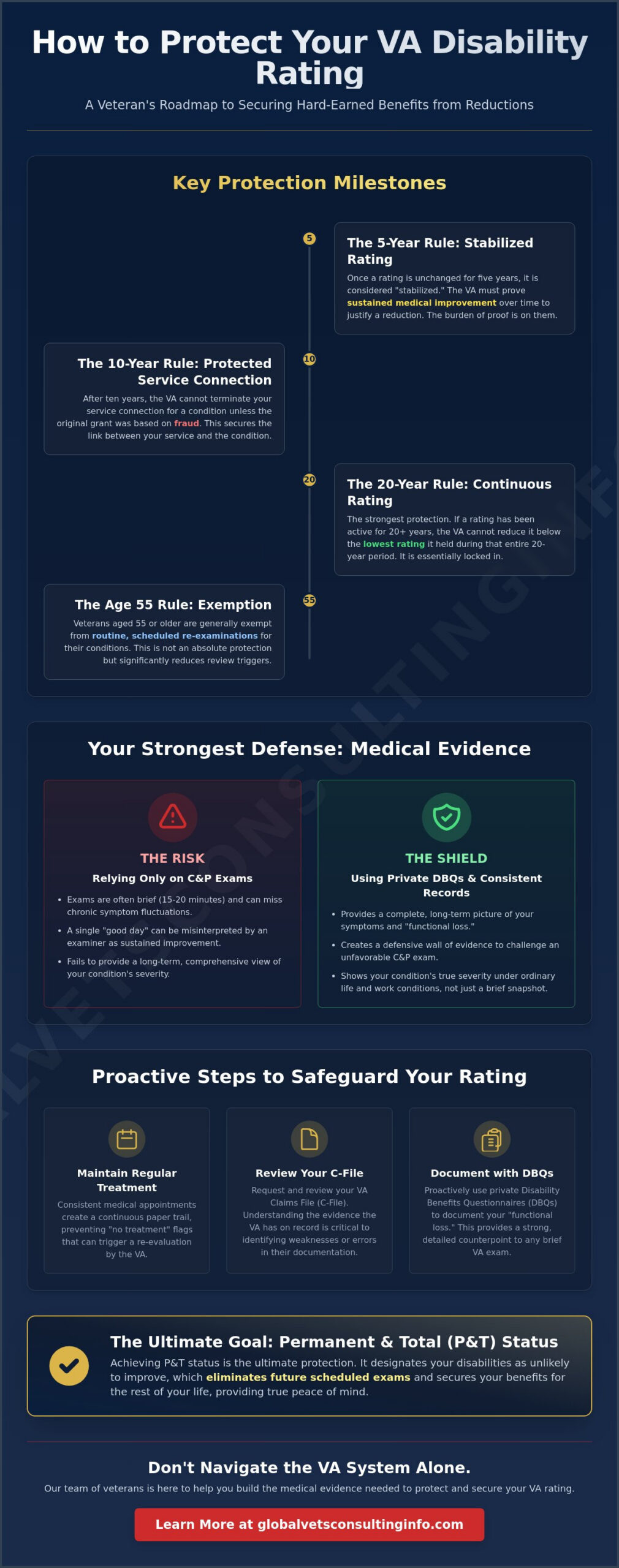
- The 5-Year Rule: Once a rating has been at the same level for five years, it’s considered “stabilized.” The VA cannot reduce it unless they prove the condition has shown sustained medical improvement over time.
- The 10-Year Rule: This milestone protects the service connection itself. After ten years, the VA cannot terminate your service connection unless the original grant was based on fraud.
- The 20-Year Rule: This is the strongest protection available. If a rating has been in effect for 20 years or more, it’s considered continuous. The VA cannot reduce it below the lowest percentage it held during that 20-year period.
- The Age 55 Rule: Veterans who are 55 or older are generally exempt from routine, scheduled re-examinations, though this isn’t an absolute protection against all reviews.
Stabilized vs. Protected Ratings
Many people use these terms interchangeably, but they carry different legal weights within the framework of U.S. veterans’ benefits. A stabilized rating occurs at the five-year mark. It doesn’t mean you’re immune to reviews, but it significantly raises the bar the VA must clear to lower your check. A truly protected rating usually refers to the 20-year mark, where the rating is essentially locked in for life. Identifying your current milestone helps you choose the right medical evidence strategy to maintain your financial stability.
The Burden of Proof for Rating Reductions
If the VA proposes a reduction for a stabilized rating, they can’t just point to one “good day” at a C&P exam. They must demonstrate actual improvement under the ordinary conditions of life and work. The VA is legally required to review your entire medical history before proposing a reduction to ensure any perceived improvement isn’t just a temporary fluctuation. This high burden of proof is your greatest asset when figuring out how to protect your va disability rating through consistent documentation.
The Importance of Medical Evidence: Using DBQs to Shield Your Benefits
While the 5, 10, and 20-year milestones provide a legal safety net, consistent medical documentation serves as your active shield. The VA cannot simply decide to lower your benefits without a paper trail that suggests your health has improved. According to the federal guidelines on the stabilization of disability evaluations, any proposed reduction must be based on more than just a single exam. This is why having a current Disability Benefits Questionnaire (DBQ) is vital; it provides a comprehensive snapshot of your symptoms that reflects your daily reality rather than a brief moment in time.
A common trap for veterans is relying solely on a 15-minute C&P re-examination. These exams often fail to capture the nuances of chronic conditions that flare up and recede. Private medical evidence offers a longitudinal view, proving that what an examiner might call “improvement” is actually just a “temporary remission.” By maintaining a steady stream of records, you create a defensive wall that makes it difficult for the VA to argue that your condition has truly stabilized at a lower level of severity.
Handling C&P Re-examinations with Private Evidence
If you’re called for a routine re-examination, don’t walk in empty-handed. Bringing a copy of a private DBQ completed by a provider who knows your history can prevent an examiner from making broad, inaccurate assumptions. If a C&P result comes back unfavorable, you can use your private medical opinions to challenge the findings. This proactive stance is essential when learning how to protect your va disability rating because it forces the VA to reconcile conflicting evidence rather than relying on a single, potentially flawed report.
Documenting the Severity of Symptoms
Focus your documentation on “Functional Loss.” This term describes how your condition limits your ability to work or perform daily tasks. Even if a physical symptom seems slightly better on paper, the functional loss may remain the same. Understanding how to use a DBQ for a rating increase can also serve as a defensive strategy; by proving your symptoms are actually worsening, you effectively shut down any conversation about a reduction. If you need assistance gathering this critical documentation, exploring educational resources for medical evidence can help you stay ahead of the VA’s review process.
5 Proactive Steps to Safeguard Your VA Disability Rating
Taking proactive control of your claim is the most effective way to ensure long-term stability. The VA often looks for gaps in medical treatment as a primary reason to initiate a re-evaluation. If you aren’t seeing a doctor regularly for your service-connected conditions, the system assumes you’ve improved. Maintaining a consistent medical schedule is a foundational part of how to protect your va disability rating because it ensures your records stay current.
Beyond medical visits, you need to understand the evidence the VA already has on file. Requesting your C-File (Claims File) allows you to see the exact notes and ratings criteria the VA is using to evaluate you. This transparency helps you identify any inaccuracies before they lead to a proposed reduction. Additionally, tracking your “Bad Days” in a symptom log creates a specific, dated record to present during appointments, ensuring your medical notes accurately reflect your functional limitations over time.
Never Skip a Scheduled VA Examination
Missing a C&P exam is one of the fastest ways to lose your hard-earned benefits. If the VA schedules a re-examination and you don’t show up, they have the legal authority to automatically reduce or terminate your rating. If you have a legitimate conflict, contact the VA immediately to reschedule through the proper channels. This simple act of communication keeps your claim active and prevents the system from flagging you for non-compliance.
The Power of Lay Statements (Buddy Letters)
Clinical records don’t always tell the whole story of your daily struggles. Lay statements from spouses, family members, or coworkers provide a “Fully Developed” defense by documenting symptoms that a doctor might not see during a short office visit. These letters are especially important when aiming for Permanent and Total disability ratings, as they prove the persistent nature of your condition. Combining these personal accounts with formal medical evidence makes it much harder for the VA to justify a reduction.
Responding immediately to any VA notice is non-negotiable. If you receive a letter proposing a reduction, you typically have 60 days to submit evidence and 30 days to request a hearing. Don’t wait until the deadline is near. If you need help organizing your documentation, you can access expert educational resources for VA claims to ensure your response is thorough and accurate. 🇺🇸
Moving Toward Permanent and Total (P&T) Status for Ultimate Protection
Achieving Permanent and Total (P&T) status is the final objective for many veterans who want to eliminate the stress of future re-evaluations. While the time-based rules discussed earlier offer layers of security, P&T status effectively locks your benefits in place by acknowledging that your conditions aren’t expected to improve. When you’re designated as P&T, the VA removes you from the list for Routine Future Exams (RFEs), providing a level of certainty that standard ratings don’t offer. If you’re looking for the definitive answer on how to protect your va disability rating, this is it.
To qualify for this status, your medical evidence must clearly show that your service-connected disabilities are permanent. This means your doctors have documented that your symptoms are unlikely to improve for the remainder of your life. You can request this designation during the VA disability claims process if your rating decision doesn’t already include it. It’s a strategic move that shifts you from a “stabilized” rating to one that is legally considered static.
Benefits of a 100% P&T Rating
A 100% P&T rating is often called the gold standard of veteran benefits because it unlocks a suite of lifetime protections and support systems. Beyond the monthly compensation, P&T status provides your family with essential resources that standard ratings do not. These include:
- CHAMPVA: Comprehensive healthcare coverage for your spouse and dependent children.
- Chapter 35 Education Benefits: Monthly stipends for dependents pursuing degree or certificate programs.
- Property Tax Exemptions: Many states offer significant or total property tax relief for P&T veterans.
- Commissary and Exchange Privileges: Lifetime access to military installations and shopping benefits.
How Global Vets Consulting Supports Your Mission 🇺🇸
We understand that navigating the path to P&T status feels like a battle against a faceless bureaucracy. Our team operates with a “Veterans Helping Veterans” ethos, focusing on the technical accuracy required to satisfy VA examiners. We provide the educational resources and standardized DBQs you need to document permanent impairment with precision. Without this level of detail, you risk having your VA claim denied for lack of evidence, which can set your protection timeline back by years.
Our mission is to help you secure the outcomes you’ve earned through your service. By focusing on meticulous documentation and empowered education, we help you take the guesswork out of how to protect your va disability rating. Let’s work together to ensure your financial future is as stable as the service you provided to our nation. 🌎
Take Command of Your Disability Rating Security
Maintaining your financial stability requires a proactive approach to medical documentation and a clear understanding of the VA’s protection milestones. By mastering how to protect your va disability rating through consistent DBQs and strategic evidence gathering, you ensure your benefits remain secure against future reviews. You’ve navigated the toughest challenges in service; don’t let a lack of documentation put your hard-earned compensation at risk. 🇺🇸
Global Vets Consulting has been veteran-owned and operated since 2021. We specialize in meticulous DBQ preparation to ensure your medical records are accurate and fully compliant with VA standards. Our team acts as a steady partner, offering a 24/7 National Client Services Hotline 📞 to answer your questions whenever they arise. We’re dedicated to simplifying the complex claims process and helping you move toward the ultimate protection of Permanent and Total status.
Get the medical evidence you need to protect your rating at Global Vets Consulting. Your service earned these benefits, and we’re here to help you safeguard them for the long haul. 🌎
Frequently Asked Questions
What is the VA disability 5-year rule?
The 5-year rule designates a disability rating as “stabilized” once it has been in effect at the same level for five years or more. Under this regulation, the VA cannot reduce your percentage based on a single medical examination. They must instead prove that your condition has shown sustained improvement under the ordinary conditions of life and work. This rule provides a significant legal buffer that shifts the burden of proof onto the VA.
Can the VA reduce my 100% rating?
Yes, the VA can reduce a 100% rating if it is not designated as Permanent and Total (P&T). If your 100% rating is subject to future re-evaluations, the VA may propose a reduction if a C&P exam suggests your condition has improved. Learning how to protect your va disability rating at the 100% level involves documenting that your symptoms are static and not expected to improve for the rest of your life.
How do I know if my VA disability rating is permanent?
You can determine if your rating is permanent by reviewing your VA Rating Decision letter for the phrase “Permanent and Total” or a statement indicating that “no future exams are scheduled.” Additionally, your Benefits Summary letter on the VA portal will often show if you are considered P&T. If you see a date for a future re-examination, your rating is currently considered temporary and requires ongoing medical documentation to maintain.
Can the VA reduce my rating after I turn 55?
The VA generally stops scheduling routine re-examinations once a veteran reaches age 55. This policy provides a layer of protection, but it’s not an absolute guarantee against reductions. The VA can still re-evaluate your rating if you file a new claim for an increase or if there is evidence of fraud. Even after 55, it’s vital to maintain consistent medical records to ensure your existing ratings remain secure during any administrative reviews.
What should I do if I receive a ‘Notice of Proposed Reduction’ from the VA?
You must act immediately by requesting a hearing within 30 days and submitting new medical evidence within 60 days. Requesting a hearing stops the reduction from taking effect until the process is completed. This is the most critical time to gather current DBQs and lay statements that prove your condition has not improved. Responding quickly and thoroughly is the most effective way to show the VA that a reduction is not warranted.

Article by
Willie Daniel
Willie Daniel is the Founder and Chief Executive Officer (CEO) of Global Vets Consulting (GVC) – National Veterans Disability Services, a veteran-led educational and medical evidence support organization dedicated to helping veterans better understand VA disability rating increases, DBQ medical evidence, secondary claims education, and C&P examination preparation.
He is a retired U.S. Army Medical Service Corps Officer with more than 27 years of honorable military service, a decorated Iraq combat veteran, and a retired federal official with the U.S. Department of Veterans Affairs. Throughout his military and federal career, Willie Daniel served in leadership, healthcare administration, operational, and veteran-support roles focused on improving services and support systems for servicemembers, veterans, and their families.
Drawing from decades of military leadership, healthcare administration, veteran advocacy, and federal government experience, Willie Daniel brings a practical, veteran-centered perspective to Global Vets Consulting’s educational articles, AI-powered veteran resources, video education initiatives, and outreach programs. His experience navigating military systems, medical documentation processes, and veteran-related administrative operations provides valuable insight into many of the challenges veterans face when seeking to better understand VA disability rating criteria, medical evidence, documentation strategies, and secondary condition education.
Through GVC’s “Veterans Helping Veterans” mission, his focus is on delivering clear, educational, and easy-to-understand information designed to empower veterans with knowledge, resources, and educational tools that may help them make more informed decisions regarding their individual VA disability journeys.
The information provided through GVC is intended for educational and informational purposes only and should not be considered legal or medical advice.
Disclaimer
Disclaimer: Global Vets Consulting, LLC (“GVC”) is a veteran-led educational and medical evidence support organization. GVC is not a law firm, is not a Veterans Service Organization (VSO), and is not affiliated with the U.S. Department of Veterans Affairs (VA) or any government agency.
Global Vets Consulting does not provide legal advice, medical advice, medical treatment, or healthcare services. GVC does not prepare, file, or submit VA disability claims on behalf of veterans. All information provided through this website, blog articles, videos, educational materials, AI tools, dashboards, templates, and communications is intended solely for general educational and informational purposes.
Veterans are encouraged to consult with accredited representatives, licensed attorneys, qualified medical providers, or Veterans Service Organizations regarding their specific legal, medical, or VA-related matters. VA disability decisions, ratings, and outcomes are determined solely by the U.S. Department of Veterans Affairs based on applicable laws, regulations, medical evidence, and individual circumstances. Past results do not guarantee future outcomes.